
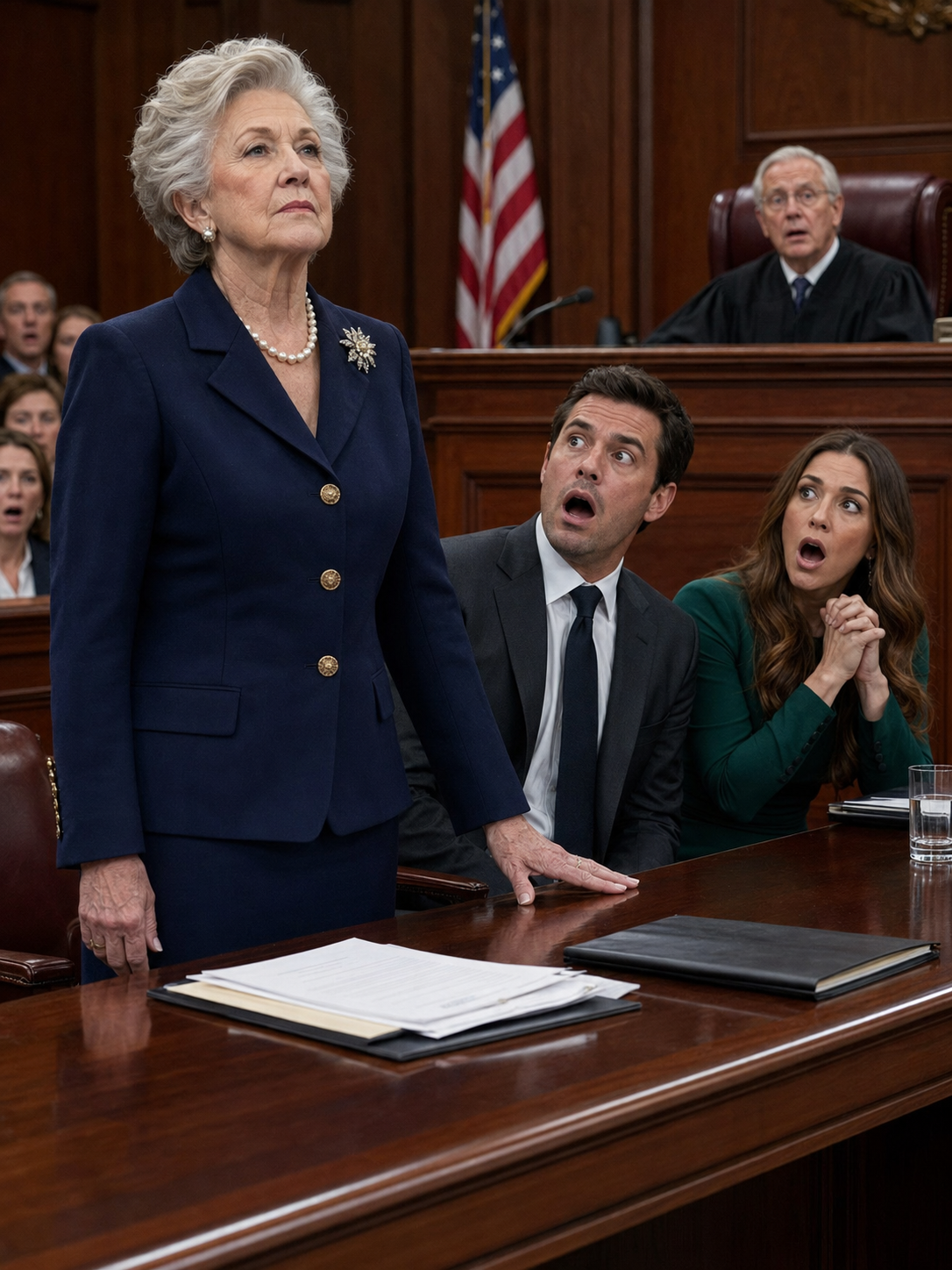
Daniel still wore the expression of a man who believed an awkward fact could be overcome if he simply waited long enough.
Vanessa understood faster.
Her hand had disappeared from his arm.
Judge Mercer turned to Hale.
“You have alleged that Mrs. Vance lacks sufficient capacity to manage her financial affairs.”
“Yes, Your Honor.”
“Did you know her professional history before filing?”
Hale hesitated.
“My understanding was that she had retired some years ago.”
“That was not my question.”
“No, Your Honor.”
“Did you independently investigate her current cognitive condition?”
“We have declarations from family members.”
“Medical evidence?”
“One physician’s statement.”
“Which says?”
Hale looked down.
“That Mrs. Vance reported recent sleep disruption, grief-related concentration difficulties, and two incidents of misplacing personal items.”
Judge Mercer waited.
Hale cleared his throat.
“It also recommends a full cognitive assessment.”
“Does it diagnose incapacity?”
“No.”
“Dementia?”
“No.”
“Any condition rendering her unable to manage money?”
“No, Your Honor.”
Judge Mercer removed his glasses.
“Then I am going to ask the question that should have been answered before this petition reached an emergency calendar.”
He looked directly at Daniel.
“What emergency required removing this woman’s control over her property before a full hearing?”
Daniel’s smirk was gone.
His attorney stood.
“Your Honor, the petitioners were concerned Mrs. Vance might make significant transfers while in a vulnerable state.”
I opened my folder.
Judge Mercer noticed.
“Mrs. Vance, do you wish to respond?”
“Yes.”
I removed the first document.
“My son’s concern about significant transfers is well founded.”
Daniel’s head turned sharply.
I placed the paper on the respondent’s table.
“Because he made several himself.”
Vanessa whispered something I could not hear.
Hale immediately said, “Objection to characterization without foundation.”
Judge Mercer looked at me.
“You understand rules of evidence?”
“I spent twenty-eight years preparing financial evidence for courts.”
“Yes,” he said dryly. “I imagine you do.”
A few people in the gallery shifted.
I disliked that.
This was not theater.
Daniel was still my son.
Even now.
Especially now.
“I have certified bank records,” I said. “A fraud affidavit submitted to my bank, a copy of the disputed loan application, and locksmith invoices related to the unauthorized lock change at my residence.”
Judge Mercer looked toward his clerk.
“Mark them for identification.”
Daniel finally looked at me.
Really looked.
His face had changed.
Not with fear.
With something closer to betrayal.
As if I had violated an agreement by being more prepared than he expected.
That hurt more than I wanted it to.
Hale requested a recess.
Judge Mercer granted fifteen minutes.
The moment the courtroom doors closed behind us, Daniel approached.
“Mom.”
I kept walking.
“Mom, wait.”
I stopped in the corridor.
Vanessa stood several feet behind him. Hale had moved aside to make a phone call.
Daniel lowered his voice.
“You brought bank records?”
“Yes.”
“Why didn’t you tell me?”
I stared at him.
“That question cannot possibly be serious.”
His jaw tightened.
“You know what I mean.”
“No, Daniel. I don’t.”
He ran a hand through his hair.
“We were trying to help you.”
“By changing my locks?”
“That got out of hand.”
“By moving Kevin into my guesthouse?”
“He needed somewhere temporary.”
“By withdrawing forty-eight thousand dollars from my emergency account?”
His eyes flicked toward Vanessa.
There it was.
The smallest movement.
I had spent a career watching people react to numbers.
Most people thought lies lived in words.
Often they lived in the half second before them.
Daniel whispered, “It wasn’t forty-eight.”
I said nothing.
He stopped.
“What?”
“You just corrected an amount I never told you I knew.”
His face went pale.
Vanessa closed her eyes.
I felt no triumph.
Only exhaustion.
Daniel lowered his voice further.
“Mom, please.”
For one terrible instant, he sounded eight years old.
The same boy who once stood in my kitchen holding a broken lamp and insisting the dog had knocked it over even though we had never owned a dog.
Back then, his father had laughed so hard he had to leave the room.
I had crouched in front of Daniel and said, “The truth becomes harder to carry the longer you hold it badly.”
He had confessed before dinner.
Thirty-five years later, he still had not learned.
“Please what?” I asked.
“Don’t do this here.”
“You filed here.”
“I didn’t think—”
“No.”
My voice stayed quiet.
“That, I believe.”
Vanessa stepped forward.
“Eleanor, maybe we should all talk privately.”
I turned to her.
“We had that opportunity at my kitchen table.”
Her face tightened.
“You weren’t listening.”
“That is an interesting criticism from someone who changed the locks on my house.”
“I did not change them.”
“Your brother arranged it.”
“Because Daniel said you had wandered outside at night.”
I looked at Daniel.
He looked away.
That was new.
“Is that what you told her?”
Vanessa frowned.
“He said you were confused after Frank died.”
“I was grieving.”
“Exactly.”
“Grief is not incompetence.”
“No one said it was.”
“Your petition says my grief has made me incapable of managing my affairs.”
Vanessa pressed her lips together.
For the first time, I saw uncertainty in her.
Not guilt.
Not yet.
A crack.
The courtroom officer opened the doors.
“Recess is over.”
I walked back inside.
Judge Mercer spent the next forty minutes doing something I respected deeply.
He ignored the drama.
He reviewed process.
He asked what evidence had supported the emergency filing.
He asked who had access to my accounts.
He asked whether the petitioners had attempted less restrictive measures.
He asked whether I had executed powers of attorney.
I had.
Twenty years earlier.
My late husband, Thomas, had been my primary agent.
My longtime business partner, Margaret Ellis, was alternate.
Not Daniel.
That surprised him.
I saw it.
Judge Mercer asked, “Mr. Vance, did you know your mother had appointed someone other than you?”
Daniel answered carefully.
“No, Your Honor.”
“Did you ask?”
“No.”
“Did you know she had a trust?”
His eyes lifted.
“A trust?”
I said nothing.
Judge Mercer looked at me.
“Mrs. Vance?”
“Yes. A revocable trust created nineteen years ago and amended several times.”
“Who is successor trustee?”
“Margaret Ellis.”
Vanessa leaned toward Daniel.
He whispered, “What trust?”
Hale heard.
His shoulders sank slightly.
The guardianship petition had been built on a picture of me as an elderly widow sitting alone inside an unstructured estate, surrounded by accounts she no longer understood.
The truth was less vulnerable.
My affairs were organized.
Audited.
Documented.
That did not mean I was invincible.
It meant someone had chosen not to ask.
Judge Mercer declined to grant emergency guardianship.
He did not dismiss the petition entirely.
That surprised Daniel.
It surprised me too.
Instead, he scheduled an expedited evidentiary hearing and appointed an independent court evaluator to assess my capacity and living situation.
“That protects Mrs. Vance,” he said, “and it protects the integrity of this process.”
I nodded.
Fair.
He also ordered that no one alter possession, title, access, or financial control regarding my residence or accounts pending hearing.
Then he looked at Daniel.
“Mr. Vance, that means you will not enter your mother’s home without her permission.”
Daniel swallowed.
“Yes, Your Honor.”
“And any person occupying the guesthouse will vacate within forty-eight hours unless Mrs. Vance consents otherwise.”
Vanessa looked down.
Finally, Judge Mercer addressed me.
“Mrs. Vance, I strongly recommend counsel.”
“I understand.”
“Expertise can make people overestimate how well they can represent themselves emotionally.”
That was a very good sentence.
I had said similar things to clients.
“I’ll retain counsel.”
“Good.”
He closed the file.
“Then we reconvene in fourteen days.”
Outside the courthouse, reporters were not waiting.
Thank God.
Nobody cared.
That was another thing real life got right.
My family crisis was enormous to me and almost invisible to the world.
Margaret Ellis was waiting in her car.
She had silver hair cut sharply at her jaw and a habit of looking disappointed before anyone actually failed her.
I got in.
She handed me coffee.
“You went alone.”
“I did.”
“You promised you would call before doing anything foolish.”
“I did call.”
“After you filed a response yourself.”
“I did not file anything foolish.”
“That is not what I said.”
I took the coffee.
She drove.
For twenty minutes, neither of us spoke.
Then she said, “How bad?”
“Worse than I expected.”
“Daniel?”
“Yes.”
“Vanessa?”
“I don’t know yet.”
Margaret glanced at me.
“You’ve never liked her.”
“That is irrelevant.”
“It is not irrelevant if you are investigating her.”
“I am not investigating her.”
“You brought bank records to court.”
“I investigated Daniel.”
Margaret waited.
I hated when she did that.
“What?”
“Nothing.”
“Margaret.”
“You always get precise when you’re protecting a feeling.”
I looked out the window.
Autumn trees passed in a blur of gold and rust.
“I raised him.”
“Yes.”
“I taught him better.”
“Yes.”
“I know every explanation he will use because I taught people how to identify them.”
“Yes.”
“And I still missed it.”
Margaret turned onto the road leading toward my house.
“That is because forensic accountants do not normally audit their children.”
I said nothing.
“Nor should they.”
“I saw signs.”
“After Thomas died, everyone looked strange.”
That was true.
My husband had been dead eleven months.
Forty-seven years of marriage ended in six weeks of pancreatic cancer.
There had been no time to become ready.
People told me I was fortunate we had so many years.
They were right.
It did not make the kitchen table less empty.
When Margaret pulled into my driveway, Daniel’s car was gone.
Vanessa’s too.
The lock had already been restored.
My locksmith, Arthur, stood on the porch.
“Mrs. Vance.”
“Thank you.”
He handed me new keys.
“Court order came through fast.”
“I know people.”
“That sounds ominous.”
“It is mostly administrative.”
He smiled.
Inside, the house smelled wrong.
Not damaged.
Occupied.
There is a difference.
Someone else’s coffee.
Someone else’s laundry soap.
A bowl had been left in the sink.
Thomas’s bourbon stood open on the sideboard.
I closed it.
Margaret watched.
“You want me to stay?”
“No.”
“Yes.”
I looked at her.
She took off her coat.
“Good decision.”
We walked through each room.
Nothing important appeared missing.
Daniel had used the study.
I knew because the chair sat too low.
He always lowered chairs.
Even as a teenager.
Vanessa had moved several framed photographs from the mantel.
Nothing cruel.
Probably dusting.
Maybe trying to make the room feel like hers.
That bothered me more than if she had broken something.
Upstairs, my bedroom was untouched.
I sat on the edge of the bed.
Margaret stood in the doorway.
“You’re allowed to cry.”
“I know.”
“You don’t look convinced.”
“I am seventy-one years old. I do not need permission.”
“Excellent. Then cry aggressively.”
I laughed.
And then, because grief sometimes waits for absurdity to open the door, I cried.
Not because of the money.
Not even the petition.
Because Daniel had drunk Thomas’s bourbon.
His father had saved that bottle for their first grandson’s wedding, despite Daniel and Vanessa having no children and no plans to have any.
“I know that makes no sense,” I said.
Margaret handed me a tissue.
“Most grief doesn’t.”
The next morning, I retained counsel.
Her name was Priya Deshmukh.
Fifty-two.
Probate specialist.
Sharp enough to frighten me slightly.
Which I considered a good sign.
She came to the house with no flattery.
“I know your work,” she said.
“So does the judge.”
“That is not necessarily helpful.”
I smiled.
“I already like you.”
“You may not in ten minutes.”
She sat at my dining-room table.
“First problem: you think you are the best person to investigate this.”
“I am highly qualified.”
“Which was not my statement.”
I folded my hands.
“Continue.”
“You are emotionally involved. Your son is adverse to you. Your daughter-in-law may be a witness. Your home is part of the dispute.”
“Yes.”
“So you will give me the documents and stop conducting surprise interviews.”
“I have conducted none.”
“Good. Preserve that achievement.”
Margaret smiled into her coffee.
Traitor.
Priya reviewed the bank withdrawal.
Forty-eight thousand dollars.
Not one transaction.
Three.
Twelve thousand.
Eighteen thousand.
Eighteen thousand.
Two had been initiated electronically.
One involved a cashier’s check.
Daniel had apparently gained access because, months earlier, I had given him temporary online credentials while I was caring for Thomas.
I had forgotten to change them after my husband died.
That was my mistake.
A human one.
Not proof of incapacity.
The forged loan application was more complicated.
It had been submitted using my name, my property information, and a scanned version of my signature.
But the application had never funded.
The lender flagged inconsistencies and called me.
That call was how I discovered everything.
“What loan amount?” Priya asked.
“One hundred sixty thousand.”
“For what purpose?”
“Home improvement, according to the form.”
“Whose home?”
“Mine.”
“But no improvement was planned.”
“No.”
“Where would proceeds have gone?”
I slid over the application.
The proposed disbursement account belonged to a limited liability company.
Westmere Renovations LLC.
Priya frowned.
“Daniel’s?”
“Vanessa’s brother Kevin.”
“The man in your guesthouse?”
“Yes.”
Margaret stopped drinking her coffee.
That was the first time I saw genuine surprise in her.
Priya asked, “Do you believe your son forged your signature?”
“I know someone did.”
“That is not the same thing.”
“No.”
“Did Daniel have access to the scanned signature?”
“Yes.”
“Did Vanessa?”
“Possibly.”
“Kevin?”
“I don’t know.”
“Then we do not know who forged it.”
I disliked that.
Which meant she was right.
Priya moved to the withdrawals.
“What does Daniel say the money was for?”
“I haven’t asked.”
“Good.”
Margaret laughed.
Priya ignored her.
“We’ll seek records.”
Then she asked a question I had been avoiding.
“Has Daniel had financial trouble?”
“Everyone has financial trouble eventually.”
“Eleanor.”
I looked at her.
“No serious trouble that I knew of.”
“Knew of.”
“Yes.”
“Was he employed?”
“Commercial real estate.”
“Stable?”
“He told me it was.”
Margaret looked at me.
“What?”
She set down her cup.
“Thomas asked me about Daniel’s business last year.”
I stared at her.
“When?”
“June.”
Four months before Thomas became ill.
“What did he ask?”
“Whether I knew how leveraged Daniel was.”
The room went silent.
“You never told me.”
“Thomas told me not to.”
Anger came fast.
That surprised me.
“You kept a financial concern about my son from me because my husband told you to?”
Margaret did not flinch.
“Yes.”
“Why?”
“Because Thomas said he was trying to understand it before worrying you.”
I stood.
Priya said nothing.
Good lawyer.
Margaret continued.
“He did not think Daniel was stealing from you.”
“I didn’t say he did.”
“He thought Daniel had overextended himself professionally.”
“How?”
“He mentioned two failed development deals.”
I stared at her.
“Daniel told us business was excellent.”
“I know.”
“Did Thomas lend him money?”
Margaret hesitated.
That was answer enough.
“How much?”
“Eleanor.”
“How much?”
“Seventy-five thousand.”
I sat down.
My husband and I had shared everything.
At least I thought we had.
“From where?”
“His separate inherited account.”
Thomas had inherited money from his mother years earlier.
We kept some separate property for estate reasons.
That did not mean it was secret.
Except apparently this was.
“When?”
“Last March.”
“Terms?”
“Formal note.”
“Interest?”
“Three percent.”
“Repayment?”
“None yet.”
My heart beat slowly.
Not dangerously.
Just hard.
Priya asked, “Did Daniel know his father had not told Eleanor?”
Margaret nodded.
“Yes.”
That hurt differently.
My son and husband had shared a financial secret about money.
From me.
Margaret reached across the table.
“I argued with Thomas.”
“Did you?”
“Yes.”
“What did he say?”
“That Daniel was ashamed.”
I laughed once.
“Shame is becoming very expensive.”
Priya waited until the room settled.
“Do you have the note?”
Margaret nodded.
“In the trust files.”
“Bring it.”
The promissory note was real.
Signed.
Witnessed.
Daniel borrowed seventy-five thousand dollars from his father for “business stabilization.”
Repayment was due in twenty-four months.
But attached to it was something else.
A handwritten memorandum from Thomas.
Not legally significant.
Personally devastating.
Daniel asked me not to tell Eleanor because she will see immediately how serious this is.
I read the line twice.
Then:
I agreed temporarily. Mistake? Probably.
Typical Thomas.
He distrusted solemnity even in his private notes.
The next paragraph was more serious.
Daniel is not reckless by nature. He is proud. Pride makes decent people hide ordinary problems until the problems stop being ordinary.
I stopped.
Priya looked away.
Margaret’s eyes filled.
I continued.
Eleanor will be furious I kept this from her.
Correct.
But she will also turn into an auditor before she turns into his mother, and I think he needs the second one first.
I put the page down.
For several minutes, no one spoke.
Finally I said, “He underestimated me.”
Margaret nodded.
“He did.”
“And protected Daniel.”
“Yes.”
“At my expense.”
“Yes.”
I appreciated that she did not soften it.
Priya said, “This may matter to motive.”
I looked at her.
“How?”
“If Daniel is in serious debt, the withdrawals and loan application have a financial context.”
“Context is not excuse.”
“I agree.”
“What else?”
“If Thomas knew about those financial problems, there may be additional records.”
There were.
Over the next week, we found them.
Not hidden theatrically.
Simply filed where I had not looked because they belonged to Thomas’s affairs.
Emails.
Notes.
A spreadsheet.
My husband had been tracking Daniel’s commercial real estate losses.
Two partnerships had failed.
A third project was stalled.
Daniel had personally guaranteed several obligations.
Potential exposure: nearly four hundred thousand dollars.
My stomach tightened when I saw the number.
“How did he hide this?” I asked.
Margaret answered gently.
“By not telling you.”
That simple.
My expertise meant nothing if the people I loved denied me the data.
Priya subpoenaed records through the court proceeding.
Daniel’s attorney objected to breadth.
Judge Mercer narrowed requests but allowed enough.
The picture became clearer.
Daniel had not spent my forty-eight thousand dollars on vacations or luxury goods.
He had transferred most of it into a business account two days before a loan payment came due.
The rest paid legal fees and property taxes on one of his failed projects.
Again, context.
Not permission.
Kevin’s LLC had received no money from my account.
But Kevin had prepared the forged loan application.
That was the first major surprise.
The metadata traced the document to his company laptop.
Vanessa had emailed him a copy of my property tax bill.
Daniel had sent him my scanned signature from an old family trust document.
But there was no email explicitly saying, Forge Mom’s name.
There was only a chain of increasingly ambiguous messages.
Daniel:
She won’t agree to leverage the house.
Kevin:
Then we need another path.
Vanessa:
She is not thinking clearly. Dad’s death has made her impossible about money.
Daniel:
Do what you can. I cannot lose the Riverside property.
Do what you can.
Three words.
Enough to create a disaster while preserving denial.
I had seen that pattern in corporate fraud.
Executives rarely wrote, Break the law.
They wrote:
Make it work.
Solve the problem.
I don’t care how.
Then they acted surprised by the method.
Priya asked, “What do you think Daniel meant?”
“What I think is irrelevant.”
“You are not on the witness stand.”
I looked at the message again.
“I think he wanted an outcome badly enough not to ask how Kevin would create it.”
“That is my reading too.”
“What about Vanessa?”
“She provided information.”
“Knowing?”
“We don’t know.”
Again.
I was beginning to hate those words.
The court evaluator came to my house three days before the hearing.
Dr. Lillian Cho was a geriatric psychiatrist with practical shoes and no interest in my résumé.
Excellent.
She asked me questions about date, place, finances, medication, grief, routines, safety, driving, sleep, and daily functioning.
Then she asked me to remember five words.
Apple.
Velvet.
Train.
Church.
Copper.
I smiled.
She did not.
“This is not a competition.”
“Everything is a competition if you keep score.”
“That attitude is exactly why I am not telling you the scoring system.”
I liked her.
She asked about Daniel.
That was harder.
“What do you want?” she asked.
“In court?”
“In life.”
I looked toward the window.
“My house.”
“That’s property.”
“My independence.”
“That’s a condition.”
I sighed.
“You are annoying.”
“Occupational hazard.”
I thought.
“I want my son to tell me the truth without first deciding what version I can tolerate.”
Dr. Cho nodded.
“Anything else?”
“I want to stop feeling stupid.”
She watched me.
“Why do you feel stupid?”
“Because I missed it.”
“His debt?”
“Everything.”
“The withdrawals?”
“Yes.”
“The petition?”
“Yes.”
“The secrets with Thomas?”
My throat tightened.
“Yes.”
She sat quietly.
Then said, “Knowledge and intimacy use different evidence.”
I frowned.
“What does that mean?”
“You spent your career detecting inconsistencies from documents.”
“Yes.”
“But family life depends partly on believing people without requiring supporting schedules.”
“That sounds irresponsible when you say it like that.”
“It would make Christmas difficult otherwise.”
I almost smiled.
She continued.
“Trust creates vulnerability by definition. If someone uses that vulnerability badly, it does not retroactively make trust foolish.”
I said nothing.
That sentence stayed.
After two hours, she left.
The day before the hearing, Daniel called.
Priya advised me I could speak with him if I wanted, but nothing about the case should be negotiated privately.
I agreed.
Then I answered.
“Hello.”
For several seconds, my son said nothing.
“Mom.”
“Yes.”
“I want to talk.”
“Then talk.”
“I don’t want to do this through lawyers.”
“You chose a guardianship petition.”
“I know.”
“No, Daniel. I’m not sure you do.”
Silence.
Then:
“I withdrew the money.”
“I know.”
“I was going to put it back.”
“I know you probably believed that.”
“You don’t believe me?”
“I believe you expected circumstances to rescue you before consequences arrived.”
He inhaled sharply.
“You always do that.”
“What?”
“Turn everything into a diagnosis.”
I looked toward Thomas’s empty chair.
“Your father said something similar.”
Daniel went quiet.
“What?”
“He thought I would turn into an auditor before a mother.”
There was a long pause.
“He wrote that?”
“Yes.”
Daniel’s voice changed.
“Dad knew?”
“About your debt?”
“Yes.”
“Did he tell you?”
“No.”
Another pause.
Then Daniel whispered, “He promised.”
Something inside me shifted.
Not forgiveness.
Understanding.
“You asked him not to tell me.”
“Yes.”
“Why?”
“Because you would have looked at me the way you’re looking at me now.”
“We are on the phone.”
“You know what I mean.”
I did.
He continued.
“You and Dad built everything carefully. You saved. You planned. You never had a business collapse.”
“Your father had two.”
Daniel stopped.
“What?”
“Before you were born.”
“That’s not true.”
“It is.”
“You never told me.”
“Because you were six when the second one failed.”
“No. I mean later.”
I sat down.
Daniel sounded genuinely stunned.
Thomas and I had always presented our early years as modest but stable.
We had edited the story.
Not dishonestly.
Tenderly.
Maybe too tenderly.
“Dad lost everything?”
“Not everything.”
“How much?”
“Enough that we sold our first house.”
Daniel was silent.
Then he laughed once, bitterly.
“He never told me.”
“No.”
“He sat there and acted like I was—”
“Careful.”
My voice sharpened.
“Your father loaned you seventy-five thousand dollars and protected your confidence.”
“I know.”
“He made mistakes. Do not rewrite his kindness because you are ashamed.”
The line went quiet.
When Daniel spoke again, his voice was smaller.
“I didn’t know how to tell you.”
“That you were failing?”
“Yes.”
“You weren’t failing.”
“I lost nearly four hundred thousand dollars.”
“That is a failed investment.”
“It felt like me.”
There it was.
Not greed.
Not only greed.
Identity.
Pride.
The terrible merger between a person’s worth and the outcome of his decisions.
“I needed to fix it,” he said.
“With my money.”
“I know.”
“You took forty-eight thousand dollars.”
“I know.”
“You let Kevin prepare a loan in my name.”
“I didn’t tell him to forge you.”
“Did you tell him not to?”
Silence.
“That is the question you need to answer for yourself.”
He breathed shakily.
“Vanessa thought you were slipping.”
“Did you?”
“I thought you were grieving.”
“That isn’t the same.”
“No.”
“Why file guardianship?”
Another long pause.
“Curtis said if the court appointed me temporarily, I could stop you from freezing everything while we sorted out the accounts.”
I closed my eyes.
“So you used incapacity as a financial strategy.”
“When you say it like that—”
“How else should I say it?”
“I don’t know.”
“Good.”
He said nothing.
Then:
“I’m sorry.”
The words landed gently.
They were not enough.
That did not make them meaningless.
“I believe you’re sorry tonight.”
“Is that all?”
“For now.”
He swallowed.
“Do you hate me?”
“No.”
The answer came immediately.
That surprised both of us.
“No,” I said again. “I am deeply angry with you. I do not trust you. Those are not the same as hatred.”
Daniel began crying quietly.
My own eyes filled.
I hated that the sound still activated every maternal instinct I had.
He was forty-three.
My body remembered four.
“Mom.”
“Yes?”
“There’s something else.”
My stomach tightened.
“What?”
“Dad gave me more than the seventy-five.”
I went still.
“How much more?”
“Not money.”
“What?”
“A folder.”
My fingers tightened around the phone.
“What folder?”
“He gave it to me two weeks before he went into the hospital.”
“Why?”
“He said if anything happened to him, I should wait until you were ready.”
“Ready for what?”
Daniel breathed.
“For the truth about the house.”
I stared down the hallway toward the living room Thomas and I had built together forty years earlier.
“What truth?”
“I don’t know all of it.”
“You opened the folder.”
“Yes.”
“Of course you did.”
“I’m sorry.”
“What is in it?”
“Old deeds. Partnership papers. Letters.”
My mouth went dry.
“Letters from who?”
“Grandpa.”
My father.
Dead thirty-two years.
“What do they say?”
“I think the house was never entirely Dad’s.”
“That makes no sense.”
“I know.”
“Where is the folder?”
Silence.
“Daniel.”
“At Curtis Hale’s office.”
I stood so quickly the chair scraped backward.
“Why?”
“Because when we filed the guardianship, I thought it might prove I had an ownership interest.”
I could barely speak.
“Through your grandfather?”
“Maybe.”
“You gave my family documents to your attorney without telling me.”
“Yes.”
I closed my eyes.
“What exactly did Thomas write on the outside?”
Daniel hesitated.
Then he read from a photograph on his phone.
For Eleanor, when she is ready to know why her father never forgave me for building the house.
The room seemed to tilt.
My father had adored Thomas.
Or I had believed he had.
They had gone fishing together.
Spent holidays together.
Sat beside each other at Daniel’s graduation.
My father had died in the guest bedroom upstairs.
Never forgave me.
For building the house.
I heard Thomas’s voice in memory.
Forty years of it.
Then Daniel said softly, “Mom, I think Dad was trying to tell you something before he got sick.”
I looked at the walls around me.
At the staircase Thomas had sanded himself.
At the dining room where my father had carved the Thanksgiving turkey.
At a house I had spent three weeks fighting not to lose.
And suddenly, for the first time, I wondered whether the property at the center of our family had been built on a story none of us had ever fully heard.