
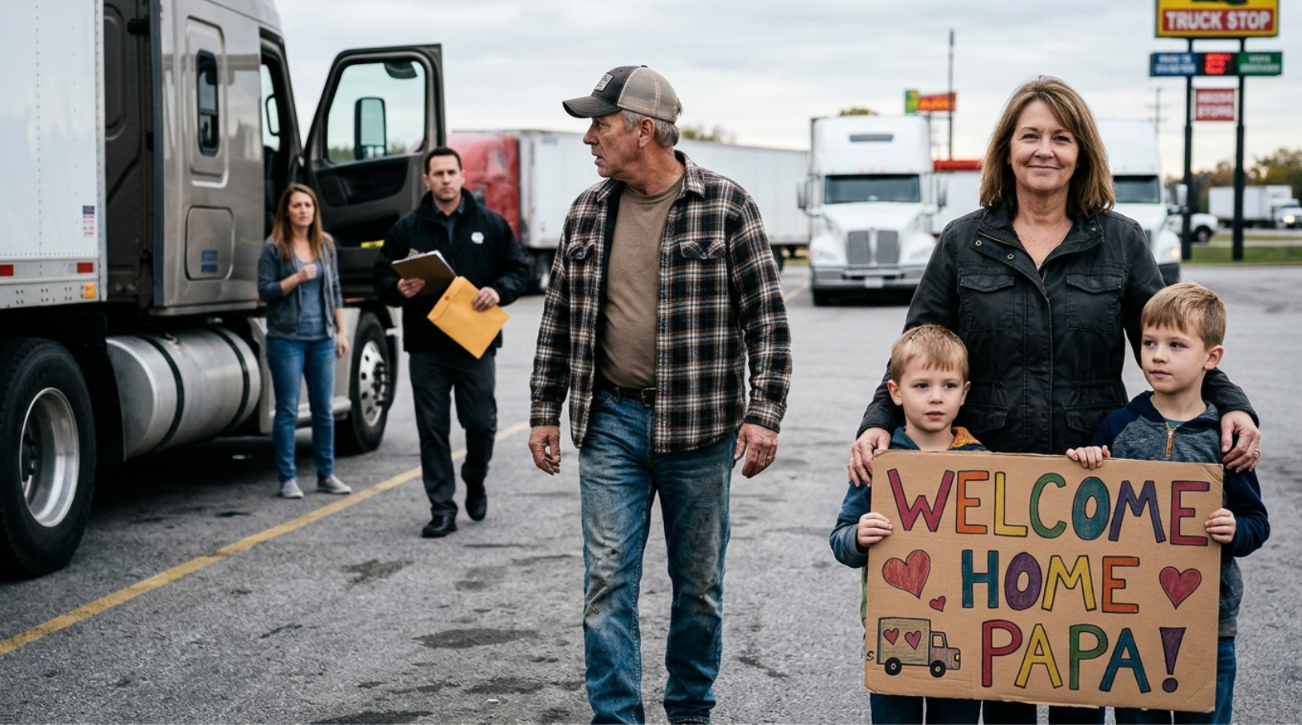
PART 3
He stepped toward her wheelchair, reaching for the handles.
She pulled away.
“Don’t touch me.”
Those three words came out so softly that I almost missed them.
But Roscoe heard them.
So did Jasmine.
And so did the boys.
His mother had spent most of her life defending that man.
When he was a little boy, she defended him when he broke windows, skipped school, and got into fights.
When he was a teenager, she defended him when he came home drunk.
When he married me, she told everyone that her son had finally found a woman who knew how to take care of him.
Even after her stroke, when she couldn’t walk without help, she’d tell me how proud she was of him.
“He works so hard, Libby-girl,” she’d say. “He never had an easy life.”
I never argued.
I knew she loved her son.
But now she was looking at the same son who had just stood in front of his wife and grandchildren and explained why another woman deserved a place in his truck.
“How long?” she asked.
Roscoe rubbed the back of his neck.
“Mother, this isn’t the place.”
“How long have you been bringing that woman around?”
Jasmine rolled her eyes.
“Look, I don’t think we need to do this.”
His mother slowly turned her head toward her.
“Excuse me?”
Jasmine crossed her arms.
“I’m just saying, this is between adults. There’s no reason to make everybody uncomfortable.”
His mother stared at her.
Then she gave a small, bitter laugh.
“Between adults?”
She pointed one trembling finger toward the boys.
“Those are children. Those children came here with a sign because they love their grandfather. And you think the problem is that somebody is making you uncomfortable?”
Jasmine’s smile disappeared.
Roscoe stepped between them.
“That’s enough, Ma.”
“No, son. It isn’t.”
His mother took a breath.
“I’ve spent my whole life making excuses for you. I told myself you were a good boy who sometimes made bad decisions. I told Libby to be patient when you were gone for weeks. I told her you were tired when you forgot birthdays. I told her you were under pressure when you came home angry.”
Her voice began to shake.
“And now I find out that while this woman was riding around with you, your wife was bathing me, feeding me, washing my clothes, and making sure I never felt like a burden.”
I felt my throat tighten.
“Ma, please,” I whispered.
She looked at me.
“Don’t you dare apologize for anything, Libby-girl.”
Then she turned back to Roscoe.
“Do you know what she did last night?”
He said nothing.
“She stayed awake until nearly three in the morning because I was having trouble breathing. She sat beside my bed and held my hand. She called the nurse. She changed my sheets. And when I finally fell asleep, she went downstairs and packed your sandwiches because she thought you were coming home today.”
Roscoe looked down.
His mother continued.
“She did all that while you were kissing somebody else.”
For the first time, Jasmine let go of his arm.
“Roscoe, maybe we should go.”
His mother looked at her.
“Yes. You should.”
Roscoe snapped.
“Mother, stop treating me like I’m a child!”
His mother’s eyes filled with tears.
“I’m not treating you like a child. I’m treating you like a man who has forgotten what being a husband and father means.”
The silence that followed was unbearable.
Then my oldest grandson tugged on my coat.
“Grandma?”
I looked down.
“Yes, sweetheart?”
“Is Grandpa still our grandpa?”
That question nearly broke me.
I knelt in front of him.
“Of course he is, honey. Nothing changes how much you boys deserve to be loved.”
“But why did he kiss that lady?”
I didn’t have an answer.
Not one that a seven-year-old should have to hear.
I pulled him into my arms.
“Sometimes grown-ups make choices that hurt people. But that’s never the children’s fault.”
Behind me, Roscoe cleared his throat.
“Come on, boys. Grandpa’s home. Let’s get out of here.”
The little one didn’t move.
He looked at the pizza-box sign in his hands.
Then he looked at Roscoe.
“We made this for you.”
Roscoe forced a smile.
“I know, buddy.”
“We worked on it all morning.”
“I know.”
“I wanted you to put it in your truck.”
Roscoe looked at the sign.
For a second, I thought he might finally understand what he’d done.
Then he said something I’ll never forget.
“Well, maybe next time.”
My grandson lowered the sign.
And just like that, something changed in his little face.
He wasn’t crying.
He wasn’t angry.
He just looked disappointed.
Sometimes disappointment is much harder to watch than tears.
I stood up and took the sign from his hands.
“Come on, sweetheart. Let’s go sit with Great-Grandma.”
Roscoe frowned.
“Where are you going?”
“Home.”
“We haven’t even talked.”
I looked at him.
“You’ve talked enough for one afternoon.”
“Libby, don’t start acting crazy.”
His mother closed her eyes.
“Roscoe.”
But I was already turning away.
I pushed his mother’s wheelchair toward the restaurant entrance while the boys followed.
Behind us, I heard Jasmine whisper something.
Then I heard Roscoe say, “Just wait here.”
I didn’t turn around.
Not once.
Inside the restaurant, I helped his mother settle near the window.
The boys sat on either side of her.
I ordered hot chocolate for them and coffee for myself.
For several minutes, nobody said anything.
Then his mother reached across the table and took my hand.
“Libby-girl.”
I looked at her.
“I’m sorry.”
I shook my head.
“You don’t have anything to apologize for.”
“Yes, I do.”
She swallowed.
“I raised him.”
I squeezed her hand.
“You raised a little boy. You didn’t make every decision that man made afterward.”
Her eyes filled again.
“I always thought he’d take care of you.”
I looked out the window.
“I thought so too.”
A few minutes later, Roscoe walked into the restaurant.
Jasmine wasn’t with him.
He came straight to our table.
“Can we talk?”
I kept stirring my coffee.
“About what?”
“About what happened.”
“What part?”
He looked irritated.
“Don’t do that, Lib.”
I put my spoon down.
“You told me you were lonely. You told me Jasmine wasn’t the only woman. You kissed her in front of our grandsons. What exactly would you like to explain?”
He glanced at the boys.
“Not in front of the kids.”
“Then perhaps you should have thought about that before doing it in front of them.”
His jaw tightened.
“Forty years, Libby. Forty years together. You’re really going to throw all that away over one mistake?”
I looked at him.
“One mistake?”
He sighed.
“Fine. It wasn’t just one time.”
His mother gasped.
I didn’t move.
He continued.
“I’ve known Jasmine for about eight months.”
Eight months.
I repeated those words inside my head.
Eight months.
Eight months of me making his favorite meals.
Eight months of me telling his grandchildren that Grandpa was working hard.
Eight months of me believing that every phone call from the road meant something.
“Does she know you’re married?” I asked.
He gave me a look.
“Of course she knows.”
“Does she know you have a wife at home taking care of your mother?”
He didn’t answer.
“Does she know that when your mother falls at night, I’m the one who gets her up?”
“Libby, don’t make this about Ma.”
I laughed.
Not because anything was funny.
Because I suddenly understood how little he thought about the things I did.
“You’re right, Roscoe. It isn’t about your mother. It’s about you.”
He pulled out the chair opposite me.
“Look, I don’t want a divorce. I just want things to calm down. Jasmine and I have something, but that doesn’t mean I don’t care about you.”
His mother pushed her coffee away.
“Get out.”
Roscoe turned.
“Ma—”
“Get out of this restaurant and leave your wife alone.”
“You’re choosing her over your own son?”
His mother looked at him with tears running down her cheeks.
“No, son. I’m choosing the woman who has been there for me when I needed someone.”
He stood there for a moment.
Then he looked at me.
“I’ll be home tonight. We can discuss this properly.”
I didn’t respond.
He walked away.
Through the window, I watched him cross the parking lot toward his pickup.
Jasmine was waiting beside it.
She said something.
He shook his head.
Then she climbed into the passenger seat.
They drove away.
I sat there for another ten minutes.
Then I took out my phone.
There was one person I needed to call.
My sister, Martha.
She lived about twenty minutes away and had always been the person I called when life became too heavy.
She answered on the second ring.
“Libby? Everything okay?”
I looked at the boys.
Then at the old woman sitting beside me.
“No, Martha. Nothing is okay.”
“What happened?”
I took a breath.
“Can you come over tonight? I think I need you.”
She didn’t ask another question.
“I’ll be there.”
We got home around four-thirty.
I helped the boys wash their hands and put their coats away.
Then I warmed some soup for everyone.
His mother barely ate.
She kept staring at the front window.
“Do you think he’ll come home?” she asked.
I sat beside her.
“I don’t know.”
“He’s still my boy.”
“I know.”
“I don’t want to lose him.”
I held her hand.
“You aren’t losing him because of something I did. He’s responsible for his own choices.”
She nodded slowly.
Then she said something that surprised me.
“There’s something I need to tell you, Libby-girl.”
I turned toward her.
“What is it?”
She looked toward the hallway to make sure the boys weren’t listening.
“Before my stroke, I heard Roscoe talking on the phone.”
My stomach tightened.
“What did you hear?”
“He was talking about money.”
“What money?”
She shook her head.
“I couldn’t understand everything. But I heard him say something about selling the property.”
I frowned.
“What property?”
“The little house.”
I stared at her.
The little house was the property his father had left behind.
It sat on three acres outside town.
It wasn’t fancy, but it had been in his family for generations.
Roscoe had always said he wanted to keep it for the grandchildren.
“Did he say he was selling it?”
“He said somebody was going to pay him a lot of money. He also said you didn’t need to know.”
My hands went cold.
“Ma, when was this?”
“About six months ago.”
Six months.
Almost exactly when Jasmine entered his life.
I looked at her carefully.
“Did you tell him you heard?”
“No. I wanted to ask him, but then I had the stroke.”
I sat back.
Something about the conversation didn’t feel right.
Roscoe had always handled our finances.
He paid the mortgage, insurance, and truck expenses.
I handled groceries, household bills, and everything involving his mother.
We had one joint checking account and a savings account.
At least, that’s what I thought.
“Do you know if he sold the property?”
His mother shook her head.
“I don’t know.”
I reached for my phone.
Then I stopped.
There was no point making accusations without knowing the facts.
For forty years, I’d trusted my husband with almost everything.
But that afternoon had taught me something important.
Trust should never mean refusing to look at the truth.
Martha arrived just after six.
She brought a casserole and a bottle of wine.
One look at my face told her that the situation was worse than I’d explained over the phone.
She hugged me in the kitchen.
Then she listened.
I told her everything.
The truck stop.
The kiss.
Jasmine.
His mother’s words.
The eight months.
And finally, the little house.
Martha didn’t interrupt.
When I finished, she sat quietly for a moment.
Then she asked, “Libby, do you know how much money you two have?”
I frowned.
“Of course. We have our savings.”
“How much?”
I opened my mouth.
Then closed it.
I knew we had been saving for retirement.
I knew Roscoe had a pension through his company.
I knew we had paid off the house several years ago.
But I couldn’t tell her the exact amount in our accounts.
Martha leaned forward.
“Have you checked your bank statements recently?”
I shook my head.
“Roscoe handles the banking.”
She looked at me.
“Then maybe it’s time you started handling it too.”
I knew she was right.
After dinner, while the boys watched television with their great-grandmother, I opened the banking app on my phone.
I had the login information because Roscoe had helped me install it years earlier.
I hadn’t used it much.
The first account looked normal.
Then I opened the savings account.
I stared at the screen.
The balance was $18,420.
I remembered it being over $76,000.
I refreshed the page.
The number didn’t change.
My fingers started trembling.
I opened the transaction history.
There were withdrawals.
Large withdrawals.
$5,000.
$8,500.
$12,000.
Another $7,500.
All transferred to an account I didn’t recognize.
The transfers had started eight months earlier.
My heart began beating faster.
I opened another document.
There was a payment of $14,800 to a property management company.
Then a transfer of $9,200.
Then another withdrawal of $6,000.
I called the bank.
After verifying my identity, the representative explained that the transfers had been authorized through the joint account.
“Can you tell me the name of the receiving account holder?” I asked.
“I’m sorry, ma’am. I can explain the transaction details associated with your joint account, but I can’t disclose private information about another customer’s account.”
I understood.
I thanked her and hung up.
Martha was standing behind me.
“How bad?”
I turned the phone toward her.
She read the numbers.
Then she sat down.
“Libby…”
I nodded.
“I know.”
For a few minutes, neither of us spoke.
Then I noticed something else.
There was a recent email notification from the bank.
It was about a change to our account contact information.
I opened it.
The primary phone number had been changed.
It was Roscoe’s number.
The email address was still mine, but the bank had sent a notification explaining that the change had been made three weeks earlier.
I stared at the date.
Three weeks.
The same day Roscoe had called me from the road and told me he was working overtime.
My hands were shaking so badly that Martha took the phone from me.
“Tomorrow,” she said firmly. “We’re going to the bank tomorrow.”
I nodded.
But before I could answer, my phone rang.
It was Roscoe.
I looked at Martha.
She shook her head.
I answered anyway.
“Hello?”
“Libby, we need to talk.”
“About what?”
“Don’t start. I know you’re upset.”
I said nothing.
He continued.
“I want you to understand that Jasmine isn’t the issue anymore.”
I felt my stomach tighten.
“Then what is?”
There was a long pause.
Then he said:
“I need you to sign something for me.”
I sat up straighter.
“What?”
“Some paperwork. Nothing complicated.”
“What paperwork?”
“It’s related to the property.”
My eyes moved toward Martha.
She had stopped breathing.
“What property, Roscoe?”
“The little house. I told you about it before.”
“No, you didn’t.”
He sighed.
“Don’t make this difficult. I need your signature because the property is in both our names.”
I stared at the phone.
“What are you talking about?”
“Just trust me. I’ll bring the papers home tonight.”
I almost laughed.
Trust him.
After everything I’d seen that afternoon.
After discovering that nearly $58,000 had disappeared from our savings.
After hearing about the property from his own mother.
He still expected me to trust him.
“Roscoe?”
“What?”
“I’m not signing anything until I have a lawyer look at it.”
Silence.
Then his voice changed.
“Libby, don’t be stupid.”
I felt my face grow hot.
“Excuse me?”
“You heard me. You don’t understand property paperwork. This is business.”
“Then you shouldn’t have any problem letting a lawyer review it.”
He exhaled sharply.
“You’ve changed.”
I looked at the kitchen table.
At the bank statements.
At the little pizza-box sign the boys had made.
“No, Roscoe. I think I’m finally seeing things clearly.”
I hung up.
Martha put her hand on my shoulder.
“Good.”
But the worst part of that evening hadn’t happened yet.
At 8:17 p.m., someone knocked on the front door.
I assumed it was Roscoe.
I opened it.
But it wasn’t my husband.
It was a woman in a navy-blue coat carrying a large envelope.
She looked at me.
“Mrs. Libby?”
“Yes?”
“My name is Denise. I’m a paralegal with a local law office. I was asked to deliver these documents to you.”
I looked at the envelope.
“By whom?”
She checked the paperwork.
“Mr. Roscoe.”
My stomach dropped.
I didn’t take it immediately.
“Can I ask what these documents are about?”
She hesitated.
Then she gave me a careful look.
“Mrs. Libby, I strongly recommend that you have an attorney review these before signing anything.”
I took the envelope.
“Is there something wrong with them?”
She lowered her voice.
“I wasn’t involved in preparing the documents, so I can’t advise you. But I noticed that the paperwork includes a proposed transfer of ownership.”
My fingers tightened around the envelope.
“Ownership of what?”
She looked at me.
“The three-acre property outside town.”
I felt the blood drain from my face.
Before I could ask another question, Denise added:
“There’s one more thing you should know. The buyer has already been communicating with your husband for several months.”
I stared at her.
“Who is the buyer?”
She glanced down at the paperwork again.
Then she said a name.
And suddenly, the missing money, the secret phone calls, and the woman at the truck stop began to fit together in a way I hadn’t imagined.
The buyer was Jasmine’s brother.
I stood in the doorway, unable to speak.
Because this was no longer just about my husband’s affair.
It was about something much bigger.
And I had a terrible feeling that Roscoe hadn’t simply been planning to leave me.
He had been planning to leave me with nothing.
PART 4
For several seconds, I couldn’t move.
Jasmine’s brother.
The same woman who had been standing beside my husband at the truck stop was connected to the person trying to buy our family property.
I looked down at the envelope in my hands.
“Are you certain?” I asked Denise.
She nodded.
“That’s the name listed on the proposed purchase agreement. I can’t discuss the legal details, but I would strongly advise you not to sign anything until you’ve received independent legal advice.”
I thanked her.
After she left, I closed the door and turned toward Martha.
She had heard everything.
“Libby, sit down.”
I didn’t want to sit.
I wanted to scream.
I wanted to call Roscoe and demand to know how he could spend forty years pretending to be a husband while secretly planning to take away everything we’d built.
But I didn’t.
I put the envelope on the kitchen table.
Martha opened it carefully.
There were several pages inside.
The first was a proposed property transfer.
The second was a financial disclosure.
The third was a document requesting my consent to the sale.
And the fourth made my stomach turn.
It was a power of attorney document.
Roscoe had apparently been preparing paperwork that would allow him to handle certain property and financial matters on my behalf.
My signature appeared at the bottom.
Except I hadn’t signed it.
I looked closer.
Someone had copied my signature from an older document.
“That’s not mine,” I whispered.
Martha leaned over.
“Are you sure?”
I pointed to the signature.
“Look at the L. I always write it differently. And this one doesn’t even look like my handwriting.”
Martha took pictures of every page.
“Don’t touch anything else. We need a lawyer.”
That night, I barely slept.
His mother woke twice, and I helped her back into bed.
The boys were asleep upstairs.
Every time I passed the living room, I saw their little pizza-box sign leaning against the wall.
WELCOME HOME, GRANDPA!
I picked it up.
The marker had smudged slightly where one of the boys had held it with cold fingers.
I ran my thumb over the letters.
Then I put it carefully on the shelf.
I wasn’t going to let Roscoe destroy the boys’ memories of being loved.
But I wasn’t going to protect him from the truth either.
The next morning, Martha drove me to see an attorney named Mr. Collins.
He was an older gentleman with silver hair and a quiet voice.
I explained everything.
The affair.
The missing savings.
The property.
The suspicious documents.
He listened without interrupting.
When I finished, he opened the envelope and examined the paperwork.
Then he looked at me.
“Mrs. Libby, I need to ask you something important. Have you ever given your husband permission to sign your name on financial or property documents?”
“Never.”
“Have you signed anything agreeing to sell the property?”
“No.”
He nodded.
“Then don’t sign anything now. We need to verify the ownership records, review the bank transactions, and determine whether any documents were submitted using your signature without authorization.”
He explained that the exact legal consequences would depend on the records and applicable law.
He also advised me to secure copies of our financial statements, change passwords where appropriate, and notify the bank that I disputed any unauthorized activity.
For the first time since the truck stop, I felt as if I could breathe.
Someone was finally helping me understand what was happening.
Mr. Collins made several calls.
He requested the property records and arranged for an independent review of the documents.
Then he asked me another question.
“Do you know why your husband is so eager to sell this property?”
I shook my head.
“All I know is that his father left it to him.”
Mr. Collins studied the paperwork.
“Then we need to find out whether there are any outstanding debts or agreements connected to it.”
I looked at Martha.
She looked equally concerned.
I had spent forty years believing that our biggest problem was the occasional broken appliance or unexpected medical bill.
I had never imagined that my husband might have been making financial decisions behind my back.
At noon, Roscoe called.
I let it ring twice before answering.
“Where are you?” he demanded.
“Out.”
“Where?”
“Taking care of something.”
He sighed.
“Listen, Lib. I don’t appreciate you involving outsiders in our family business.”
I almost smiled.
“Our family business?”
“Yes. You had no right to take those documents to a lawyer.”
“They were delivered to my house with my name on them.”
“I was going to explain everything.”
“Then explain it now.”
He was quiet.
Finally, he said, “I need the money.”
“For what?”
“That’s none of your business.”
I closed my eyes.
“Roscoe, we’ve been married forty years. If you’re selling our property and transferring money from our savings, it is absolutely my business.”
He lowered his voice.
“Jasmine’s brother is willing to pay more than anyone else. It’s a good deal.”
“Why is he buying it?”
“Because he wants the land.”
“And why does Jasmine know about it?”
“Because she’s involved in the arrangement.”
I felt my stomach tighten.
“What arrangement?”
He didn’t answer.
“Roscoe, did you promise her something?”
“Don’t start asking questions you don’t understand.”
Then he said the sentence that changed everything.
“I already told her the property would be hers once the sale went through.”
I couldn’t speak.
He continued.
“She wants to build something there. Her brother is handling the purchase. I was going to use part of the money to start a new life.”
A new life.
Those words landed harder than the kiss.
“With Jasmine?”
“Yes.”
He said it without hesitation.
I looked out the car window.
People were walking along the sidewalk.
A woman was carrying groceries.
A man was helping his little daughter onto a bicycle.
Ordinary life continued while mine was falling apart.
“Then why didn’t you tell me?” I asked.
“Because I knew you’d make a big deal out of it.”
I laughed quietly.
“You’re right, Roscoe. I would have made a big deal out of you secretly selling our family property and taking our savings.”
“You’re being dramatic.”
“No. I’m finally paying attention.”
I ended the call.
Martha looked at me.
“What did he say?”
I turned toward her.
“He promised Jasmine the property.”
Martha shook her head.
“That man has lost his mind.”
I looked down at my hands.
“Maybe he never understood what he had.”
That afternoon, something happened that I hadn’t expected.
His mother asked me to bring her the old wooden box from her bedroom.
It was a small box her husband had made decades earlier.
She kept family photographs, letters, and important papers inside.
I brought it to her.
She opened it slowly.
“There’s something I should have told you a long time ago,” she said.
I sat beside her.
She took out an old envelope.
Inside was a copy of her late husband’s will.
She handed it to me.
I read the first page.
Then the second.
My eyes stopped at a paragraph near the bottom.
The three-acre property had originally belonged to Roscoe’s father.
But he had included a condition in his estate planning documents.
The property was intended to remain within the family for the benefit of future generations, subject to the legal ownership arrangements and applicable inheritance rules.
His mother explained that Roscoe had received the property, but his father had always wanted it protected.
“He told Roscoe something before he died,” she said.
“What?”
“That land was supposed to be a place where the grandchildren could always come home. No matter what happened in their lives.”
I swallowed.
“Did Roscoe know about this?”
“Of course. He was standing right beside me when his father explained it.”
She looked at the photograph inside the box.
Her husband was standing in front of the little house, one arm around a young Roscoe.
“He promised his father he would take care of it.”
Her voice broke.
I held her hand.
“Ma, we’ll let the lawyer review everything.”
She nodded.
Then she reached into the box again.
This time, she pulled out a small folded letter.
“Your father-in-law wrote this to you before he died.”
I stared at her.
“To me?”
She nodded.
“He said I should give it to you when the time was right. I suppose the time is now.”
I unfolded the paper.
The handwriting was old and slightly shaky.
It read:
Dear Libby,
I know my son can be stubborn. I know he sometimes thinks working hard is the same thing as taking care of the people he loves.
But I want you to know that you are part of this family. You have brought peace into our home, and I have watched you love my wife as if she were your own mother.
If anything ever happens to me, please remember that you deserve the same care you have given everyone else.
Never let anyone convince you that your kindness means you are weak.
Take care of yourself, too.
With love,
Dad.
I couldn’t finish reading it.
I pressed the letter against my chest and cried.
Not because I wanted Roscoe back.
Not because I was afraid of being alone.
I cried because a man who had been gone for years had somehow understood what his son had failed to understand for forty years.
I deserved to be cared for, too.
Three days later, Mr. Collins called.
“Mrs. Libby, we have some important information.”
I sat down.
“What is it?”
“The property records show that the sale has not been completed. However, there is evidence that documents were prepared using a signature that you dispute.”
My heart began pounding.
“Can they sell it without me?”
“That depends on the property’s actual title, ownership structure, and applicable law. We’re taking steps to protect your interests and prevent any transfer based on disputed authorization.”
He paused.
“There’s also another issue.”
“What issue?”
“The financial transactions.”
He explained that the bank had provided information about several transfers from the joint savings account.
Some payments appeared to be connected to expenses associated with Jasmine.
Others had gone to an account connected to a business that had been preparing the property transaction.
The exact purpose of each payment still needed to be verified.
But one thing was becoming clear.
The money wasn’t simply disappearing because Roscoe had been careless.
He had been moving it deliberately.
I thanked Mr. Collins and hung up.
Martha was sitting across from me.
“How much?”
I told her what the attorney had said.
She shook her head.
“Libby, this is going to be difficult.”
I nodded.
“I know.”
“But you’re not doing it alone.”
I reached across the table and took her hand.
For forty years, I had been the person everyone depended on.
It felt strange to finally let somebody depend on me in return.
Roscoe came home that Friday.
He arrived at six in the evening.
I heard his pickup pull into the driveway.
Then the front door opened.
He walked into the kitchen carrying his travel bag.
“Lib?”
I was sitting at the table with a cup of tea.
His mother was in the living room.
The boys had gone home with their parents.
Roscoe looked around.
“Where’s Ma?”
“Watching television.”
He dropped his bag.
“We need to settle this.”
I looked at him.
“Then sit down.”
He seemed surprised.
Perhaps he had expected me to cry.
Or shout.
Or beg him to explain himself.
Instead, I simply pointed to the chair.
He sat.
For a moment, neither of us spoke.
Then he reached into his jacket and pulled out a folder.
“These are the papers. If you sign them, we can get this over with.”
I didn’t touch them.
“My lawyer has already reviewed the earlier documents.”
His expression changed.
“Your lawyer?”
“Yes.”
He laughed bitterly.
“Since when do you need a lawyer?”
“Since my husband started using my signature without my permission.”
He leaned forward.
“I never stole anything from you.”
“Then where did our savings go?”
He looked away.
“I used some money.”
“Fifty-eight thousand dollars isn’t some money, Roscoe.”
He rubbed his face.
“I was going to replace it.”
“With what?”
“I had a plan.”
“What plan?”
He didn’t answer.
I opened the folder Mr. Collins had prepared for me.
Inside were copies of the bank transfers, the disputed signature, and the property documents.
I placed them in front of him.
“Tell me about these.”
He stared at the pages.
Then he pushed them away.
“You’re making this worse than it needs to be.”
“No, Roscoe. You made it worse when you decided I didn’t deserve to know what was happening in my own marriage.”
He stood up.
“Fine. You want the truth?”
I looked at him.
“Yes.”
He walked around the kitchen.
“I’ve been unhappy for years.”
I nodded slowly.
“Then you should have told me.”
“I didn’t want to hurt you.”
I looked at him for a long moment.
“Roscoe, you kissed another woman in front of our grandchildren. You planned to sell a property that belonged to our family. You moved our savings without telling me. And you thought the kind thing to do was keep me ignorant?”
He didn’t answer.
Then he said:
“Jasmine makes me feel young again.”
I looked at the man sitting across from me.
His hair had turned gray.
His hands were rough from forty years of driving.
His face carried the lines of age and hard work.
I remembered those hands holding our first child.
I remembered them carrying groceries into the house.
I remembered the first Christmas we spent together.
I remembered the night our son was born, when Roscoe cried so hard the nurse laughed.
And I realized something.
I wasn’t angry because he had found another woman.
I was angry because he had treated our entire life together as if it were something he could sell, replace, and walk away from without consequences.
“Then go be young, Roscoe,” I said.
He frowned.
“What?”
“You heard me. If Jasmine makes you happy, go be with her. But you don’t get to take my money, my home, or my dignity with you.”
His face hardened.
“So that’s it? Forty years and you’re throwing me out?”
I shook my head.
“No. You walked out of this marriage long before you kissed her at that truck stop.”
He stared at me.
Then he looked toward the living room.
His mother was sitting in her wheelchair.
She had heard everything.
“Ma, say something.”
She looked at him.
“What would you like me to say?”
“Tell her she’s overreacting.”
His mother shook her head.
“No, son.”
“You’re my mother!”
“And I still love you. But loving you doesn’t mean I have to lie for you.”
He looked away.
Then his mother spoke again.
“Your father would be ashamed of what you’ve done.”
Roscoe’s face changed.
“Don’t bring Dad into this.”
“I don’t need to bring him into anything. You already forgot everything he taught you.”
He grabbed his bag.
“I’m leaving.”
I nodded.
“That’s your decision.”
He stopped at the doorway.
“You’ll regret this.”
I looked at him.
“For the first time in forty years, Roscoe, I’m making a decision without worrying about whether you’ll approve.”
He walked out.
The front door slammed.
And for the first time in a very long time, the house felt quiet.
Not empty.
Quiet.
There was a difference.
The weeks that followed were difficult.
There were lawyers’ meetings, bank appointments, paperwork, and conversations I never imagined having at my age.
Roscoe moved into a small apartment.
Jasmine stayed with him for a while.
But their relationship didn’t last.
Apparently, when Roscoe no longer had access to our shared savings or the promised property, Jasmine became much less interested in building a future with him.
Her brother withdrew from the proposed purchase after the legal questions surrounding the documents became clear.
The property sale was stopped while the ownership and disputed paperwork were reviewed.
The bank also investigated the disputed transfers.
With the help of Mr. Collins, I was able to protect my legal interests and recover part of the money through the financial and legal process.
Some of it took longer.
Some of it was gone.
But I stopped measuring my life by what Roscoe had taken.
I began measuring it by what I still had.
My health.
My home.
My sister.
My grandchildren.
And a future that belonged to me.
His mother remained with me.
One evening, while I was brushing her hair, she looked at me through the mirror.
“Libby-girl?”
“Yes, Ma?”
“Do you hate him?”
I stopped brushing.
I thought about the question.
“I don’t know if hate is the right word.”
She nodded.
“I still love my boy.”
“I know.”
“But I’m disappointed in the man he became.”
I gently placed the brush on the table.
“Sometimes loving someone doesn’t mean allowing them to hurt you.”
She reached for my hand.
“Your father-in-law would have been proud of you.”
I smiled.
“I hope so.”
Six months later, spring arrived.
The trees around the old family property began turning green.
One Saturday morning, I drove there with the boys.
We brought sandwiches, lemonade, and a blanket.
The little house needed repairs, but it was still standing.
The boys ran across the grass.
My oldest grandson found a broken branch and pretended it was a sword.
The youngest chased butterflies near the fence.
I sat on the porch and watched them.
“Grandma!”
I looked up.
“Yes, sweetheart?”
“Can we come here again next weekend?”
I smiled.
“Of course.”
“Can we bring Grandpa?”
The question caught me off guard.
I looked at him.
“Do you miss Grandpa?”
He nodded.
“Sometimes.”
I pulled him onto my lap.
“It’s okay to miss someone, honey. You can love someone and still understand that some things they do are wrong.”
He thought about that.
Then he asked:
“Will Grandpa ever come back?”
I kissed his forehead.
“That’s something Grandpa has to decide for himself.”
My oldest grandson came running toward us.
“Grandma! Look what I found!”
He was holding a little wooden sign.
It was the old family sign that had been leaning against the fence for years.
The paint was faded.
The letters were almost gone.
But I could still read the words:
CARTER FAMILY HOME.
I smiled.
“That’s beautiful.”
“Can we fix it?”
I looked at the boys.
“Yes. I think we can.”
That afternoon, we brought the sign home.
The boys helped me clean it.
We painted the letters again.
And underneath the family name, my oldest grandson asked if we could add something.
“What should we write?” I asked.
He thought for a moment.
Then he said:
“Everyone belongs here.”
I looked at him.
My eyes filled with tears.
“That’s perfect, sweetheart.”
A year passed.
Roscoe eventually contacted me.
His voice sounded older when he called.
“Libby.”
I stood at the kitchen window.
“Hello, Roscoe.”
“How are you?”
“I’m doing well.”
He was quiet.
Then he asked about his mother.
I told him she was doing better, that she was eating well, and that the boys visited regularly.
He thanked me.
Then he said something I hadn’t expected.
“I’ve been thinking about what happened.”
I didn’t respond.
“I know I hurt you.”
I looked at the garden outside.
“Yes, you did.”
“I’m sorry.”
For a moment, I thought about the woman I had been forty years earlier.
The young bride who packed sandwiches.
The woman who waited by the window.
The wife who believed that love meant enduring almost anything.
I wasn’t that woman anymore.
“I hope you find peace, Roscoe,” I said.
“I miss you.”
I closed my eyes.
“I miss the man I thought I married.”
He began to cry.
I listened.
I didn’t insult him.
I didn’t celebrate his pain.
I simply let him speak.
When he finished, I said:
“Roscoe, I forgive you for my own peace. But forgiveness doesn’t mean things go back to the way they were.”
“I understand.”
“I hope you do.”
We ended the call.
I placed my phone on the table.
Then I went back to preparing dinner.
His mother was waiting in the living room.
The boys were coming over that weekend.
And I had a house full of things to do.
Life had continued.
Not the life I had planned.
But a life that was finally mine.
On the anniversary of that afternoon at the truck stop, I took the boys back to the same restaurant.
We ordered hot chocolate.
His mother came with us in her wheelchair.
She was wearing her favorite blue sweater.
The boys sat beside her, laughing about something that had happened at school.
I watched them and smiled.
Then my youngest grandson pulled something from his backpack.
It was a new sign.
This time, it wasn’t made from a pizza box.
It was a small wooden board he’d painted himself.
The letters were uneven, but beautiful.
It said:
WELCOME HOME, GRANDMA!
I stared at it.
“What’s this for?”
He shrugged.
“Because you always take care of everybody. We wanted you to know you have a home too.”
I couldn’t speak.
His older brother leaned across the table.
“And we’re going to visit you even when we’re grown-ups.”
I laughed through my tears.
“That’s a promise?”
“Promise!”
His great-grandmother reached over and took my hand.
“See, Libby-girl?” she whispered.
I looked at her.
“You spent so many years making sure everyone had a place to come home to.”
She smiled.
“Now they’re making sure you know you belong.”
I looked around the restaurant.
At the little boys.
At the old woman who had become more like a mother to me than an in-law.
At the wooden sign resting against my chair.
And I finally understood something.
For forty years, I had believed that keeping a family together was my responsibility.
I thought if I cooked enough meals, made enough sacrifices, forgave enough mistakes, and waited patiently enough, everything would be all right.
But a family isn’t held together by one person’s sacrifices.
Love is not supposed to require one person to disappear so everyone else can be comfortable.
And loyalty should never mean accepting disrespect.
Roscoe had spent forty years driving across the country.
He had seen mountains, rivers, cities, and endless highways.
But somewhere along the way, he had forgotten the most important destination.
Home.
And when he finally realized what he’d lost, the door was no longer open in the same way.
I didn’t need revenge.
I didn’t need to make him suffer.
I just needed to stop abandoning myself to keep someone else happy.
That afternoon, as we walked toward the van, my youngest grandson slipped his hand into mine.
“Grandma?”
“Yes, sweetheart?”
“Are you happy?”
I looked at him.
Then I looked at the sky.
For the first time in many years, I didn’t have to think about my answer.
“Yes, baby. I really am.”
And I meant it.
Because sometimes the best ending isn’t getting the person who hurt you to come back. It’s discovering that you can build a beautiful life without waiting for them to return.