
He introduced himself as Malcolm Price, locked the glass entrance behind us, and quietly asked another employee to bring the branch compliance officer downstairs.
I asked why security had been called, but Malcolm only said the account contained restrictions that required immediate verification before anyone discussed details.
The young teller kept staring at me with frightened sympathy, as though whatever appeared on her monitor had changed the meaning of my grandmother’s funeral.
Within ten minutes, two police officers entered the branch and spoke privately with Malcolm before approaching me beside the closed teller window.
One officer, Detective Lena Ortiz, asked whether anyone knew I had brought the passbook to the bank that morning after Margaret’s death.
I thought about Dad watching the dirt cover Grandma’s casket and told her everyone believed the book was still buried with my grandmother.
Her expression tightened immediately, and she asked me not to contact Richard, Susan, Tyler, or anybody else in my family.
Then Malcolm returned carrying a red file folder and asked me to follow everyone into a small conference room behind the vault.
On the table sat photocopies of signatures, transfer requests, surveillance photographs, and several documents containing my father’s name in places it never belonged.
Malcolm explained that Grandma’s passbook represented only the visible portion of a much larger relationship she maintained with the bank.
The ordinary savings account contained modest deposits, but the red stamp linked it to an older custodial trust established twenty-seven years earlier.
That trust carried my full legal name, Chloe Margaret Henderson, along with a birth certificate number matching the identification inside my wallet.
I stared at Malcolm because nobody had ever mentioned a trust, inheritance, custodial account, or anything financially connected to my birth.
My mother died when I was six, and Dad spent years telling me she had left nothing except medical bills behind.
According to Malcolm, that story was false because my mother’s parents had established a protected trust for me before she became seriously ill.
My maternal grandfather contributed farmland proceeds, while my mother added life-insurance benefits and investments intended exclusively for education and future housing.
Grandma Maggie became secondary custodian after my mother died because Dad had already demonstrated serious problems with debt and gambling.
The account remained legally mine, but certain distributions required either my adulthood acknowledgment or Grandma’s verified approval until protective conditions expired.
I asked why I had never received anything after turning eighteen, and Malcolm opened another folder filled with returned letters.
The bank had mailed notices to three addresses associated with me, but each one came back marked moved or recipient unavailable.
One certified envelope had actually been signed for by Richard Henderson eight years earlier, although I never saw its contents.
Detective Ortiz slid the receipt toward me, and my father’s familiar signature appeared beneath the line confirming successful delivery.
That year, Dad told me no college money existed and demanded I surrender my scholarship refund toward household expenses instead.
I remembered crying in the grocery-store parking lot after he emptied my account, while Susan called me selfish for complaining.
Malcolm continued carefully, explaining that someone later attempted changing the trust’s mailing address and adding Richard as an authorized financial representative.
The bank rejected those requests because Grandma had previously placed a fraud warning requiring in-person verification before any authority could change.
Two weeks afterward, someone submitted a notarized document claiming Grandma had become mentally incompetent and Richard should replace her as custodian.
The notary later denied witnessing Grandma’s signature, and the bank opened an internal investigation without immediately confronting Richard directly.
That investigation expanded when electronic transfer requests began appearing against related accounts carrying my grandmother’s name and identification information.
Some transfers succeeded because they came from accounts where Richard had legitimate limited authority for household bills and medical expenses.
Others failed because the amounts exceeded authorized limits or attempted moving funds into companies apparently connected with Susan and Tyler.
The initials R.H. written beside passbook entries were not teller codes, as Dad had apparently hoped Grandma would believe.
They represented investigative annotations Grandma added after bank employees helped her reconstruct which suspicious withdrawals were linked to Richard Henderson.
Detective Ortiz asked whether Grandma had ever told me she feared him, and I repeated her final warning from two nights earlier.
I also told them about Dad taking my scholarship money and the times Grandma physically stepped between us during arguments.
Ortiz wrote everything down, then asked whether I understood why the teller had become frightened after entering my identification.
My name was attached to an active protective alert stating that any appearance by Chloe Henderson should trigger immediate contact with investigators.
Grandma had requested that alert six months earlier after learning someone was preparing documents declaring me financially incapable of managing inherited property.
The proposed papers described me as unstable, unemployed, irresponsible, and dependent upon Richard for basic support since adolescence.
Every statement was either misleading or completely false, because I had worked continuously since college while paying my own rent and expenses.
The documents would have granted Dad broad authority to manage my trust if he convinced a court I lacked capacity.
I laughed once from disbelief, because the man who called me useless had apparently spent years trying to control money already belonging to me.
Then Malcolm told me the current value, and the number made the fluorescent conference room seem to tilt beneath my chair.
Between investments, accumulated dividends, proceeds from my maternal grandfather’s farmland, and life-insurance funds, the trust exceeded four million dollars.
I asked him to repeat himself because Grandma had lived inside a modest bungalow and bought canned vegetables only when they were discounted.
Malcolm clarified that Grandma could not personally spend the trust freely, which explained why her own lifestyle never reflected its value.
Her responsibility had been protecting the assets until I could assume control without Richard manipulating either of us during the transition.
Grandma apparently delayed telling me because she believed Dad monitored my mail, finances, and relationships more closely than I understood.
She planned to reveal everything after updating legal protections, but worsening heart failure shortened the time she believed remained available.
Three days before her death, Grandma personally visited another branch and signed a sworn statement describing years of suspected financial exploitation.
She included copies of Richard’s messages, photographs of missing documents, recordings of arguments, and a handwritten timeline covering nearly twelve years.
Malcolm placed one transcript before me, and I recognized Dad’s language before reaching the name identifying him as the speaker.
He had demanded Grandma authorize a property sale because Chloe would waste everything on useless dreams once she learned the truth.
Grandma answered that my money belonged to me, and Richard responded that children owed parents whatever parents decided family required.
Another recording captured Susan suggesting they could claim Grandma had dementia if she continued refusing to cooperate with their plans.
Susan laughed afterward and said nobody believed confused old women once relatives started documenting enough supposed mistakes around them.
Detective Ortiz told me those recordings were one reason police had been contacted immediately when the passbook resurfaced that morning.
Grandma had specifically instructed the bank to treat the book as a signal that I had finally received her warning.
The muddy condition suggested I had recovered it from somewhere unusual, but I hesitated before admitting I dug it from Grandma’s grave.
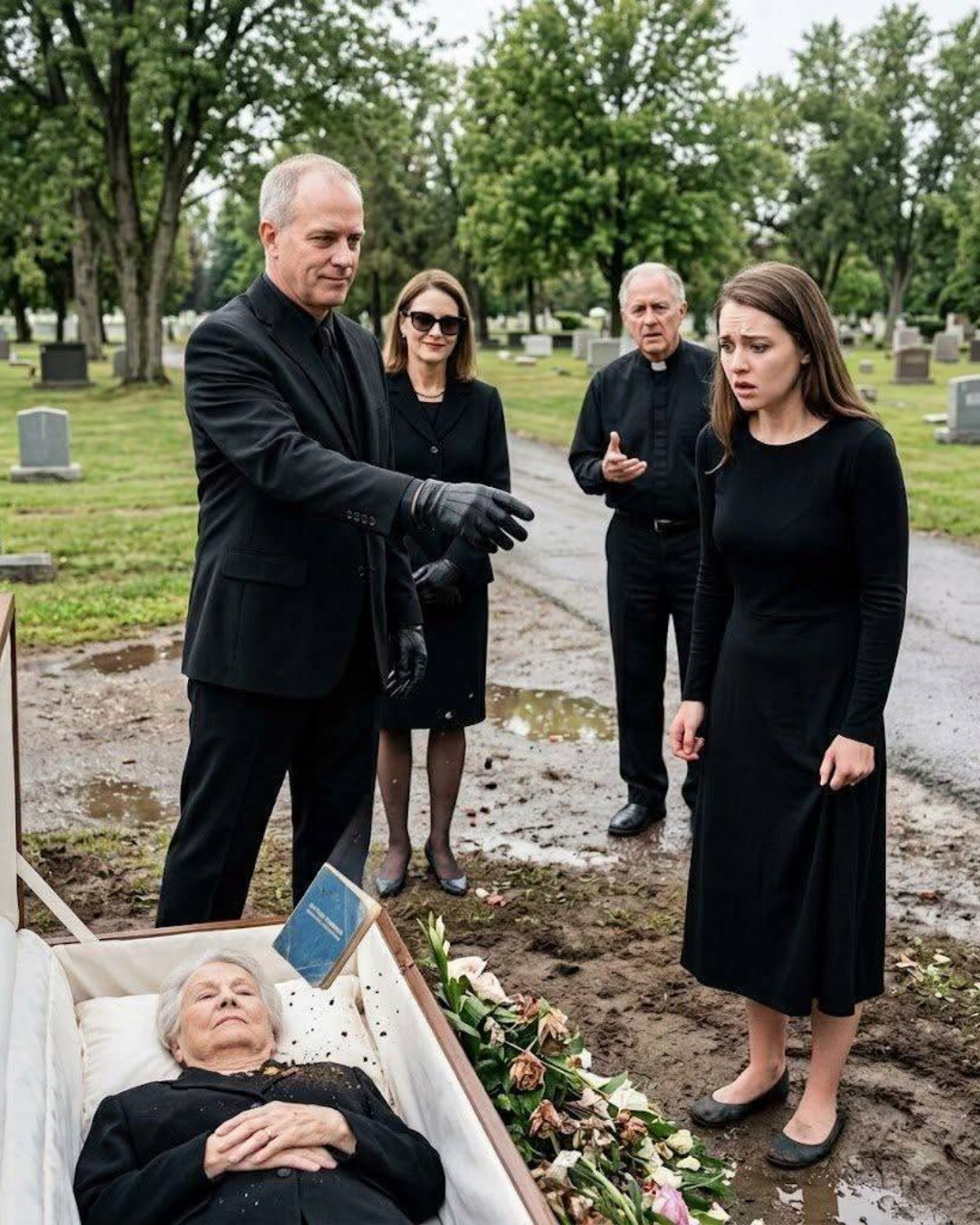
Malcolm looked stunned, while Ortiz asked me to explain exactly how Richard tossed it onto the open casket during yesterday’s funeral.
I described his words, Susan’s laughter, Tyler’s burger joke, and everyone leaving while the book disappeared beneath falling cemetery dirt.
Ortiz exchanged a look with her partner because discarding potential financial evidence after Grandma’s warning carried implications I had not considered.
Dad might have believed burying the passbook destroyed the clearest physical connection between suspicious transfers and Grandma’s investigation into his behavior.
Unfortunately for him, I had spent childhood listening carefully whenever adults told me something supposedly did not matter enough to keep.
The bank copied every page before returning the original to an evidence envelope, and officers photographed mud still trapped inside its binding.
Then Malcolm introduced attorney Rebecca Shaw, who had arrived after receiving notification that Grandma’s designated beneficiary had finally appeared in person.
Rebecca had represented Grandma privately for four years, although Grandma deliberately kept that relationship hidden from most relatives, especially Richard.
She opened another sealed folder containing a letter Grandma had written for me only eleven days before she died.
I expected legal instructions, but the first paragraph apologized for allowing fear to keep the truth away from me so long.
Grandma wrote that Richard’s behavior worsened after discovering my mother’s trust during probate proceedings following her death.
He initially demanded direct guardianship over everything, but my maternal grandparents fought him and secured independent management protections instead.
When my grandfather died, Grandma became the last relative standing between Dad and assets he believed should have belonged to him.
She described years of threats disguised as family arguments, including repeated demands that she sign blank forms involving my inheritance.
Sometimes Richard stopped speaking to her for months, only returning when debts increased or another business investment began collapsing.
Grandma wrote that she tolerated his anger because she believed keeping him close helped her monitor what he might attempt next.
Eventually she realized that strategy endangered both of us, especially after Susan began encouraging Richard to pursue formal control over me.
The final line read, “Chloe, money cannot replace the years stolen from you, but truth can stop them stealing more.”
I pressed the letter against my mouth and cried harder than I had beside Grandma’s grave the previous afternoon.
Rebecca waited until I could breathe steadily again before explaining what Grandma had legally arranged during her final months.
She transferred custodial authority away from herself into an independent fiduciary structure that automatically terminated once I personally verified my identity.
That meant neither Richard, Susan, nor anyone else could gain control simply because Grandma died before speaking with me.
The moment the bank confirmed who I was, full beneficiary protections activated and outside trustees gained temporary management during transition.
Rebecca recommended I avoid moving large amounts immediately, change every financial password, freeze my credit, and establish completely independent legal representation.
I agreed because suddenly every harmless family question about my salary, address, passwords, and employment history looked different.
Before leaving the bank, Detective Ortiz asked whether Dad possessed keys to my apartment or access to any of my devices.
He had an old emergency key from years earlier, so police advised me not to return home alone that afternoon.
Two officers accompanied me while my landlord changed the locks and reviewed building-camera footage from the previous night.
The recordings showed Dad arriving at 11:42 p.m., trying my apartment door, and leaving only after discovering the chain was engaged.
That was while I sat inside reading Grandma’s letter with a chair wedged beneath the knob several feet away.
I had heard a faint sound in the hallway but convinced myself grief was making ordinary building noises seem threatening.
Detectives later learned Richard texted Susan immediately afterward saying, “She has something, but she’s too scared to understand it.”
Another message instructed Tyler to search Grandma’s house before probate representatives arrived and remove any folders marked with my name.
Police obtained an emergency warrant before Tyler could finish, finding several boxes loaded inside his truck behind Grandma’s bungalow.
Among them were my original birth certificate, insurance records, trust correspondence, and old letters from my deceased mother addressed to me.
Tyler claimed Richard told him the papers were worthless family junk that needed clearing before the property was sold.
That excuse weakened when investigators found text messages promising Tyler twenty thousand dollars after everything was successfully transferred into Dad’s control.
Susan’s phone contained photographs of Grandma’s signature beside practice attempts apparently used to prepare documents appearing throughout the bank investigation.
Her search history included questions about contesting trusts, declaring adults incompetent, transferring inherited assets, and destroying handwritten financial records.
By the second evening, investigators interviewed all three separately, and their carefully united family story began breaking apart almost immediately.
Tyler claimed Susan organized the paperwork, Susan blamed Richard, and Dad insisted Grandma had always promised him everything before becoming confused.
The trust documents demolished that argument because they dated back to my childhood and carried signatures from multiple independent attorneys and trustees.
More importantly, my mother’s estate records clearly identified me as the sole intended beneficiary of most protected assets after adulthood.
Dad had never legally owned that money, regardless of how many years he spent convincing everyone inheritance naturally belonged to parents.
Within weeks, prosecutors filed charges related to attempted financial exploitation, forged documents, theft, and other conduct uncovered during the investigation.
I learned quickly that criminal cases move slower than dramatic television scenes, with hearings, motions, evidence reviews, and arguments over every document.
Still, Dad’s control disappeared almost immediately because banks froze disputed accounts and courts restricted access to Grandma’s property during probate.
Susan stopped posting smiling photographs from expensive restaurants, while Tyler suddenly removed jokes about my supposed poverty from social media.
Several relatives contacted me claiming they never knew what Richard was doing and had only believed whatever he told them.
I remembered their laughter beside Grandma’s grave and told them ignorance was not always innocent when cruelty had been entertaining enough.
I did not cut everyone off forever, but I stopped treating shared blood as automatic evidence that someone deserved access.
Rebecca helped me move into a safer apartment and introduced independent financial advisers who explained the trust without speaking to me like a child.
I used almost none of the money during the first year because suddenly having wealth felt less important than understanding what Grandma protected.
My first major decision was paying off the small educational debt Dad created after taking money intended for my college expenses.
Then I established a scholarship honoring Margaret Henderson for students whose families used financial control to obstruct their education.
The award never carried Dad’s name, although his actions were part of the reason I understood how powerful financial independence could become.
Grandma’s bungalow eventually transferred to me through her separate will, despite Richard’s attempt to challenge several provisions through counsel.
I kept the kitchen table, porcelain angel, and rusted butter-cookie tin where she once hid the little blue passbook.
Inside the tin, I placed a copy of her final letter beside the embroidered napkin that protected the book for years.
I also kept one photograph from the funeral, showing Richard standing beside the grave moments before he threw away what he considered worthless.
He believed value existed only when he controlled it, which explained why he underestimated Grandma, me, and one muddy savings book.
Months later, I testified during proceedings about the night Grandma warned me and the morning I entered the bank alone.
Dad sat across the courtroom wearing the same polished expression he used throughout my childhood whenever he expected people to believe him.
His attorney suggested Grandma might have become confused before death, but medical records showed she remained mentally competent when signing protective documents.
Then prosecutors played her recorded conversation with Richard, and I watched his expression change before her steady voice filled the courtroom.
She told him clearly that the money belonged to Chloe and warned that attempting another forged transfer would eventually destroy him.
Dad answered that nobody would believe an old woman over her own son once he convinced everyone she had lost her mind.
Hearing those words publicly ended whatever uncertainty remained among relatives who still described everything as a tragic family misunderstanding.
Grandma had understood exactly what he planned, documented it carefully, and built protections strong enough to survive even after her death.
The final legal consequences took time, but substantial restitution orders and criminal penalties followed evidence investigators could independently verify and authenticate.
I never celebrated Dad’s downfall because revenge could not restore my mother, Grandma, childhood savings, or years spent believing I deserved less.
What mattered was recovering ownership of my future and understanding that their contempt had never been an accurate measurement of my worth.
On the first anniversary of Grandma’s death, I returned alone to Oakfield Cemetery carrying fresh flowers and the cleaned blue passbook.
I sat beside her grave and told her about the scholarship, the trust, my apartment, and everything investigators had uncovered afterward.
Then I thanked her for leaving one sentence where she knew I would eventually discover it despite Richard’s attempts.
“If Richard says it’s worth nothing, it’s because he already tried to cash it,” she had written in trembling blue ink.
My father threw that book into her grave because he believed dirt could bury evidence as easily as intimidation buried questions.
Instead, I dug it back up with my bare hands and carried the truth directly into the bank he feared.
The teller turned pale not because Grandma’s passbook contained some magical fortune printed plainly between its faded little pages.
She turned pale because my name activated years of warnings, failed fraud attempts, hidden records, and one grandmother’s carefully prepared protection.
Richard called the passbook worthless while standing above his mother’s open grave, surrounded by relatives laughing at the daughter he underestimated.
By the next morning, that supposedly worthless book had opened every account, every lie, and every secret he had tried burying with her.