
PART 1
“I want you to bathe her in our tub. And please, don’t call the staff. Do it yourself.”
I thought my husband had completely lost his mind.
My name is Mariana. I’m thirty-six years old, and until that afternoon, I believed I knew every single thing about the man I’d been married to for fifteen years. Alejandro owned a series of major commercial construction firms across Chicago. He had more money than we could ever spend, but he possessed a habit that sometimes drove me to my wit’s end: whenever he set his mind on a charitable crusade, nothing on earth could stop him.
That week, he had decided to personally volunteer at a soup kitchen near the bus terminal downtown. He claimed he was tired of just writing big corporate checks for photo opportunities and wanted to meet the people receiving aid face-to-face.
I didn’t share his sudden enthusiasm.
“Some people genuinely need a hand up,” I had scoffed that morning over coffee. “But plenty of others just prefer living that way.”
How easy those words rolled off my tongue from the comfort of my climate-controlled home, with a cook preparing breakfast and a private driver waiting outside. I understood nothing back then.
Late that afternoon, I returned from a lunch date with friends to find Alejandro standing in our grand foyer alongside a woman who looked as though she had lived on the streets for decades.
Her hair was a tangled, matted mess, her skin was caked in layers of dark grime, and she wore a threadbare coat that emitted an odor so foul I instinctively covered my nose and stepped back.
“What on earth is she doing in our house?” I demanded.
The woman quickly lowered her eyes, shrinking into herself.
Alejandro answered with an irritating, unbothered calm. “Her name is Lucy.”
“Is that her name, or did you just decide to name her?”
“She doesn’t remember her real name, Mariana.”
I thought he was making a sick joke.
The woman quietly explained in a raspy voice that she had spent twenty years moving between transit stations, parks, and abandoned buildings. She remembered waking up two decades ago amidst the debris of a construction site, but nothing before that. No family, no last name, no home address.
Nothing.
Alejandro had met her while serving soup that afternoon.
“I’m going to help her track down her identity papers and find a decent place to live,” Alejandro announced firmly. “Until then, she’s staying in our guest suite.”
I felt my blood boil. “In our home?!”
“Yes.”
“What’s next, Alejandro? Are you turning our guest rooms into a shelter?”
The woman took a timid step backward toward the front door. “I don’t want to cause trouble. I can leave.”
Alejandro caught her arm gently. “You aren’t going anywhere.” Then he turned his gaze to me, his eyes sharp. “Mariana, I was just filling the garden tub upstairs. Go help her wash up.”
I went completely rigid. “Me?”
“Yes.”
“We have a full house staff, Alejandro!”
“Exactly. If you truly believe helping people is important, start by treating her like a human being instead of a mess someone else has to clean up.”
His words stung because I knew they were aimed straight at my arrogance.
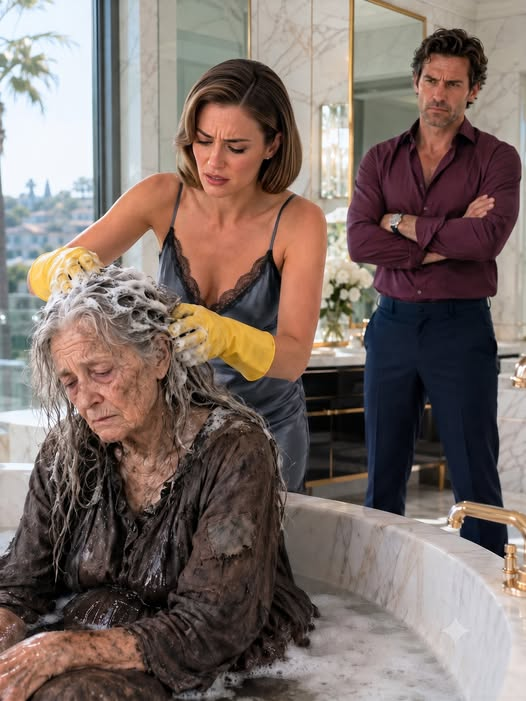
Muttering furious insults under my breath, I led the woman upstairs to the master bath. I pulled on heavy rubber cleaning gloves before turning to face her.
“Take those rags off and put them directly in that trash bag,” I said coldly. “We’re throwing everything away.”
“I can wash myself,” she offered in a surprisingly polite, cultured tone.
“I’d prefer to make sure you don’t ruin the marble.”
Even now, my heart aches with shame when I remember how cruelly I spoke to her.
The woman stepped into the warm water, and almost instantly, the clear bath turned a dark, murky brown. I took a soft sponge, and forcing myself to swallow my disgust, I began scrubbing her right shoulder.
As years of dirt lifted away, something caught my eye beneath the grime.
A tiny, crescent-shaped birthmark.
The sponge slipped from my fingers, splashing into the water.
The air evaporated from my lungs.
“Turn around,” I whispered, my voice trembling.
“Is something wrong, ma’am?”
I grabbed a wet cloth and began wiping the grime from her face with desperate, frantic strokes. Beneath twenty years of dirt and street neglect emerged a worn, aged, and exhausted face—a face completely unrecognizable to the rest of the world.
But not to me.
I began to shake violently.
I sprinted to my vanity drawer, pulled out a tarnished gold locket I had kept locked away for two decades, and snapped it open in front of her face.
Inside sat a faded photograph. A young, vibrant woman was smiling brightly, her arms wrapped around a ten-year-old girl.
“This woman was my mother,” I sobbed, tears blurring my vision. “She had that exact same crescent birthmark on her shoulder.”
The woman stared at the photograph. Then she looked up into the bathroom mirror.
And I uttered a name I hadn’t dared speak aloud in twenty years:
“Mom… your name is Lucile.”
PART 2
Lucile didn’t throw her arms around me. She didn’t weep with sudden joy.
She simply held the small gold locket in her trembling, water-pruned hands and stared at the image.
“I’m so sorry,” she whispered, her voice cracking. “I don’t remember this little girl.”
I felt as though someone had reached into my chest and ripped out my heart.
For twenty long years, my family had told me that my mother perished in a catastrophic house fire in our old neighborhood. The firefighters never recovered a body, but the structure had been reduced to ash, and everyone assumed no one could have survived.
I was only ten years old.
After the fire, I was taken in and raised by an aunt. At twenty-one, I met Alejandro, but I never stopped wondering what had truly happened on that awful night.
Now, my mother was sitting in my bathtub.
Alive.
Yet to her, I was an absolute stranger.
When we walked downstairs, Alejandro was waiting in the living room.
I marched straight up to him, tears streaming down my face. “You knew, didn’t you? You brought her here on purpose!”
Alejandro shook his head gently. “I wasn’t completely sure, Mariana.”
He confessed that while volunteering at the shelter, he had noticed two distinct details: Lucile’s approximate age and a long, jagged burn scar across her left wrist. Years ago, I had mentioned to him that my mother burned that exact wrist while cooking when I was a child.
“I thought it might just be a bizarre coincidence,” he explained softly. “That’s why I brought her here. I needed you to see her before I gave you false hope.”
I collapsed against his chest, sobbing uncontrollably.
The next morning, we brought Lucile to a top private neurologist downtown. After a comprehensive series of brain scans and cognitive evaluations, the doctor explained that the severe physical and emotional trauma she suffered twenty years ago had triggered profound psychogenic amnesia.
“Do not force her memories,” the doctor warned us gently. “Old photographs, familiar places, smells, childhood songs… any sensory stimulus tied to her past life might unlock a door. Let it happen naturally.”
Over the next several weeks, I transformed our suburban home into a living museum of my childhood.
I pulled out old photo albums. I prepared the hot cinnamon rolls she used to bake for me every Sunday morning. I played old jazz records she used to listen to while cleaning the house. I drove her to the park where she used to buy me ice cream after school.
Nothing.
Lucile offered polite smiles, but the light of recognition never entered her eyes.
One afternoon, she pointed to a framed black-and-white photograph resting on the fireplace mantle. A handsome man was standing beside a young Lucile.
“Who is he?” she asked quietly.
A heavy lump formed in my throat. “That’s my father. Robert.”
“Where is he?”
I couldn’t answer.
“Mariana,” she pressed, looking deeply into my eyes. “What happened to him?”
I stood up and quickly turned the photograph face down. “That can wait, Mom.”
I couldn’t bear to tell her. Because for twenty years, I had believed my father died because of me.
A week later, I decided to drive Lucile back to the street where our old house used to stand. The lot where my childhood home once stood was now occupied by a pharmacy and a strip mall.
Lucile stared out the car window, her eyes completely blank. “I’m sorry, sweetheart,” she whispered. “I don’t recognize any of this.”
“It’s okay, Mom,” I said, trying to hide my heartbreak.
We stepped out of the car and walked down the sidewalk toward a nearby park.
Suddenly, the deafening blare of a truck horn pierced the air, followed by the violent screech of burning tires. A distracted driver in a heavy pickup truck had mounted the curb, barreling straight toward us at forty miles an hour.
I froze in absolute panic, paralyzed by fear.
Lucile didn’t hesitate.
She lunged forward, shoving me out of the way with incredible force.
I slammed hard onto the pavement, scraping my hands and knees. The truck missed us by mere inches, smashing violently into a metal utility pole down the block.
When I pushed myself up, my mother was kneeling on the concrete, gasping for air, her body shaking violently.
Then she began to sob.
But it wasn’t from the shock of the near-accident.
She turned her head and looked at me with an intensity I hadn’t seen since I was ten years old.
“Marianita…”
My heart stopped beating. No one on earth had called me Marianita since I was a child.
Lucile clutched both hands to her temples, tears streaming down her face.
“I remember…” she gasped, her voice trembling. “I remember what happened to your father.”