
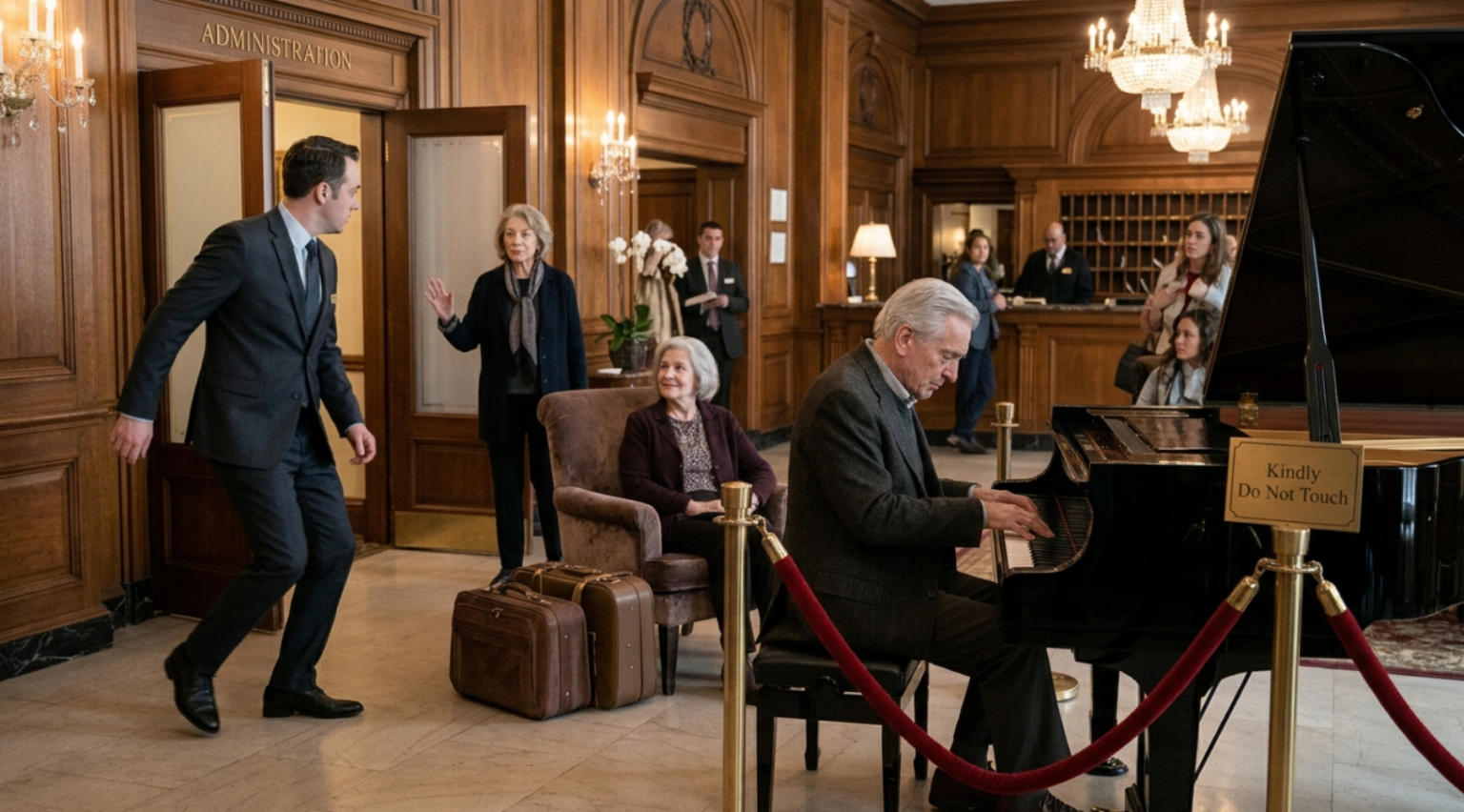
PART 3
“And they tipped better?”
The manager froze.
I felt my stomach tighten.
Apparently, Evelyn had heard everything.
She looked toward the reception desk.
“Young man, what is your name?”
The clerk, who had been standing behind the counter only moments earlier, suddenly became very interested in a stack of papers.
“Mr. Daniel,” the manager answered quickly. “His name is Daniel. He’s one of our front-desk employees.”
Evelyn raised an eyebrow.
“I asked him, not you.”
Daniel slowly stepped forward.
“Daniel, ma’am.”
“Daniel, did these people have a confirmed reservation for the anniversary suite?”
He hesitated.
“Yes, ma’am.”
“Did they pay for it?”
“Yes, ma’am.”
“Then why are they sitting in the lobby with their luggage?”
Daniel looked at the manager.
That was his first mistake.
Evelyn noticed.
She leaned slightly on her cane.
“Look at me when I’m speaking to you.”
Daniel’s face turned red.
“Mr. Collins instructed us to move them to another room. He said the suite should go to Mr. and Mrs. Whitmore.”
The manager’s jaw tightened.
“Daniel, that’s enough.”
“No,” Evelyn said sharply. “He hasn’t finished.”
Daniel looked down at the desk.
“He told us the Whitmores were willing to pay extra for the suite. He said the older couple wouldn’t complain because they probably wouldn’t know the difference.”
For several seconds, nobody spoke.
I looked at my father.
He was still sitting at the piano, his hands resting gently on the keys.
He wasn’t angry.
He wasn’t even looking at the manager.
He was looking at Evelyn.
And there was something in his expression I had never seen before.
It was the look of someone remembering a part of his life that he had buried a very long time ago.
Evelyn turned back toward the manager.
“Mr. Collins, I want you to understand something. This hotel has been standing for 112 years. It has welcomed presidents, musicians, business owners, and people who have traveled across oceans to stay here.”
She paused.
“But before any of those people came through those doors, there were ordinary people who made this place worth remembering.”
The manager nodded nervously.
“Absolutely, Mrs. Harlow.”
She pointed toward my father.
“That man is one of them.”
The manager glanced at Dad.
“I understand, ma’am. We will certainly arrange another room for him.”
Evelyn’s expression changed.
“Another room?”
She looked at the luggage beside Mom.
“Do you know what tonight is?”
The manager shook his head.
“It’s their fiftieth wedding anniversary,” I answered.
Evelyn slowly closed her eyes.
For a moment, she looked as though someone had struck her.
“Fifty years,” she whispered.
Then she opened her eyes and looked directly at my father.
“Frankie, you never told me.”
Dad gave a small smile.
“Well, Evelyn, I didn’t think you’d want to hear from me after all these years.”
Evelyn’s fingers tightened around the handle of her cane.
“Don’t say that.”
Her voice cracked.
“Don’t you ever say that.”
Mom finally walked toward the piano.
She placed one hand on Dad’s shoulder.
“Evelyn, it’s been a long time.”
The old woman turned toward her.
And then, for the first time since she had appeared, her stern expression softened.
“Margaret.”
Mom nodded.
“Hello, Evelyn.”
Evelyn looked at Mom for a long moment.
Then she reached out and gently held her hand.
“I remember you.”
Mom smiled through her tears.
“I remember you too.”
I stood there completely confused.
My sister, who had been standing beside me, leaned closer.
“Do you know what’s happening?”
I shook my head.
“No idea.”
But we were about to discover that our parents had a history with this hotel that neither of us had ever heard.
Evelyn turned toward the manager again.
“Mr. Collins, I want the original guest records from 1974 through 1977.”
The manager blinked.
“Ma’am?”
“You heard me. The original guest and employee records. I want them brought here.”
“Those records are kept in the archive downstairs. Some of them are quite old.”
“Then I suggest you start walking.”
The manager immediately signaled to another employee.
Evelyn wasn’t finished.
“And I want the Whitmores informed that their room arrangement was made improperly. They may keep their current room for tonight, but the suite belongs to these guests. They will receive a full refund for any additional charge they paid.”
The manager nodded.
“Of course.”
“Also, I want the front desk reservation records preserved. Nobody deletes anything. Nobody changes anything. Do you understand?”
“Yes, ma’am.”
She looked at Daniel.
“And you will remain here until I have spoken with the hotel’s human resources director.”
Daniel’s face went pale.
“Yes, ma’am.”
The manager tried to recover some dignity.
“Mrs. Harlow, perhaps we should discuss this privately in my office.”
Evelyn looked at him.
“Why? Are you embarrassed that the guests might hear how you treat people?”
He didn’t answer.
“Good. Then let them hear.”
She turned toward my father.
“Frankie, would you please come with me?”
Dad slowly rose from the piano bench.
He looked at Mom.
She nodded.
He walked toward Evelyn, and she placed her hand on his arm.
Together, they headed toward the back office.
Before they disappeared through the doorway, Evelyn stopped and looked at us.
“Your children?”
Dad smiled.
“Yes. My daughter and son.”
“Come with us. There’s something they deserve to know.”
The back office was much larger than I expected.
Behind the manager’s polished reception area was an old room filled with wooden cabinets, framed photographs, and shelves of leather-bound books.
Unlike the modern lobby, this room seemed untouched by time.
There were photographs of the hotel from different decades.
A black-and-white picture of the original building.
A photograph of the ballroom in the 1960s.
A group photograph of employees standing in front of the main entrance.
And then I noticed something.
A photograph of a young man sitting at a grand piano.
He had dark hair, a narrow face, and a small smile.
I looked closer.
It was Dad.
He couldn’t have been older than thirty.
Underneath the photograph was a small brass plate.
FRANKIE — RESIDENT LOUNGE PIANIST, 1974–1977.
I turned toward him.
“Dad?”
He followed my eyes.
“Oh, that old thing.”
“Why have you never told us about this?”
He shrugged.
“Because it was just a job.”
Evelyn, who had settled into a leather chair, looked at him.
“Just a job?”
She shook her head.
“You always were terrible at understanding what you meant to people.”
Dad smiled.
Evelyn reached toward a drawer and removed a small photograph.
She held it in both hands.
It showed three people standing together in front of the hotel ballroom.
A young Dad.
A young Mom.
And a handsome older man wearing a dark suit.
“Do you recognize him?” Evelyn asked.
Dad looked at the photograph.
His smile disappeared.
“Mr. Harlow.”
Evelyn nodded.
“My husband.”
She looked down at the picture.
“Arthur.”
For a moment, the room became very quiet.
“Arthur loved this hotel,” she continued. “He built his entire life around it. He believed a hotel wasn’t just a building where people slept. It was a place where strangers became friends, where families celebrated, and where people could find comfort when they were far from home.”
She looked at Dad.
“And he adored you.”
Dad lowered his eyes.
“I know.”
“No, Frankie. I don’t think you do.”
She carefully placed the photograph on the table.
“My husband used to come downstairs every evening after dinner. He would sit near the lounge and listen to you play. He always said you had something most musicians never learned.”
“What was that?” my sister asked.
Evelyn smiled sadly.
“You knew how to make people feel something without asking them to listen.”
Dad looked embarrassed.
“He was too kind.”
“He wasn’t.”
Evelyn reached into another drawer.
This time, she removed a yellowed envelope.
The paper was old, and the edges had become fragile.
On the front, in faded handwriting, were the words:
For Frankie and Margaret.
Dad stared at it.
His fingers began to tremble.
“Where did you get that?”
“Arthur left it with me.”
Dad looked confused.
“Why didn’t you give it to me?”
Evelyn took a slow breath.
“Because I was angry.”
She paused.
“Not with you. With myself. And with the world.”
She looked toward the window.
“Arthur died in November 1977.”
Mom reached for Dad’s hand.
I knew my father had lost people over the years, but I had never heard him speak about anyone named Arthur.
Evelyn continued.
“He had been ill for months. Most people didn’t know. He continued coming to work because this hotel was his entire life.”
Her voice became softer.
“During his final weeks, he spent a great deal of time listening to your music. Sometimes he would sit in the lounge until closing. I would tell him to come home, but he always said he wanted to hear one more song.”
Dad slowly sat down.
“I remember,” he whispered.
Evelyn nodded.
“On his final night here, he asked you to play a particular song.”
Dad looked at the piano in the lobby through the open doorway.
“The song I just played.”
“Yes.”
Evelyn’s eyes filled with tears.
“He asked you to play it because it was our wedding song.”
She touched the envelope.
“After you finished, Arthur told me something. He said that if he ever left this world before me, I should never let anyone forget the people who made this place beautiful.”
She looked at Dad.
“And he specifically mentioned you.”
Dad rubbed his forehead.
“I didn’t know he was that sick.”
“Of course you didn’t. We didn’t tell anyone.”
Evelyn paused.
“He wanted to give you something. He told me to deliver this letter after your wedding.”
Mom leaned forward.
“What letter?”
Evelyn gently pushed the envelope across the table.
Dad stared at it for several seconds before opening it.
Inside was a handwritten letter and a folded piece of paper.
The handwriting was elegant but slightly uneven.
Dad began reading.
At first, he read silently.
Then his lips started moving.
And finally, he whispered the words aloud.
“Dear Frankie and Margaret,
If you are reading this, I hope you have already begun building the beautiful life you deserve.
Frankie, I have watched you play music in this hotel for three years. I have seen guests arrive angry, lonely, and exhausted. I have watched you sit down at that piano and turn an ordinary evening into something people remember for the rest of their lives.
I have also watched you fall in love.
Margaret, you have brought a light into this building that no chandelier could ever match.
I want you both to know that this hotel will always have a place for you.
The ballroom is yours for your wedding. No payment. No conditions.
And Frankie, if you ever need a piano, you will always have one here.
With gratitude,
Arthur Harlow.”
Dad stopped reading.
His eyes were wet.
Mom covered her mouth.
I looked at the folded paper.
“What is that?”
Evelyn gently unfolded it.
It was an old document.
At the top was the Grand Hotel’s official letterhead.
Below it was a statement signed by Arthur Harlow.
The Grand Hotel shall maintain a permanent place of honor for the musicians and employees whose service helped establish its reputation.
At the bottom was another handwritten sentence.
The piano in the main lobby shall never be sold or removed. It is to remain available for those who understand what music means to this house.
My sister looked at Evelyn.
“Does that mean Dad was allowed to play it?”
Evelyn smiled.
“Your father was the reason that instruction was written.”
Dad looked down at the document.
“I thought Arthur had forgotten about me.”
Evelyn shook her head.
“He never did.”
She reached over and touched his hand.
“And neither did I.”
For the next several minutes, nobody spoke.
I watched my father hold that old letter.
He was eighty years old.
His hands were no longer as steady as they had been when he was young. His shoulders had grown smaller, and his movements were slower.
But as he sat there, holding a letter written nearly fifty years earlier, I saw the young man from the photograph.
The man who had played six nights a week.
The man who had fallen in love with a waitress.
The man who had built a life with almost nothing except a piano and a dream.
Finally, Dad looked at Evelyn.
“Why did you stop people from playing that song?”
Evelyn’s smile disappeared.
She looked down at her hands.
“Because I couldn’t bear it.”
She took a long breath.
“After Arthur died, I came downstairs one evening and heard someone playing it. I thought for a moment that he was sitting in his old chair again.”
Her voice cracked.
“I walked into the lounge, and of course, it wasn’t him. It was just another musician. A stranger playing the song.”
She wiped her cheek.
“I told the staff never to play it again. I thought if I could silence the music, I could silence the memories.”
Dad looked at her for a long time.
Then he said something that made Mom cry even harder.
“Arthur wouldn’t have wanted you to be lonely, Evelyn.”
She closed her eyes.
“I know.”
“He loved hearing that song.”
“I know.”
Dad reached for her hand.
“Then maybe it’s time we let it play again.”
Evelyn began crying.
Not the quiet tears Mom had shed earlier.
These were the tears of someone who had spent nearly fifty years carrying a grief she had never properly put down.
She held Dad’s hand tightly.
“Frankie, would you play it for me again?”
Dad smiled.
“Of course.”
When we returned to the lobby, the manager was standing beside the reception desk.
A new employee had arrived, and the lobby was still unusually quiet.
The guests who had witnessed everything were whispering among themselves.
Evelyn walked straight toward the piano.
She stopped beside it and turned to the manager.
“Mr. Collins.”
“Yes, Mrs. Harlow?”
“Bring me the reservation records.”
He immediately handed her a folder.
She opened it.
Her eyes moved across the pages.
Then she stopped.
“These people paid nine hundred dollars per night for two nights?”
“Yes, ma’am.”
“And you moved them into room 212?”
The manager nodded.
“We were trying to accommodate the situation.”
“Accommodation?”
Evelyn looked at the folder.
“Room 212 is directly beside the ice machine.”
The manager said nothing.
“Did you offer them a refund?”
“We were going to discuss that.”
“Did you offer them an apology?”
He hesitated.
“I was about to.”
Evelyn closed the folder.
“Then let me make this very simple. These guests will receive the suite they booked. Their entire stay will be complimentary. Their dinner tonight will be paid for by the hotel, and they will receive a written apology from management.”
The manager nodded quickly.
“Certainly.”
“And one more thing.”
“Yes?”
Evelyn looked toward Daniel.
“Your decisions as manager reflect the values of this hotel. I will be reviewing your conduct with the board tomorrow morning.”
The manager’s face drained of color.
“Mrs. Harlow, please. I’ve worked here for fifteen years.”
“Then you should have learned something about hospitality during those fifteen years.”
She turned away.
The manager stood there without another word.
Daniel quietly disappeared behind the reception desk.
But Evelyn wasn’t finished.
She looked toward the guests who had gathered around the lobby.
“To everyone who witnessed what happened tonight, I apologize on behalf of this hotel. This is not how we treat people here.”
Then she turned toward my father.
“Now, Frankie. I believe you owe this old piano another song.”
Dad laughed.
“I suppose I do.”
He sat down.
Mom stood beside him.
Evelyn settled into a chair near the piano.
And Dad began to play.
This time, it wasn’t a sad song.
It was the song he had played at his own wedding in 1976.
Mom started crying before he reached the second verse.
My sister squeezed my hand.
And as I stood there watching my eighty-year-old father play the piano in the same hotel where he had met the love of his life, I realized something.
We had booked our parents a luxury suite to celebrate fifty years of marriage.
But we had accidentally brought them back to the place where their entire story began.
And there was still one thing Evelyn Harlow hadn’t told us.
Something hidden in that old hotel archive.
Something that would change the way I understood my father’s life forever.
Because when the song ended, Evelyn stood up, looked at my father, and said:
“Frankie, there’s one more thing Arthur wanted you to have.”
She turned toward the back office.
“Something he made sure I kept safe all these years.”
And then she asked him a question.
“Do you remember the little music room upstairs?”
Dad’s fingers stopped moving.
His smile slowly disappeared.
“Yes,” he whispered.
Evelyn nodded.
“Then I think it’s time you saw what he left behind.”
PART 4
My father didn’t move.
For several seconds, he simply stared at Evelyn.
“The music room?” he finally asked.
Evelyn nodded.
“Yes, Frankie. The little room on the third floor.”
Dad slowly looked toward Mom.
She was just as confused as we were.
“What music room?” I asked.
Dad rubbed his hands together.
“Back when I worked here, there was a small room upstairs. It wasn’t really a guest room. Arthur used it for private meetings, and sometimes he allowed musicians to practice there.”
He paused.
“There was an old upright piano in that room. I used to go there after my shifts when the lounge was empty.”
Evelyn smiled.
“Arthur loved that room. He used to say it was the quietest place in the entire building.”
She looked toward the manager.
“Would you please have someone bring the keys?”
The manager quickly nodded.
“Of course, Mrs. Harlow.”
A few minutes later, a young maintenance employee arrived carrying a small collection of keys.
Evelyn selected an old brass key.
“This one.”
She looked at Dad.
“Would you like to come with me?”
Dad stood slowly.
Mom took his arm.
“Let’s go.”
My sister and I followed them.
We walked past the reception desk, through a narrow hallway, and up a staircase that most guests probably never noticed.
The third floor looked completely different from the modern lobby.
The carpet was old.
The walls were covered with framed photographs.
And at the end of the hallway stood a wooden door.
There was no room number.
Only a small brass plate.
MUSIC ROOM.
Evelyn inserted the key.
The lock turned.
The door opened with a long, quiet creak.
And what we saw inside made my father stop breathing for a moment.
The room was small.
A large window overlooked the city.
There was an old wooden desk, two leather chairs, and a dusty upright piano against the far wall.
But that wasn’t what caught Dad’s attention.
It was the photograph hanging above the piano.
A photograph of my parents.
Their wedding day.
1976.
Mom was wearing her simple white wedding dress.
Dad was standing beside her in a dark suit, smiling as though he had just won the greatest prize in the world.
They looked so young.
So happy.
So completely unaware of everything life would eventually ask of them.
Mom walked toward the photograph.
“Oh my goodness.”
She touched the frame.
“Frankie, look.”
Dad approached it slowly.
“I haven’t seen this picture in years.”
Evelyn smiled.
“Arthur had it enlarged. He said it belonged somewhere special.”
My father looked around the room.
“Why was this kept here?”
“Because this room was never meant to be forgotten.”
Evelyn walked toward the desk.
She opened a small wooden drawer.
Inside was a brown leather folder.
She removed it carefully and placed it on the desk.
“Arthur left instructions that this should be given to you when the time was right.”
Dad looked at her.
“What is it?”
“Open it.”
His hands trembled as he untied the leather string.
Inside were several documents, photographs, and another envelope.
The first document was dated December 1977.
Dad began reading.
Then he looked up.
“Evelyn…”
She nodded.
“Keep reading.”
The document was a letter from Arthur Harlow.
It explained that Arthur had wanted to help my parents establish a more secure future.
He knew Dad was a talented musician, but he also knew that playing in hotel lounges wasn’t going to make anyone wealthy.
He knew they were young.
He knew they were starting a family.
And he knew that Dad had always dreamed of having a small music school someday.
Dad stopped reading.
He looked at Mom.
“I told you about that?”
Mom nodded.
“You talked about it for years.”
Dad smiled sadly.
“I never thought it would happen.”
Evelyn pulled another document from the folder.
“Arthur did.”
It was a financial document showing that Arthur had established a small education fund in my father’s name.
The original amount was $25,000.
For 1977, it was an extraordinary gift.
But there was more.
The document explained that the money had been placed into a protected account, intended to support my father’s future music education project.
However, the fund had never been claimed.
Dad stared at the papers.
“Why?”
Evelyn looked down.
“Because after Arthur died, his business affairs became complicated. There were disagreements within the family. The hotel changed hands, and several old arrangements were never properly completed.”
She paused.
“I kept the documents because I knew Arthur would have wanted them protected. Eventually, I placed them with the hotel’s legal records.”
My sister leaned forward.
“Does that money still exist?”
Evelyn nodded.
“Not in its original form. The account was reorganized many years ago, and the money was used to establish a small charitable fund for music education.”
Dad looked confused.
“Then why give me these papers?”
Evelyn smiled.
“Because the money wasn’t the most important part of Arthur’s gift.”
She reached into the folder and removed the final document.
It was a letter.
A personal letter addressed to my father.
Dad opened it.
This time, he read it aloud.
“Dear Frankie,
If you have found this letter, I hope life has treated you and Margaret kindly.
I know you dream of having a place where children can learn music without worrying about whether their parents can afford expensive lessons.
I want you to know that I believe in that dream.
I have arranged for the Grand Hotel to provide a permanent music scholarship in your name, should you ever wish to establish such a program.
The scholarship will support children from families who cannot afford private music education.
Please don’t think of this as charity.
Think of it as passing along something beautiful.
You gave people music when they needed it most.
I hope one day someone will do the same for you.
Your friend,
Arthur.”
Dad couldn’t finish the final sentence.
His eyes filled with tears.
Mom wrapped her arms around him.
For a long time, they stood together in that little room.
I looked at the photograph above the piano.
Then I looked at my father.
And suddenly I understood why Evelyn had been so emotional when she heard him playing downstairs.
She hadn’t simply recognized an old musician.
She had heard the voice of someone who reminded her of the happiest years of her life.
We eventually returned to the lobby.
Evelyn had arranged for the hotel staff to prepare the anniversary suite.
But before we went upstairs, she asked everyone to gather around the piano.
There were now more people in the lobby than before.
Guests had come down from their rooms after hearing what happened.
Some were holding phones.
Others were simply standing quietly.
Evelyn took a microphone from the reception desk.
“I would like to say something.”
The lobby became silent.
“My name is Evelyn Harlow. My husband, Arthur, owned this hotel for many years. He believed that the reputation of a hotel wasn’t built by expensive furniture, beautiful chandeliers, or impressive buildings.”
She looked around.
“It was built by the way people were treated.”
She paused.
“Tonight, we failed to honor that belief.”
The manager stood near the desk.
He looked uncomfortable.
Evelyn continued.
“Two guests arrived to celebrate fifty years of marriage. They had made a reservation, paid for their stay, and trusted this hotel to make their anniversary special.”
She turned toward my parents.
“Instead, they were treated as though their comfort mattered less than someone else’s money.”
A few people shook their heads.
“That is unacceptable.”
She took a breath.
“Frankie and Margaret were part of this hotel’s history long before many of the people working here were born. Frankie played music here for three years. Margaret worked here. They met here. They fell in love here. They were married here.”
She smiled at them.
“And tonight, fifty years later, they came home.”
Mom began crying again.
Evelyn continued.
“I cannot change what happened earlier this evening. But I can make sure it doesn’t happen again.”
She announced that the hotel would establish a permanent annual scholarship for young musicians from families with limited financial means.
It would be called:
The Arthur and Frankie Music Scholarship.
The hotel would contribute $25,000 to begin the program and provide additional funding every year.
Dad immediately shook his head.
“Evelyn, that’s too much.”
She looked at him.
“No, Frankie. It isn’t.”
“But I don’t need that kind of money.”
“I know.”
She smiled.
“That’s precisely why I trust you with it.”
The guests began applauding.
Dad lowered his head.
He had never been a man who enjoyed attention.
He was happiest sitting behind a piano, playing for people who might not even know his name.
But that evening, the entire lobby was standing for him.
The next morning, the hotel manager personally came to our suite.
Our parents had spent the night in the beautiful room we originally booked.
The city lights had been visible through the enormous windows.
Mom had slept peacefully.
Dad had spent almost an hour looking through the old photographs Evelyn had brought upstairs.
At around ten in the morning, someone knocked.
I opened the door.
It was Mr. Collins.
He looked very different from the previous evening.
His expensive suit was still perfectly pressed, but his confidence was gone.
“May I speak with your parents?”
I stepped aside.
He entered the sitting area.
Dad was sitting near the window, reading a newspaper.
Mom was having coffee.
Mr. Collins stood in front of them.
“Mr. and Mrs. Frankie, I want to apologize.”
Dad folded his newspaper.
“For what?”
The manager looked uncomfortable.
“For the way you were treated yesterday. I made a decision based on the financial value of another reservation rather than the reservation that had already been confirmed.”
Dad listened quietly.
“I also allowed my staff to believe that your age made you less likely to complain. That was disrespectful, and there is no excuse for it.”
Mom placed her coffee cup down.
“Do you know what hurt the most?”
The manager looked at her.
“It wasn’t the room. It wasn’t the money. It wasn’t even the ice machine.”
She paused.
“We came here because this was where our life began. We wanted to remember something beautiful. And for a moment, you made us feel as though we didn’t belong here anymore.”
The manager lowered his eyes.
“I understand.”
Dad looked at him.
“Do you?”
The man nodded.
Dad continued.
“One day, you will be eighty years old. You might come back to a place that means everything to you. You might bring the person you have loved for fifty years. And I hope nobody ever looks at you and decides that you’re not worth treating properly.”
The manager swallowed.
“I hope so too, sir.”
Dad extended his hand.
The manager shook it.
There was no shouting.
No humiliation.
No dramatic revenge.
Just an old man reminding another man of something he should have understood years earlier.
Before leaving, the manager informed them that the hotel had begun a formal review of the reservation incident.
Daniel, the desk clerk, had been suspended pending an investigation. The manager himself had been placed under review by the hotel board.
Evelyn later confirmed that the investigation would be fair, but the hotel’s policy would be changed.
No employee would ever again be allowed to give away a confirmed reservation simply because another guest offered more money.
And no guest would be treated as less important because of age, appearance, or financial status.
That afternoon, Evelyn invited us to lunch.
She had arranged a private table in the ballroom where my parents had been married.
When we entered, Mom stopped.
The ballroom had been decorated with white flowers.
There were candles on the tables.
A beautiful anniversary cake stood in the center.
And above it hung a large framed photograph of my parents from their wedding day.
Mom covered her mouth.
“Frankie…”
Dad smiled.
“Well, I suppose we’re getting married again.”
Evelyn laughed.
“Not quite. But I thought fifty years deserved more than a room upgrade.”
She had invited several retired employees who had worked at the hotel during the 1970s.
Some were in their eighties.
Others were even older.
One of them, an elderly gentleman named Robert, immediately recognized Dad.
“Frankie!”
Dad turned.
“Robert?”
The two men embraced.
Robert had been a bellhop in 1976.
He remembered Dad playing in the lounge.
He remembered Mom bringing him coffee during late shifts.
He even remembered the night of their wedding.
“Arthur made us all come downstairs,” Robert said, laughing. “He told everyone that the pianist was getting married, and nobody was allowed to leave before the celebration.”
Mom laughed.
“He nearly ruined my wedding dress because he spilled champagne on it.”
Robert burst out laughing.
“I remember that!”
Soon, everyone was sharing stories.
Stories about the old hotel.
About the musicians.
About the customers who came every Friday night.
About Arthur Harlow, who apparently had a habit of secretly paying for meals when he noticed a struggling employee having a difficult week.
My father listened more than he spoke.
But I noticed something.
For the first time in a long while, he looked completely young.
Not physically.
His hair was still white.
His hands still trembled slightly.
But his eyes were bright.
He was surrounded by people who remembered the person he had been before he became somebody’s father, somebody’s grandfather, and eventually an old man.
They remembered Frankie.
The piano player.
The young husband.
The man who had once believed that music could change the world.
After lunch, Evelyn asked Dad to accompany her to the little music room one more time.
This time, she brought something different.
A small wooden box.
She placed it on the desk.
“Arthur kept this in his office.”
Dad looked at it.
“What is it?”
“Something he wanted you to have.”
Inside was a gold pocket watch.
The back had two initials engraved on it.
F.H.
Dad picked it up carefully.
“Frankie Harlow?”
Evelyn smiled.
“Frankie Harlow?”
She shook her head.
“No. Frankie and Harlow. Arthur had it engraved with both names because he said you were like family.”
Dad turned the watch over.
Inside the lid was a tiny handwritten message.
For the man who gave this house its music.
Dad couldn’t speak.
He closed the watch and held it against his chest.
“Thank you,” he whispered.
Evelyn looked at him.
“I should have given it to you years ago.”
Dad shook his head.
“You gave it to me when I needed it.”
She smiled.
“Then I suppose Arthur would be happy.”
Three months later, something wonderful happened.
The Grand Hotel officially launched the Arthur and Frankie Music Scholarship.
The first group included twelve children from families who could not afford private music lessons.
The hotel converted the old third-floor music room into a small teaching space.
A local music teacher volunteered to lead the program.
And my father agreed to visit every Saturday.
At first, he said he was too old.
He told us his fingers weren’t as quick as they used to be.
He worried the children would become bored listening to an old man play.
But when the first little girl sat beside him and asked him to teach her how to play a simple melody, something changed.
Dad smiled.
He placed her fingers gently on the keys.
“Don’t worry about playing quickly,” he told her. “First, learn how to listen.”
The little girl nodded.
He played one note.
She played it back.
Then he played another.
And soon, the two of them were making music together.
Mom sat in the corner watching.
She had tears in her eyes.
After the lesson, I asked Dad how it went.
He smiled.
“Pretty good.”
“Just pretty good?”
He looked toward the little girl, who was proudly showing her parents what she had learned.
Then he said something I will never forget.
“I spent most of my life playing music for people who could afford to sit in expensive rooms. Now I get to play for children who might never have had the chance to touch a piano.”
He paused.
“That feels like a pretty good ending to my career.”
But it wasn’t the end.
Not even close.
One year later, my parents celebrated their fifty-first wedding anniversary.
We returned to the Grand Hotel.
This time, there was no reservation problem.
The staff welcomed them by name.
The manager had changed.
Daniel no longer worked there.
The new management team had introduced a strict policy protecting confirmed reservations and treating every guest with equal respect.
But the most beautiful change was in the lobby.
The velvet rope around the grand piano was gone.
Beside it stood a small brass plaque.
I read it slowly.
IN MEMORY OF ARTHUR HARLOW
AND IN HONOR OF FRANKIE AND MARGARET, WHO REMINDED US THAT A HOTEL’S TRUE VALUE IS MEASURED NOT BY THE ROOMS IT SELLS, BUT BY THE MEMORIES IT HELPS CREATE.
Dad stood in front of it for a long time.
Then he sat at the piano.
Mom took her familiar place beside him.
Evelyn was there too.
She had grown weaker over the past year and now used a wheelchair.
But she insisted on attending.
Dad looked at her.
“Which song would you like?”
She smiled.
“You already know.”
He placed his hands on the keys.
And he played the same song that had brought everything back to life.
The song he had played for Arthur in 1977.
The song Evelyn had been unable to hear for nearly fifty years.
When the final note faded, the lobby remained silent.
Then Evelyn began applauding.
Soon everyone joined her.
She looked at Dad with tears in her eyes.
“Arthur would have loved that.”
Dad nodded.
“I think he heard it.”
A few months later, Evelyn passed away peacefully.
She was ninety-one.
The hotel held a small memorial service in the ballroom.
My parents attended.
On the front table stood photographs of Arthur and Evelyn together.
There was also a photograph of my parents on their wedding day.
Evelyn had specifically requested it.
In her final letter to the hotel board, she had written:
“Please remember that buildings can be renovated, furniture can be replaced, and businesses can change hands. But the people who give a place its heart are irreplaceable.”
She also left instructions that the music scholarship must continue.
And it did.
Every year, more children received lessons.
Some learned piano.
Others learned violin, guitar, or drums.
A few eventually became professional musicians.
Dad continued visiting as long as his health allowed.
He never asked for payment.
He never asked for recognition.
He simply wanted to teach.
And every Saturday, before leaving the hotel, he would sit at the grand piano and play one song.
The same song.
The song that had once belonged to Arthur and Evelyn.
On my parents’ fifty-second anniversary, I visited them at home.
Dad was sitting in his favorite chair.
The gold pocket watch rested on the table beside him.
Mom was looking through their old wedding photographs.
I picked up one of them.
It showed Dad standing beside Mom in the ballroom in 1976.
They looked so young.
So full of hope.
I asked Dad something I had wanted to ask him for a long time.
“Do you ever think about what would have happened if you hadn’t played that piano that night?”
He smiled.
“Of course.”
“What do you think?”
He looked at the photograph.
“I think your mother and I would have gone upstairs, complained a little, and eventually forgotten about it.”
I laughed.
“Then why did you play?”
He considered the question.
“Because I wasn’t playing for the manager.”
He looked at Mom.
“I was playing for the place where I met your mother. I was playing for Arthur. I was playing for Evelyn. And I suppose I was playing for the young man I used to be.”
Mom reached over and held his hand.
Then Dad added:
“And because sometimes, when people forget who you are, you don’t need to remind them with words.”
He looked down at his hands.
“You just have to remember it yourself.”
I never forgot that sentence.
Not because my father had once been a talented pianist.
Not because an old hotel owner had left him a gift.
And not because a manager had been embarrassed in front of an entire lobby.
I remembered it because my father had been treated as though he didn’t matter.
He could have shouted.
He could have demanded attention.
He could have made a scene.
Instead, he sat at a piano and played.
And the music reminded everyone of something that money could never buy.
A lifetime of kindness.
A friendship that survived death.
A love that lasted fifty years.
And the simple truth that growing old should never mean becoming invisible.
The Grand Hotel gave my parents a room next to the ice machine because someone else tipped better.
But they had no idea that the elderly man they had pushed aside had helped give that hotel its soul.
And when he finally played that piano, he didn’t just reclaim a room.
He brought an entire forgotten history back to life.
Because some people leave behind money, some leave behind buildings, and some leave behind memories.
But the greatest people leave behind something that continues to make the world better long after they are gone.
And my father?
He left behind music.
And every time a child touches those piano keys at the Grand Hotel, a little piece of Frankie is still there. ❤️