
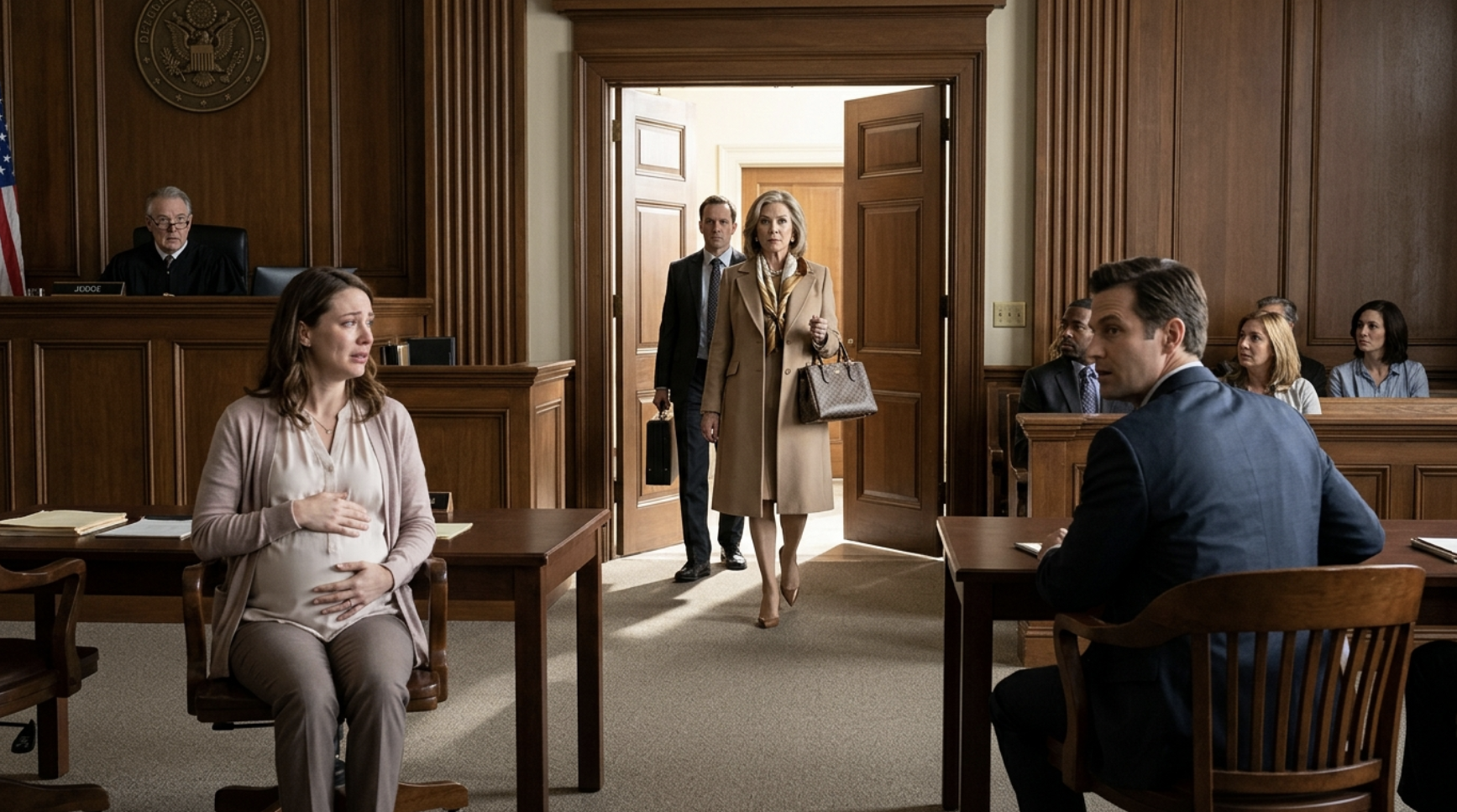
PART 3
And she was standing in the middle of my divorce hearing, looking at my husband as though he were a stain on the floor.
“Mom?” I whispered.
Her expression softened when she looked at me.
“Oh, sweetheart.”
Those two words nearly broke me.
I had imagined hearing them a thousand times during the lonely years of my childhood. I had imagined them when I graduated from college, when I got my first job, when I married Ethan, and when I sat alone in a hospital room after learning that I was pregnant.
But I had never imagined hearing them here.
Not in a courtroom.
Not with my marriage collapsing around me.
Not when I was eight months pregnant, exhausted, and standing before a judge who had just ruled that I would leave with practically nothing.
Margaret reached for my hand.
Her fingers were warm.
“You’ve been carrying this burden alone for far too long,” she whispered. “I’m sorry I wasn’t here sooner.”
I stared at her, tears gathering in my eyes.
“Why now?” I asked.
It was barely audible.
“Why did you wait until now?”
Pain crossed her face.
Before she could answer, Ethan let out a short, disbelieving laugh.
“I’m sorry,” he said, rising from his chair. “Who exactly do you think you are?”
Margaret turned toward him.
The softness disappeared from her expression.
“Margaret Whitmore.”
Ethan blinked.
His attorney went completely still.
I watched the color drain from Ethan’s face as recognition slowly settled over him.
He knew that name.
Of course he did.
His company had spent the previous two years trying to secure a major logistics partnership with Whitmore Global Holdings. Ethan had personally attended investor conferences where Margaret was the keynote speaker. He had once returned home furious after discovering that her investment firm had declined to review his proposal.
He had complained about her for an entire evening.
He had called her arrogant, unreasonable, and impossible to impress.
Now she was standing less than ten feet away from him.
And she had just called me her daughter.
Ethan looked at me.
Then at Margaret.
Then back at me.
“No,” he said quietly.
It was the first time that day I had heard genuine fear in his voice.
Margaret tilted her head.
“No?”
Ethan swallowed.
“This is some kind of misunderstanding.”
“I assure you,” Margaret replied, “there is no misunderstanding.”
She turned to the judge.
“Your Honor, my legal team has documents that may be relevant to this proceeding. We respectfully request permission to submit them before this matter is considered concluded.”
The judge looked from Margaret to her attorneys.
“Ms. Whitmore, this hearing has already reached a ruling.”
“I understand.”
“Then you also understand that I cannot simply reopen a matter because someone wealthy has entered the room.”
Margaret gave a small nod.
“Of course. Wealth does not entitle anyone to special treatment. Neither should it allow anyone to conceal financial misconduct. My attorneys are prepared to explain why the evidence they possess may warrant further examination under the applicable procedures.”
Something changed in the courtroom.
For the first time that morning, the judge looked interested.
Ethan’s attorney immediately stood.
“Your Honor, we object to the introduction of untimely evidence from a third party who has no established standing in this matter.”
“Then you should be relieved to hear that we intend to follow every required procedure,” Margaret’s lead attorney replied.
He placed a thick folder on the clerk’s desk.
“My name is Daniel Reeves. I represent Ms. Whitmore and her investment company. We are not asking this court to disregard its rules. We are asking that the court consider whether newly available evidence concerning potentially concealed marital assets should be referred for appropriate review.”
Ethan stood so abruptly that his chair scraped against the floor.
“This is ridiculous! My finances have already been examined!”
Margaret looked at him.
“Have they?”
He opened his mouth.
Nothing came out.
Then she said something that made his attorney turn toward him with an expression I will never forget.
“Because if your finances have been examined as thoroughly as you claim, Mr. Bennett, you should have no difficulty explaining the six million four hundred thousand dollars transferred through a holding company shortly before you filed for divorce.”
The courtroom erupted in whispers.
My heart began pounding.
She knew about the transfer.
But how?
Only Claire, the forensic accountant, and I had been discussing that particular transaction.
I turned toward my mother.
She squeezed my hand.
“We’ll talk about everything,” she whispered. “I promise.”
The judge struck the gavel.
“Order!”
The room slowly quieted.
He looked toward Ethan’s attorney.
“Counsel, are you aware of the transaction Ms. Whitmore has described?”
The attorney hesitated.
“Your Honor, I would need to review the specific documents before commenting.”
Margaret’s attorney opened the folder.
“We anticipated that response. The documentation includes corporate filings, transaction records, and communications that appear to connect the holding company to entities controlled by Mr. Bennett.”
Ethan’s face had become rigid.
“These documents are stolen,” he snapped.
“No,” Daniel replied calmly. “The records were obtained through lawful channels. Their admissibility and significance are matters for the court to determine.”
The judge leaned forward.
“Is there any indication that these assets were acquired during the marriage or that marital funds were used in the transfers?”
Daniel glanced at Claire.
“Our preliminary analysis suggests both possibilities. We are not asking the court to reach a conclusion today. We are asking that the evidence be preserved and reviewed.”
Claire rose.
“Your Honor, this information directly relates to the concerns we raised earlier regarding incomplete financial disclosures. We request an opportunity to submit our own supporting evidence and seek whatever relief the court determines appropriate.”
For the first time in months, I saw hope in my attorney’s eyes.
The judge studied the documents.
Then he looked at Ethan.
“Mr. Bennett, I strongly suggest you refrain from making further statements until your counsel has reviewed this material.”
Ethan sat down.
His jaw was clenched so tightly that I could see the muscles moving beneath his skin.
And for the first time since he had filed for divorce, he was no longer smiling.
But the biggest surprise was still waiting.
Because my mother had not come to the courtroom merely to help me challenge a financial ruling.
She had come because she had discovered something about Ethan that even I did not know.
Something that connected his company to her own.
Something that could destroy far more than his marriage.
And when she finally told me what it was, I understood why she had arrived with two attorneys, a locked document case, and an expression that made even Ethan afraid.
The judge called for a brief recess.
People began filing into the corridor, talking in hushed voices. Ethan disappeared into a private conference room with his attorney. Vanessa Cole, who had been sitting in the back of the courtroom, hurried after them.
I had barely noticed her earlier.
She wore a fitted black dress, carried a designer handbag, and had the kind of polished appearance that made every movement seem rehearsed.
For months, I had imagined confronting her.
I had imagined asking her how she could look me in the eyes at company dinners while secretly sleeping with my husband. I had imagined asking whether she had ever felt guilty knowing that I was pregnant.
But as I watched her hurry away, I felt something unexpected.
Nothing.
No jealousy.
No burning need to compete.
Just a deep, quiet exhaustion.
I had spent too much of my life worrying about what Ethan wanted, what Vanessa thought, and what other people believed about my marriage.
I was finally beginning to understand that I didn’t have to win their approval to reclaim my life.
“Come with me,” my mother said gently.
She guided me into a small conference room beside the courtroom. Claire followed us, along with Daniel Reeves and a younger woman carrying a laptop.
As soon as the door closed, my mother turned toward me.
For a few seconds, she simply looked at my face.
Then she reached up and brushed a strand of hair away from my cheek.
“You look so much like your father,” she whispered.
My throat tightened.
“Please don’t.”
She lowered her hand.
I hated how quickly the old pain returned.
For years, I had told myself that I no longer cared about her absence. I had built a life, earned my own money, fallen in love, and started a family. I had convinced myself that the little girl who once waited beside a window for her mother to come home had finally disappeared.
But one gentle touch was enough to bring her back.
“I need you to answer one question,” I said.
My mother nodded.
“Ask me anything.”
“Did you know where I was all these years?”
She looked down.
“Yes.”
The answer hurt more than I expected.
I took a step backward.
“You knew?”
“Yes.”
“And you never called?”
Her eyes filled with tears.
“I called several times during the first year after you left. Your father told me you didn’t want to speak to me. Later, I received letters from you saying the same thing.”
I stared at her.
“I never wrote you any letters.”
The room became silent.
My mother slowly lifted her head.
“What?”
“I never wrote you letters. I didn’t even know where to send them. Dad told me you had moved overseas and started another family. He said you had chosen your career over me.”
My mother’s face changed.
It was not the expression of a woman hearing an unpleasant memory.
It was the expression of someone discovering that a wound she had spent years trying to understand had been deliberately inflicted.
She turned toward Daniel.
“Do you still have the correspondence records?”
“Yes,” he answered carefully. “But I suggest we discuss those privately with you and your personal counsel.”
She nodded, then turned back to me.
“I thought you hated me,” she whispered.
I felt tears slipping down my cheeks.
“I thought you had forgotten me.”
Neither of us spoke for several seconds.
Then she stepped forward and wrapped her arms around me.
I resisted for only a moment.
Then I collapsed against her.
I cried the way I had not cried since childhood, with my face pressed against her shoulder and my hands gripping the back of her cream suit.
She held me tightly.
“I’m sorry,” she whispered over and over. “I’m so sorry, sweetheart.”
I wanted to forgive her.
Part of me already did.
But another part of me was still the nineteen-year-old girl who had stood outside her father’s house with a suitcase, believing that the only parent who might have helped her had abandoned her.
“I can’t fix fifteen years,” she said quietly. “I know that. I won’t ask you to pretend it didn’t happen. But if you’ll allow me, I want to be here now.”
My daughter kicked beneath my hands.
I drew back and wiped my face.
“I’m having a little girl,” I whispered.
My mother’s expression softened.
“I know.”
“You know?”
She smiled sadly.
“I found out three weeks ago.”
I stared at her.
“How?”
“Through a mutual acquaintance. Someone recognized your name on a legal notice connected to the divorce. I began looking into the circumstances because I wanted to know whether you were safe.”
She paused.
“What I found frightened me.”
My stomach tightened.
“What did you find?”
My mother looked toward Daniel.
He opened his laptop and placed it on the table.
“Before we discuss Mr. Bennett’s financial activities,” he said, “there is something you should understand about Whitmore Global and his company.”
He turned the screen toward me.
A corporate diagram appeared.
At the top was Whitmore Global Holdings.
Beneath it were several investment subsidiaries, shipping companies, and international logistics partnerships.
At the bottom, highlighted in red, was Bennett Logistics Group.
I stared at the name.
“Your company invested in Ethan’s business?”
“Not directly,” my mother said. “One of our investment funds entered a commercial financing arrangement with Bennett Logistics two years ago. At the time, the company appeared to have strong growth potential.”
Daniel pointed toward a line on the screen.
“The arrangement included financing for warehouse expansion, equipment purchases, and international shipping contracts. The original investment was substantial, but it was supported by financial representations made by Mr. Bennett’s company.”
He opened another document.
“Three months ago, our auditors identified inconsistencies between those representations and the company’s actual financial position.”
I leaned closer.
“What kind of inconsistencies?”
“Revenue figures that did not match independently verified shipping records. Payments to consulting firms with no clear business purpose. Transfers between related companies that appeared to have been recorded as legitimate operating expenses.”
My mouth went dry.
The same things I had discovered while reviewing Ethan’s financial records.
The shell companies.
The strange invoices.
The payments to Vanessa.
The six-point-four-million-dollar transfer.
I looked at my mother.
“That’s why you came?”
“Partly,” she answered. “When I learned that you were married to the man whose company was under review, I wanted to understand whether you had any connection to the financial irregularities.”
I felt a chill run down my spine.
“Did you think I was involved?”
“No,” she said immediately. “I thought you might be the only person who could explain what was happening inside that company.”
I looked down at my hands.
For eight years, I had been the person Ethan called when a contract went wrong, when a shipment was delayed, when a customer refused payment, or when an employee discovered an error in the books.
He had once told me that his business would have collapsed without me.
I had believed him.
But I had never imagined that the company I helped save might have been built, in part, on financial deception.
“There’s something else,” I said.
Claire looked at me.
I swallowed.
“I have copies of internal emails and financial documents. I kept them because Ethan started changing the records after I questioned him about the transfers.”
Daniel leaned forward.
“Do you still have the original files?”
“Yes. They’re stored securely with my attorney.”
“Have they been altered?”
“No.”
“Do they include dates and identifying information showing where they originated?”
“Yes.”
He exchanged a glance with Claire.
“Then we should preserve them and have an independent expert review them. We need to establish exactly what they show before drawing any conclusions.”
For the first time, I realized that the evidence I had gathered to protect myself might reveal something much larger.
But I also understood the danger.
Ethan was not a man who accepted defeat gracefully.
He had spent months trying to make me look unstable, dependent, and incapable of understanding the business I had helped build.
If he learned how much I knew, he might try to destroy the evidence—or my credibility.
As though she had read my thoughts, my mother reached across the table and took my hand.
“You don’t have to face him alone anymore.”
I wanted to believe her.
I really did.
But trust was not something that could be restored in a single afternoon.
Not after fifteen years of silence from one parent and eight years of manipulation from another.
“I appreciate your help,” I said carefully. “But I need to make my own decisions.”
My mother nodded without hesitation.
“Of course.”
“I don’t want you buying my freedom. I don’t want Ethan telling everyone that I won because my mother is rich.”
“Then we won’t let that happen.”
“I want the truth to matter.”
My mother’s eyes shone with something that looked almost like pride.
“Then the truth is exactly what we’ll pursue.”
When we returned to the courtroom, Ethan was already waiting.
His attorney stood beside him, whispering urgently into his ear.
Vanessa had disappeared.
The judge resumed the hearing and listened to arguments from both legal teams. No final decision was made that afternoon about the disputed assets. Instead, the court ordered the parties to follow the appropriate process for reviewing the newly presented material and determining whether further proceedings were warranted.
Ethan’s lawyer requested time to examine the documents.
Claire requested preservation of relevant financial records.
Daniel agreed to provide the materials through the proper legal channels.
The judge warned both sides against destroying, concealing, or improperly transferring any potentially relevant records.
Then he turned toward Ethan.
“Mr. Bennett, the court expects full compliance with its orders. If additional evidence establishes that material financial information was withheld, the court will address that issue according to law.”
Ethan’s expression was unreadable.
But I noticed that he no longer looked at me.
He looked at my mother.
As the hearing ended, he approached her near the courtroom doors.
“You have no idea what you’re getting involved in,” he said quietly.
Margaret adjusted the cuff of her jacket.
“Then explain it to me.”
“This is a private family matter.”
“Your financial dealings with my company’s investment fund are not a private family matter.”
Ethan’s eyes narrowed.
“You’re making a serious mistake.”
My mother smiled without warmth.
“Perhaps. But I have spent decades learning to distinguish a mistake from a warning.”
He stepped closer.
“You think money gives you power over everyone?”
“No,” she replied. “I think evidence gives people a reason to answer questions.”
For a moment, I thought he might say something worse.
Then he looked at me.
“You’re enjoying this, aren’t you?”
I shook my head.
“No, Ethan. I’m trying to protect our daughter.”
His face twisted.
“Our daughter? You mean the child you’re planning to use against me?”
The words struck me like a slap.
I felt my mother’s hand tighten around mine, but I raised my other hand slightly, asking her to let me speak.
“You told me this morning that I would never survive without you,” I said. “You told me that my baby and I would have nothing. You said it because you wanted me to feel powerless.”
He rolled his eyes.
“You are being dramatic.”
“No. I’m finally listening to what you’ve been telling me for years.”
I took a breath.
“You don’t want a wife, Ethan. You want someone who will take responsibility for your problems, protect your reputation, and remain silent when you hurt her.”
His jaw tightened.
“And you don’t want a partner. You want a man who will let you pretend you built everything yourself.”
I looked at him for a long moment.
“You may be right about one thing. I did help build your company. But I also know what it cost me to do that. I know how many nights I stayed awake fixing problems you created. I know how many opportunities I turned down because you told me your success was our future.”
My voice trembled, but I continued.
“I believed in you. That was never my mistake. My mistake was believing that your success would eventually teach you how to love me.”
For the first time, Ethan had no immediate answer.
I turned away.
My mother walked beside me through the courthouse corridor.
Behind us, Ethan called my name.
I didn’t stop.
And for the first time in eight years, walking away from him felt less like losing and more like breathing.
The following morning, I woke in a guest bedroom at my mother’s home.
I had not planned to stay there.
After the hearing, I had expected to return to the small apartment I had rented after leaving Ethan’s house. But Claire had advised me to avoid unnecessary confrontation while the legal proceedings were being reviewed, and my mother had offered me a quiet place to rest.
The house was enormous.
There were high ceilings, polished wooden floors, and windows overlooking gardens that seemed to stretch forever.
Yet the thing that surprised me most was not the size of the property.
It was the silence.
No shouting.
No sarcastic remarks from Ethan.
No phone calls demanding that I solve a business problem while I was trying to eat breakfast.
For the first time in months, I woke without immediately wondering what I had done wrong.
I sat on the edge of the bed and placed my hands over my stomach.
“It’s just you and me, little girl,” I whispered.
She kicked.
I smiled.
“Okay. Maybe it’s us and Grandma.”
The smile faded as I remembered the years I had spent believing that my mother had forgotten me.
I wasn’t ready to call her home.
Not yet.
But I was willing to let her try.
When I came downstairs, I found her sitting at a small breakfast table near the garden.
She had already prepared tea, toast, fresh fruit, and scrambled eggs.
She looked up when I entered.
“I wasn’t sure what you liked anymore,” she admitted. “So I made a little of everything.”
I sat opposite her.
“You remembered that I hated grapefruit.”
She smiled.
“You used to hide it under your napkin and pretend you’d eaten it.”
I laughed before I could stop myself.
It was a small laugh, almost unfamiliar.
My mother laughed too.
For a few seconds, we were not a billionaire and an estranged daughter.
We were simply two people remembering a little girl who had once believed the world was safe.
Then the silence returned.
My mother placed her cup on the table.
“There is something I need to tell you about your father.”
I felt my shoulders tense.
“What about him?”
“After he died, I learned that he had made several financial decisions that affected both of us. I spent years trying to understand why he had cut off contact between us.”
She paused.
“I don’t want to make excuses for him. Whatever happened between your parents, you were a child. You deserved honesty.”
I looked down at my plate.
“He told me you didn’t want me.”
“I know.”
“He said you chose your company over your family.”
My mother’s eyes filled.
“I loved my company, but I never stopped loving you.”
I wanted to ask why she hadn’t fought harder.
Why she had believed letters she couldn’t verify.
Why fifteen years had passed before she discovered the truth.
But I also knew that we would not repair everything in one conversation.
So I asked the question that mattered most to me that morning.
“What happens now?”
She took a breath.
“Now, you decide what kind of life you want. I’ll help if you want me to. I’ll respect your choices if you don’t.”
“And Ethan?”
“Ethan will have to answer for his own decisions. Neither my money nor my name can determine what a court will decide.”
I studied her face.
It was not the answer I had expected from a woman whose fortune could purchase almost anything.
But perhaps that was the point.
She wasn’t promising to make Ethan disappear.
She was promising to help me stand on my own feet.
And that was something I could accept.
Three days later, Claire called.
I was sitting in the garden, reading through a list of questions for an upcoming meeting with the forensic accountant, when my phone began vibrating.
“It’s about the financial records,” she said as soon as I answered.
My stomach tightened.
“What did they find?”
“The initial review confirms that several transfers require further explanation. We are still examining the underlying documents, and nothing has been conclusively established about every transaction. But there is one development you need to know about.”
I stood.
“What?”
“Ethan’s attorneys have requested an agreement that would prevent either party from discussing certain financial matters publicly while the divorce proceedings continue.”
“Isn’t that normal?”
“Confidentiality provisions can be appropriate in some circumstances. But the proposed language is unusually broad. It could interfere with disclosures required by law or with cooperation in a legitimate investigation. I have advised against signing it as written.”
I closed my eyes.
Of course Ethan wanted silence.
He had always believed that if he controlled the story, he could control the consequences.
“What should I do?”
“Don’t sign anything without reviewing it with us. We will respond through the proper channels.”
I thanked her and ended the call.
When I looked up, my mother was standing near the garden doors.
She had heard enough to understand.
“More trouble?” she asked.
“Ethan wants me to sign another agreement.”
“Do you want to sign it?”
“No.”
“Then don’t let anyone rush you.”
She sat beside me.
“Listen carefully. You do not owe anyone a signature just because they insist that you should give one. You owe yourself the time to understand what you’re agreeing to.”
I looked at her.
“Were you always this strong?”
She laughed softly.
“No. I learned to become strong because there were times when nobody else could make a decision for me.”
Then her expression grew serious.
“But strength doesn’t mean you must do everything alone. It means knowing when to stand firm and when to accept help.”
I thought about that for a long time.
Ethan had always treated my independence as a threat whenever I disagreed with him.
He praised me when I helped him succeed, then called me selfish when I asked for recognition.
He told me I was capable when he needed something done and helpless when he wanted to control me.
I had spent years trying to become the kind of woman he could not criticize.
Now I was beginning to understand that no such woman existed.
He would always find a reason to criticize me if criticism helped him get what he wanted.
I didn’t need to become perfect.
I needed to stop organizing my life around his approval.
A week later, the forensic accountant requested a longer meeting.
Claire attended with me. Daniel joined remotely, and my mother sat quietly at the far end of the conference table.
The accountant, a careful, soft-spoken man named Robert Hayes, opened several spreadsheets.
“We have reviewed the documents supplied by Mrs. Bennett and compared them with records available through authorized channels,” he began. “Our work remains ongoing, but we have identified a pattern of transfers between Bennett Logistics and several related entities.”
He pointed to a series of entries.
“Some payments were recorded as consulting expenses. Others were described as equipment leases or international service fees. The supporting documents are inconsistent, and several counterparties require further verification.”
I leaned forward.
“Can you identify where the money went?”
“Not all of it. We have traced portions of the transfers, but the beneficial ownership of some entities is not yet established.”
He clicked to another page.
“This is particularly important because one of the companies appears to have received funds shortly before the divorce filing.”
The six-point-four-million-dollar transfer.
My stomach tightened.
“Can you prove Ethan controlled it?”
“We have evidence suggesting a connection, but we need additional records before reaching a definitive conclusion. We are also checking whether the transfer represented a legitimate business obligation, an attempt to conceal assets, or some combination of transactions that cannot yet be fully explained.”
I appreciated his caution.
For months, I had lived with Ethan’s certainty that his version of events was the only one that mattered.
Now I was learning that the truth did not need to be exaggerated to be powerful.
It needed to be established.
Robert opened another document.
“This is where your testimony becomes important. You identified several emails in which Mr. Bennett instructed employees to change descriptions on invoices after the original payments had been made.”
I nodded.
“I remember those.”
“Did you participate in making those changes?”
“No.”
“Did you approve them?”
“No. I questioned them.”
“Do you have the original messages?”
“Yes.”
“Then preserve them exactly as they are. Do not edit them, annotate them, or forward them in a way that could alter the available metadata. Let your attorneys arrange for proper collection.”
Claire made a note.
Robert continued.
“We also found references to a consulting arrangement involving Vanessa Cole. The payments were not necessarily improper simply because she was involved, but the available records do not clearly establish what services were provided in exchange for every payment.”
I stared at the screen.
I remembered the night I had found the first invoice.
Vanessa’s name had appeared beside a payment large enough to cover several months of my salary.
When I asked Ethan about it, he told me the company had hired her to manage an international partnership.
When I asked to see the supporting contract, he accused me of being jealous.
Later, I discovered messages suggesting that the arrangement had been backdated.
At the time, I had wondered whether I was imagining things.
Now I understood why he had been so determined to make me doubt myself.
But there was another question I needed answered.
“What about the money transferred before the divorce?” I asked. “Was any of it connected to our personal accounts?”
Robert looked at Claire before answering.
“We are still investigating that question. There are indications that funds may have moved through accounts connected to both business and personal interests. We need bank records and supporting documentation before determining which amounts, if any, belong in the marital asset calculation.”
I nodded slowly.
I wasn’t expecting an instant victory.
I was expecting a fair investigation.
That was enough.
Then Robert brought up one final document.
It was an email from Ethan to a senior finance employee, dated several weeks before he filed for divorce.
The subject line read: REVISED OWNERSHIP STRUCTURE — URGENT.
My blood ran cold.
I had seen that subject before.
I remembered printing the email, placing it in a folder, and wondering why Ethan had insisted that the employee remove my name from a set of corporate records.
But there was something in the message I had not fully understood at the time.
Robert read the relevant section aloud.
“Please ensure that the revised structure is completed before the next reporting cycle. I don’t want any questions about historical ownership when the separation becomes public.”
The room went silent.
Claire looked at me.
“Did you know about this email when you were still living together?”
“Yes,” I whispered. “But he told me it was routine restructuring.”
Robert nodded.
“That is why context matters. The message does not establish wrongdoing by itself. However, when considered alongside the timing of the transfers and the incomplete disclosures, it raises questions that deserve further examination.”
I looked at the words on the screen.
For the first time, I allowed myself to acknowledge something I had been afraid to say.
Ethan might not have simply decided to leave me.
He might have been preparing for the divorce long before he told me it was happening.
He might have been arranging his finances while I was busy preparing for our daughter’s arrival.
While I was choosing a crib.
While I was attending prenatal appointments alone because he claimed he was too busy with work.
While I was lying awake wondering how to save our marriage.
He had been preparing to make sure I would leave with nothing.
I placed a hand over my stomach.
My daughter moved gently beneath my palm.
And the sadness that filled me was different from the sadness I had felt in the courtroom.
It was not the pain of losing a husband.
It was the pain of realizing how long I had been fighting for someone who had already decided to treat me as an obstacle.
I took a breath.
“Then let’s find out the truth.”
Claire nodded.
“We will.”
And for the first time, I no longer felt afraid of what the truth might reveal.
I was afraid of what silence would cost my daughter.
That was the difference.
I had spent eight years trying to save a marriage.
Now I was determined to protect a child.
And I would not let Ethan’s reputation, his money, or his threats decide what that protection looked like.
PART 4
The morning my daughter was born, Ethan Bennett sent me a message that I will never forget.
It arrived at 4:17 a.m., while I was gripping the hospital bedrail with one hand and holding my mother’s fingers with the other.
“Don’t expect me to come running just because you’ve had the baby. You chose this life. Now live with it.”
I read the message twice.
Then I turned off my phone.
For months, I had imagined that the birth of our daughter might change something in Ethan. Perhaps the first time he held her, he would finally understand what he had thrown away. Perhaps he would look into her tiny face and realize that whatever anger existed between us had nothing to do with her.
Perhaps he would remember the man he had been when we first met.
But as another contraction tightened around me, I realized I could no longer build my hopes around the possibility that Ethan might become a different person.
My mother leaned closer.
“Is everything all right?”
I nodded, although tears had gathered in my eyes.
“It’s nothing.”
She glanced at the phone.
She didn’t ask to read the message. She didn’t demand to know what he had written. She simply took the phone from my hand, placed it facedown on the bedside table, and held my fingers more firmly.
“You don’t have to answer him,” she whispered. “Not today. Today belongs to you and your daughter.”
Those words gave me more comfort than she could have imagined.
For eight years, Ethan had made me feel that every difficult moment in our lives was somehow my responsibility. If he was angry, I had to calm him. If his company was struggling, I had to solve the problem. If he hurt me, I had to find a way to make the house peaceful again.
Even our divorce had become another test I was expected to pass without making him uncomfortable.
But that morning, I had only one responsibility.
Bring my little girl safely into the world.
Hours later, just after sunrise, I heard her cry.
It was the most beautiful sound I had ever heard.
The nurse placed her against my chest, and I looked down at the tiny face I had spent eight months imagining.
She had a little nose, dark hair, and tightly closed fists. Her cheeks were flushed, and her mouth trembled as she protested the bright hospital lights.
I began to cry.
Not because I was frightened.
Not because I was alone.
But because, for the first time in a very long time, I felt something stronger than fear.
Love.
Pure, uncomplicated love.
“Hello, sweetheart,” I whispered. “I’ve been waiting for you.”
My mother stood beside the bed, tears streaming down her face.
“She’s beautiful,” she whispered.
I looked up at her.
“What should we call her?”
We had chosen the name months earlier, before Ethan’s affair had come to light, before the lawyers, before the courtroom.
I had once imagined Ethan standing beside me as we announced it to our family.
Now the name belonged to a different future.
“Grace,” I said softly. “Her name is Grace.”
My mother kissed my forehead.
“Grace,” she repeated. “That’s perfect.”
And as I held my daughter, I made a promise that would guide every decision I made afterward.
Grace would never have to earn my love.
She would never have to wonder whether she was worth protecting.
And she would never be taught that loving someone meant allowing them to destroy her.
I couldn’t control the family she had been born into.
But I could control the home I would build for her.
And I intended to make it a place where she would always feel safe.
Ethan did not visit the hospital.
He did not call to ask whether Grace was healthy.
He did not send flowers.
Instead, two days after her birth, his attorney delivered a formal letter to Claire.
Ethan was requesting a meeting to discuss the divorce proceedings and the financial claims that had emerged during the previous weeks.
Claire called me that afternoon.
“He wants to negotiate,” she said.
I was sitting beside Grace’s bassinet, watching her sleep.
“Negotiate what?”
“Several things. The financial disclosures, the disputed transfers, and a proposed agreement concerning future communications about the company.”
I looked at my daughter.
“Does he want to see her?”
There was a pause.
“His letter doesn’t mention visitation.”
I closed my eyes.
Somewhere deep inside, a small part of me had still been waiting for Ethan to ask about Grace.
I hated that part of myself.
Not because it loved him, but because it kept reaching for something he had repeatedly shown he was unwilling to give.
“Tell him that any arrangements concerning Grace must be handled separately and through the proper legal process,” I said. “I’m not going to use her as a bargaining chip, and I won’t allow him to use her to pressure me.”
“That’s sensible,” Claire replied. “We’ll put that in writing.”
“And Claire?”
“Yes?”
“I’m ready to finish this.”
She was quiet for a moment.
“Then we’ll prepare for the next stage.”
I ended the call and leaned over the bassinet.
Grace had opened her eyes.
They were dark and curious, and she seemed to be studying me as seriously as a newborn could study anything.
I touched her tiny hand.
“You and I are going to be okay,” I whispered.
For the first time, I believed it without needing anyone else to promise me.
The next few weeks were filled with paperwork, sleepless nights, medical appointments, and meetings that I would once have found overwhelming.
My mother hired no one to make my decisions for me.
Instead, she offered to pay for reasonable legal and medical expenses while I recovered, and she made it clear that the assistance came without conditions.
When I told her I wanted to keep my own apartment rather than move permanently into her mansion, she didn’t argue.
When I asked to see the financial documents before agreeing to any legal strategy, she arranged for the attorneys to explain them in plain language.
When I said I didn’t want my name appearing in the news, she respected that too.
Little by little, I began to understand the difference between someone rescuing me and someone helping me regain control of my life.
Ethan had always insisted that he was the reason I had a comfortable home, a good wardrobe, and a stable life.
He had made his success sound like a gift he could take back whenever I disappointed him.
My mother never spoke that way.
She didn’t remind me how much her assistance cost.
She didn’t demand gratitude.
She simply asked what I needed.
And when I said I wanted to return to work eventually, she helped me explore my options without assuming I would join her company.
“You don’t have to work for me,” she told me one afternoon as we sat in her garden while Grace slept nearby. “I would love to have you involved in the business if that’s what you want, but I want you to choose a life that belongs to you.”
I smiled.
“You’re very different from the mother I imagined.”
She lowered her eyes.
“I wish I had been there for the years you needed me.”
I didn’t know how to answer that.
Forgiveness, I was learning, wasn’t a switch that could be flipped.
It was a door I could choose to open slowly.
So I reached across the table and took her hand.
“We have time now,” I said.
She squeezed my fingers.
“Yes,” she whispered. “We do.”
Three weeks after Grace’s birth, the forensic accountant completed a substantial portion of his review.
The findings were serious.
Several transactions involving Bennett Logistics required further explanation. Documents suggested that certain payments had been routed through related companies, while some supporting invoices appeared to have been created or revised after the payments were made.
There were also discrepancies between reported revenue and independently verified business records.
Most importantly, the review identified evidence suggesting that some assets potentially relevant to the divorce proceedings had not been fully disclosed.
The six-point-four-million-dollar transfer was at the center of the investigation.
But it wasn’t the only issue.
The accountant had also found payments to a company called Northbridge Advisory, which had received substantial sums from Bennett Logistics during the year before Ethan filed for divorce.
The company was registered to a business address in Delaware.
Its listed manager was a corporate services provider.
And the available records did not establish what services Northbridge had actually performed.
Claire placed the report in front of me during our meeting.
“We have enough to challenge the completeness of the financial disclosures,” she said. “But we need to distinguish what the evidence establishes from what still requires investigation.”
I nodded.
“What about Vanessa?”
“The records show payments connected to arrangements involving her, but we still need documentation to establish the nature of those arrangements. Her relationship with Ethan may be relevant to your personal history, but the financial questions must be answered through evidence.”
I appreciated Claire’s honesty.
I didn’t want a revenge story built on assumptions.
I wanted the truth.
And if the truth showed that Ethan had made legitimate transactions, I would have to accept that too.
But if it showed that he had deliberately concealed assets, then he would have to answer for that.
A few days later, Claire informed me that the court had scheduled further proceedings to consider the disputed financial disclosures and the appropriate next steps.
The earlier ruling was not automatically erased, and the court had not yet determined the final division of the disputed property.
However, the new evidence gave us grounds to seek further review.
For the first time, Ethan’s claim that I would leave with nothing no longer looked like a settled fact.
It looked like a conclusion that might not survive scrutiny.
The first major development came from an unexpected source.
Vanessa Cole contacted Claire through her own attorney.
She wanted to provide information about the financial arrangements at Bennett Logistics.
At first, I assumed she was trying to protect herself.
Perhaps Ethan had stopped paying her.
Perhaps their relationship had collapsed.
Perhaps she had finally realized that the man who had promised to build a future with her was not the man she thought he was.
Whatever her motivation, Claire made it clear that we would not accept unverified claims or informal promises.
Any information Vanessa provided would need to be documented and reviewed.
Several days later, Claire called me.
“Vanessa has supplied some records,” she said. “They include internal emails and copies of invoices. Some appear consistent with the documents you’ve already provided.”
My stomach tightened.
“Does she have proof of the transfers?”
“She has information that may help investigators trace certain transactions. But the records still need to be authenticated, and we can’t assume every statement she makes is accurate.”
I looked at Grace, who was sleeping against my shoulder.
“Why would she help us?”
“Her attorney says she wants to cooperate with the review. Beyond that, I won’t speculate about her motives.”
I understood.
People rarely told the whole truth about themselves when they were frightened.
But facts did not become meaningless simply because the person presenting them had made bad choices.
Over the following weeks, Vanessa provided additional information through the appropriate legal channels.
The documents suggested that Ethan had asked employees to revise certain invoice descriptions and had directed payments through companies whose business purposes were not clearly documented.
Some emails also raised questions about whether the corporate restructuring had been intended, at least in part, to make the company’s ownership and financial position harder to understand.
The evidence did not prove every suspicion.
But it created a much clearer picture of what might have happened.
And that picture was not the one Ethan had presented in court.
Ethan finally asked to meet me in person two months after Grace was born.
His attorney arranged the meeting through Claire, and we agreed to meet in a conference room at the law office.
I brought Claire with me.
Ethan arrived ten minutes late.
He looked tired.
His suit was still expensive, but it hung differently on him. His hair was less carefully arranged, and the confidence that once seemed to follow him into every room had been replaced by a tension I had never seen before.
He glanced at Claire, then at me.
“You look well,” he said.
“Thank you.”
He looked down at the folder in front of him.
“How’s the baby?”
The question caught me off guard.
“She’s healthy.”
He nodded.
“Good.”
For a moment, I wondered whether he would ask to see a photograph.
He didn’t.
Instead, he opened his folder.
“I think we need to be practical,” he said. “This situation has become unnecessarily complicated.”
I folded my hands on the table.
“Then let’s simplify it.”
He looked at me.
“I can offer you a settlement.”
“What’s the offer?”
“Enough to provide a comfortable life for you and the child. A substantial lump sum, plus certain ongoing payments.”
I waited.
He named an amount.
It was much higher than the twenty thousand dollars he had offered before the first hearing.
But it was still tied to a condition.
In exchange, he wanted me to withdraw certain financial claims, agree to broad confidentiality provisions, and release him and related companies from potential claims to the extent legally permissible.
I stared at him.
“You want me to stop asking questions.”
“I want this to end.”
“You want the financial investigation to stop.”
His jaw tightened.
“It’s damaging the company.”
“Then explain the transactions.”
“My attorneys are handling that.”
“Then let them handle it.”
He leaned forward.
“Do you have any idea what this is costing me?”
I looked at him for a long moment.
“Yes, Ethan. I know what this is costing you.”
He seemed surprised.
I continued.
“You’re losing control of the story. You’re having to answer questions you thought nobody would ask. And for the first time, you can’t simply tell me that I’m wrong and expect me to believe you.”
His face reddened.
“You’ve changed.”
“Yes.”
“Your mother has turned you against me.”
I almost laughed.
“No, Ethan. You did that yourself.”
He pushed the folder toward me.
“Take the settlement. Start over. You have a baby to raise. You don’t need to spend years fighting over money.”
I looked at the papers.
He was right about one thing.
I had a baby to raise.
That was precisely why I needed to be careful.
I wasn’t going to risk Grace’s future on a desire to punish her father. I wasn’t going to spend her childhood trapped in an endless war if a fair resolution was possible.
But fairness was not the same as silence.
“I am willing to negotiate a reasonable settlement,” I said. “I am willing to resolve the divorce without unnecessary hostility. But I will not sign an agreement that requires me to conceal evidence, abandon legitimate claims without proper disclosure, or interfere with lawful investigations.”
Ethan’s expression hardened.
“Then you’re making a mistake.”
“Maybe you should stop assuming that every decision I make is a mistake simply because it doesn’t benefit you.”
He stood.
“This isn’t over.”
“No,” I replied. “But it isn’t yours to control anymore.”
He walked out without another word.
Claire waited until the door closed.
“Are you all right?”
I took a slow breath.
“Yes.”
And I was.
Not because the meeting had been pleasant.
Not because Ethan had apologized.
But because I had finally learned how to sit across from him without begging him to understand me.
I no longer needed him to admit that I had been a good wife.
I no longer needed him to agree that I had contributed to his success.
I no longer needed him to recognize the years I had sacrificed.
I knew what I had done.
And that knowledge was enough.
The most difficult moment came a week later.
Claire called to tell me that Ethan’s attorneys had formally challenged portions of the evidence.
They questioned the provenance of certain emails and argued that some records had been taken out of context.
It was an expected legal response, but it meant the process would take longer.
I sat on the edge of my bed with Grace sleeping beside me.
For one terrible moment, I felt the old fear returning.
What if he escaped every consequence?
What if the records were insufficient?
What if the court accepted his explanation?
What if I had spent months fighting only to end up with nothing?
Claire listened patiently as I told her everything.
“Those are legitimate concerns,” she said. “But we don’t need to predict the outcome today. We need to keep our evidence organized, follow the process, and make decisions based on the facts as they develop.”
After the call, I carried Grace into the living room.
My mother was visiting that afternoon.
She found me sitting by the window, staring at nothing.
“What happened?” she asked.
I told her.
She sat beside me.
“May I tell you something?”
I nodded.
“When I built my first company, I lost a contract that I had spent two years trying to secure. I had invested money, time, and every ounce of confidence I possessed. When the contract went to someone else, I thought it meant I wasn’t good enough.”
“What happened?”
“I went home. I cried. Then I looked at the numbers again.”
She smiled faintly.
“I discovered that I had made a mistake in my proposal. It wasn’t a catastrophic mistake, but it was enough to weaken my position. I corrected it, learned from it, and tried again.”
She looked at Grace.
“Life doesn’t always reward us immediately for doing the right thing. Sometimes we do everything carefully and still lose. Sometimes the truth takes longer to establish than we think it should.”
I listened quietly.
“But you cannot build your entire life around the fear of losing,” she continued. “If you do, the person who frightens you will always have power over you.”
I looked down at my daughter.
“What if Ethan wins?”
“Then you will decide what to do next. You’ll still be Grace’s mother. You’ll still have your skills, your experience, and your ability to build a life.”
She took my hand.
“And you’ll still have me, if you want me.”
I looked at her.
“I do want you.”
The words came out before I could overthink them.
My mother closed her eyes for a moment.
Then she kissed my hand.
“Thank you,” she whispered.
We sat together in silence while Grace slept.
And I understood that even if the court case did not end the way I hoped, my life had already begun to change.
I had a daughter who needed me.
I had a mother who was trying to make amends.
I had work I could return to.
And I had discovered that my worth was not determined by a husband’s willingness to recognize it.
For the first time, I had a future that did not depend on Ethan.
Three months after the divorce hearing, the financial review reached a decisive stage.
The independent professionals examining the records had identified inconsistencies that could not be reconciled with Ethan’s original disclosures.
Additional documents obtained through the appropriate procedures connected several of the disputed transactions to entities associated with his business interests.
The six-point-four-million-dollar transfer remained particularly significant.
Records indicated that the money had moved through a holding company shortly before the divorce filing. Other documents raised questions about whether the transfer had been properly disclosed and whether it represented an actual business obligation.
The court would still need to determine the legal significance of those findings.
But Ethan could no longer rely solely on the assertion that the money belonged outside the marital estate.
At the same time, the financial concerns involving Bennett Logistics were being reviewed separately from the divorce.
The company faced questions from lenders and investors.
Some contracts were temporarily delayed while the relevant parties sought clarification.
Ethan’s attorneys issued statements emphasizing that the transactions had legitimate explanations and that their client denied any wrongdoing.
I didn’t celebrate.
A company employs people whose livelihoods may have nothing to do with the decisions of its executives. Employees had families, mortgages, and children. I didn’t want them to suffer because of something they hadn’t done.
I wanted accountability for the people responsible.
Nothing more.
Nothing less.
One evening, my mother received a call from Daniel.
After speaking with him, she came into the living room where I was feeding Grace.
“They’ve reached a preliminary understanding about the financial review,” she said.
I looked up.
“What does that mean?”
“It means the relevant parties have agreed on a process for resolving several outstanding questions. Some documents will be produced, and certain transactions will undergo further independent examination.”
“So they haven’t proved everything?”
“No. Not everything. But the process is moving forward.”
I nodded.
I had learned to be cautious about good news.
“What about my divorce?”
“Claire believes the evidence gives you a stronger basis for negotiating a fair resolution. But the court still has to decide what is appropriate, and nothing is final yet.”
I looked down at Grace.
“That’s enough for tonight.”
My mother smiled.
“You sound like someone who has learned patience.”
“I’ve had a lot of practice.”
She laughed softly.
And for the first time, the uncertainty ahead no longer felt like a cliff edge.
It felt like a road.
A difficult road, perhaps.
But one I could walk.
The final divorce proceedings took place several months later.
By then, Grace was nearly six months old.
She had learned to smile when I entered a room, and she had developed a habit of gripping my finger with surprising strength.
Every morning, I woke to her little sounds from the crib beside my bed.
Every night, I kissed her forehead before putting her down.
She had become the center of my world.
And in the quiet moments between feeding, changing, and soothing her, I began to recognize the woman I had been before my marriage consumed so much of my identity.
I started reading again.
I took short walks.
I began updating my professional skills and reconnecting with former colleagues.
I even found myself laughing at things that had nothing to do with Ethan.
It was a strange experience, realizing how much room happiness required when fear was no longer occupying every corner.
The morning of the final hearing, I wore a simple navy dress.
I didn’t borrow jewelry from my mother.
I didn’t wear designer shoes.
I wanted to walk into that courtroom as myself.
My mother accompanied me but sat quietly behind Claire.
She had made it clear from the beginning that she would not interfere with my decisions or use her wealth to pressure the court.
This was my marriage.
My daughter.
My future.
And I wanted to be able to look back one day and know that I had stood up for myself.
Ethan arrived with his attorney.
He looked thinner.
His once-perfect confidence had become something more brittle.
He glanced toward my mother, then quickly looked away.
The proceedings began.
Claire presented our position concerning the incomplete financial disclosures, the disputed transfers, and the contributions I had made during the marriage.
She explained that I had provided evidence of work performed for Bennett Logistics, including correspondence, project documents, and records showing my involvement in negotiations and operational decisions.
She also addressed the question of the company’s financial arrangements.
“We are not asking the court to punish Mr. Bennett for being successful,” she said. “We are asking the court to determine the marital rights of both parties based on complete and accurate information.”
Ethan’s attorney argued that several assets were protected by preexisting structures and that some of the transactions had legitimate commercial explanations.
The judge listened carefully.
He asked questions.
He reviewed the documents.
He considered the evidence from both sides.
For once, the case was not decided by whoever spoke most confidently.
It was decided through a process that required explanations, records, and scrutiny.
When the judge finally addressed the disputed assets, my heart began pounding.
He explained that the evidence justified rejecting the assumption that every contested transaction could automatically be excluded from consideration. The court would determine the treatment of specific assets based on the applicable law, the established facts, and the evidence properly before it.
The earlier ruling that I would receive nothing was no longer the basis for the final resolution.
Some claims were accepted.
Others were limited or rejected.
The result was not a magical reversal in which every dollar Ethan had ever earned became mine.
It was something more grounded.
A fairer accounting.
A recognition that my contributions mattered.
And an enforceable resolution of the marital financial issues that had remained in dispute.
The court approved a settlement based on the established financial record and the parties’ remaining claims.
I would receive a substantial financial award, together with the property and support arrangements specified in the final orders. The agreement also required the parties to comply with the applicable financial obligations and preserved any duties they had under separate lawful proceedings.
The exact terms were private.
But one thing was clear.
I was not leaving with nothing.
When the judge finished speaking, I sat very still.
Claire squeezed my hand.
“It’s done,” she whispered.
I looked across the courtroom.
Ethan was staring at the papers in front of him.
For months, he had told me that I was helpless without him.
He had laughed when I said I would be fine.
He had assumed that my lack of a billionaire’s fortune meant I had no power.
But the court had examined the evidence, and the outcome had not followed the script he had written for me.
I did not feel triumphant.
I felt relieved.
The kind of relief that comes when you have been holding your breath for so long that you almost forget what breathing normally feels like.
Outside the courtroom, Ethan approached me.
“Are you happy now?” he demanded.
I looked at him.
“No.”
His expression shifted, as though he had expected me to gloat.
“Then what did you want?”
I took a breath.
“I wanted a fair process. I wanted the truth examined. I wanted the opportunity to rebuild my life without being threatened into silence.”
He shook his head.
“Your mother could have given you all of this without dragging me through court.”
I stared at him.
“My mother didn’t create the financial records, Ethan. She didn’t make the transfers. She didn’t write the emails. And she didn’t tell you to leave your pregnant wife with nothing.”
His face hardened.
“You’re going to regret turning everyone against me.”
I looked at him for a long moment.
“No, Ethan. I regret how long I believed I had to keep everyone happy, even when I was the one being hurt.”
Then I walked away.
This time, I didn’t look back.
The investigation into Bennett Logistics continued after the divorce.
Additional reviews revealed further problems with the company’s financial reporting and internal controls. Some matters were resolved through corrections and financial agreements, while other questions were referred to the appropriate authorities for consideration.
Ethan continued to deny that he had intentionally concealed assets or misrepresented the company’s finances.
I didn’t claim to know everything that had happened behind closed doors.
I didn’t need to.
The records had been examined by professionals, the relevant proceedings had followed their own course, and the consequences of Ethan’s business decisions were no longer mine to manage.
Vanessa eventually left Bennett Logistics.
Through her attorney, she confirmed that she would cooperate with legitimate requests for information concerning the transactions she knew about.
I never met with her.
I had once imagined confronting her in a crowded room and asking her how she could do what she did.
But as time passed, I realized that I didn’t need her explanation to move forward.
She had made her choices.
Ethan had made his.
I had made mine.
And my future no longer required either of them to admit that they were wrong.
One year after the day of the divorce hearing, my mother invited me to dinner.
It wasn’t a grand event.
There were no reporters, no speeches, and no expensive guests.
It was just the two of us, Grace, and a small table near the garden.
Grace was now a lively toddler who had recently discovered that she could make everyone in the room laugh by dropping a spoon and then looking innocently surprised when someone picked it up.
My mother was completely helpless against her charm.
“She knows exactly what she’s doing,” Margaret said, retrieving the spoon for the fourth time.
I laughed.
“She learned from you.”
My mother placed a hand over her heart.
“An outrageous accusation.”
For a while, we talked about ordinary things.
Grace’s latest words.
A book I had been reading.
A restaurant my mother wanted to try.
Then, after dinner, she asked me to walk with her through the garden.
The evening air was cool, and the lights along the path glowed softly.
“I’ve been thinking about something,” she said.
I glanced at her.
“What?”
“The years I missed.”
I didn’t answer immediately.
She continued.
“I can’t give them back to you. I can’t be there for your childhood or undo the loneliness you experienced. And I know that buying you things or paying your expenses won’t change that.”
She stopped beside a small fountain.
“I want to be your mother in the ordinary ways now. I want to know what makes you happy. I want to hear about your difficult days. I want to be there when Grace takes her first steps, when she starts school, and when she asks questions you don’t know how to answer.”
Her voice trembled.
“But I don’t want you to feel obligated to forgive me simply because I’m here.”
I looked at her.
For a long time, I had imagined this conversation ending with an apology that would somehow make everything right.
But life was rarely that simple.
“You hurt me,” I said quietly.
She nodded.
“I know.”
“I spent years believing you didn’t want me.”
Tears filled her eyes.
“I am so sorry.”
“And sometimes, even now, I wonder why you didn’t find me sooner.”
She didn’t defend herself.
She didn’t blame my father.
She simply nodded again.
“You have every right to wonder.”
I took a slow breath.
“But I don’t want the rest of my life to be defined by what happened between us.”
She looked at me.
“I want us to build something better.”
Her lips trembled.
“Do you mean that?”
I smiled through my tears.
“Yes, Mom.”
It was the first time I had called her that since the day she walked into the courtroom.
She covered her mouth with one hand.
Then she pulled me into her arms.
We stood beneath the garden lights, holding each other while the fountain murmured behind us.
We could not recover the years we had lost.
But we could choose what to do with the years we still had.
And for the first time, that felt like enough.
Two years later, I stood in front of a group of young business professionals and spoke about the experience that had changed my life.
I had returned to work gradually, first consulting on operational projects and later helping develop a small advisory firm focused on business processes, financial controls, and responsible corporate management.
I did not join my mother’s company.
She had offered me the opportunity, but I wanted to build something of my own.
My firm began with two former colleagues and a modest office.
We helped small businesses organize their financial systems, improve internal procedures, and create clearer records of their operations.
I found the work meaningful.
I knew what it felt like to work behind the scenes while someone else took the credit.
I knew what it felt like to be dismissed because I didn’t have the right title.
And I knew how dangerous it could be when a company’s culture discouraged people from asking questions.
I wanted to help build workplaces where honesty was valued more than appearances.
My mother’s investment company eventually became one of our clients, although we maintained clear professional boundaries.
She never asked me to give her special treatment.
I never asked her to guarantee my success.
We learned to respect one another as both family and professionals.
During my presentation, a young woman raised her hand.
“Can I ask something personal?”
I smiled.
“Of course.”
She hesitated.
“How do you find the courage to start over when someone has made you feel like you’re nothing?”
The room became quiet.
I thought about the courtroom.
I thought about Ethan’s smirk.
I thought about the months I had spent wondering whether I could survive without the man who had once promised to love me forever.
Then I thought about Grace.
I thought about my mother’s hand in mine as I walked into the hospital.
I thought about the first morning I woke without fear.
“You don’t always feel courageous when you begin,” I said. “Sometimes you begin while you’re frightened. Sometimes you begin while you’re exhausted. Sometimes you begin because staying where you are has become more painful than taking the first step.”
The young woman listened carefully.
“And you don’t have to rebuild everything in one day. You can start by protecting one thing. Your peace. Your health. Your ability to make decisions. Your right to ask questions.”
I paused.
“Someone else’s opinion of you is not the final measure of your worth. And someone else’s success does not mean you have no future without them.”
After the presentation, several people approached me.
Some wanted professional advice.
Others simply wanted to tell me that they had been through difficult separations of their own.
I listened to them.
I didn’t pretend that every story ended happily or that courage could solve every problem.
But I told them what I had learned.
That asking for help was not weakness.
That evidence mattered more than threats.
That financial independence could take time, but even small steps toward it were meaningful.
And that leaving a harmful relationship did not require you to become rich, powerful, or famous.
It required you to recognize that your life was worth protecting.
Ethan and I eventually established a formal arrangement concerning Grace.
The process was not always easy.
There were disagreements, difficult conversations, and moments when old resentments threatened to return.
But I refused to turn our daughter into a weapon.
I followed the legal arrangements, communicated through the appropriate channels when necessary, and kept records of important matters.
When Ethan made an effort to participate responsibly in Grace’s life, I allowed the agreed arrangements to proceed.
When disagreements arose, I dealt with them through the proper process rather than responding in anger.
I did not pretend that our marriage had ended peacefully.
It hadn’t.
But Grace deserved the opportunity to grow up without being forced to carry the emotional burden of her parents’ conflict.
One afternoon, when she was old enough to ask questions about why her parents lived in separate homes, I sat beside her on the sofa.
She held a stuffed rabbit in her lap.
“Mommy,” she asked, “why don’t you and Daddy live together?”
I took a breath.
It was the question I had known would eventually come.
“Sometimes grown-ups discover that they cannot be happy together,” I said gently. “Your daddy and I made choices that meant we couldn’t continue being married.”
She looked down at her rabbit.
“Was it because of me?”
My heart broke.
I immediately took her hands.
“No, sweetheart. Never.”
She looked up.
“Not even a little?”
“Not even a little.”
I brushed a strand of hair away from her face.
“You were never the reason. You were never responsible for fixing anything between us. Adults are responsible for their own choices, and children are never to blame for those choices.”
She considered that for a moment.
“Do you still love me?”
I pulled her into my arms.
“More than you can imagine.”
She hugged me tightly.
“Then I’m happy.”
I kissed the top of her head.
And in that moment, I knew that whatever Ethan and I had failed to give one another, I could still give Grace something essential.
The freedom to be a child.
The freedom to love without fear.
The freedom to know that she was not responsible for the mistakes of the adults around her.
That was the future I wanted for her.
And I would protect it for as long as I could.
Five years after the divorce hearing, I returned to the courthouse.
Not for another hearing.
Not to sign another document.
And certainly not because Ethan had threatened me.
I had been invited to speak at a legal aid event supporting women who needed help understanding their financial rights during separation and divorce.
The organizers had chosen the courthouse because it was where the local program had first been established.
As I walked through the entrance, memories came flooding back.
I remembered the cold courtroom.
The judge’s exhausted expression.
Ethan’s smug smile.
The words that had nearly broken me.
Let’s see how you and that baby survive without me.
For a moment, I stood still.
Then I remembered the doors swinging open.
My mother’s cream suit.
Her steady voice.
My daughter will live far better without you.
I smiled.
Not because my mother had defeated Ethan.
Not because her fortune had rescued me.
But because that day had marked the beginning of a life I had never imagined for myself.
A life built on my own choices.
A life in which I no longer measured my worth by someone else’s willingness to love me.
After the event, I walked outside and found my mother waiting beside the steps.
She was older now.
Her hair had become almost entirely silver, and she moved a little more slowly than she once had.
But her eyes were still the same.
She held Grace’s hand.
My daughter, now five years old, ran toward me as soon as she saw me.
“Mommy!”
I bent down and caught her in my arms.
“How was your day?”
“I drew a picture!”
She held up a sheet of paper.
It showed three figures beneath a bright yellow sun.
One was tall, one was small, and one had silver hair.
I smiled.
“Who’s this?”
“That’s me.”
“And who’s this?”
“That’s you.”
I pointed to the third figure.
“And who’s this?”
“Grandma!”
My mother laughed.
“I think you’ve made my head too big.”
Grace giggled.
“It means you’re smart!”
My mother pretended to consider that explanation.
“Well, I suppose I can’t argue with the artist.”
We walked toward the car together.
For a few moments, I watched them talking.
My mother asked Grace about her drawing.
Grace described the sun, the flowers, and the enormous tree she had added at the last minute.
Their conversation was ordinary.
Beautifully ordinary.
And that was when I realized how much my life had changed.
I had once believed that happiness meant having the perfect marriage.
Then I believed it meant winning the divorce.
Later, I thought it might mean proving Ethan wrong.
But none of those things had given me lasting peace.
Peace came slowly.
It came from building a life in which I could make decisions without fear.
It came from learning to trust my judgment again.
It came from repairing a relationship with my mother while accepting that some wounds would always leave scars.
It came from watching my daughter grow up knowing that she was loved.
And it came from understanding that my future was not a prize someone else could grant or withhold.
It was something I could build.
That evening, after Grace had fallen asleep, I sat on the balcony with a cup of tea.
My phone vibrated.
A message from an unfamiliar number appeared on the screen.
It was Ethan.
“I heard about your event today. I suppose you’ve become quite successful.”
I read it without feeling the old rush of anxiety.
Another message followed.
“I was wrong about some things. I should never have spoken to you the way I did during the divorce.”
I stared at the screen.
For years, I had imagined receiving an apology from him.
I had imagined how satisfying it would feel to hear him admit that I had been right.
But now, the message felt smaller than I had expected.
Not meaningless.
Just insufficient to rewrite the past.
I typed a response, deleted it, and started again.
Finally, I wrote:
“I appreciate you acknowledging that. I hope we can continue making decisions that are best for Grace. I wish you well.”
I sent the message.
Then I put the phone down.
I did not ask him whether he regretted losing me.
I did not ask whether he remembered the woman who had helped him build his company.
I did not ask whether Vanessa was still in his life or whether his business had recovered.
Those questions belonged to a chapter I no longer needed to reopen.
I went inside and checked on Grace.
She was sleeping peacefully, one hand resting beneath her cheek.
I tucked her blanket around her and kissed her forehead.
“Goodnight, my love,” I whispered.
Then I turned off the light.
And for the first time in years, I realized that I no longer needed the ending to be perfect.
Ethan did not need to lose everything for me to have a good life.
My mother did not need to make up for every lost year for us to build a loving relationship.
I did not need to forget the pain to move beyond it.
I simply needed to keep choosing the future over the past.
And I would.
Because the woman who had walked into that courtroom eight months pregnant, frightened, and convinced she might lose everything had discovered something more valuable than a settlement or an inheritance.
She had discovered that she could survive.
She could rebuild.
She could love again.
And she could raise a daughter who would never mistake cruelty for love or control for commitment.
The day Ethan told me I would leave with nothing, he believed he had taken away my entire future.
He was wrong.
I left that courtroom with my dignity wounded, my heart broken, and a child growing beneath my heart.
But I also left with the truth still waiting to be heard.
And when the courtroom doors opened, my mother walked in.
She helped me find the strength to fight for what was fair.
She helped me rediscover the family I thought I had lost.
But she did not give me my worth.
I had possessed that all along.
Ethan thought he had won because the judge had ruled against me that morning.
He never understood that a courtroom could decide a financial dispute, but it could not decide the value of my life.
And that was the victory I carried with me long after the hearing ended.
Not revenge.
Not humiliation.
Not the satisfaction of watching someone else fall.
Just freedom.
The freedom to live without begging for love.
The freedom to protect my daughter.
The freedom to build a future that belonged to me.
And, at last, the freedom to be happy.