
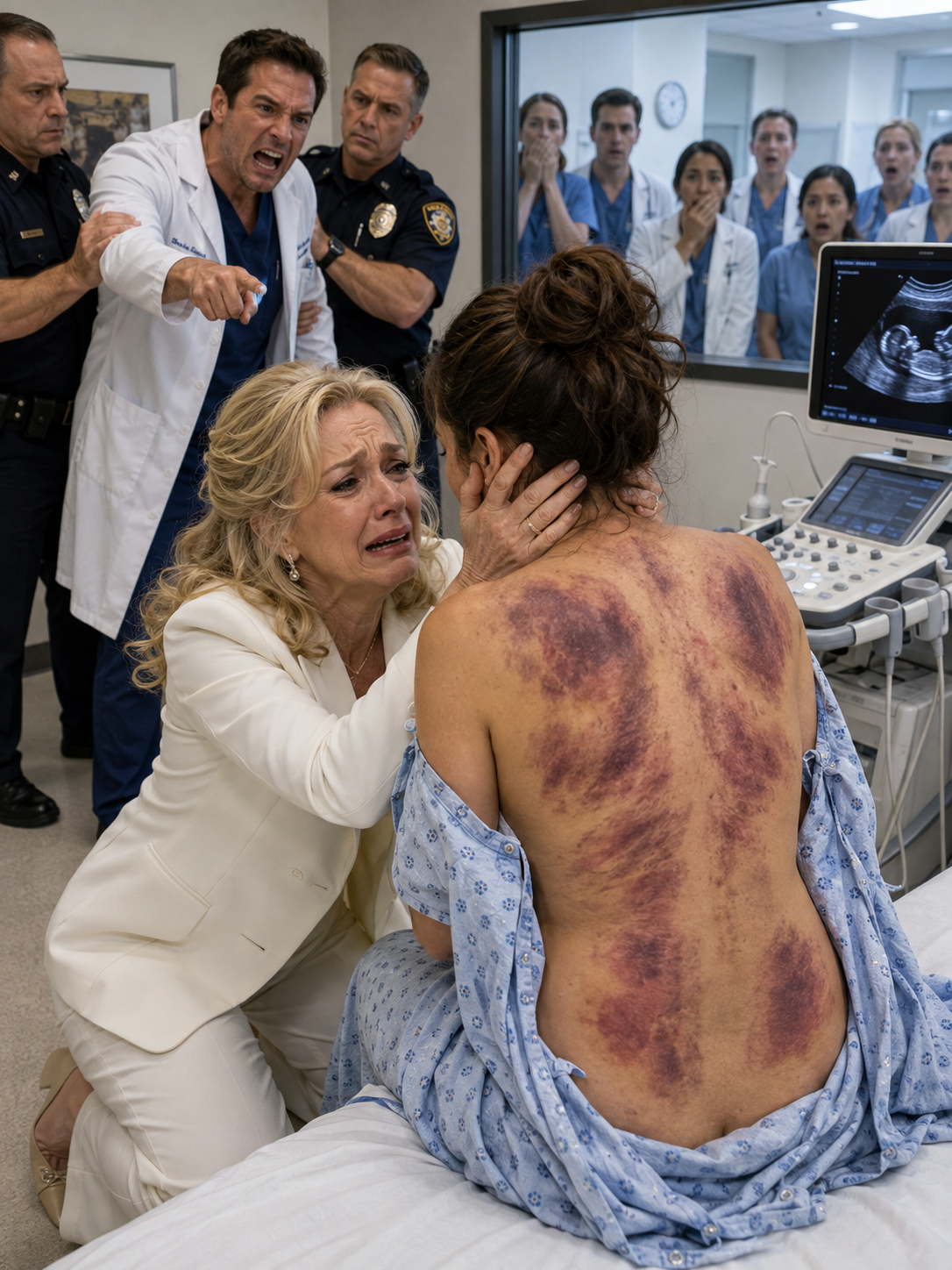
Not the bruises.
Not the threat he had made about the C-section.
Just the steady pulse of a child preparing to enter the world.
“One hundred and forty-two beats per minute,” the technician said. “Strong and regular.”
Emily exhaled.
It was not quite relief. Relief belonged to people who believed the danger had passed.
Still, some color returned to her face.
“Would you like a picture?” the technician asked.
“Yes,” I said.
Emily looked at me.
I squeezed her hand.
“We’re going to need one for the baby book.”
Her mouth trembled into the smallest smile.
The technician printed several images, then continued with the measurements. She was young, perhaps early thirties, with a gentle voice and an observant stillness. Her badge read NINA PATEL, RDMS.
As she moved the probe along Emily’s abdomen, she glanced toward the examination gown.
“Are you comfortable?”
Emily nodded too quickly.
Nina paused.
“The pressure isn’t hurting you?”
“No.”
“Emily,” I said softly.
My daughter stared at the ceiling.
Nina’s gaze moved from her face to mine.
Something passed between us. Not certainty. Recognition.
Healthcare workers noticed more than people realized. The question was whether they felt free to act on what they saw.
Nina lowered her voice.
“I need to get one more measurement from the side. You may need to roll slightly.”
Emily’s entire body tensed.
“I can’t.”
“That’s all right,” Nina said immediately. “We can take our time.”
She removed the probe and handed Emily a towel.
“I’m going to step outside for a moment and speak to the obstetrician. Mrs. Carter, would you stay with your daughter?”
I nodded.
When the door closed, Emily pulled the gown tighter around herself.
“She knows.”
“She suspects.”
“You can’t tell her.”
“Emily—”
“You don’t understand how this hospital works.”
“I understand that you’re afraid.”
“He chooses department heads. He approves contracts. He decides who gets promoted and who gets transferred.” Her eyes darted toward the door. “Nurses have families. Doctors have loans. People don’t risk everything for someone they barely know.”
I sat beside her.
“Some people do.”
“And what happens when they fail?”
Her question stopped me.
It was not cynicism. It was experience.
For years, I had believed my daughter’s marriage was strained but respectable. Brandon worked long hours. Emily canceled dinners because she was tired. She wore long sleeves in warm weather and became unusually careful about answering her phone.
I had accepted every explanation because the truth seemed too terrible to imagine.
Now I had to accept something worse.
Emily had tried to calculate the cost of asking for help before.
Perhaps she had even asked.
“Has someone here failed you already?” I asked.
Her face closed.
Before she could answer, the door opened.
Nina returned with Dr. Helen Ward, Emily’s obstetrician.
Dr. Ward was a silver-haired woman with kind eyes and the composed manner of someone who had spent decades delivering difficult news without making patients feel abandoned.
She carried a tablet.
“The baby looks healthy,” she said. “But I’d like to examine you before you go.”
Emily’s grip tightened around the gown.
“Why?”
“You mentioned tenderness near your ribs at your last appointment.”
“I said it was normal pregnancy discomfort.”
“That may be all it is.”
Dr. Ward pulled a stool close to the bed.
“However, I need to ask you a few routine questions. Nina, would you please show Mrs. Carter where she can get some water?”
Emily looked at me in panic.
“No. She stays.”
Dr. Ward did not argue.
“That’s fine.”
She glanced toward Nina, who quietly left and closed the door.
Then Dr. Ward turned the tablet face down.
“Emily, are you safe at home?”
The question was direct and calm.
Emily stared at her.
“Yes.”
“Has anyone hit, kicked, pushed, restrained, or frightened you?”
“No.”
“Has anyone threatened your life or interfered with your medical decisions?”
“No.”
Every answer came automatically.
Dr. Ward looked at me.
I could have spoken.
I could have lifted the back of Emily’s gown and forced the truth into the room.
But my daughter had already had control taken from her in too many ways.
I would not take it again.
“May I examine your ribs?” Dr. Ward asked.
Emily’s eyes filled.
“No.”
The doctor remained still.
“All right.”
No judgment. No pressure.
She reached into the pocket of her coat and placed a plain white card on the table.
It contained no hospital logo, only a telephone number and the words PATIENT ADVOCACY—24 HOURS.
“You do not have to tell me anything today,” she said. “But if you ever need to change your care team, your surgery plan, your emergency contact, or the people permitted in the delivery room, you can do so.”
Emily’s gaze dropped to the card.
“My husband is the chief medical officer.”
Dr. Ward’s expression did not change.
“I am aware.”
“He can see my chart.”
“Not legally without a clinical reason.”
“But he can.”
The doctor’s silence was answer enough.
She picked up the card and slipped it inside the folder containing the ultrasound images.
“Then we will be especially careful.”
Emily looked up.
Something flickered across her face.
Hope, perhaps.
Or the memory of hope.
Dr. Ward stood.
“I also want blood tests and fetal monitoring today. Your blood pressure is higher than it was last week, and stress can affect both you and the baby.”
“I have to go home.”
“You do not have to go anywhere you don’t wish to go.”
The words were simple.
Emily flinched as if they were dangerous.
A knock sounded at the door.
Before anyone answered, Brandon walked in.
He wore his white coat over a tailored navy suit, his hospital identification clipped neatly to his lapel. His dark hair was perfectly combed. His smile was warm enough to belong on one of the billboards in the lobby.
“There are my girls.”
He crossed the room and kissed Emily on the forehead.
She went rigid.
The movement was so slight that someone who did not know her might have missed it.
I did not.
Brandon placed a hand on her shoulder.
“How’s our little man?”
“Healthy,” Dr. Ward said.
“Excellent.”
His gaze moved to the tablet, then to the folder beside Emily.
“Any concerns?”
“Nothing I’m prepared to discuss without my patient’s permission.”
His smile remained in place.
“Helen, I’m her husband.”
“And she is my patient.”
The room became very quiet.
Brandon’s fingers tightened once against Emily’s shoulder.
Then he released her.
“Of course,” he said pleasantly. “I’m only anxious. First-time father.”
He turned to me.
“Margaret, I didn’t know you were coming today.”
Emily had not used my name in years without calling me Mom.
Brandon always called me Margaret when he wanted to remind me I was outside the marriage.
“She asked me.”
“How thoughtful.”
His eyes rested on mine.
I wondered whether he knew.
Not that I had seen the bruises. He would eventually assume that.
I wondered whether he knew about the message I had sent.
One trusted contact.
One instruction.
The contact was Daniel Ruiz, a former prosecutor who now directed a nonprofit legal clinic specializing in patient safety and domestic abuse. Twenty-five years earlier, Daniel and I had worked together at the state attorney general’s office, before I left law to care for my husband during his final illness.
Brandon knew I had once been an attorney.
He believed that part of my life was over.
He was wrong.
My message to Daniel had contained no accusations, only facts.
Pregnant adult daughter. Possible serious domestic abuse. Alleged threat involving scheduled surgery. Husband is hospital chief medical officer. Need immediate confidential safety guidance and preservation of records.
Daniel’s response had arrived while the baby’s heartbeat filled the room.
Do not confront him. Do not remove her without a plan unless there is immediate danger. Ask whether she consents to a forensic examination. I’m contacting an independent advocate.
I had not yet shown the message to Emily.
Brandon reached for the ultrasound folder.
“Let me see.”
Emily pulled it toward her chest.
His eyes narrowed for less than a second.
Then he smiled again.
“Later,” she whispered.
“Of course.”
He checked his watch.
“I cleared my afternoon. We can have lunch at home.”
Dr. Ward stepped between him and the examination table.
“Emily is staying for monitoring.”
Brandon looked at her.
“Why?”
“Elevated blood pressure.”
“I’ll review the reading.”
“No.”
The word was quiet.
Brandon’s public smile finally faltered.
“No?”
“You are not part of her treating team.”
“I’m the chief medical officer of this facility.”
“And that does not make you her physician.”
They held each other’s gaze.
It was the first time I saw someone inside the hospital deny him access without apology.
It was also the first time I saw fear in Brandon.
Not fear of being exposed.
Fear of losing control of the room.
He recovered quickly.
“Fine,” he said. “I’ll wait in my office.”
He bent toward Emily.
“I’ll call you.”
She nodded.
His lips brushed her cheek.
As he turned, his gaze met mine.
For the briefest moment, the warmth disappeared from his eyes.
Then he left.
Emily waited until the door closed.
“He knows,” she whispered.
“He suspects something,” I said.
“He always knows.”
Dr. Ward pulled the stool close again.
“Emily, I need to ask plainly. Do you want your husband present during your delivery?”
Emily looked toward the door.
“No.”
The answer came so softly I almost missed it.
Dr. Ward did not.
“Do you want him to have access to your medical information?”
“No.”
“Do you want him making decisions if you are unable to speak?”
Emily began to cry.
“No.”
Dr. Ward reached for her hand.
“Then we change all three today.”
The next hour unfolded through a series of careful decisions.
No dramatic rescue.
No police rushing through the corridor.
No public accusation.
Instead, Dr. Ward contacted the hospital’s confidential patient advocate from a phone Brandon could not monitor. Emily signed new privacy restrictions. She removed Brandon as her healthcare proxy and named me in his place. Her scheduled C-section was placed under a restricted access protocol.
Each step seemed small.
Together, they formed the first door Emily had opened out of her marriage.
An advocate named Leah joined us in a private consultation room far from the executive wing.
She was in her forties, plainly dressed, with a canvas bag and no visible hospital identification.
“Before we discuss anything,” she said, “I want you to know that you control this conversation. You can stop at any time. You can decline any option. We will not contact law enforcement without your consent unless there is an immediate, legally reportable danger.”
Emily sat beside me, one hand covering her stomach.
“What if my husband finds out?”
“We plan for that possibility.”
“He owns half the people in this building.”
“No one owns people.”
Emily gave a bitter little laugh.
“You haven’t worked here long.”
Leah did not look offended.
“I don’t work for the hospital.”
That caught Emily’s attention.
“I’m from an independent support organization. Dr. Ward contacted us through an external referral line.”
Emily looked at the closed door.
“What can you actually do?”
“Help you assess danger. Document injuries with your consent. Arrange confidential lodging. Connect you with legal counsel. Create a delivery safety plan. Preserve evidence. Discuss protective orders when you are ready.”
“And if I’m not ready?”
“Then we begin with what you are ready for.”
Emily’s shoulders lowered a fraction.
Leah placed a sheet of paper on the table.
“Is it safe for you to go home today?”
“No,” I said.
Leah looked at Emily.
My answer did not count.
Emily stared at the paper.
“I don’t know.”
“Has the violence become more frequent?”
A pause.
“Yes.”
“More severe?”
“Yes.”
“Has he ever restricted your breathing?”
Emily closed her eyes.
My stomach turned.
“Yes.”
“Does he have access to weapons?”
“He has a licensed handgun in a safe.”
“Does he monitor your phone or location?”
“Yes.”
“Has he threatened to harm you during medical care?”
Emily nodded.
Leah’s voice remained steady.
“Based on what you’ve told me, returning home may carry significant risk.”
“He’ll come looking for me.”
“We would expect that.”
“He’ll accuse my mother of manipulating me.”
“We would expect that too.”
“He’ll tell everyone I’m unstable.”
Leah nodded.
“That is also common.”
Emily looked at her.
“You say that like you’ve heard this exact story.”
“Not exact. But the patterns repeat.”
For the first time, my daughter’s fear seemed less like a private failure and more like something that had been studied, named, and survived by others.
Leah asked whether Emily would consent to photographs of the bruises and an examination by a clinician outside Brandon’s chain of authority.
Emily hesitated.
“If I document it, then it becomes real.”
I took her hand.
“It is already real.”
She looked at me with such exhaustion that I wished I could carry the choice for her.
But that was not what she needed.
After a long silence, she nodded.
The examination took place in a small outpatient clinic connected to the hospital by an enclosed walkway. Emily asked me to remain with her.
The nurse who photographed the injuries explained every step before touching her.
No one hurried.
No one asked why she had stayed.
No one said she should have known better.
When it was over, Emily dressed slowly.
“I used to think leaving was one decision,” she said.
Leah sat across from her.
“It’s usually many decisions.”
“What if I change my mind?”
“Then we keep you as safe as possible while you decide again.”
Outside the clinic, Daniel Ruiz waited near a bank of windows.
His hair had gone almost completely gray since I had last seen him, but he still wore the same slightly crooked tie and carried files under one arm as if he had never trusted briefcases.
He did not embrace me.
He understood that familiar gestures could draw attention.
Instead, he said, “Mrs. Carter?”
“Yes.”
“I’m Daniel. We spoke by phone.”
Emily looked at me.
“You called a lawyer?”
“I called someone I trust.”
“You said one message.”
“One message was enough.”
Her expression hardened.
“You planned all of this without asking me.”
The accusation hurt because it was true.
“I planned for options,” I said. “Not decisions.”
“You should have told me.”
“I was afraid you’d stop me.”
“I might have.”
“I know.”
Her eyes filled again, but this time the tears came with anger.
“You don’t get to take over my life because Brandon did.”
The words struck cleanly.
I could have defended myself.
I could have reminded her that I had seen bruises shaped like boots across her ribs. I could have said a mother had no obligation to remain calm while her daughter’s life was in danger.
All of that might have been understandable.
None of it would have made her wrong.
“You’re right,” I said.
She looked surprised.
“I should have told you before contacting Daniel. I was trying to protect you, but I made a decision about your life without your permission.”
Daniel quietly stepped away, giving us privacy.
Emily turned toward the window.
“I don’t know how to make decisions anymore.”
“You just made several.”
“Because everyone told me which ones were safe.”
“You told Dr. Ward you didn’t want Brandon in the delivery room.”
Her hand moved across her stomach.
“That was for the baby.”
“It was for you too.”
She shook her head.
“No. I don’t know how to choose for me.”
The grief in her voice was deeper than fear.
It was the grief of someone who had been slowly separated from her own judgment.
I stood beside her.
“Then we start small.”
“How small?”
“Where do you want to go tonight?”
She watched rain begin to streak the glass.
“Not your house.”
I swallowed my disappointment.
“All right.”
“He’ll expect me to go there.”
“That’s true.”
“And I don’t want you dragged into this more than you already are.”
“I’m your mother. I’m already in it.”
She looked at me.
“That’s what scares me.”
In the end, Emily chose a confidential apartment managed by Leah’s organization.
Daniel arranged for a family law attorney to meet us there. Dr. Ward prepared a medical reason for Emily’s continued absence from home: observation for pregnancy-related hypertension. It was not a lie. Her blood pressure had risen again.
The hospital did not tell Brandon where she had gone.
At least, that was the plan.
We left through a staff exit in an ordinary gray sedan.
Emily’s phone remained behind in a shielded evidence bag because Daniel believed Brandon might be tracking it. Leah gave her a basic replacement device with only six stored numbers.
As the city passed outside the window, Emily sat with both hands over her stomach.
“I left everything.”
“Things can be replaced.”
“My wedding photographs. The blue blanket for the baby. Dad’s watch.”
At the mention of her father, my throat tightened.
“Your father’s watch is in the safe deposit box.”
She turned.
“What?”
“You gave it to me before the wedding. You were afraid you’d lose it on the honeymoon.”
“I forgot.”
“I didn’t.”
She leaned her head against the seat.
“Brandon said I was always forgetting things.”
“Everyone forgets things.”
“He made lists.”
“What kind of lists?”
“Appointments I missed. Names I got wrong. Times I misunderstood him.” Her voice became distant. “He said pregnancy was making me confused. Before that, he said grief over Dad had made me unstable.”
My hands curled in my lap.
Emotional abuse left no bruises for a camera.
It worked by turning a person against their own memory.
“Did he ever ask a doctor to evaluate you?” Daniel asked from the front seat.
Emily looked up.
“Yes.”
“Who?”
“Dr. Leonard Shaw. Psychiatry.”
Daniel and I exchanged a glance.
“Was Dr. Shaw treating you?” he asked.
“Not officially. Brandon arranged a private consultation at home.”
“When?”
“Three months ago.”
“What did he say?”
“That I had symptoms of prenatal anxiety and possible delusional thinking.”
“Did he write a report?”
“I don’t know.”
Daniel faced forward again.
“That matters.”
The confidential apartment was on the third floor of an unremarkable building near a residential neighborhood. No sign identified its purpose. The rooms were clean, modest, and quiet.
Emily stood in the doorway of the bedroom.
On the bed lay a welcome basket containing toiletries, soft socks, a notebook, and a small stuffed elephant.
She picked up the toy.
“He didn’t let me buy one of these.”
“Why?”
“He said stuffed animals collected bacteria.”
She held the elephant against her chest and began to cry.
Not loudly.
Her shoulders simply folded inward as months of fear escaped through a crack she could no longer close.
I held her only after she reached for me.
That night, she slept for four hours.
I did not sleep at all.
I sat at the kitchen table with Daniel and reviewed what we knew.
The medical photographs had been secured outside the hospital system. Emily’s account had been documented but not yet submitted to police. Her attorney would seek an emergency protective order the following morning, provided Emily still consented.
The greater concern was the delivery.
Her C-section was scheduled in nine days.
“Can Dr. Ward move it to another hospital?” I asked.
“Possibly,” Daniel said. “But at thirty-eight weeks, continuity matters. And transferring records could alert him.”
“Keeping her there puts her in his building.”
“It is not his building.”
“You heard her.”
“I did.”
Daniel removed his glasses.
“The question is not whether Brandon has influence. He clearly does. The question is whether that influence extends far enough to compromise a surgical team without anyone objecting.”
“He threatened her.”
“I believe her.”
“But?”
“But a threat may be designed to create obedience rather than describe an actual plan. We need to treat it seriously without assuming every clinician around him is involved.”
I looked toward the bedroom.
“What about Dr. Shaw?”
“I’ll investigate the consultation.”
“Quietly.”
“Of course.”
He placed his glasses back on.
“There’s something else.”
I waited.
“The message you sent said Brandon was the hospital’s chief medical officer.”
“He is.”
“Not exactly.”
“What does that mean?”
“He was appointed interim CMO eight months ago. The board has delayed making the position permanent.”
“Why?”
“I don’t know yet.”
“Could this be about his behavior?”
“Perhaps. Or finances. Or internal politics.”
“Find out.”
Daniel gave me a tired look.
“You haven’t changed.”
“I’ve changed considerably.”
“You still give orders like the attorney general is waiting in the next room.”
“I said find out, not subpoena everyone.”
“That is growth.”
Despite everything, I almost smiled.
At six the next morning, Emily woke from a nightmare.
I found her sitting on the edge of the bed, breathing quickly.
“He was in the operating room.”
“It was a dream.”
“He was standing behind the anesthesiologist. No one could hear me.”
I sat beside her.
“You will not be alone.”
“He doesn’t need to be in the room. He controls who is.”
“Dr. Ward is changing the team.”
“He’ll know.”
“Then we move the surgery.”
She pressed her hands against her temples.
“I can’t keep running.”
“This isn’t running. It’s choosing ground where you can stand.”
She looked toward the window.
“Mom, there’s something I didn’t tell you.”
I waited.
“The first time he hit me was after I found a file in his office.”
“What file?”
“A patient complaint.”
My heartbeat slowed.
“What kind of complaint?”
“A woman said she woke during a procedure and heard Brandon arguing with another doctor. She said he told someone to alter the surgical record.”
“Was Brandon her surgeon?”
“No. He was reviewing the case for administration.”
“What happened to the complaint?”
“It disappeared.”
“How do you know?”
“I searched for it later. The electronic record was gone.”
“Did you keep a copy?”
Emily shook her head.
“He came in while I was reading it.”
“Was that when he hurt you?”
“He grabbed my arm. The next day, he apologized. He cried. He said the complaint involved confidential information and I could destroy his career by repeating it.”
“What was the patient’s name?”
“I only remember the first name. Rachel.”
Daniel entered the room behind us, already dressed.
He had heard enough to understand.
“Do you remember the date?” he asked.
“Last November.”
“What procedure?”
Emily closed her eyes.
“An emergency C-section.”
The room went silent.
Her hand moved protectively across her stomach.
“Did the patient survive?” I asked.
“I don’t know.”
Daniel took out his phone.
“This may explain the board delay.”
Emily looked frightened.
“I don’t want this turned into some giant case. I just want my baby safe.”
“Then that remains the priority,” he said. “But if someone inside the hospital altered a surgical record, it could affect how we protect you.”
An hour later, the protective order paperwork was ready.
Emily read every page.
She signed the first three.
When she reached the affidavit describing Brandon’s threat, she stopped.
“What happens after this is filed?”
“He will be notified,” her attorney said. “The order can restrict contact and prohibit him from approaching you.”
“He’ll come apart.”
“Possibly.”
“He’ll say I’m unstable.”
“We expect that.”
“He’ll use Dr. Shaw’s evaluation.”
“Then we challenge it.”
Emily placed the pen down.
“I need to see the report first.”
It was a reasonable request.
It was also a delay.
No one pressured her.
Daniel began working through formal channels to request any records connected to the psychiatric consultation. By noon, the hospital reported that no such evaluation existed in Emily’s chart.
At twelve thirty, Brandon called my phone.
I stared at his name on the screen.
Emily stood across the room, pale.
“You don’t have to answer,” I said.
“He’ll keep calling.”
“We can document that.”
“He’ll call the police and report me missing.”
“You are an adult. You have already informed them through counsel that you are safe.”
The phone stopped.
Then a message appeared.
Margaret, I know Emily is with you. Her blood pressure is dangerous. You are putting both her and the baby at risk. Please bring my wife home so we can handle this privately.
A second message followed.
I don’t blame you. You have not been told the truth about her condition.
Emily read it over my shoulder.
“There.”
“What?”
“That’s how he does it.”
Another message arrived.
Ask her what happened at Lake Mercer.
Emily dropped the phone.
Every trace of color left her face.
“What happened at Lake Mercer?” I asked.
“Nothing.”
Her breathing quickened.
“Emily.”
“I said nothing.”
She backed away from us.
Leah entered from the hallway.
“Do you need space?”
Emily looked at the door as though considering escape.
Then she sank into a chair.
“Lake Mercer was where we went after Dad died,” she whispered.
“I remember. You and Brandon rented a cabin.”
“He said I tried to walk into the water.”
My chest tightened.
“Did you?”
“I don’t know.”
“What do you remember?”
“Drinking wine at dinner. Taking a sleeping pill. Waking up wet.”
Daniel leaned forward.
“Who gave you the pill?”
“Brandon.”
“Was anyone else there?”
“Dr. Shaw came the next morning.”
My thoughts aligned with terrible clarity.
A private psychiatric consultation.
A story about suicidal behavior.
A report that did not appear in Emily’s official chart.
“What did Dr. Shaw say?” I asked.
“That I had experienced a grief-related episode. He said Brandon had saved me.”
“Do you believe that?”
Emily stared at her hands.
“I did.”
“And now?”
“I don’t know what I believe.”
Daniel’s phone vibrated.
He read the message, then looked at me.
“I found Rachel.”
Emily lifted her head.
“Is she alive?”
“Yes.”
The answer brought relief, but Daniel did not look relieved.
“She filed a civil complaint six months ago under a sealed case number. It was withdrawn two weeks later.”
“Why?” I asked.
“I don’t know.”
“Can you contact her?”
“Not directly without care. But her former attorney is someone I know.”
He stepped into the kitchen to make the call.
Emily picked up my phone again.
Brandon had sent one final message.
You are not remembering clearly. Let me help you before your mother makes this worse.
She read it twice.
Then she deleted nothing.
That mattered.
For years, she had erased messages, concealed bruises, and corrected stories to protect him.
This time, she preserved the evidence.
“I want the order,” she said.
Her attorney brought the affidavit back.
Emily signed it.
The emergency order was granted shortly after four that afternoon.
Brandon was prohibited from contacting her directly, approaching her temporary location, or entering her delivery area without written consent.
The order did not remove him from the hospital.
That required a different process.
At five fifteen, Dr. Ward called.
Her voice was controlled.
“There has been a change.”
My body went cold.
“With the baby?”
“No. With me.”
“What happened?”
“I’ve been removed from Emily’s case pending an internal review.”
Emily heard the words through the speaker.
“On what grounds?” she asked.
“A complaint that I violated administrative procedures by transferring a patient to an external advocacy service without authorization.”
“Brandon,” I said.
“I cannot confirm that.”
“Who replaced you?”
There was a pause.
“Dr. Marcus Bell.”
Emily gripped the table.
“Brandon’s residency mentor.”
Dr. Ward exhaled.
“I have filed an objection. I strongly recommend transferring delivery to another hospital tonight.”
That erased the last of Emily’s hesitation.
Within twenty minutes, arrangements began for admission to St. Catherine’s Medical Center across the city. Daniel contacted its legal department. Leah coordinated secure transport. The new obstetrician reviewed Emily’s records remotely.
Then the hospital portal stopped working.
Emily’s prenatal files had become inaccessible.
“Temporary maintenance,” the error message said.
Daniel did not believe it.
Neither did I.
Dr. Ward sent the records she had personally downloaded before losing access. They included blood tests, imaging, and surgical notes.
But one document was missing.
The anesthesiology plan.
Emily stared at the screen.
“He changed it.”
“We don’t know that,” Daniel said.
“Yes, we do.”
“We know the file is unavailable.”
“He told me he could decide whether I woke up. The anesthesia plan disappears the same day I leave him, and you want me to believe that’s a coincidence?”
No one answered.
At seven that evening, as we prepared to leave the apartment, Emily doubled over.
I caught her before she fell.
“Pain?”
She nodded, unable to speak.
A few seconds later, fluid spread across the floor beneath her.
Leah checked the time.
“Her water broke.”
The room transformed.
Bags were lifted. Calls were made. The secure car was brought to the rear entrance.
Emily clung to my arm as another contraction began.
“It’s too early.”
“You’re full term.”
“The surgery isn’t supposed to be for nine days.”
“Babies do not read calendars.”
She almost laughed, then winced.
We reached the car.
Daniel sat in front, speaking to St. Catherine’s. Leah drove. I remained beside Emily in the back.
Traffic thickened beneath the evening rain.
Her contractions came faster.
“Seven minutes,” I said.
“Last one was eight.”
“She may have progressed before the water broke,” Leah said.
Emily’s replacement phone rang.
Only six people had the number.
The screen showed DR. WARD.
I answered.
“Where are you?”
“On the way to St. Catherine’s.”
“Do not go to the main entrance.”
“Why?”
“I received a copy of Emily’s anesthesia plan.”
Emily turned toward the phone.
Dr. Ward continued.
“It was not merely missing from the system. It had been amended yesterday.”
“By whom?”
“The authorization shows my credentials.”
“You didn’t do it.”
“No.”
“What was changed?”
A contraction seized Emily. She gripped my hand and cried out.
Dr. Ward’s voice lowered.
“The plan added a medication Emily previously reacted badly to. The allergy warning was also removed.”
My skin turned cold.
“Could that have killed her?”
“It could have caused a serious complication.”
“Who had access to your credentials?”
“Several administrators could reset them.”
“Including Brandon?”
“Yes.”
Daniel looked back from the front seat.
He had heard everything.
Dr. Ward continued.
“There is more. I found the original file because someone sent it to me anonymously from inside the hospital.”
“Who?”
“I don’t know. But the message included an attachment unrelated to the surgery.”
My heart pounded.
“What attachment?”
“A scanned psychiatric report about Emily.”
Emily stopped breathing for a moment.
“From Dr. Shaw?” she asked.
“Yes.”
“What does it say?”
Dr. Ward hesitated.
“That you suffered a delusional episode at Lake Mercer and attempted self-harm.”
Emily closed her eyes.
Brandon’s version of the story had been turned into a document.
A document he could use to discredit everything she said.
Then Dr. Ward added, “But the signature is dated three days before the trip took place.”
No one spoke.
Rain hammered the car roof.
The report had not recorded an incident.
It had predicted one.
Or prepared for one.
Emily opened her eyes.
For the first time that day, fear was not the only thing in them.
There was clarity.
“Mom,” she whispered, “he didn’t save me at Lake Mercer.”
Another contraction began, stronger than the last.
She held my hand as the car turned toward St. Catherine’s.
“He planned it.”