
PART 3
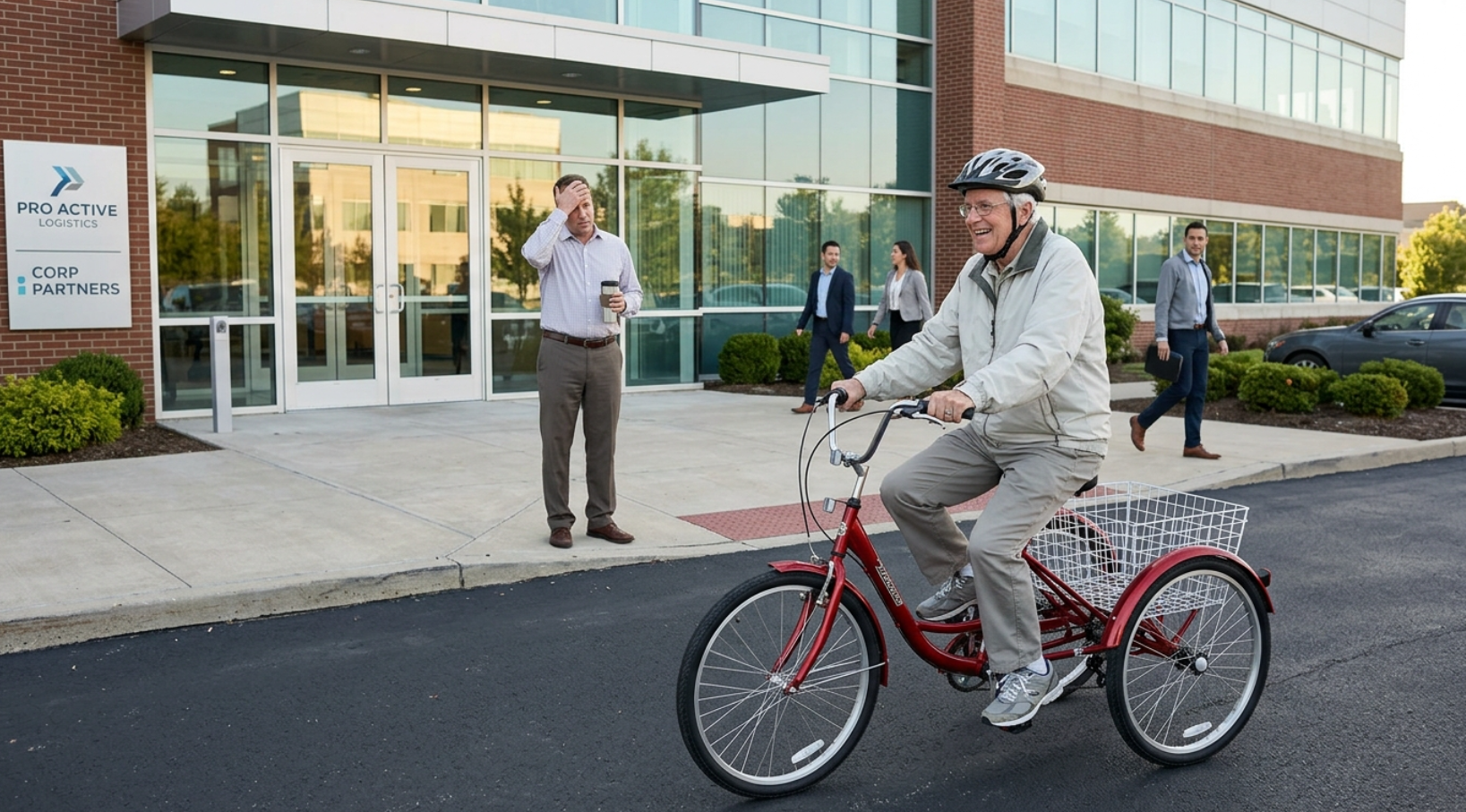
He looked at the bicycle again. The red frame, the three wheels, the little chrome bell Eli had given me for free.
“How did you even get here?”
“I pedaled.”
“Mom.”
“That’s generally how bicycles work.”
Despite myself, I almost smiled. He didn’t.
“Please come inside,” he said. “People are staring.”
I looked down at my cardigan, brushed a tiny piece of lint from the sleeve, and stepped away from the curb.
“Fine. But I’m bringing my bicycle.”
He closed his eyes briefly.
“Of course you are.”
He walked beside me as I pushed it through the office entrance. His receptionist, Linda, rose from her chair.
“Good morning, Mrs. Bennett.”
“Good morning, dear.”
She smiled at me, then looked at Brian with an expression I couldn’t quite interpret.
His office smelled of printer paper, coffee, and the lemon cleaner the building’s maintenance man used every Friday. There were photographs on the wall: Brian at his college graduation, Brian receiving an award from his insurance company, Brian with his wife, Megan, and their two children.
In every photograph, he wore the same confident smile.
I wondered when he had begun believing that confidence gave him the right to make decisions for everyone around him.
Brian closed his office door.
“Mom, sit down.”
I chose the chair opposite his desk.
He remained standing.
“Look, I know you’re upset about the Buick. But I did what I thought was right. You hit a mailbox. What if it had been a child?”
“What if the mailbox had been made of gold?” I asked. “Would that have made selling my car without permission acceptable?”
“That’s not what I’m saying.”
“Then tell me what you are saying.”
He rubbed his forehead.
“You’re seventy-six. You live alone. Your reflexes aren’t what they used to be. You don’t always see things the way you used to.”
I watched him carefully.
“Did your father stop being a person when he turned seventy-six?”
His face changed.
His father, Thomas, had been gone eleven years. He’d worked at a machine shop for most of his life, coming home with grease beneath his fingernails and a joke ready for dinner. He had loved that Buick. He’d bought it for me on our fortieth anniversary, a used blue sedan with a cracked dashboard and a heater that took ten minutes to warm up.
When he died, Brian helped me sort through the paperwork.
That’s when the title ended up with both our names on it, connected by the word or.
At the time, Brian had said it would make things easier if I ever needed help.
I had believed him.
“Dad couldn’t drive near the end,” Brian said.
“Your father was seriously ill. He could barely stand without help. I am not seriously ill, Brian. I clipped a mailbox in the rain.”
“You’re making this personal.”
“It became personal when you took my keys.”
He finally sat down.
For a moment, he looked less like a successful insurance agent and more like the little boy who used to come into my bedroom after thunderstorms, pretending he needed a glass of water.
“I’m worried about you,” he said.
“Then why didn’t you ask me what I needed?”
He didn’t answer.
I opened my purse and removed a folded envelope. Inside was a receipt for the bicycle, the cashier’s check from the sale of my car, and a small notebook.
Brian frowned.
“What is all that?”
“Records.”
“Records of what?”
“Everything I own, everything I spend, and everything I intend to decide for myself.”
He stared at the notebook.
“Mom, nobody is trying to take your life away.”
I looked at him for a long time.
“Then why does it feel as though you’re taking pieces of it away, one decision at a time?”
His eyes dropped to the desk.
I had expected an apology. Perhaps a promise to discuss things differently next time.
Instead, he said something I would remember for the rest of my life.
“Sometimes, Mom, people need someone else to make the hard decisions for them.”
I stood.
“Then I hope you never become one of those people who mistakes love for ownership.”
I pushed my bicycle toward the door.
“Where are you going?”
“Home.”
“Let me drive you.”
I looked at him.
“Brian, you already drove me home once. That’s how this started.”
I left before he could answer.
Outside, Linda held the door open for me.
“Take care, Mrs. Bennett,” she said softly.
“You too, dear.”
I climbed onto the bicycle and began pedaling.
I wasn’t angry anymore.
I was disappointed, and disappointment has a peculiar way of making a person see clearly.
For eleven years, since his father died, I had allowed Brian to help me with everything from insurance forms to bank appointments. I had mistaken his involvement for care and his confidence for competence.
Perhaps he had made the same mistake.
But I was not finished living.
And I had a feeling that my little red bicycle was going to take me somewhere neither of us had expected.
The first thing I did when I reached home was call Wilma.
She answered on the second ring.
“Well?”
“Well what?”
“Did he apologize? Did he buy your car back? Did he faint when you rang that little bell?”
I laughed so hard that I had to sit down.
“No fainting. No apology. No car.”
“Men,” she said. “Give them a desk and a necktie, and suddenly they think they’re kings.”
“Not all men.”
“Fine. Some men are kings. Yours is a retired king with a red bicycle.”
I laughed again.
Then I told her everything.
When I finished, Wilma was quiet.
“You know,” she said eventually, “my daughter once told me I shouldn’t climb the ladder to clean my gutters. I told her I wouldn’t. Then I hired a man to do it. She was happy, I was happy, and nobody broke a hip.”
“That sounds reasonable.”
“Because I asked you to listen to the story, not argue with the conclusion. There’s nothing wrong with being careful, Evelyn. There’s something wrong with someone deciding that being careful means you no longer get a vote.”
I looked out the kitchen window toward the empty carport.
The oil stain remained where the Buick had stood for years.
“I suppose you’re right.”
“I’m always right. It’s one of my few remaining pleasures.”
After we hung up, I made tea and opened the notebook I’d taken to Brian’s office.
On the first page, I wrote three things.
My health. My money. My independence.
Under each heading, I made a list.
My health: schedule an appointment with my doctor for a proper driving assessment, discuss my eyesight, and ask whether there were any concerns I needed to address.
My money: review my accounts, check the Buick title paperwork, and speak with an attorney about my rights.
My independence: find safe ways to get around town, including my bicycle, the bus, and rides with friends.
I didn’t write those things because I intended to prove Brian wrong.
I wrote them because I needed to know the truth for myself.
That afternoon, I called the clinic and scheduled an appointment.
Then I called a local attorney whose advertisement I’d seen in the newspaper.
His name was Mr. Collins, and his receptionist offered me an appointment for the following Tuesday.
Finally, I called Brian’s wife.
Megan answered while I could hear children playing in the background.
“Evelyn! How are you?”
“I’m well, dear. I was wondering if you knew what happened to the Buick.”
There was a pause.
“What do you mean?”
“Brian sold it.”
Another pause, longer this time.
“Oh.”
That single word told me more than a whole speech might have.
“You knew?”
“I knew he was worried about you driving. I didn’t know he’d actually sold it.”
I leaned back in my chair.
“Did he discuss it with you?”
“He said he was handling it.”
“Handling what?”
“I don’t know, Evelyn. Your car, I suppose.”
I heard a door close on her end.
“Listen,” she said quietly, “Brian’s been under a lot of pressure lately. Work has been difficult, and the kids’ school expenses are piling up. He’s been worried about everything.”
“I understand that.”
“He thought he was helping.”
“Perhaps. But helping someone doesn’t mean you get to decide everything for them.”
“No,” Megan said. “I suppose it doesn’t.”
Her voice sounded tired.
I almost asked whether Brian had told her something else, but I decided not to.
Instead, I said, “I hope you’re doing well, dear. Give the children a kiss for me.”
After we hung up, I sat quietly for a while.
I loved my son. I loved his wife. I loved my grandchildren.
Nothing about that had changed.
But love, I was beginning to understand, could not be the only rule in a family.
There had to be respect, too.
And sometimes, respect had to be taught to people who had forgotten how to give it.
On Tuesday morning, I arrived at Mr. Collins’s office with my notebook, the Buick paperwork, and a folder containing every document I could find.
I had ridden the bicycle to the end of my street before calling Wilma to take me the rest of the way. I was learning that independence did not require me to do everything alone.
It required me to decide when to ask for help.
Mr. Collins was a small, silver-haired man with round glasses and a habit of listening without interrupting.
When I finished explaining what had happened, he examined the title and the sale documents.
“Because the title lists both of you with the word ‘or,’ your son may have had the authority to transfer the vehicle under state law,” he said. “I would need to review the full paperwork and applicable law before reaching a conclusion. But legal authority to sell a vehicle is not the same thing as having your informed agreement.”
“So I may not be able to get the Buick back?”
“Not necessarily. That depends on the documents, the transaction, and the circumstances. We should also find out what happened to the proceeds.”
I looked at the cashier’s check.
“Brian gave me this.”
“Have you deposited it?”
“No.”
“Good. Keep it safe while we determine exactly what it represents.”
He made copies of everything and asked whether Brian had ever been given authority to manage my bank accounts.
“No. He helps me with paperwork sometimes, but the accounts are mine.”
“Do you have a will?”
“Yes.”
“An updated one?”
I hesitated.
My husband and I had prepared our wills years ago. After he died, I had changed a few things, but that had been six years earlier.
Mr. Collins suggested reviewing it, along with my financial records, medical directives, and any documents that might grant someone authority to act on my behalf.
He was careful not to frighten me.
“Mrs. Bennett, planning ahead isn’t an accusation against your son. It’s a way to make sure your wishes remain clear, whatever happens.”
I liked that.
For years, I had believed that preparing for the future meant trusting my family to do what was best.
Now I understood that it also meant making sure they knew what I considered best.
Before I left, I asked one final question.
“Mr. Collins, what if my son truly believes he’s doing the right thing?”
He folded his hands.
“Then an honest conversation may help him understand the difference between protecting you and controlling you. But you are not required to surrender your rights simply because someone has good intentions.”
I walked out feeling lighter than I had in weeks.
The law had not handed me a magical solution.
It had given me something better.
A place to begin.
That evening, Brian called.
I was sitting at the kitchen table, writing in my notebook, when his name appeared on my phone.
“Hello, sweetheart.”
“Mom, did you go to a lawyer?”
I stopped writing.
“Who told you?”
“I called the house. You weren’t there. Wilma said she’d taken you to an appointment.”
“Then you already have your answer.”
He exhaled sharply.
“Why would you do that?”
“Because I wanted advice.”
“From a lawyer?”
“Yes, Brian. That’s generally what lawyers are for.”
“This is ridiculous. I’m your son.”
“And I’m your mother. That doesn’t mean either of us gets to ignore the other person’s rights.”
He was quiet for a moment.
Then he said, “I heard you haven’t deposited the check.”
“That’s correct.”
“Why not?”
“Because I want to understand the sale before I decide what to do with the money.”
“The money is yours, Mom.”
“Then we agree on something.”
“Please don’t turn this into a legal battle.”
I looked at the empty carport.
“I don’t want a battle. I want a conversation in which you listen to me without deciding beforehand that you know better.”
His voice softened.
“I was scared something would happen to you.”
That was the first honest thing he’d said since my birthday.
I closed the notebook.
“I know, Brian. And I am grateful that you care whether I come home safely. But fear isn’t permission.”
He didn’t answer immediately.
When he spoke again, his voice was smaller.
“I don’t know what you want me to do.”
“Start by asking me what I want.”
We stayed on the phone for several more minutes, but neither of us solved everything.
Before we hung up, he said he would come by on Sunday.
I told him he was welcome.
After the call, I went outside and checked the bicycle’s tires.
The red frame gleamed beneath the porch light.
I rang the little chrome bell once.
It made a bright, cheerful sound.
For the first time in days, I felt that I was moving forward.
I had no idea that Sunday would bring a conversation far more difficult than the one we’d just had—or that the Buick’s sale would turn out to be only one part of a much larger problem.
And when Brian arrived, he wouldn’t be coming alone.
PART 4
On Sunday afternoon, Brian arrived at my house with Megan beside him.
He carried a bakery box in one hand and a thick envelope in the other.
I noticed the envelope before I noticed the cake.
“Happy belated birthday, Mom,” he said.
“My birthday was last week.”
“I know.”
He placed the cake on the kitchen counter and looked toward the window, where my red bicycle stood beneath the porch roof.
“I see you’re still using that thing.”
“Her name is Ruby.”
Megan laughed softly.
Brian didn’t.
I poured coffee for all three of us, then sat at the kitchen table.
“Before we begin,” I said, “I want you to understand something. I love you. I will always love you. But I will not spend the rest of my life proving that I’m capable of making my own decisions.”
Brian looked down at the envelope.
“I didn’t come here to argue.”
“Good. Neither did I.”
He pushed the envelope across the table.
Inside were copies of the Buick’s sale documents, a receipt from the buyer, and a handwritten statement explaining that he had received $4,200 for the car.
“I want everything to be clear,” he said. “I didn’t keep any of the money.”
“I never accused you of keeping it.”
“I know. But I thought you might wonder.”
I studied his face.
He looked exhausted.
“Brian, why did you really sell the Buick so quickly?”
He rubbed his hands together.
“I told you. I was worried about your driving.”
“That was one reason. Was there another?”
His eyes flickered toward Megan.
She looked at him, then at me.
“Brian,” she said quietly, “you should tell her.”
He leaned back in his chair.
For several seconds, he seemed to be searching for the right words.
Then he finally spoke.
“Three months ago, Dad’s old friend called me. He told me he’d seen you driving on the highway and thought you were having trouble staying in your lane.”
I frowned.
“Who?”
“Mr. Harris. From Dad’s machine shop.”
I remembered him. A tall man with a white mustache who had attended my husband’s funeral.
“I spoke to Mr. Harris,” I said. “He saw me move around a pothole. He apologized for making a fuss.”
Brian nodded.
“But then there was the mailbox.”
“Yes. One mailbox.”
“And I started thinking about what would happen if you were seriously hurt. You live alone. What if you ended up in the hospital? What if you couldn’t manage the house anymore?”
“Then I would make arrangements.”
“You always say that.”
“Because it’s my life to arrange.”
He looked away.
I waited.
Finally, he admitted something that made the room feel suddenly smaller.
“I’ve been afraid of losing you.”
For the first time that afternoon, I saw the little boy beneath the expensive suit.
“I lost Dad,” he continued. “And after that, I started worrying about you. Every time you didn’t answer the phone, every time you mentioned feeling tired, every time you went somewhere alone, I imagined something terrible happening.”
I reached across the table, but I didn’t take his hand.
“Brian, I lost your father, too.”
His eyes filled.
“I know.”
“No, sweetheart. I don’t think you do. You were grieving your father. I was grieving my husband, my companion of forty-five years, the man who knew how I took my coffee and which floorboard creaked outside our bedroom.”
I swallowed.
“After he died, I had to learn to sleep in an empty bed. I had to learn to fix things he used to fix. I had to learn to eat dinner without someone asking about my day.”
Brian wiped his eyes.
“And I learned to keep living,” I continued. “Not because I stopped missing him, but because I still had a life.”
He stared at the table.
“I thought if I could keep you safe, I wouldn’t have to lose you, too.”
I finally took his hand.
“Oh, Brian. You cannot protect someone from every possible loss. And you cannot love someone so tightly that you prevent them from living.”
He began to cry.
I had not seen my son cry since his father’s funeral.
For a moment, I wanted to take back every sharp word I’d said to him. I wanted to comfort him, tell him everything was fine, and promise never to challenge him again.
But I knew that would solve nothing.
So I held his hand and let him cry.
When he finally looked up, I asked him the question that had been troubling me since my birthday.
“Did you think I was incapable of deciding whether I could still drive?”
He hesitated.
“Yes,” he whispered. “I suppose I did.”
“Did you ask my doctor?”
“No.”
“Did you arrange an independent driving assessment?”
“No.”
“Did you ask me what I wanted?”
He closed his eyes.
“No.”
I squeezed his hand.
“Then you weren’t protecting me, Brian. You were protecting yourself from your fear.”
He nodded.
“I know that now.”
Megan reached for her coffee.
“I tried to tell him,” she said. “I told him you might be upset, and that we should talk to you first. But he was convinced that if he waited, something terrible would happen.”
I looked at her.
“Thank you for telling me.”
She gave me a small, apologetic smile.
Brian opened the envelope again and removed one final sheet of paper.
“I’ve written down what I think we should do next,” he said.
I raised an eyebrow.
“Written down?”
“I know. It sounds like I’m making another plan for you.”
“It does.”
He almost smiled.
“But this time, I want you to tell me what’s wrong with it.”
That was the first time since my birthday that I felt we might actually be getting somewhere.
The plan was simple.
First, we would consult the attorney about the Buick sale and make sure the paperwork and proceeds were handled properly.
Second, I would have my eyesight and general fitness to drive assessed by qualified professionals. If they found a problem, I would consider my options.
Third, we would discuss practical transportation arrangements that allowed me to remain independent without pretending I was twenty-five.
Finally, Brian would stop making decisions on my behalf without speaking to me first.
I read the list twice.
“You forgot one thing.”
He looked worried.
“What?”
“You need to learn how to apologize without explaining why you were right.”
Megan covered her mouth to hide a laugh.
Brian looked at her.
“Whose side are you on?”
“My mother-in-law’s, apparently.”
I laughed.
Brian looked back at me.
“I’m sorry, Mom. I shouldn’t have sold your car without discussing it with you. I thought I was doing the right thing, but I didn’t give you the respect you deserved.”
The words were not perfect.
They were enough to begin with.
“Thank you,” I said.
Then I pointed toward Ruby.
“And you owe that bicycle a little respect, too.”
He followed my gaze.
“I’m not riding it.”
“I wasn’t going to ask you to.”
“Good.”
“But you can help me adjust the brakes.”
He sighed.
“Of course I can.”
That afternoon, Brian spent forty minutes examining Ruby’s wheels and tightening a loose bolt. Megan helped me plant new flowers beside the porch.
Before they left, Brian stood beside the bicycle and examined the chrome bell.
“Where did you get this?”
“The young man at the bicycle shop gave it to me.”
“Why?”
“Because he thought somebody ought to give me something.”
Brian ran his thumb over the bell.
Then he reached into his pocket, pulled out a small screwdriver, and tightened its mounting screw.
“There,” he said. “Now it won’t rattle.”
I rang it.
The sound was bright and clear.
“Perfect,” I told him.
For the first time in weeks, we said goodbye without anyone feeling defeated.
But repairing our relationship would take more than one apology.
And I was about to discover that the hardest part of growing older was not learning to accept help.
It was learning which help to accept—and how to refuse the rest.
The following month, I visited my doctor.
He examined my eyes, reviewed my medications, and asked about my driving history.
I told him about the mailbox.
He listened without judgment.
“An accident like that doesn’t automatically mean you should stop driving,” he explained. “But at your age, it is sensible to assess your vision, reaction time, and any other factors that might affect safety.”
He referred me for a formal driving assessment.
I completed it several weeks later.
The assessor recommended some changes, including avoiding night driving and heavy rain until I had completed additional practice and review. He also advised me to remain alert to any changes in my vision.
I followed his recommendations.
For the first time, I understood that independence did not mean refusing every restriction.
It meant making informed choices instead of allowing someone else to make them for me.
I also started taking a weekly exercise class at the community center. Wilma came with me, mostly because she claimed the instructor was handsome.
He was seventy-two, married, and had a hearing aid.
Wilma said those were minor details.
I began walking to the library, visiting the farmers’ market, and riding Ruby along quieter streets during daylight hours.
Sometimes Brian drove me to appointments.
Sometimes I took the bus.
Sometimes I stayed home because I wanted to.
That last part mattered more than I expected.
For months, I had felt that every choice I made was being measured against my age. If I went out, I was risking something. If I stayed home, I was becoming frail. If I asked for help, I was dependent. If I refused it, I was stubborn.
I was tired of being treated like a problem that needed solving.
I was still Evelyn Bennett.
I liked crossword puzzles, cinnamon toast, old movies, and the sound of rain against the kitchen window.
I liked gardening before breakfast and having coffee with Wilma on Fridays.
I liked my son, even when he frustrated me.
And I liked the fact that I could still learn new things.
One afternoon, I rode Ruby to the grocery store. I parked her near the entrance and went inside.
A young woman in her twenties held the door open for me.
“That’s a beautiful bicycle,” she said.
“Thank you. She’s a good girl.”
The woman smiled.
“I’m thinking of buying one for my grandmother. She says she’s too old to learn.”
“Tell her that I learned at seventy-six.”
“Really?”
“Really.”
The woman thanked me and went on her way.
I stood for a moment beside the shopping carts, smiling at nothing in particular.
Perhaps my bicycle would never take me as far as my Buick had.
Perhaps there would come a day when I could no longer ride it, either.
But that day had not arrived.
And I was done mourning things I had not yet lost.
By early spring, Brian had changed in small but meaningful ways.
He called before visiting.
He asked whether I wanted him to handle certain errands instead of simply doing them.
When he disagreed with me, he explained his concerns and listened to my response.
Sometimes we still argued.
One Saturday, he arrived at my house and found me carrying a bag of garden soil from the shed.
“Mom, let me take that.”
“I can carry it.”
“It’s heavy.”
“So am I, and I manage that every day.”
He laughed despite himself.
“Please let me help.”
I handed him the bag.
Not because he had ordered me to.
Because I had decided to.
That distinction became the foundation of our new relationship.
We also reviewed my financial arrangements with Mr. Collins. I updated my will, confirmed that my accounts were properly documented, and made sure any future authority to act on my behalf would be clearly defined and based on my wishes.
Brian was not excluded from my life.
He was simply no longer allowed to confuse being included with being in charge.
One evening, as we sat on the porch, he asked me something unexpected.
“Mom, do you think Dad would be disappointed in me?”
I looked at him.
“Why would he be?”
“Because I treated you that way.”
I considered the question.
“Your father could be stubborn,” I said. “He once spent three hours trying to repair a toaster that cost less than the replacement parts.”
Brian laughed.
“And when I told him he was wasting his time, he said that wasn’t the point. The point was that he wanted to finish what he’d started.”
I looked toward the garden.
“Your father loved you. He would want you to learn from your mistakes, not spend the rest of your life punishing yourself for them.”
Brian nodded.
“I wish I could ask him what to do.”
“So do I, sweetheart.”
We sat in silence for a while.
Then he said, “I miss him.”
I reached over and rested my hand on his.
“Me too.”
It was a small moment, but something shifted between us.
For the first time, we were not a frightened son trying to control his mother or an angry mother trying to prove her independence.
We were two people who had lost someone we loved and were learning how to live with that loss together.
Almost a year after my birthday, Brian invited me to lunch.
He chose the same supper club where he’d taken my keys.
When I arrived, he was waiting at a table near the window.
He stood when he saw me.
“Happy birthday, Mom.”
“My birthday is tomorrow.”
“I know. I wanted to beat everyone else to it.”
There was a small gift beside his plate.
I sat down.
“What’s that?”
“Open it.”
Inside was a framed photograph.
It showed me on Ruby, riding down Main Street with my cardigan buttoned to the neck and my purse in the basket. My hair was blowing in the wind, and my face was turned toward the camera.
I looked ridiculous.
I also looked happy.
“Where did you get this?”
“Linda took it from the office window that morning. She sent it to me a few weeks ago.”
I studied the photograph.
In the background, Brian stood outside his office, staring at me with an expression that seemed to contain fear, embarrassment, and something else I couldn’t quite identify.
“What were you thinking that day?” I asked.
He looked at the picture.
“That I had no idea what to do.”
“And now?”
He smiled faintly.
“Now I know I should have asked you.”
I put the photograph back in its frame.
“That’s a good start.”
He took a deep breath.
“There’s something else I want to tell you.”
I waited.
“I’ve been thinking about Dad’s title paperwork. I helped you put my name on the Buick because I thought it would make things easier after he died. I never imagined I’d use it to make a decision you didn’t agree with.”
“I know.”
“I should have checked with you first.”
“Yes.”
He nodded.
“I can’t change what happened. But I want you to know that I understand why you were hurt.”
I looked at him for a long moment.
Then I reached across the table and took his hand.
“Brian, I don’t need you to spend the rest of your life feeling guilty. I need you to remember this the next time you’re tempted to make a decision for someone because you’re afraid.”
He squeezed my hand.
“I will.”
Our food arrived, and we talked about ordinary things: the grandchildren’s school projects, Megan’s new job, Wilma’s latest argument with the community center instructor.
We laughed.
We ate.
And for the first time in a long time, lunch felt like lunch rather than a family meeting.
When we finished, Brian walked me outside.
Ruby was parked near the entrance.
He looked at the bicycle, then at me.
“Do you need a ride home?”
I considered the question.
“No, thank you. It’s a nice day.”
“All right.”
He paused.
“Would you mind if I rode with you for a little while?”
I stared at him.
“You want to ride a bicycle?”
“Not that one. I’m not sitting in the little back seat.”
“Coward.”
He laughed.
“I was thinking I’d walk beside you.”
I smiled.
“That’s what you used to do when you were little.”
“I remember.”
For a moment, I saw him at six years old, walking beside me along the sidewalk, his small hand reaching for mine whenever he felt uncertain.
We began moving down the street, Ruby’s red wheels turning steadily beneath me while Brian walked at my side.
He didn’t hold the handlebars.
He didn’t tell me which way to turn.
He simply walked beside me.
And that was exactly what I had wanted from him all along.
On my seventy-seventh birthday, I received three gifts.
Wilma gave me a bright yellow raincoat.
Megan gave me a book of crossword puzzles.
Brian gave me a small envelope containing a handwritten letter.
I read it alone that evening.
Dear Mom,
Last year, I thought loving you meant preventing anything bad from happening to you. I thought if I could remove every risk, I could keep you safe forever.
I was wrong.
I can’t promise that you’ll never fall, never get sick, or never need help. I can’t promise that life will always be easy.
But I can promise that I’ll ask before I act. I’ll listen before I decide. And I’ll remember that being your son means standing beside you, not standing in front of you.
I’m sorry I took your keys.
I’m even sorrier that I made you feel you had to prove you were still capable of living your own life.
I love you, Mom.
Brian
I folded the letter carefully and placed it in the drawer beside my husband’s old watch.
Then I went outside.
Ruby stood beneath the porch light, her red frame shining in the darkness.
I rang the bell.
Its bright little sound carried across the quiet street.
The following morning, I rode to the grocery store, bought fresh flowers, and stopped by the cemetery to visit Thomas.
I placed the flowers beside his headstone and told him about Brian, the bicycle, and everything that had happened during the past year.
“I think our boy is finally growing up,” I said.
The wind moved softly through the trees.
I smiled.
“I wish you could have seen him walking beside me.”
Then I climbed back onto Ruby and rode home.
I was seventy-seven years old. My knees ached when the weather changed, and I sometimes forgot why I’d walked into a room. I had good days and difficult ones, just like everyone else.
I knew there would come a time when I would need more help.
When that day arrived, I hoped I would have the wisdom to accept it.
But I also hoped my family would have the wisdom to ask what I needed before deciding what was best for me.
Because growing older does not mean a person stops being a person.
It does not erase a lifetime of choices, memories, mistakes, courage, or dreams.
And love should never become a cage simply because someone is afraid of what might happen outside it.
Brian had sold my Buick for $4,200.
He could never buy back the exact morning he took my keys, or undo the humiliation I felt sitting beside my birthday cake while my own son decided that my life belonged in his hands.
But he could learn.
And I could forgive him without pretending what he’d done was right.
That was our second chance.
Not a perfect family, not a perfect son, and not a perfect mother.
Just a family learning to love one another better.
As for Ruby, she carried me through another summer, another autumn, and another winter.
And whenever someone asked why a woman my age rode a three-wheeled bicycle through town, I gave them the same answer.
“Because I can.”
Then I rang the bell and kept going.