
PART 3
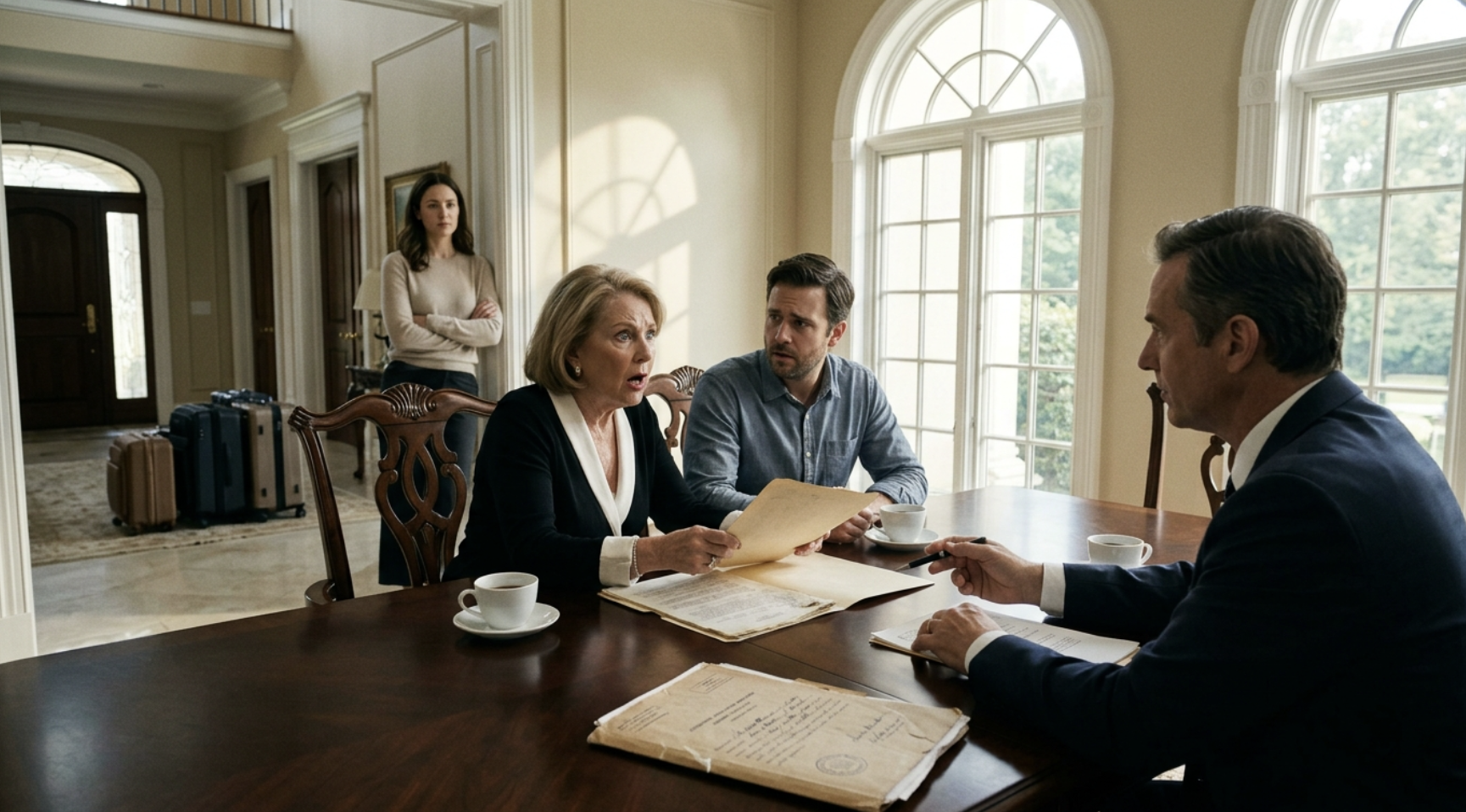
Michael scanned the first page.
His eyebrows drew together.
“But the house belongs to my mother. That’s what she’s always told me.”
Charles nodded. “That is what you were told. It is not the complete legal picture.”
Eleanor abruptly pushed back her chair.
“I will not sit here and listen to this nonsense. Jonathan was very ill when he signed those papers. He wasn’t thinking clearly.”
“Jonathan’s physician documented that he was mentally competent,” Charles replied calmly. “Two independent witnesses were present, and the signing was recorded in the estate file.”
“Then why have I never seen it?”
“Because the agreement included instructions about when certain provisions were to be disclosed.”
Michael looked from Charles to his mother.
“What provisions?”
Charles opened the folder to the second page.
“The first concerns the mansion. The second concerns a trust established by your father. And the third concerns Lisa.”
My name seemed to echo through the room.
Eleanor turned toward me so sharply that her pearl necklace shifted against her collar.
“Lisa? What does she have to do with any of this?”
For the first time that morning, Charles looked directly at her.
“More than you appear to have understood.”
I felt my heart beating faster.
I had married Michael because I loved him. I had never expected his family’s money, and I had certainly never asked Jonathan Richardson to leave me anything.
In fact, Jonathan had been gone for two years before Michael and I married.
I remembered him as a quiet man with kind eyes. During the few family gatherings I had attended before his death, he was usually the only person who asked whether I had eaten enough or whether I was enjoying myself.
Once, when Eleanor criticized my inexpensive dress at a Christmas dinner, Jonathan had simply smiled at me and said, “Never measure a person by the price tag on what they wear.”
It was a small remark, but I had never forgotten it.
Now Charles was telling me that Jonathan had included me in an estate agreement I had never known existed.
“Mr. Harrison,” I said carefully, “I don’t understand. I barely knew Jonathan. Why would he have made arrangements involving me?”
Charles’s expression softened.
“Because he observed more than people realized.”
Eleanor gave a sharp, humorless laugh.
“Oh, please. She was practically a stranger to him.”
“Jonathan disagreed,” Charles said.
He removed another document from the folder.
“This is a letter written in his own hand. He instructed me to preserve it and deliver it if a specific set of circumstances occurred.”
“What circumstances?” Michael asked.
Charles glanced at me before answering.
“Circumstances in which Lisa was being forced out of the home without a fair explanation of her legal position.”
The room became silent.
I remembered the two suitcases standing by the front door the previous night. I remembered Michael looking at his coffee instead of looking at me. I remembered Eleanor’s satisfied expression as she told me we could deal with the situation like adults.
Suddenly, I wondered whether Jonathan had somehow anticipated the very thing that had happened.
Charles unfolded the letter.
“Would you like me to read it aloud?”
Eleanor stood up.
“No.”
Charles paused.
She gripped the back of her chair.
“I said no. Whatever Jonathan wrote, it has nothing to do with this family’s current arrangements.”
“Actually,” Charles replied, “it has everything to do with them.”
He began to read.
To whoever is responsible for carrying out my final instructions,
If this letter is being read, then something has happened that I hoped my family would never allow.
I have spent my life building a home that I wanted to be a place of safety, not a weapon used to control the people living inside it.
I know my wife. I know my son. And I know that money, pride, and fear can sometimes make good people forget what matters.
If Lisa Richardson has been treated as though she has no place in this home simply because she did not bring wealth into this marriage, then the people making that judgment have misunderstood everything I wanted this family to stand for.
Charles stopped reading for a moment.
I looked down at my hands.
My eyes were burning.
No one had ever defended me in that house. Not in a way that lasted longer than a single sentence, and certainly not when Eleanor was determined to have her way.
Yet a man who had been dead for years had somehow left words that reached straight into the wound I had spent five years hiding.
Charles continued.
Lisa did not marry into this family because of its property. She came into our lives with her own work, her own values, and a willingness to care for people without expecting applause.
If she is ever made to believe that her place in this family depends on someone else’s permission, then I want the truth made clear.
The lawyer lowered the letter.
Michael was staring at the table.
Eleanor’s lips had tightened into a thin line.
“What sentimental rubbish,” she muttered. “Jonathan always had a weakness for people he thought needed saving.”
Charles did not respond to the insult.
Instead, he placed the letter beside the first document.
“Jonathan was very specific about the legal arrangements. I suggest we discuss those before making any further assumptions.”
He pointed to a paragraph on the second page.
“The mansion was transferred into a family trust before Jonathan’s death. Eleanor was granted the right to reside here for her lifetime, provided she complied with the trust’s conditions. Michael was named a future beneficiary, but he was not given unrestricted authority to sell, transfer, or dispose of the property.”
Michael frowned.
“So Mom doesn’t own the house outright?”
“Not in the way you have both apparently assumed.”
Eleanor’s face flushed.
“I have lived here for thirty years. I managed this household. I paid the staff. I maintained the property.”
“And the trust recognizes your right to reside here,” Charles said. “But it does not make you its sole owner.”
He turned another page.
“The property is held for the benefit of the Richardson family according to Jonathan’s instructions. Those instructions also contain provisions intended to protect anyone who was granted a lawful right to occupy the residence.”
I leaned forward.
“Does that mean I have a right to live here?”
“Not automatically,” Charles explained. “Your rights depend on the trust’s exact terms and the circumstances of your marriage. That is why I am here. We need to establish what happened, what rights exist, and whether anyone has acted contrary to the governing documents.”
Eleanor seized on the qualification.
“Exactly. She has no right to this house. She’s my son’s wife, and he can decide where she lives.”
Charles looked at her.
“Your son may have certain rights under the trust. That does not mean either of you can disregard the agreement.”
For the first time since I had known her, Eleanor had no immediate response.
Michael rubbed his temples.
“I don’t understand why Dad would do this. Why didn’t he tell me?”
Charles’s voice became gentler.
“He intended to explain more to you, Michael. But his health deteriorated, and he left instructions that the remaining documents should be reviewed if the family began disputing the property or if someone was unfairly excluded from it.”
“Unfairly excluded?” Eleanor repeated. “This is my home!”
“And last night,” Charles said, “you instructed Lisa to leave it.”
Eleanor’s eyes flashed.
“She is not a prisoner. I didn’t throw her onto the street. She has a car. She has money of her own.”
I stared at her.
She had made it sound so reasonable.
As though having somewhere to sleep was the same as being treated with dignity.
Charles closed the folder halfway.
“Before I draw any conclusions, I need to understand precisely what happened. Lisa, did you receive a written notice asking you to leave?”
“No.”
“Did anyone explain a legal reason for your removal?”
“No. Eleanor told me to leave, and Michael had already packed my belongings.”
Charles turned toward Michael.
“Is that accurate?”
Michael swallowed.
“I packed her things because Mom asked me to.”
“Did you ask Lisa whether she wanted to leave?”
“No.”
“Did you consult an attorney about her rights?”
“No.”
“Did you know about the trust?”
Michael shook his head.
Charles made a brief note.
“Then we need to examine the relevant documents before anyone takes further action.”
Eleanor sat down slowly.
For a moment, she seemed older than I had ever seen her. Not frail, exactly, but suddenly aware that the room was no longer arranged entirely according to her wishes.
Then she looked at me.
“You planned this.”
I almost laughed, but there was nothing funny about it.
“I didn’t even know this document existed until yesterday.”
“You must have known something. Why else would you call Charles?”
“Because he had left me a voicemail three days earlier, asking to discuss Jonathan’s estate. I called him after you put my suitcases by the door.”
Her eyes narrowed.
“And you expect us to believe that?”
“I don’t need you to believe me. I need you to stop pretending you can decide everything without considering anyone else’s rights.”
The words came out more steadily than I expected.
Michael looked at me.
Perhaps it was the first time in five years that he had heard me speak to his mother without immediately softening my words to keep the peace.
He opened his mouth.
“Lisa, I—”
I raised my hand.
“Please don’t.”
He stopped.
I had listened to his explanations for years. His mother was old-fashioned. His father had left complicated affairs behind. Eleanor was under stress. She didn’t mean what she said. I should be patient because she had lost her husband.
There had always been another reason for his silence.
But there had never been a moment when his silence had protected me.
Charles gathered the documents into a neat stack.
“There is one more matter we need to address today.”
Eleanor stiffened.
“What now?”
Charles took out a final sheet.
“This concerns a condition Jonathan attached to the trust’s management provisions. It involves the financial records for the mansion and the family accounts.”
Michael looked confused.
“What financial records?”
“The annual maintenance expenses, the trust distributions, and any payments made from accounts controlled by the family.”
Eleanor’s expression changed.
It was subtle, but I noticed it.
Her fingers tightened around the edge of the table.
“Those records are private.”
“They are also relevant to the proper administration of the trust,” Charles said. “I have requested copies from the financial institution and the property manager. They should be available shortly.”
“Why would you request them without asking me?”
“Because I am responsible for reviewing the estate arrangements, and the documents authorize that review under certain circumstances.”
She looked at Michael.
“Tell him this is ridiculous.”
Michael didn’t answer immediately.
For the first time, he seemed to understand that there was a difference between being his mother’s son and blindly agreeing with everything she demanded.
“Mom,” he said slowly, “if Dad put these conditions in place, shouldn’t we find out what they mean?”
Eleanor stared at him as though he had slapped her.
“You’re taking her side?”
“No. I’m trying to understand what Dad actually wanted.”
“That woman has been here for five years, and now she’s suddenly the center of everything!”
I felt a cold stillness settle over me.
There it was.
Not grief. Not concern. Not even a genuine argument about the law.
Resentment.
Eleanor had never wanted me to belong because my presence reminded her that Michael had built a life outside her control.
I had spent years believing I needed to earn her approval.
Perhaps the real problem was that she had never intended to give it.
Charles rose from his chair.
“I recommend that everyone refrain from moving property, changing account access, or signing any documents until the review is complete. I’ll send formal instructions this afternoon.”
Eleanor remained seated.
“And what happens to Lisa?”
Charles looked at me.
“That depends on the legal findings and what Lisa herself wants. She is not required to make a decision in this room under pressure.”
For the first time that morning, I felt as though someone had opened a window in a house that had been suffocating me for years.
I stood and picked up my purse.
“I don’t want to take anything that doesn’t belong to me,” I said. “I don’t want to punish anyone, and I don’t want this house simply because it is expensive. I want the truth. And I want the right to make my own decisions about my life.”
Charles nodded.
“That’s a sensible place to begin.”
I walked toward the hallway.
Michael followed me.
“Lisa, wait.”
I stopped near the front door, beside the spot where my suitcases had stood the night before.
“Can we talk?”
I looked at him.
“About what?”
“About us.”
I almost asked him where that conversation had been when he packed my things. I almost asked why he had let his mother humiliate me for five years.
Instead, I waited.
Michael glanced back toward the dining room.
“I didn’t know about Dad’s documents.”
“I believe you.”
Relief crossed his face, but I wasn’t finished.
“But you knew you were packing your wife’s belongings because your mother told you to. You knew I hadn’t been asked what I wanted. And you still did it.”
He lowered his eyes.
“I thought if I went along with her, things would calm down.”
“They always calm down for you, Michael. You make me carry the pain, and then you call it peace.”
He looked as though he wanted to argue.
Then he closed his mouth.
I opened the door.
“I’m going to stay at the hotel for now. I need time to think, and I need you to think about what happened without your mother telling you how to explain it.”
“Are you leaving me?”
I studied his face.
Five years earlier, I might have rushed to reassure him. I might have promised that everything would be fine if he would only stand beside me for once.
Now, I understood that I couldn’t repair a marriage by myself.
“I haven’t decided what happens to our marriage,” I told him. “But I know I can’t return to the way things were.”
Then I stepped outside.
Behind me, the door closed softly.
This time, it was my choice to leave.
And that made all the difference.
By noon, Charles had sent me a message asking whether I could meet him at his office the following afternoon.
He wanted to explain a provision in Jonathan’s letter that he had deliberately postponed discussing in front of Eleanor.
I agreed.
That evening, I sat by the hotel window with a cup of tea and watched traffic move along the highway. My phone buzzed repeatedly.
Michael called six times.
Eleanor sent two messages.
The first read, I hope you’re satisfied with the disruption you’ve caused.
The second arrived twenty minutes later.
You should think very carefully about what happens when this family decides you are no longer welcome.
I read it twice.
Then I took a screenshot and forwarded it to Charles, asking whether he needed it for the file.
He replied almost immediately.
Please preserve all communications. Do not respond to threats. We’ll discuss everything tomorrow.
I put my phone down.
For the first time in years, I didn’t feel the urge to explain myself.
I didn’t have to convince Eleanor that I was a good person. I didn’t have to persuade Michael to recognize my pain. I didn’t have to apologize for asking questions about documents that affected my life.
I could simply wait for the truth.
The following afternoon, I arrived at Charles’s office shortly before two.
He had prepared a small conference room with the estate folder, several financial statements, and a copy of Jonathan’s handwritten letter.
“Before we begin,” he said, “I want you to understand something. Jonathan did not leave these arrangements because he expected you to fight with his family. He created them because he believed clear rules could protect people when personal relationships became difficult.”
I sat down.
“What exactly did he leave me?”
Charles didn’t answer immediately.
Instead, he opened the folder and showed me a document with my name printed near the top.
It was a declaration establishing a separate family trust provision for a future spouse of Michael Richardson.
My hands went cold.
“I’m listed as the beneficiary?”
“Potentially, yes, subject to the conditions in the document and the applicable law. Jonathan wanted the person Michael married to have an independent measure of security. He specifically stated that the arrangement should not be used to control that person’s choices.”
I looked at the page.
There were provisions concerning a separate investment account, a designated share of certain trust income, and protections against unilateral changes by other family members.
But the most important clause was written in plain language.
The beneficiary’s rights were not to depend on obedience to the wishes of another family member.
I read it again.
“Why would Jonathan do this for someone he barely knew?”
Charles smiled sadly.
“He knew enough to recognize the kind of person you were. He also knew his family. He worried that whoever married Michael might find herself in a difficult position if she didn’t fit the expectations Eleanor had established.”
I remembered Jonathan sitting with me on the back terrace during one of my earliest visits.
He had asked about my work, my parents, and the things I hoped to accomplish.
When I told him that I wanted to open a small bookkeeping service someday, he had listened with genuine interest.
“Never give up having a life of your own,” he had told me. “Marriage should add to your life, not erase it.”
At the time, I had thought he was simply being kind.
Now I wondered how much he had seen.
“Did Michael know about any of this?” I asked.
“Not about the full arrangement. Jonathan left him a separate letter, which I delivered after his death. Michael acknowledged receiving it, but he never requested the supporting documents.”
“Why not?”
Charles leaned back.
“I can’t tell you what Michael was thinking. But I can tell you that your father-in-law anticipated that some of these provisions might be ignored until someone had a reason to examine them.”
He slid another paper across the table.
“This is where matters become more complicated. The trust’s financial records show that a number of payments were made over several years. Some appear ordinary. Others require explanation.”
I looked at the figures.
Maintenance expenses. Property management fees. Transfers between accounts.
Then I noticed a recurring payment that had been made every month for nearly three years.
The amount was substantial.
The recipient was a private property company I had never heard of.
“What’s this?” I asked.
Charles turned the statement toward himself.
“That is one of the transactions we need to investigate. The company was involved in managing certain Richardson assets. The payments were described as administrative and property-related expenses, but the supporting records are incomplete.”
“Who authorized them?”
“The available documents suggest Eleanor had a role in approving some of the transactions. That does not establish wrongdoing by itself. We need the underlying records before drawing conclusions.”
I studied the dates.
Several payments had occurred during the final months of Jonathan’s life.
Others continued long after his death.
Then I noticed something that made my stomach tighten.
One transfer had been made only two days before I married Michael.
Another had occurred the week after our first wedding anniversary.
And the latest payment was dated just six weeks earlier.
“Charles,” I said quietly, “why would a property company continue receiving money if no one can explain what services it provided?”
“That is precisely the question I intend to ask.”
He gathered the statements.
“I don’t want you to jump to conclusions. There may be legitimate explanations. But until we have them, the estate’s records must be protected and reviewed.”
I nodded.
Then I asked the question that had been troubling me since the morning before.
“Does this mean Eleanor knew she couldn’t simply throw me out?”
Charles considered his answer carefully.
“It means she should not have assumed that she had unrestricted authority over the property or over your rights. Whether she understood the full legal position is something we still need to establish.”
I stared at the documents.
For five years, Eleanor had told me that I was fortunate to live in her house.
She had made me feel as though every dinner I cooked, every repair I arranged, and every holiday I helped prepare was payment for the privilege of being tolerated.
Yet Jonathan had created legal protections without asking me to prove that I deserved them.
He had not given me those protections because I had served his family well.
He had given them because I was a person who deserved to be treated fairly.
That distinction changed something inside me.
Before leaving, Charles handed me a sealed envelope.
“Jonathan wrote this separately. The instructions say it should be given to you personally if you ever become involved in a dispute concerning your residence or financial independence.”
My name was written across the front in his familiar handwriting.
I held it carefully.
“May I read it now?”
“Of course.”
I opened the envelope.
Inside was a single page.
Dear Lisa,
If you are reading this, I hope it is because you have found the courage to ask questions that others would prefer you not ask.
I don’t know what your life with Michael will become. I cannot predict whether my family will make you feel welcome or whether you will sometimes wonder if you belong.
But I want you to remember one thing.
You do not need to earn the right to be treated with dignity.
If you choose to stay, let it be because you are loved and respected. If you choose to leave, let it be because you believe another life will be better for you.
Do not remain somewhere merely because someone has convinced you that you have nowhere else to go.
The truth may take time to uncover. Be patient with the process, but never surrender your judgment to someone else’s pride.
With respect and affection,
Jonathan.
I couldn’t speak for several seconds.
Then I folded the letter and held it against my chest.
Outside the conference room, people hurried through the corridor, carrying files and answering phones. The world continued as it always had.
But for the first time since I had married Michael, I felt that my future belonged to me.
I still didn’t know what the documents would reveal.
I didn’t know whether my marriage could survive what had happened.
And I certainly didn’t know why Eleanor had reacted with such fear when she saw Jonathan’s signature.
But I knew one thing.
I was no longer going to spend my life begging for a place at a table where everyone else believed they had the right to decide whether I belonged.
And as I slipped Jonathan’s letter into my purse, Charles spoke again.
“Lisa, there’s one more document I haven’t shown you.”
I turned toward him.
He reached into the folder and removed a sealed envelope marked with a date from seven years earlier.
“Your father-in-law instructed me to open this only if the estate’s financial records came under formal review. Given what we’ve discovered, I believe that time has arrived.”
He placed it between us.
Then he looked at me with an expression that made my heart begin to race.
“Whatever is inside this envelope, Lisa, it may explain why Jonathan was so determined to protect the person Michael eventually married.”
PART 4
I stared at the sealed envelope on Charles Harrison’s desk.
For several seconds, neither of us spoke.
The envelope looked ordinary. Its edges had yellowed slightly with age, and Jonathan Richardson’s handwriting appeared across the front. But beneath the date, he had written a sentence that made my chest tighten.
To be opened only when someone in my family mistakes wealth for ownership of another person’s life.
I read it twice.
“Did Jonathan really write that?” I asked.
Charles nodded.
“He wrote it himself. I was present when he sealed the envelope.”
“Did he tell you what was inside?”
“No. He said the contents would make sense when the time came.”
Charles carefully opened the envelope.
Inside were three documents and a photograph.
The photograph showed Jonathan sitting on the back terrace of the mansion, smiling beside a woman I recognized immediately.
It was me.
But the photograph had been taken five years before I married Michael.
I remembered that afternoon. I had been working part-time for a small accounting firm, and Jonathan had invited several people to a charity fundraiser at the mansion. Michael had been away on business, and I had spent most of the afternoon helping an elderly guest who had become overwhelmed by the crowd.
Jonathan had thanked me afterward.
I had assumed he was simply being polite.
“Why would he keep this?” I whispered.
Charles examined the photograph.
“Because he wanted to remember something about you.”
He handed me the first document.
It was a record of a charitable donation made by Jonathan several years before his death. The donation had established a small financial assistance program for people who had lost their jobs or experienced unexpected hardship.
My name appeared in the supporting paperwork.
I frowned.
“I don’t understand. I never received money from Jonathan.”
“You didn’t,” Charles said. “You helped administer the program through the accounting firm you worked for at the time. You prepared some of the records and volunteered to help organize the donations.”
I slowly remembered.
For several months, I had helped process paperwork for the charity. I hadn’t known who had provided most of the funding because the donations had been made through a foundation.
Jonathan had apparently been one of its principal supporters.
“He recognized my name,” I said.
“More than that,” Charles replied. “He remembered that you insisted on checking every payment, even when doing so meant staying late. He told me you were one of the few people he had met who treated small amounts of money with the same care as large ones.”
I looked at the photograph again.
For years, I had believed I entered the Richardson family as an outsider who had to prove her worth.
Jonathan had met me long before that family became part of my life. He had seen how I behaved when I had nothing to gain from knowing him.
The second document was a letter from Jonathan to Charles.
It explained that Jonathan had become increasingly concerned about the way family decisions were being made. He worried that the mansion, the family investments, and the business interests attached to them had become more important to Eleanor than the people those assets were supposed to serve.
He had also noticed that Michael rarely challenged his mother’s decisions.
Jonathan did not accuse his wife of a crime. He did not claim his son was incapable of becoming a responsible adult.
Instead, he wrote that both had grown accustomed to avoiding difficult conversations.
I fear my son will confuse keeping the peace with doing the right thing, one sentence read.
I lowered the page.
That sentence described my marriage more accurately than anything I could have written myself.
Charles continued reading the letter.
Jonathan had arranged for an independent review of certain family financial accounts. He wanted to ensure that the estate would be administered according to its governing documents, rather than according to the wishes of whichever family member spoke the loudest.
He had also established a separate fund intended to support Michael’s future spouse in pursuing education, professional development, or independent living.
It was not a reward for marrying into the family.
It was protection against financial dependence.
The fund could not be controlled unilaterally by Eleanor, and its provisions could not be used to compel the beneficiary to remain in a marriage or residence.
I stared at the document.
“He wanted me to be able to leave if I needed to.”
Charles nodded.
“He believed that financial security should give someone choices, not take them away.”
For the first time, I understood the full meaning of Jonathan’s arrangements.
He had not tried to decide my future.
He had tried to make sure I could decide it for myself.
Then I noticed the third document.
It was a handwritten note addressed to Michael.
Charles explained that Jonathan had left it with instructions to deliver it if Michael ever became involved in a dispute over the estate’s property or the rights of someone living in the family home.
“Michael received a separate letter after his father’s death,” Charles said. “This one was intended for a more specific circumstance.”
I read the note silently.
Michael,
If you are reading this, ask yourself whether you have become the man you promised me you would be.
You do not have to agree with every decision your wife makes. You do not have to agree with every decision your mother makes either.
But you must never make someone you love pay the price for your fear of disappointing someone else.
If you allow another person to be humiliated because defending them would be uncomfortable, your silence becomes part of the humiliation.
I hope you learn this before you lose something that cannot be replaced.
Your father.
I sat back.
There was no accusation in the letter, no demand that Michael divorce his mother or abandon his family.
There was only an honest question.
Had he become the man he had promised to be?
I thought about Michael standing in the kitchen while his mother ordered me out. I remembered him carefully arranging my suitcases beside the door, as though organizing my departure could make it less cruel.
I wondered whether he had thought about that moment since.
“Charles,” I said, “I need to ask you something.”
“Go ahead.”
“If these documents protect me, does that mean I can take control of the mansion?”
“No,” he answered firmly. “And I want to be clear about that. The trust gives different people different rights. It does not automatically transfer ownership to you, and it doesn’t authorize you to take over the property.”
I nodded.
“Then I don’t want anyone pretending that is what I’m trying to do.”
“I understand.”
“I want the accounts reviewed. I want the legal arrangements respected. And I want to know why Eleanor believed she could force me out without even discussing it with me.”
Charles closed the folder.
“Those are reasonable questions. We will seek answers through the proper process.”
I left his office that afternoon carrying copies of the documents and Jonathan’s letter.
I had entered his office wondering whether I had any place in the Richardson family’s affairs.
I left knowing that my place in the world did not depend on their permission.
But the hardest conversation was still waiting for me.
Michael had called again that morning.
This time, I decided to answer.
The Husband Who Finally Had to Listen
“Lisa?”
Michael sounded exhausted.
“I’m here.”
“Can we meet? Just the two of us?”
I considered refusing.
Then I realized that I didn’t need to avoid him to protect myself. I needed to stop allowing his discomfort to dictate the terms of every conversation.
“Tomorrow afternoon,” I said. “Somewhere neutral. Not the mansion.”
We met at a quiet café near the park.
Michael was already there when I arrived. He stood as I approached, but I sat down without returning his nervous smile.
For a moment, he seemed unsure how to begin.
Finally, he said, “I read Dad’s letter.”
I waited.
“Charles sent me a copy after he explained what happened at the house. I didn’t know he had written that.”
“You knew he worried about your mother’s control over the family.”
Michael looked down.
“Yes.”
The admission surprised me.
He rubbed his hands together.
“When Dad was alive, he tried to get me to speak up more. He said I always waited until Mom made a decision and then convinced myself that agreeing was easier than arguing.”
“And what did you tell him?”
“That he didn’t understand how difficult she could be.”
I looked at him.
“Did he understand how difficult she was for me?”
Michael said nothing.
“That is what I needed you to understand five years ago,” I continued. “I wasn’t asking you to stop loving your mother. I was asking you to recognize that I was your wife, not an employee who had to earn permission to exist in your home.”
His eyes reddened.
“I know.”
“No, Michael. You understand it now because there are documents and lawyers involved. I need you to understand what it felt like before any of that existed.”
I told him about the dinners where Eleanor corrected me in front of guests. The holidays when I spent hours preparing food only to be reminded that I was fortunate to be included. The times she rearranged my belongings or criticized my clothes, and how he always told me to ignore her.
I told him about the loneliness of living in a mansion full of people and feeling that I had nowhere to belong.
Most importantly, I told him about the previous night.
“When I saw those suitcases, I realized you had made a decision about my life without asking me a single question. You didn’t even have the courage to look me in the eye.”
Michael covered his face.
“I thought if I did what Mom wanted, she would calm down. I thought we could talk afterward and work everything out.”
“You thought I would forgive you again.”
He slowly lowered his hands.
“Yes.”
For once, he didn’t offer an excuse.
“I have spent my entire life trying to keep her happy,” he admitted. “When Dad died, I felt responsible for her. I thought if I disagreed with her, I would be abandoning her.”
“And what did you think you were doing to me?”
His eyes filled with tears.
“I wasn’t thinking about you. Not the way I should have been.”
The honesty hurt more than another excuse would have.
I had wanted him to defend me for so long that I once believed one apology would repair everything.
But an apology could not return the years I had spent shrinking myself to make his family comfortable.
“Do you still want this marriage?” he asked.
“I don’t know.”
He flinched, but I continued.
“I love the man I believed you could be. I remember the person who made me laugh when we first met, who listened to my plans, who promised we would build a life together. But I cannot keep living with the man who disappears whenever his mother becomes unhappy.”
Michael nodded slowly.
“What do you need from me?”
“Time. Honesty. And change that doesn’t disappear the moment your mother gets angry.”
“I can do that.”
“You cannot promise it today. You have to prove it.”
He looked at me for a long moment.
Then he reached into his jacket and placed a small key on the table.
“What is this?” I asked.
“The key to the apartment I rented this morning.”
I stared at him.
“Why did you rent an apartment?”
“Because I need to learn how to live without having every decision made for me. And because I understand that you don’t want to return to the mansion right now.”
He paused.
“I also told Mom that I won’t participate in any decision about your belongings or your residence without first understanding the legal arrangements and speaking to you directly.”
It was the first meaningful action he had taken without asking me to manage his feelings about it.
But I wasn’t ready to reward him for doing what should have been ordinary.
“I’m glad you did that,” I said. “But it doesn’t change what happened.”
“I know.”
We sat quietly until our coffee grew cold.
When we finally stood to leave, Michael didn’t ask me to come home.
He didn’t ask me to forgive him.
He simply said, “I’m sorry, Lisa.”
This time, I believed that he understood what he was apologizing for.
Whether he could become a better husband remained a different question.
The Financial Records Reveal a Bigger Problem
Over the following two weeks, Charles worked with an independent accountant to examine the Richardson estate’s records.
I remained at the hotel for several nights before moving into a small furnished apartment.
It was nothing like the mansion.
There were no marble floors, no enormous windows, and no landscaped gardens. The kitchen was barely large enough for two people to stand in comfortably.
But I could leave my shoes wherever I wanted.
I could cook without someone inspecting my food.
I could sit in silence without wondering whether my presence was irritating anyone.
Every evening, I returned to that little apartment and felt a kind of peace I hadn’t experienced in years.
Meanwhile, the financial review uncovered several questionable transactions.
The property company receiving recurring payments had been established by an associate of Eleanor’s. Some of the invoices described services that had not been adequately documented. Other payments appeared to overlap with expenses already recorded elsewhere.
The accountant could not yet determine whether the transactions represented improper payments, careless recordkeeping, or legitimate expenses supported by missing documents.
But the pattern was serious enough to warrant a more thorough examination.
Charles sent a formal request for the remaining records.
Eleanor responded with anger.
She accused him of humiliating her and allowing Lisa to interfere in private family matters.
Charles replied that the review was required by his professional responsibilities and the estate documents.
Then came a discovery that changed the entire dispute.
A transfer of funds had been made from an account associated with the estate into a separate investment account. The transaction was not automatically unlawful, but the authorization records were incomplete, and the money had not been clearly accounted for in the estate’s summaries.
The amount was large enough that the accountant recommended an independent investigation.
Charles contacted the appropriate professionals, preserved the records, and advised the family not to move or dispose of any disputed assets while the matter was being examined.
When Eleanor learned about the recommendation, she called Michael.
I wasn’t present for the conversation, but he told me about it afterward.
“She said Dad would be ashamed of me,” he explained during one of our scheduled conversations.
“What did you say?”
“I told her Dad’s wishes couldn’t be established by whichever one of us shouted loudest. I told her we had to let the review happen.”
“And how did she react?”
“She said I had changed.”
I looked at him.
“What did you tell her?”
“That I hoped I had.”
For the first time, Michael had disagreed with his mother without immediately calling me afterward to complain about how upset she was.
It was a small step, but it was a real one.
The review continued.
Several weeks later, the accountant concluded that some payments had been poorly documented and that certain transfers required further explanation. There was not enough evidence to establish that Eleanor had personally stolen money, and Charles cautioned everyone against making accusations before the investigation was complete.
The estate’s trustees restricted certain transactions while they obtained additional records.
Eventually, the property company produced some of the missing invoices. Several expenses were legitimate, but others could not be adequately substantiated. The disputed sums were referred for further review, and the trustees began the process of recovering amounts that could not be justified under the governing arrangements.
Eleanor was furious.
She claimed that everyone had turned against her.
But the documents did not care who felt betrayed.
They simply required answers.
And for the first time, Eleanor could not end a difficult conversation by declaring that the house belonged to her and everyone else needed to obey.
The Confrontation at the Mansion
Three months after I left, Charles arranged a meeting at the mansion.
The purpose was to review the findings, explain the trust’s requirements, and discuss how the household would operate going forward.
I almost declined.
I had no desire to return to the place where I had been humiliated.
But I decided that if I was going to close this chapter of my life, I would do so on my own terms.
When I arrived, Eleanor was sitting in the drawing room.
She wore her usual pearls and cream blouse, but her expression was different. The old certainty had been replaced by a brittle defensiveness.
Michael stood near the window.
Charles placed the final review documents on the table.
“The investigation has clarified several important issues,” he began. “The mansion remains subject to the family trust. Eleanor retains the rights granted to her under its terms, while other decisions must be made in accordance with the trust’s provisions. No individual family member has unrestricted authority over every aspect of the property.”
Eleanor looked away.
“The financial review also identified expenses that were inadequately supported. Some have now been explained, while others remain subject to recovery or further review. The trustees will continue to manage those matters according to their legal obligations.”
She pressed her lips together.
Then she turned to me.
“Are you happy now?”
I had imagined this moment many times.
In some versions, I would tell her everything I had wanted to say for five years. I would describe every insult and every humiliation. I would make her understand how much damage she had done.
But sitting across from her, I realized I no longer needed her to understand me in order to move forward.
“No,” I answered quietly. “I’m not happy that the family has gone through this. I’m relieved that the truth is finally being examined.”
She gave a dismissive laugh.
“You could have stayed out of it.”
“You told me to leave the house. Your son packed my belongings. I had every right to understand my legal position.”
“You could have handled it privately.”
“I tried handling things privately for five years. I stayed quiet when you criticized me. I stayed quiet when you treated me as though I didn’t belong. I stayed quiet when your son refused to defend me.”
I paused.
“Being quiet didn’t make the situation better. It only made it easier for everyone else to ignore.”
Eleanor’s eyes flashed.
“You have turned Michael against me.”
“No,” I said. “Michael is responsible for his own choices. I cannot control his relationship with you, and I don’t want to. I only want him to understand that loving you doesn’t require him to mistreat me.”
For a long moment, she said nothing.
Then, unexpectedly, her expression crumpled.
“You don’t know what it was like,” she whispered. “After Jonathan died, everything felt as though it was slipping away. The house, the business, the life I had spent decades building. I thought if I didn’t keep control of everything, I would lose it all.”
I listened without interrupting.
“I didn’t want another woman coming into this family and changing everything,” she continued. “I thought Michael would forget me. I thought I would become a guest in my own life.”
Her voice trembled.
“And I suppose I made you feel like a guest in yours.”
The admission was so unexpected that I didn’t immediately know how to respond.
It wasn’t a complete apology.
It didn’t erase the past.
But it was the first time Eleanor had acknowledged what she had done without blaming me for it.
“Yes,” I said. “You did.”
She looked down at her hands.
“I was cruel to you.”
The room became silent.
“I told myself I was protecting the family,” she continued. “But I was protecting my control over it. I thought if you never felt secure here, you would always have to seek my approval.”
Michael stepped away from the window.
“Mom, why didn’t you just tell us you were afraid?”
She looked at him sharply.
“Because I didn’t know how to be afraid without becoming angry.”
For a moment, I saw the grief beneath her pride.
Jonathan’s death had changed her. Losing her husband had left a space in her life that money and property could not fill.
But grief did not excuse her behavior.
I could recognize her pain without accepting responsibility for it.
“I am sorry for what happened to you after Jonathan died,” I said. “I know losing him must have been devastating. But you cannot make other people smaller to make yourself feel safe.”
Eleanor nodded slowly.
Then she looked at Michael.
“And you,” she said. “You let this happen.”
Michael’s face tightened.
“Yes,” he replied. “I did.”
She appeared startled by his answer.
“I was afraid of upsetting you,” he continued. “So I let Lisa suffer instead. I told myself I was keeping peace, but I was only protecting myself from an uncomfortable conversation.”
He took a breath.
“I should have defended my wife. I should have spoken to her before packing her things. And I should have stopped pretending that your approval was more important than doing what was right.”
Eleanor began to cry.
Michael did not rush to comfort her, nor did he turn toward me as if expecting me to rescue the conversation.
He remained where he was.
It was the first time I had seen him allow his mother to experience the consequences of her actions without immediately trying to make everything comfortable again.
Charles gathered his papers.
“The legal matters will continue through the appropriate process,” he said. “But personal reconciliation is something you must decide for yourselves.”
I stood.
“I need to say one more thing before I leave.”
Eleanor looked up.
“I don’t want your money. I don’t want your position in the family. And I don’t want to take this mansion away from you.”
I paused.
“I want a life where I can walk into a room without wondering whether I am allowed to belong there. I want a marriage where my husband treats me as an equal. And I want to know that if I disagree with someone, I won’t be punished by having my home or my belongings taken away.”
I looked directly at Eleanor.
“If we ever have a relationship again, it will have to be built on respect. Not fear. Not money. Not the threat of being thrown out.”
She nodded, tears running down her face.
“I understand.”
For the first time, I believed she might be beginning to understand.
But forgiveness would take longer.
And I no longer felt obligated to rush it.
Six Months Later: A Different Kind of Home
Six months after that first morning with Charles, my life looked very different.
I had returned to work and begun taking on additional accounting clients. With the money I had saved and the confidence I had slowly regained, I started planning the small bookkeeping business I had once discussed with Jonathan.
I rented a modest office above a neighborhood bakery.
The windows were old, the stairs creaked, and the walls needed painting.
I loved it.
Every decision was mine.
I chose the furniture, arranged the shelves, and decided where the coffee machine belonged. No one criticized the color of the curtains or told me that my plans were inappropriate for someone of my position.
On the first morning of business, I stood in the doorway holding a cup of coffee and watched the sunlight fall across my desk.
I thought about the mansion.
For years, I had believed that living in a beautiful house meant I had succeeded. I had tried so hard to be accepted that I had almost forgotten the difference between comfort and happiness.
Now I understood that a home was not defined by its market value.
It was defined by whether you could breathe freely inside it.
My marriage with Michael was still uncertain, but it was no longer built on the assumption that I would absorb every insult to keep everyone else comfortable.
We attended counseling together.
He continued living separately for a time, learning to make decisions without asking his mother to approve them. He also began setting boundaries with Eleanor, even when those boundaries disappointed her.
He never demanded that I return to the mansion.
Instead, he asked what kind of life I wanted to build.
For the first time, he listened to the answer without trying to negotiate it into something easier for him.
One evening, we sat in a small restaurant near my office.
Michael had brought a notebook.
“I’ve been thinking about what you said,” he began. “About building a life where you don’t have to wonder whether you belong.”
I waited.
“I don’t expect you to come back just because I finally understand what I should have done. I know I have to show you that I can be different.”
He opened the notebook.
“I’ve written down some things I want to change. Not rules for you. Things for me.”
He showed me a list.
He would make decisions about our marriage with me rather than allowing his mother to make them for us. He would speak up when someone disrespected me. He would not use money, property, or family obligations as a reason to control my choices.
And if he failed, he would acknowledge it rather than making me responsible for explaining why I was hurt.
I read the list and closed the notebook.
“These are good promises,” I said. “But I need to see them become habits.”
“I understand.”
We continued counseling.
Over time, Michael became more consistent. He stopped treating every disagreement as a crisis and stopped assuming that peace required someone to surrender.
He began asking himself whether a decision was fair, rather than simply whether it would make his mother happy.
And slowly, I began to trust him again.
Not because of his father’s estate.
Not because of the mansion.
Because he was finally learning to take responsibility for his choices.
Eventually, we agreed to rebuild our marriage, but with one important condition.
We would not live in Eleanor’s mansion.
We found a smaller house in a quiet neighborhood, purchased according to our own financial circumstances and with independent legal advice. It had a modest garden, a bright kitchen, and enough room for the life we wanted.
The first evening we spent there, Michael carried in the last box and placed it beside the dining table.
Then he looked around.
“It’s not much compared with Mom’s house,” he said.
I smiled.
“That’s exactly what I like about it.”
He laughed softly.
For a moment, we were the people we had been when we first fell in love: two imperfect adults trying to build something together.
The difference was that this time, we were no longer pretending love alone would solve every problem.
We were choosing to do the work.
Eleanor’s Final Letter
A year after the night she ordered me out, I received a letter from Eleanor.
It arrived at my office on a rainy Thursday afternoon.
The envelope contained no legal documents, no demands, and no accusations.
Only three handwritten pages.
Lisa,
I have started writing this letter several times. Each time, I found myself explaining why I behaved the way I did.
I wanted to tell you about losing Jonathan, about my fear of growing older, and about the feeling that everything I had built was slowly slipping beyond my control.
All those things were true.
But none of them changed what I did to you.
I made you feel that you were living in my home on borrowed time. I treated your kindness as an obligation and your patience as permission to continue. When you tried to become part of this family, I made you prove yourself over and over again.
The worst part is that you kept trying.
You cooked the meals. You remembered the birthdays. You helped with the house. You treated me with courtesy even when I did not return it.
I told myself that you were fortunate to have what I provided. I never stopped to ask what you were providing to everyone else.
I was wrong.
I also owe Michael an apology, but that is a conversation I must have with my son. I can no longer blame you for the choices he made.
I don’t expect you to forgive me simply because I have finally written these words.
I only hope that one day, if you think of me, you will remember that I was capable of recognizing my mistakes, even if I recognized them far too late.
Eleanor.
I read the letter slowly.
Then I placed it in my desk drawer.
I didn’t call her immediately.
I didn’t rush to reassure her that everything was fine.
Because everything wasn’t fine yet.
But the letter was a beginning.
Several days later, I sent her a brief reply.
I thanked her for acknowledging what had happened and told her that I hoped we could eventually build a more respectful relationship.
I made no promises beyond that.
When we next met, it was for lunch at a restaurant rather than at the mansion.
Eleanor arrived without her usual air of authority. She asked about my business and listened as I explained how it was growing.
For the first time, she asked questions because she was interested in the answers, not because she wanted to evaluate my choices.
Before we parted, she hesitated.
“Would you ever consider visiting the mansion again?” she asked.
I considered the question.
“Perhaps,” I replied. “But only when I feel comfortable doing so.”
She nodded.
“That is fair.”
And we left it there.
Our relationship never became perfect. Some old habits surfaced occasionally, and there were moments when Eleanor still struggled to accept decisions she could not control.
But I no longer surrendered my boundaries to make her comfortable.
And she gradually learned that if she wanted me in her life, she would have to treat me as someone whose presence was a choice, not a privilege she could revoke.
That was the only foundation on which we could begin again.
The Final Visit to the Mansion
Two years later, Charles invited us to a small gathering at the Richardson mansion to mark the completion of the estate review.
The disputed accounts had been addressed through the appropriate legal process. The trustees had clarified the property’s management arrangements, and the remaining responsibilities were documented so that future disagreements would be handled according to the trust rather than personal demands.
Eleanor still lived in the mansion under the rights provided by the trust.
Michael remained a beneficiary, but neither of us treated the property as the measure of our success.
When I entered the dining room, the table was set with the same antique china Eleanor had once forbidden me to use without permission.
She noticed me looking at it.
“I thought we should use the good plates,” she said.
Then, after a pause, she added, “If you’re comfortable with that.”
I smiled.
“Of course.”
We sat down together.
For once, there were no remarks about my clothes, my work, or my place in the family. The conversation was ordinary. Charles discussed the final administrative details, Michael told a story about a client at work, and Eleanor asked about my business.
At the end of the meal, I carried my plate toward the kitchen.
Eleanor stood up immediately.
“Lisa, leave that. I’ll take care of it.”
I paused.
The words were simple, but they carried a meaning I would have understood even if she had said nothing more.
For five years, I had cleared her table because I believed that being useful might help me belong.
Now, she was asking me to sit down because I already did.
I returned to my chair.
Later, as Michael and I prepared to leave, Eleanor walked with us to the front door.
She glanced at the place where my suitcases had stood that terrible night.
“I have thought about that evening many times,” she said.
“So have I.”
“I cannot change what happened.”
“No,” I replied. “But you can choose what happens next.”
She nodded.
Then she looked at me.
“Thank you for giving me the chance to do that.”
I didn’t tell her that I had forgiven everything.
I didn’t need to.
I simply said, “You’re welcome.”
Outside, Michael took my hand.
“Are you okay?” he asked.
I looked back at the mansion.
For a long time, that house had represented everything I thought I needed to earn: acceptance, security, love, and a place in a family that seemed determined to remind me I didn’t belong.
Now it was simply a house.
A beautiful one, certainly, full of history and memories. But it was no longer the center of my life.
My home was somewhere else.
It was the small house where Michael and I had learned to speak honestly. It was the office where I had built a business of my own. It was the quiet confidence I had found when I finally stopped asking other people to decide what I deserved.
I squeezed Michael’s hand.
“I’m more than okay,” I told him.
And I meant it.
As we drove away, I thought about Jonathan’s letter.
You do not need to earn the right to be treated with dignity.
For years, I had mistaken endurance for strength. I had believed that if I remained patient enough, kind enough, and useful enough, eventually someone would decide I was worthy of belonging.
But Jonathan had understood something I had taken far too long to learn.
Respect should never be the prize at the end of someone else’s test.
Love should never require you to disappear.
And a home should never be used as a weapon against the person who lives in it.
The night Eleanor ordered me out of her $2.8 million mansion, I thought I had lost everything.
I hadn’t.
I had lost the illusion that I could earn love by accepting humiliation.
I had lost the habit of remaining silent when something was wrong.
And I had lost the fear that walking away from a beautiful house meant walking away from a beautiful life.
In their place, I found something far more valuable.
I found my voice.
I found my independence.
And, eventually, I found a marriage worth rebuilding—not because I had been forced to stay, but because we had both learned what it meant to choose each other freely.
The mansion remained part of the Richardson family’s history.
But it no longer determined my future.
Because the greatest inheritance Jonathan left me was never the trust, the money, or the legal protection.
It was the reminder that my dignity had never belonged to anyone else.
And no one—not even the owner of a $2.8 million mansion—had the right to take it away.