
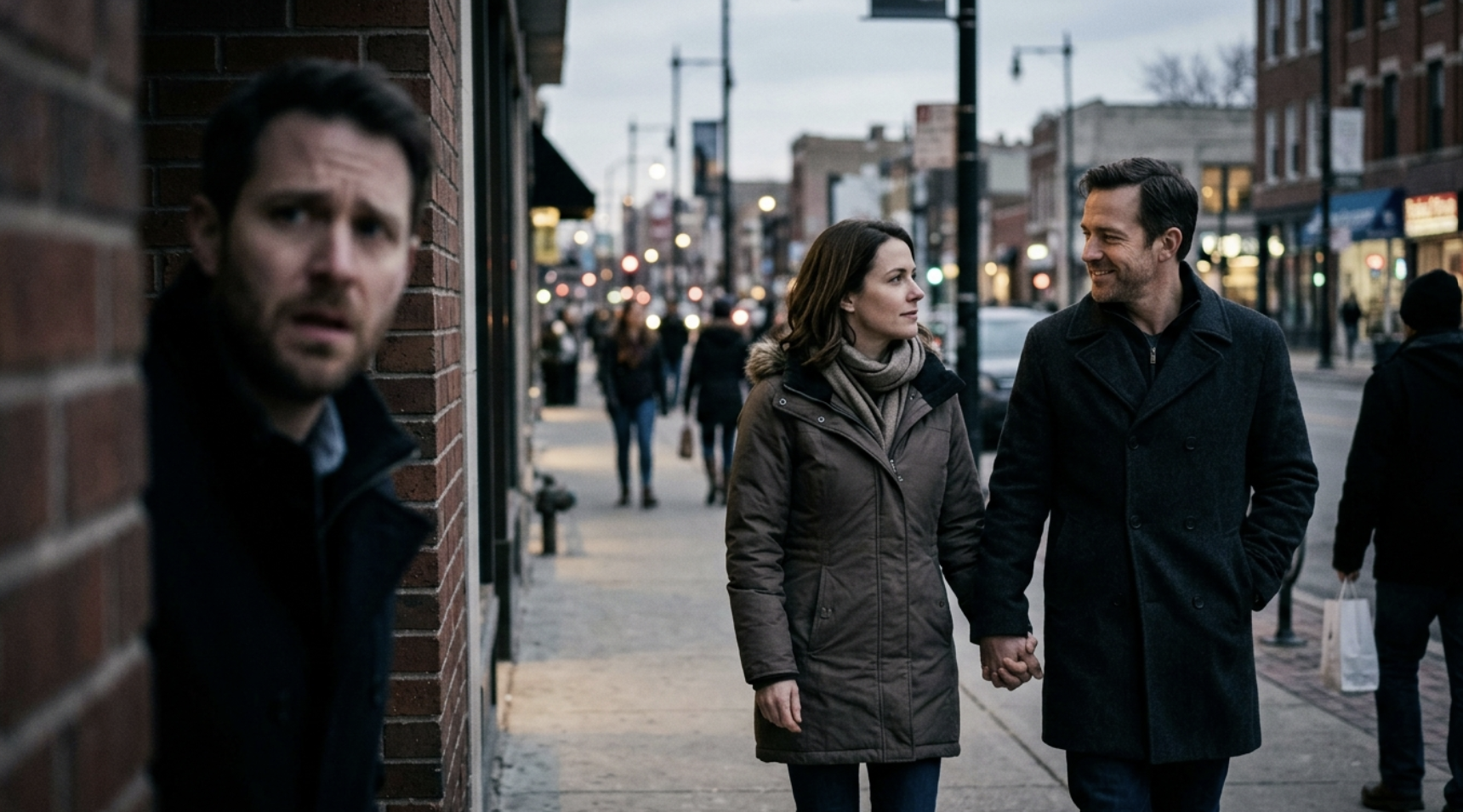
PART 3
She repeated the word so quietly that I almost wished she had shouted it.
“You think this is a game, David?”
“No. That’s not what I meant.”
“Then what did you mean?”
I rubbed my face with both hands.
I wanted her to yell. I wanted her to throw the folder at me, call me every terrible name she could think of, and tell me that she hated me.
At least then, I would know what to do.
Anger was something I understood.
Silence was not.
Sarah pushed the sealed envelope toward me.
“Read it.”
I turned it over in my hands. My name was written across the front in black ink. There was no return address, no explanation, and no indication of what I was about to discover.
“Who wrote this?”
“The man you saw today.”
I tore open the envelope.
Inside was a single sheet of paper.
The first sentence made my stomach tighten.
David, you don’t know me, but I’ve known about you for almost a year. I’ve watched what your choices have done to Sarah, and I’ve spent a long time deciding whether I should tell you the truth.
I stopped reading.
“Almost a year?”
Sarah said nothing.
I continued.
I am not the man you need to be afraid of. You should be afraid of the possibility that the woman you took for granted has finally remembered who she was before she met you.
My hands went cold.
The letter continued.
My name is Michael Bennett. I’m a family attorney, and I have been helping Sarah understand her options. I was also the attorney who helped her mother settle her estate several years ago.
I looked up.
“Her mother?”
Sarah folded her arms.
“My mother left me something when she died.”
“What does that have to do with anything?”
“Keep reading.”
I looked back at the letter.
There is something else you need to understand. Sarah did not come to me because she wanted revenge. She came because she needed to know whether she could protect herself and her children without destroying their lives in the process.
She has spent months making decisions you should have made together as a married couple. Decisions about finances, the house, and the future of your family.
You may believe your marriage is ending because you saw her holding my hand. It isn’t.
Your marriage began ending years ago, when you decided that your promises meant less than your desires.
What happens next depends on whether you are finally prepared to tell the truth.
The letter ended there.
I read it twice.
Then a third time.
When I finally lowered the paper, I looked at Sarah.
“An attorney?”
“Yes.”
“You hired an attorney without telling me?”
She let out a breath that sounded almost like a laugh, except there was no humor in it.
“You had affairs without telling me. You lied about business trips. You used money from our joint account to pay for hotel rooms. You looked me in the eyes every morning and told me you loved me while continuing to do things you knew would break my heart.”
She paused.
“And you’re upset because I spoke to an attorney?”
I opened my mouth.
Nothing came out.
She was right.
I knew she was right, and that made everything worse.
For years, I had operated under a simple assumption: if Sarah didn’t confront me, I hadn’t hurt her badly enough to matter.
I had treated her silence as permission.
Now I was discovering that silence could be a decision, too.
“Are you planning to divorce me?” I asked.
Sarah looked toward the dark window above the kitchen sink.
“I don’t know.”
That answer frightened me more than a definite yes.
“Sarah, please. Nine years. We have two children. We have a home. We have a life.”
“We have children,” she corrected gently. “We have a house. We have a life that I’ve spent years trying to hold together.”
She looked directly at me.
“But I don’t know if we still have a marriage.”
I felt something crack inside my chest.
I wanted to reach across the counter and take her hand.
Instead, I kept my hands in my lap.
For the first time, I wondered whether touching my wife was something I still had the right to do.
“Can we fix this?” I whispered.
Sarah looked at me for a long time.
“I asked myself that question for three years, David.”
Three years.
The words seemed to fill the entire kitchen.
“You knew for three years?”
“I suspected things before that. But three years ago, I found something I couldn’t explain away.”
“What?”
She stood, walked to the drawer beside the refrigerator, and returned with an old photograph.
It was a picture of us on our honeymoon.
We were standing on a beach, laughing at something outside the frame. My arm was around her waist. Her head rested against my shoulder.
I remembered that day.
I remembered promising her that I would never make her regret choosing me.
Sarah placed the photograph beside the folder.
“Do you remember when I found out I was pregnant with Emma?”
“Of course.”
“You cried.”
I nodded.
“I did.”
“You held me in the bathroom and told me that you wanted to be the kind of father you never had. You said you wanted our children to grow up watching two people who respected each other.”
I swallowed hard.
“I meant it.”
“I believe you meant it that day.”
Her voice trembled slightly.
“That’s what made everything so difficult. I kept remembering the man who said those things. I kept hoping he would come back.”
She turned the photograph over.
On the back, in my handwriting, were the words I’d written nine years earlier.
You are my home. Wherever you are, that’s where I belong.
Sarah stared at the message.
“Do you know what I did when I found the first hotel receipt?”
I shook my head.
“I told myself you were stressed. That work was difficult. That maybe you needed attention because you were struggling with something you couldn’t explain.”
She gave a small, painful smile.
“When I found the second one, I told myself every marriage had difficult seasons. When I found the messages, I told myself I had two children who deserved a stable home.”
“Sarah—”
“When I found the photographs, I stopped making excuses for you.”
Her eyes filled with tears.
“But I still stayed.”
She wiped her cheek quickly, almost angrily.
“Not because I was weak. Not because I couldn’t survive without you. I stayed because I loved you, and because I wanted to give you a chance to become the husband you promised me you would be.”
I could barely breathe.
“And now?”
“Now I’m trying to decide whether loving you is enough reason to keep hurting myself.”
She gathered the papers into the folder.
“You should sleep in the guest room tonight.”
Then she walked upstairs.
I sat alone at the kitchen island long after the lights had gone out.
The house was quiet except for the hum of the refrigerator and the distant sound of a car passing on the wet street.
For years, I had believed I was protecting my family by keeping my affairs secret.
Now I understood that I had been protecting myself.
And I had been willing to sacrifice everyone else’s peace to do it.
But the worst part wasn’t the possibility of losing my wife.
It was the realization that she had been losing herself for years while I congratulated myself on being a good husband.
And I had never even noticed.
The next morning, I woke to the sound of my daughter laughing.
For a moment, I forgot everything.
I walked downstairs expecting to find Sarah making pancakes, the way she did every Saturday morning.
Instead, I found Emma sitting at the kitchen table with a bowl of cereal. Our six-year-old son, Noah, was building a tower out of wooden blocks on the floor.
Sarah was packing their school bags.
She looked exhausted.
Not the ordinary tiredness that came from managing two children and a household.
This was something deeper.
The kind of exhaustion that came from carrying a secret so heavy that even sleep couldn’t make you forget it.
“Morning,” I said.
She nodded.
“Morning.”
I waited for her to ask if I wanted coffee.
She didn’t.
I made my own and sat across from Emma.
“Hey, sweetheart. What are you doing today?”
“Mom said we’re going to Grandma’s garden.”
I glanced at Sarah.
“Your mother’s garden?”
Sarah nodded.
“I’m taking them to visit my mother’s grave afterward.”
I remembered the anniversary was approaching. Her mother had died six years earlier, after a long battle with cancer.
Sarah had been devastated.
I’d comforted her then. I’d promised that she would never have to face grief alone.
And within a few years, I had become another source of pain she couldn’t talk about.
“Can I come with you?” I asked.
Sarah stopped packing.
“Why?”
The question caught me off guard.
“Because she’s my family, too. Because I want to be there for you and the kids.”
She looked at me for a moment.
“David, don’t confuse wanting to feel better about yourself with wanting to help me.”
The words stung because I knew there was truth in them.
I wanted to accompany her partly because I was afraid of what would happen if she left me outside the life she had built.
I wanted to prove I could still be useful.
I wanted to see whether she would allow me to stand beside her.
But I didn’t know whether I was ready to do the one thing she actually needed.
Give her space.
“You’re right,” I said.
Sarah’s expression changed slightly.
Perhaps she had expected an argument.
“I’ll stay home,” I continued. “If you need anything, call me.”
She looked away.
“Thank you.”
It wasn’t forgiveness.
But it was the first honest exchange we’d had in years.
After they left, I went into my home office and closed the door.
I opened my laptop.
For the first time in a long while, I didn’t open my work email or check my bank account.
I searched through old messages.
I found names I hadn’t thought about in months. Women whose faces I could barely remember. Conversations full of empty compliments, promises, and lies.
I had told each of them a different version of the same story.
My marriage was complicated.
My wife didn’t understand me.
We were practically roommates.
I was only staying for the children.
Somehow, I had convinced myself those words made my behavior understandable.
Reading them now, I felt sick.
Sarah hadn’t been an obstacle in my life.
She had been a person.
A person who trusted me, who had built a family with me, who had stood beside me when my father died, who had worked extra hours when money was tight, who had sat in a hospital waiting room all night when Noah developed pneumonia.
And I had treated her devotion as something I could spend without ever replenishing it.
I closed the laptop.
Then I did something I should have done years earlier.
I called my company’s employee assistance program and asked for a referral to a therapist.
I didn’t do it because I thought therapy would save my marriage.
I did it because I had finally become frightened of the man I had allowed myself to be.
And because, for the first time, I understood that even if Sarah never forgave me, I would still have to live with my own choices.
That afternoon, Sarah returned with the children.
Emma ran into the house carrying a small bunch of yellow flowers.
“Daddy! We put flowers on Grandma’s grave!”
I smiled and hugged her.
“I’m sure Grandma would have loved them.”
“She would,” Sarah said from the doorway.
She looked at me.
“Emma, sweetheart, why don’t you go show Noah your drawing in the living room?”
The children ran off.
Sarah remained by the door.
“Michael called me.”
My stomach tightened.
“What did he say?”
“He wants us to meet tomorrow.”
“Us?”
“He asked if you wanted to come.”
I stared at her.
“Why would he want to meet me?”
“Because there are things you need to understand before you make any more assumptions about what is happening.”
I wanted to ask whether she was leaving me.
Instead, I asked, “Do you want me there?”
Sarah seemed surprised by the question.
“I don’t know,” she said honestly. “But I think you should hear what he has to say.”
I nodded.
“I’ll come.”
She walked toward the stairs, then stopped.
“One more thing.”
I waited.
“I need you to stop asking me whether we’re going to be okay.”
I felt my chest tighten.
“I need you to understand that I’m not responsible for making you feel secure while I’m trying to figure out whether I can trust you again.”
She looked at me with eyes that were tired but steady.
“You spent years asking me to trust you while giving me reasons not to. I can’t spend the next year comforting you about the consequences.”
Then she went upstairs.
I stood in the hallway, listening to the children argue cheerfully over whose drawing was better.
I wanted to follow Sarah.
I wanted to explain that I was scared, that I was sorry, that I didn’t know how to repair something I had broken so thoroughly.
But I stayed where I was.
Because perhaps the first step toward becoming a better husband was learning that my feelings did not always need to become her responsibility.
The following afternoon, I met Sarah at Michael Bennett’s law office.
It was in a restored brick building downtown, not far from the café where I had seen them together.
I almost laughed at the coincidence.
For years, I had driven past that neighborhood without paying attention to anything beyond traffic and parking.
Now every street seemed to contain a memory I had overlooked.
Sarah sat beside me in the reception area.
She wore a navy dress and carried a leather folder.
She looked composed, but I noticed she kept rubbing her thumb across the edge of her wedding ring.
I wondered whether she was trying to decide if she should take it off.
When Michael opened the door, he greeted Sarah first.
“It’s good to see you.”
Then he turned to me.
“David.”
His handshake was firm, professional, and entirely without hostility.
I almost wished he would glare at me.
It would have been easier to hate him if he behaved like a rival.
Instead, he seemed like an ordinary man who had been asked to help someone I had hurt.
We entered his office.
There were bookshelves along one wall, a large window overlooking the street, and a framed photograph of Michael standing beside an older woman in a garden.
Sarah noticed me looking at it.
“That’s his mother,” she said. “She was a friend of mine before she passed away.”
Michael sat behind his desk.
“Before we begin, I want to make something clear. I’m Sarah’s attorney. My responsibility is to explain her legal options and protect her interests. I am not here to decide what should happen to your marriage.”
I nodded.
“I understand.”
He opened a file.
“David, Sarah has asked me to explain a few matters involving your finances and the information she discovered.”
My stomach tightened.
“What finances?”
Sarah looked at me.
“The money from my mother’s estate.”
I remembered.
Her mother had left her an inheritance several years earlier. At the time, Sarah had told me she wanted to keep it separate from our everyday household finances.
I had agreed.
Then, when my business had struggled two years ago, I had asked whether she could help cover a temporary cash-flow problem.
She had transferred some money into our joint account.
I had promised to repay it.
I had never properly accounted for every dollar.
“How much are we talking about?” I asked.
Michael turned a page.
“The original inheritance was substantial enough that Sarah retained much of it in separate accounts. Some of the funds were used for family expenses, and there were several transfers that require further review.”
I looked at Sarah.
“You never told me there was a problem.”
“I asked you about the transfers,” she replied. “More than once.”
I remembered a few conversations.
I’d dismissed them as routine financial questions.
Michael continued.
“Sarah has records showing that certain expenses described as business-related may have involved personal expenditures. Some of those transactions appear to overlap with the dates in the evidence of your affairs.”
I felt heat rise to my face.
“Are you accusing me of stealing from my wife?”
Michael remained calm.
“I’m explaining why Sarah wants a complete accounting. Whether a particular transfer was improper depends on the facts and the applicable law. No conclusion needs to be reached today.”
I stared at the table.
I wanted to say that I had never intended to steal anything.
That I had always believed the money would be replaced.
That the expenses were small compared with what I earned.
But I knew what those excuses sounded like.
The amounts had been smaller when I first started.
A hotel room.
A dinner.
A weekend trip.
Then came gifts, jewelry, and payments I couldn’t explain without admitting where I had been.
Each expense had seemed manageable by itself.
Together, they had become a pattern.
“How much?” I asked again.
Sarah took a slow breath.
“I don’t know the final amount. That’s why we’re reviewing everything.”
“Are you going to take me to court?”
“I’m going to protect myself and the children,” she said. “What that requires will depend on what we discover.”
Michael closed the folder.
“There’s another reason I asked you to come.”
He reached into his desk drawer and removed a smaller envelope.
“This was given to Sarah several months ago. She asked me to keep it until she was ready to decide what to do with it.”
He placed it on the desk.
My name was written on the front.
Again.
I stared at it.
“What is this?”
“Something your wife believes you should read.”
Sarah’s eyes glistened.
“I didn’t know whether to give it to you. For a long time, I wasn’t sure I wanted you to know about it at all.”
I opened the envelope.
Inside was a letter written on pale blue stationery.
The handwriting was unfamiliar, but the first line made my breath catch.
David, if Sarah has finally decided to show you this, then I hope it means you are ready to listen.
I read the next line.
My name is Elizabeth Carter. I was the woman you spoke to on the phone the night Sarah’s mother died.
I froze.
Elizabeth Carter.
Sarah’s older sister.
I had met her only a handful of times. She lived in North Carolina and had always been polite but distant toward me.
After Sarah’s mother died, Elizabeth had called our house one evening while Sarah was putting the children to bed.
I’d answered.
She had asked whether Sarah was nearby.
I told her Sarah was busy and asked whether I could pass along a message.
Elizabeth said it could wait.
We spoke for less than two minutes.
I had forgotten the conversation entirely.
But the letter continued.
I know about the affairs, David. I learned more than Sarah told me. And I know what happened when you asked her to use her inheritance to help your business.
My throat tightened.
I am not writing this to punish you. I am writing because there is something you never understood about my sister.
When our mother was dying, Sarah promised her she would always have a home where she felt safe. She thought she could build that home with you.
Our mother believed people could make terrible mistakes and still become better. Sarah inherited that hope from her.
But hope is not the same as permission.
I had to stop reading.
The room seemed to tilt.
Michael quietly offered me a glass of water.
I shook my head.
Sarah watched me, tears slipping down her cheeks now.
“Why didn’t you tell me about this?” I asked.
She looked at me with an expression I couldn’t understand.
“Because I wasn’t ready.”
“Ready for what?”
“To stop making your choices for you.”
She took the letter gently from my hands.
“My sister told me that if I ever showed you that letter, I should let you read it without explaining it first.”
She placed it back on the desk.
“Now you know.”
I stared at the words.
I had thought the man in the café was the threat.
I had thought Michael was helping Sarah prepare to leave me.
I had thought her silence was the beginning of some elaborate plan to make me suffer.
But the truth was much simpler.
Sarah had spent years trying to decide whether she could continue loving a man who had repeatedly shown her that he didn’t respect her.
And I had spent those same years believing she would never leave.
Michael cleared his throat.
“David, I recommend that you obtain independent legal advice about the financial questions we’ve discussed. Sarah and I will continue reviewing her records. You should do the same with yours.”
I nodded.
“I will.”
He stood.
“There’s no need to resolve everything today.”
Sarah rose from her chair.
“I’ll see you at home.”
The words sounded ordinary.
But I heard the distance beneath them.
As we walked out, I reached for her hand instinctively.
She stepped back.
Not dramatically.
Not angrily.
Just enough to make it clear that she wasn’t ready.
I lowered my arm.
“I’m sorry,” I whispered.
Sarah looked at me.
“I know you’re sorry, David.”
She paused.
“But being sorry is the beginning of taking responsibility. It isn’t the end of it.”
Then she walked toward the elevator.
And for the first time, I let her go without following.
That evening, I sat alone in the guest room and opened my laptop again.
I began listing every affair, every unexplained expense, every lie I could remember.
At first, I tried to organize them by date.
Then I realized the dates were only part of the problem.
I had lied to Sarah about work.
I had lied to women about my marriage.
I had lied to myself about the kind of person I was becoming.
There were entire periods of our children’s lives that I could barely remember because I had been distracted by secret conversations and carefully constructed excuses.
Emma’s first school play.
Noah’s third birthday.
A family vacation to the mountains.
I remembered being physically present.
I remembered taking photographs.
But I also remembered stepping outside to answer messages, checking my phone beneath the dinner table, and inventing reasons to leave early.
I had been there without really being there.
The realization hurt more than I expected.
At ten o’clock, Sarah knocked on the open door.
I closed the laptop.
“Can we talk?” she asked.
“Of course.”
She sat in the chair beside the window.
For a moment, neither of us spoke.
Then she asked, “Have you ever wondered why I stopped asking you where you were?”
I swallowed.
“I thought you trusted me.”
“I did trust you. That’s why I stopped asking.”
I frowned.
She continued.
“Every time I asked, you made me feel guilty. You said I was suspicious. You said I was trying to control you. Eventually, I began to feel ashamed for wanting an honest answer from my own husband.”
I looked down at my hands.
“I didn’t realize.”
“No,” she said. “You didn’t.”
She rubbed her eyes.
“Do you remember the night Emma had her school performance? You promised you would be there.”
I remembered.
I had told her I would arrive before the show started.
Instead, I had stayed at a hotel with another woman.
When Sarah called, I told her a client meeting had run late.
She had recorded Emma’s performance on her phone.
Afterward, she had sent me the video.
I watched it the next morning while sitting beside the woman I’d spent the night with.
“I remember,” I whispered.
“Emma kept looking toward the door. Every time someone came in, she thought it was you.”
My eyes burned.
Sarah looked at the window.
“I told her you were working because I didn’t want her to feel rejected. I told myself it was just one night. That you would make it up to her.”
She turned back toward me.
“But it wasn’t one night, David. It was a pattern. And I was the one who kept explaining it to our children.”
I couldn’t speak.
“I don’t want them to grow up believing that love means waiting for someone to show up,” she continued. “I don’t want Emma to think she has to accept lies to keep a relationship. I don’t want Noah to think being a husband means doing whatever you want as long as you bring home a paycheck.”
I wiped my face.
“I don’t want that either.”
“Then you need to become someone who doesn’t teach them those lessons.”
She stood.
“I haven’t decided what I’m going to do about us. I need time, and I need honesty. Real honesty. Not the version you give me when you think you’re about to lose something.”
I nodded.
“I understand.”
She reached the doorway.
“Sarah?”
She stopped.
“I won’t ask you to forgive me tonight.”
She waited.
“I know I can’t undo what I did. But I want to start doing the right things, even if you never decide to stay.”
For the first time that evening, her expression softened.
Not with affection.
Not with hope.
With something quieter.
Perhaps relief that I had finally stopped asking her to make promises she wasn’t ready to give.
“Then start there,” she said.
And she left.
I sat in the guest room for another hour.
I didn’t feel forgiven.
I didn’t feel hopeful.
But I finally understood that change could not be a bargain I offered Sarah in exchange for another chance.
It had to be something I chose because the person I had become was no longer someone I wanted to be.
And tomorrow, I would have to prove it with more than words.
PART 4
Three months later, Sarah and I sat across from each other in a small café downtown.
The same café where I had first seen her holding Michael’s hand.
She had chosen the table by the window.
For the first time in years, I arrived early.
I had spent those three months doing things I should have done long ago. I confessed everything, cooperated with the financial review, repaid the money I had misused, and began therapy to understand why I had treated loyalty as optional.
I also started showing up for my children.
Every school performance. Every soccer game. Every bedtime story.
Not to impress Sarah.
Because they deserved a father who was actually there.
But Sarah and I were still living separately within our own home, taking time to decide what came next.
She stirred her coffee.
“I’ve been thinking about what you said,” she told me.
I held my breath.
“I believe you’ve changed some things, David. But I can’t promise that I’ll ever trust you the way I did before.”
“I understand.”
“And I don’t want you to keep changing just because you’re afraid I’ll leave.”
I looked into her eyes.
“I’m not doing it to earn my way back into your life anymore. I’m doing it because I don’t want to be that man again.”
For a long moment, she said nothing.
Then she reached into her handbag and placed something on the table.
Our wedding photograph.
The same photograph she had shown me that terrible night.
“I found this while packing some things,” she explained. “I thought about throwing it away.”
My heart sank.
“But I didn’t,” she continued. “Because the good memories were real, too. So was the love I felt for you.”
She touched the edge of the frame.
“I just can’t pretend the pain wasn’t real.”
Neither could I.
“I don’t expect you to,” I said.
Sarah looked at me, and for the first time in months, I saw tears in her eyes without the exhaustion that had once accompanied them.
“I want to try counseling together,” she said. “Not because I’ve decided everything is forgiven. Because I want to find out whether we can build something honest from what’s left.”
I couldn’t believe what I was hearing.
“Are you saying we have a chance?”
She gave me a small, cautious smile.
“I’m saying you have the chance to show me who you are now. What happens after that, we’ll decide together.”
I reached across the table, then stopped before touching her hand.
She noticed.
After a moment, she placed her hand in mine.
It wasn’t the same as before.
It wasn’t a promise that everything would be fine.
It was simply a beginning.
And I knew better than to demand more.
A year later, our marriage wasn’t perfect. Some days, Sarah still struggled with memories I couldn’t erase. Some nights, I wished I could go back and become the husband she had deserved from the beginning.
But I couldn’t change the past.
I could only stop repeating it.
One evening, Emma asked me why I had started coming home early and attending every school event.
I knelt beside her.
“Because I finally realized that the people you love shouldn’t have to wonder whether you’ll show up.”
She hugged me.
From the kitchen doorway, Sarah watched us.
She didn’t say anything, but her eyes met mine.
And I understood that trust wasn’t rebuilt through grand gestures, expensive gifts, or desperate promises.
It was rebuilt in the smallest moments, repeated until they became a pattern.
Sarah and I continued counseling. Slowly, we learned to speak honestly about the things we’d buried. We didn’t erase what happened, and we didn’t pretend love alone could repair everything.
We chose to work toward a marriage that neither of us wanted to survive at the cost of our own peace.
One night, as we stood together on the porch, Sarah slipped her hand into mine.
“Do you ever wish things had been different?” she asked.
“Every day.”
She looked at me.
“Then remember this, David. I didn’t give you another chance because you deserved one. I gave myself the chance to see whether we could become something better.”
I squeezed her hand gently.
“I’ll never forget that.”
And I never did.
For years, I had believed betrayal was something you could hide as long as you were careful enough.
I was wrong.
Betrayal doesn’t always end a marriage the moment it happens. Sometimes, it slowly destroys the trust that makes a marriage worth having.
And sometimes, the person you hurt most gives you an opportunity to change—not because they owe you forgiveness, but because they finally believe their future deserves a choice.
I nearly lost Sarah because I thought her love meant she would always stay.
Now I understood that real love isn’t measured by how long someone tolerates your mistakes.
It’s measured by whether you respect them enough to stop making those mistakes.
And the greatest lesson Sarah ever taught me was this:
You can beg someone to give you another chance, but only your actions can prove that the chance wasn’t wasted.