
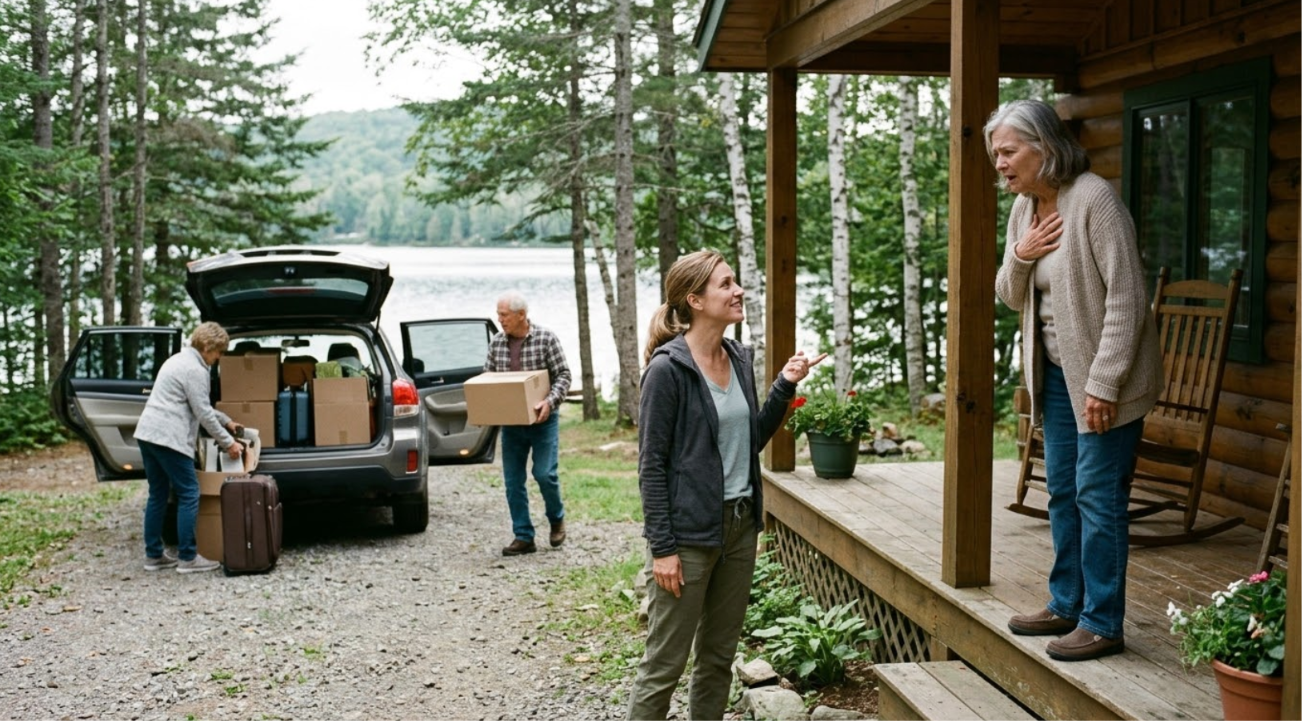
PART 3
I turned toward my son.
“Daniel?”
He looked like a man who had been called to the principal’s office for something he knew he had done but hoped nobody would mention.
“Mom, I thought we could figure this out as a family.”
“Figure what out?”
“Your parents moving into my cabin?”
He rubbed his forehead.
“Brooke said you wouldn’t mind.”
I stared at him for a moment.
Then I looked at Brooke.
“So you told your parents they could move in before you ever asked me?”
Brooke’s cheeks turned pink.
“Because I knew you would make it difficult.”
That sentence landed harder than I expected.
Not because it surprised me.
Because it confirmed something I had been trying not to admit for months.
My daughter-in-law didn’t believe I had the right to say no.
She believed I was the kind of woman who would complain quietly, cry in the bathroom, and eventually give in because keeping the peace was more important than keeping her own home.
She had mistaken my age for weakness.
My widowhood for loneliness.
My politeness for surrender.
And the worst part?
She had probably been right about me for a very long time.
I had spent most of my life trying not to inconvenience anyone.
I had been the wife who remembered birthdays.
The mother who packed extra lunches.
The teacher who stayed after school to help children whose parents couldn’t come.
The woman who brought casseroles to sick neighbors and never expected the dish back until she needed it.
I had been accommodating for so long that people had begun to confuse accommodating with having no boundaries.
But there is a difference between being kind and being available for exploitation.
I had finally learned it.
“Brooke,” I said, “you have two choices. Your parents can take their belongings back to the truck, or they can wait while we discuss the legal steps necessary to remove them from my property.”
She stared at me.
“You can’t be serious.”
“I am.”
Gary cleared his throat.
“Maybe we should just slow things down.”
Denise looked offended.
“Slow things down? We drove three hours. We’ve already sold half our furniture. The apartment was emptied yesterday.”
I felt a small ache in my chest.
Not guilt.
Just the knowledge that somewhere, people had made decisions based on a lie.
But that lie had not come from me.
“Denise,” I said gently, “I am sorry you were told something that wasn’t true. But I never agreed to this arrangement.”
She looked at Brooke again.
“Your daughter said—”
“I know what she said.”
“Then perhaps you two should settle this privately,” Gary said.
“I would be happy to,” I replied. “But the boxes are inside my home. And this conversation needs to happen before another one comes through the door.”
Brooke’s expression changed.
She looked at the boxes already sitting in the spare bedroom.
Then she looked at the moving crew.
Then at me.
“You are embarrassing me,” she whispered.
I almost smiled.
Not because I was happy.
Because for the first time in our relationship, I wasn’t the one feeling embarrassed for refusing to do something unreasonable.
“Brooke,” I said, “you embarrassed yourself when you decided my house was yours to offer.”
Daniel finally stepped between us.
“Mom, please. Can we just talk inside?”
“No.”
He blinked.
I had never refused him so quickly before.
“Mom—”
“No, Daniel. We are not going inside to make this easier for everybody except me. We are standing here because your wife made a decision about my property without my permission. And I am not going to let the truth become a private conversation that somehow ends with me apologizing.”
The silence that followed was unlike anything I had experienced with my family.
It was not peaceful.
It was uncomfortable.
And I was beginning to understand that uncomfortable was not always something I needed to fix.
I turned toward the moving crew.
“Please stop unloading.”
One of the men nodded immediately.
The other looked at Brooke.
She waved her hand impatiently.
“Just keep going.”
The man hesitated.
I held up the county deed.
“This property belongs to me. I have not authorized any further items to be brought inside.”
He looked at the paper.
Then at his coworker.
Then he stepped back.
“Sorry, ma’am. We can’t get involved in a property dispute.”
“That’s fine,” I said. “You don’t need to. Just stop unloading.”
The truck driver closed the back door.
That was when Denise began to cry.
Not loudly.
Not dramatically.
Just a few tears that slid down her face as she stood beside a suitcase that apparently contained the beginning of her new life.
And for a moment, I felt terrible.
I was not a cruel woman.
I had not wanted this scene.
I had wanted my Saturday morning coffee, the sound of water against the dock, and perhaps a little time to finish the book sitting beside my chair.
But I had also spent too many years paying for other people’s decisions with my own peace.
I could feel the old instinct rising.
Maybe I should let them stay for a week.
Maybe I could give them the spare bedroom.
Maybe we could work something out.
Then I remembered the apartment line.
If you don’t like it, go back to the apartment.
I remembered the message in the family group chat.
My parents are moving into the lake house next month.
Not asking.
Announcing.
And I remembered the rings.
The two small circles of gold that Robert and I had worn for nearly forty years.
I had sold them to buy this place.
I wasn’t going to let someone treat it like an extra bedroom in a hotel.
I took a breath.
“Daniel,” I said, “I need you to tell your wife and her parents what you actually knew.”
He looked down.
“Mom, I didn’t know she had booked the truck.”
“Did you agree to her parents moving here?”
He hesitated.
Then nodded.
“Yes.”
“Did you know she hadn’t asked me?”
He nodded again.
I felt something inside me settle.
Not anger.
Something worse.
Disappointment.
“Then you knew this was wrong.”
“Mom, I thought you’d eventually agree.”
I closed the folder.
“That’s the problem, Daniel. You didn’t think I had a choice.”
He looked up at me.
His eyes were red.
“I didn’t think it would happen like this.”
“Neither did I.”
I walked to the porch table and picked up the second envelope.
It was addressed to Daniel.
I had prepared it the night before.
Not because I knew exactly what would happen.
Because Pria had told me to be prepared for every possible version of the conversation.
“Here,” I said.
Daniel took it.
“What is this?”
“Read it.”
He opened the envelope and pulled out the letter.
His eyes moved slowly across the page.
Then he stopped.
“What?”
Brooke reached for it.
“Let me see.”
Daniel pulled the paper closer to himself.
I watched his face.
The color disappeared from his cheeks.
“What did you write?” Brooke demanded.
Daniel didn’t answer.
He read the last paragraph again.
Then looked at me.
“Mom… you really did this?”
“Yes.”
“What does this mean?”
“It means I am no longer willing to let anyone make decisions about my property without my consent. It means I have formally documented that no one has permission to occupy the cabin. And it means that if anyone continues to act as though this is their home, I will take the necessary legal steps.”
Brooke snatched the letter from his hand.
Her eyes moved quickly.
Then she laughed again.
But this time, it wasn’t a confident laugh.
It was the kind of laugh someone makes when they realize the joke is on them.
“You hired a lawyer?”
“Yes.”
“For your own family?”
I looked at her.
“Especially when my own family refuses to listen to me.”
She crumpled the edge of the paper.
“This is unbelievable.”
“No,” I said. “What is unbelievable is that you thought you could move your parents into my home without asking.”
Gary stepped toward Brooke.
“Let’s go. We can figure something else out.”
Denise shook her head.
“I don’t have anywhere to go.”
The words hung in the air.
For the first time, I saw something beyond Brooke’s arrogance.
I saw the fear of two older people who had been told they were about to have a stable place to live, only to discover that the promise had been made by someone who didn’t own the house.
I looked at Denise.
“Do you have a hotel reservation?”
She shook her head.
“Brooke said we’d be staying here.”
I closed my eyes for a moment.
That was the part I hadn’t prepared for.
I could be firm.
I could be clear.
I could refuse.
But I could not make myself stop feeling compassion for people who had been dragged into someone else’s foolishness.
I looked toward Marilyn’s house.
She was no longer watering tomatoes.
She was standing at the edge of her yard with her phone in her hand.
I knew what she was thinking.
She was waiting to see whether I would need her.
I turned back toward Denise.
“There’s a motel about twelve miles from here,” I said. “I can give you the address. I can also help you call and check whether they have rooms available. But I cannot let you stay in this house.”
Brooke stared at me.
“You would send my parents to a motel?”
“They were told they could move into a home that wasn’t yours to offer.”
“Quinn, this is ridiculous.”
“Then you should have asked me before making promises.”
Gary slowly nodded.
“Let’s go, Denise.”
She wiped her face.
Then, to my surprise, she looked at me and said, “I’m sorry.”
I nodded.
“I know.”
She didn’t say anything else.
The movers began putting the boxes back into the truck.
One suitcase.
One lamp.
The folding table.
The winter clothes.
Everything that had crossed my threshold was carried back out.
And as the truck slowly pulled away from the driveway, Brooke stood beside Daniel with her arms crossed.
She looked at me like she had never seen me before.
Maybe she hadn’t.
Maybe the woman she knew was the one who always said, “It’s okay.”
The woman who swallowed insults because she didn’t want a family gathering to become awkward.
The woman who forgave before anyone apologized.
The woman who gave away her last piece of pie because someone else looked hungry.
That woman still existed.
But she was no longer the only woman I was.
I watched the truck turn onto the county road.
Then I looked at my cabin.
My porch.
My dock.
My lake.
My home.
I had protected it.
And I had never felt so alone.
By noon, the driveway was empty.
The moving truck was gone. Gary and Denise were gone. Brooke’s car was gone.
Only Daniel remained.
He stood beside his SUV, staring at the lake as if he were trying to find the right words floating somewhere on the water.
I went inside and put the coffee pot back on.
Not because I wanted coffee.
Because I needed something ordinary to do with my hands.
I washed the two mugs I had used that morning, wiped the kitchen counter, and straightened the stack of mail beside the refrigerator. I could hear Daniel walking around outside. His footsteps stopped near the porch, started again, then stopped.
Finally, he knocked.
I opened the door.
“Can I come in, Mom?”
I stepped aside.
He sat at the kitchen table, the same table Robert and I had bought secondhand when we were first married. The wood was scratched near the edge because Daniel had once tried to cut a piece of cardboard with a pocketknife on it when he was twelve.
I remembered yelling at him.
Robert had laughed.
We had sanded the mark down, but it never disappeared completely.
Daniel stared at it.
“Do you remember this table?”
“Of course.”
“I used to hate it.”
“You hated doing homework on it.”
He smiled faintly.
For a few seconds, we were simply mother and son.
Then he looked at me.
“Why didn’t you tell me you were selling your rings?”
I sat across from him.
“Because I didn’t need you to know.”
“Mom, I would have helped.”
“Would you?”
He looked offended.
“Of course I would.”
I folded my hands.
“Daniel, when Robert was sick, I asked you to drive him to an appointment once. Do you remember what you said?”
He looked down.
“I had work.”
“You did. And I understood. I always understood. When I needed help getting the insurance paperwork sorted out, you said Brooke was overwhelmed. When I asked whether you could come over one afternoon and help me move a heavy cabinet, you said you would try the following weekend. The following weekend came, and I hired someone.”
“Mom, I wasn’t trying to—”
“I know. You weren’t trying to hurt me. But you weren’t trying very hard to help me, either.”
He rubbed his face.
“I thought you were doing okay.”
“That’s what everybody thought.”
I looked toward the kitchen window.
The lake was turning silver under the afternoon sun.
“People saw me teaching. They saw me paying my bills. They saw me bring food to your house at Christmas. They saw me smiling when you asked whether I was lonely. Nobody asked how much it cost me to build this life.”
Daniel’s voice dropped.
“I didn’t know you sold the rings.”
“I didn’t tell you.”
“Why?”
“Because I wanted to buy something without asking anyone for permission or help. Because your father and I spent our whole lives building a life for other people. I wanted one thing that was mine.”
He looked at me for a long time.
Then he said something I had not expected.
“Brooke thinks this house should belong to the family.”
I almost laughed.
“Does she?”
“She says you won’t need it forever. She says we should eventually have a place here, especially if you get older and need help.”
I felt my stomach tighten.
“Eventually?”
Daniel nodded.
“She thinks the cabin is an investment for all of us.”
I leaned back in my chair.
“Daniel, I bought this cabin to escape the idea that every part of my life had to become an investment for somebody else.”
He said nothing.
I could tell he was beginning to understand that this was not about four boxes in a spare bedroom.
It was about a decision that had been made without me.
And there was something else.
Something that bothered me more than the moving truck.
“Daniel,” I said, “when did Brooke start talking about my cabin like it belonged to her?”
He looked uncomfortable.
“She has always liked it.”
“That isn’t what I asked.”
He sighed.
“About six months ago, I guess.”
“Six months?”
“She was talking about her parents’ financial situation. Their rent kept going up. Gary’s hours were cut. Denise had some medical expenses. Brooke said they needed a place where they could live without worrying about rent.”
“And you told her?”
“I told her you probably wouldn’t mind helping.”
I stared at him.
“Helping?”
“Mom, I didn’t think she’d actually move them without asking.”
“Did you ever tell Brooke that the cabin was mine and that I would decide who lived here?”
He swallowed.
“I assumed she knew.”
“Assumptions are expensive, Daniel.”
He rubbed his forehead.
“I know.”
“No. I don’t think you do.”
He looked up.
I continued.
“Your wife planned this for months. She told her parents they could move into my home. She booked a truck. She arranged for their furniture to be moved. She told them they had a place to live. And you stood beside her because you thought I would eventually agree.”
“Mom, I didn’t think she would go that far.”
“But you knew she wanted to.”
He didn’t answer.
I looked at my son, and for the first time that morning, I didn’t see a little boy who had forgotten to do his homework.
I saw a forty-year-old man who had learned to let someone else make difficult decisions as long as he didn’t have to be the one to disappoint anybody.
Except today, someone had disappointed him.
And it was me.
“I need you to understand something,” I said.
“This cabin is not a family project. It is not a future inheritance you can make plans around. It is not a place you can promise to your wife’s parents. It is my home.”
Daniel nodded.
“I understand.”
“Do you?”
“Yes.”
“Then tell Brooke.”
He looked at me.
“What?”
“Tell your wife that this cabin is mine. Tell her she cannot make plans for it. Tell her the fact that I am your mother does not mean she has a right to my property.”
He looked away.
“I will.”
I stood and poured him another cup of coffee.
He accepted it.
For a few minutes, neither of us spoke.
Then he asked, “Are you going to change your will?”
I stopped pouring.
That was an interesting question.
Not because I hadn’t thought about it.
Because he had asked it before asking whether I was okay.
I placed the coffee pot down.
“Why?”
He looked surprised.
“I mean, after all this, I thought you might.”
“Are you worried about your inheritance?”
“No. That’s not what I mean.”
“Then what do you mean?”
He looked at his coffee.
“I don’t want Brooke to think this means we’re being cut out of your life.”
I stared at him.
“Daniel, you are my son. You are not being cut out of my life. But you are also not entitled to control it.”
He nodded slowly.
“I know.”
“Your father’s will left his estate to me. My will is my decision. My property is my decision. My money is my decision. If I want to spend the next twenty years watching sunsets from this porch and eating grilled cheese sandwiches, that is my decision.”
He smiled a little.
“You still make grilled cheese the same way.”
“Because it’s good.”
He finally laughed.
It was a small laugh.
A familiar one.
And for a moment, I felt the grief of losing Robert ease.
But then Daniel said, “Brooke’s going to be furious.”
I looked out the window.
“She already is.”
“She’ll say you humiliated her.”
I turned toward him.
“Did I?”
He didn’t answer.
“Daniel, I did not humiliate your wife. I stopped her from doing something she had no right to do. There is a difference.”
He nodded.
Then he stood.
“I should go.”
I walked him to the porch.
He hugged me, but it was an awkward hug. The kind that comes when two people have too many things they want to say and neither knows how to begin.
“Love you, Mom.”
“I love you, too.”
He got into his SUV.
Before he closed the door, he looked at me.
“Can I come back next weekend?”
I thought about it.
“Of course.”
His face softened.
“Thanks.”
“But Daniel?”
He paused.
“Yes?”
“Come next weekend because you want to see me. Not because Brooke wants to discuss the cabin.”
He nodded.
“I promise.”
I watched him drive away.
Then I went inside.
I locked the door.
And for the first time since the moving truck arrived, I allowed myself to cry.
Not because I had lost my home.
I hadn’t.
But because I had finally realized how close I had come to losing it.
And because the people I loved most had been willing to take something from me without even asking.
At 4:37 that afternoon, my phone rang.
Brooke.
I let it ring twice before answering.
“Hello.”
“Quinn, we need to talk.”
Her voice was cold.
“About what?”
“About what happened today.”
I sat down on the porch.
“There’s nothing left to discuss about your parents moving into my cabin.”
“Oh, don’t do that.”
“Do what?”
“Act like you’re some victim here.”
I said nothing.
She continued.
“My parents are humiliated. They had to unload everything and drive back to their apartment. Gary’s knee is killing him. Denise has been crying for hours.”
“I’m sorry they’re upset.”
“Sorry? That’s all you have to say?”
“Brooke, what would you like me to say?”
She took a breath.
“I want you to stop making this about the deed.”
I almost dropped my phone.
“Stop making this about the deed?”
“Yes. Family should be more important than paperwork.”
I looked at the navy-blue box sitting inside the house.
“Family is important. That’s why I expected you to ask before making a decision about my home.”
“You’re being selfish.”
There it was.
The word I had been waiting for.
Selfish.
It is a strange word when someone uses it against you for refusing to give them something you worked your entire life to earn.
I had been called selfish for taking a day off when Robert was sick.
Selfish for not babysitting when I was exhausted.
Selfish for refusing to lend money I didn’t have.
Selfish for wanting to retire.
And now selfish for keeping my own house.
I took a deep breath.
“Brooke, I will not discuss this further today.”
“You can’t just—”
“I can.”
I ended the call.
My hands shook for a moment.
Then I placed the phone face down.
I watched the sun slowly disappear behind the trees.
And I made myself a grilled cheese sandwich.
For the first time in a very long time, I ate dinner without worrying about whether someone else was angry with me.
But at 8:16 that evening, a message appeared.
Not from Brooke.
From Denise.
It was a photograph.
A screenshot of a message conversation between Brooke and her parents.
And underneath the picture, Denise had written:
“Quinn, I think you deserve to know what Brooke told us before we packed our things. I didn’t know she was telling you something different. Please don’t let her know I sent this.”
I opened the screenshot.
The first message was from Brooke.
Don’t worry. Quinn won’t say no. She never does.
The next one was from Denise.
Are you sure she won’t mind? It is her cabin.
Brooke’s reply was:
Daniel already agreed. Quinn is lonely anyway. She needs people around her. We are doing her a favor.
I read that sentence twice.
We are doing her a favor.
Then another message appeared in the screenshot.
Brooke had written:
Once Mom and Dad are settled, Daniel and I can start talking to Quinn about moving closer to us. The lake house is too much for her at her age. Eventually, she will see it makes more sense for us to handle it.
My fingers went cold.
I scrolled down.
There was one more message.
And this one made me sit up straight.
Don’t worry about the deed. Daniel said if something happens to Quinn, we will be the ones handling everything anyway.
I stared at the screen.
Then I looked toward the navy-blue box.
The deed.
Robert’s will.
My notarized notice.
Everything I had prepared.
And suddenly, I realized that the moving truck had never really been the beginning of this story.
It was only the first time Brooke had been forced to discover that I could say no.
I picked up my phone and called Pria.
She answered on the third ring.
“Quinn? Is everything okay?”
“No,” I said. “I think we need to talk about something else.”
“What happened?”
I looked at the screenshot again.
“Brooke isn’t just trying to move her parents into my cabin.”
I swallowed.
“She’s making plans for what happens to me next.”
And for the first time since Robert died, I was afraid of something I couldn’t see coming.
Because I had spent the last three years believing my family was simply careless with my feelings.
Now I was beginning to wonder whether they had been careless with my future, too.
And I had a feeling the next thing I uncovered would be much worse.
PART 4
Pria listened to me read the messages twice.
The first time, she said nothing.
The second time, she asked me to forward every screenshot Denise had sent.
“Quinn, don’t respond to Brooke tonight,” she said. “Don’t argue. Don’t threaten. Don’t tell her what you’re thinking of doing. Save everything.”
“Do you think they’re trying to take my house?”
“I think we need to understand what they are planning before we assume anything. But those messages are concerning. Especially the part about your age and what happens if something happens to you.”
I sat on my porch with my cardigan wrapped around my shoulders.
The lake was dark now. The dock lights reflected in the water, making little trembling lines that disappeared whenever the wind moved.
“I never thought my own son would be part of something like this.”
“Daniel may have agreed to things without understanding what Brooke was doing. But we shouldn’t make assumptions about his intentions. We need facts.”
That was Pria.
She never let emotions make decisions that documents could make better.
“Tomorrow morning,” she said, “I want you to do three things. First, make sure your property records are secure and current. Second, review your will and any power-of-attorney documents. Third, write down everything that happened today, including who was there, what was said, and what was brought into the cabin.”
“What about the messages?”
“Keep the originals. Don’t delete them. Don’t edit them. If Denise is willing to provide a statement about what she was told, that’s something we can discuss later. But don’t pressure her.”
I agreed.
After we hung up, I sat for another twenty minutes.
Then I went inside and opened the drawer where I kept Robert’s old notebooks.
He had been a man who wrote everything down.
The price of lumber.
The number of miles on his truck.
The name of a doctor who had treated him well.
The date we planted our first apple tree.
Sometimes he wrote things that made no sense to anybody but him.
One notebook had a list of things he wanted to do after retirement.
Fishing in Canada.
Driving along the coast of Maine.
Building a little workshop.
Buying a cabin near a lake.
The cabin near a lake was the last item on the list.
I ran my finger over his handwriting.
“Well, Robert,” I whispered, “I got the cabin.”
I closed the notebook.
Then I cried again.
But this time, I wasn’t crying because I felt powerless.
I was crying because I had finally understood how much I had sacrificed to build a life that I was afraid to defend.
The next morning, I drove into town.
Pria had arranged for me to meet her at 10:00.
Before I went to her office, I stopped at the county courthouse.
The woman at the property-record counter knew me from when I had helped organize the school library fundraiser years earlier.
“Quinn Burn! What brings you here?”
“Just checking some records.”
She smiled.
“Buying another property?”
“Not exactly.”
I asked for a certified copy of the deed and verified that the ownership record remained unchanged.
My name.
Only my name.
No liens.
No transfers.
No recorded agreements.
Then I drove to Pria’s office.
She had already printed the screenshots.
We reviewed my will, the deed, the title insurance, my retirement accounts, and the documents I had signed when I bought the cabin.
Pria asked me about my wishes.
Not what Daniel wanted.
Not what Brooke thought was reasonable.
Not what other family members would consider fair.
My wishes.
“What do you want to happen to the cabin if you become unable to live independently?” she asked.
I thought about it.
“I want to stay there as long as it’s safe. If I need assistance, I want to be able to hire someone. If I eventually need a different kind of care, I want to decide where I go. I don’t want anyone moving into my house because they think they can make decisions for me.”
Pria nodded and wrote it down.
“What do you want to happen to the property after your death?”
I hesitated.
Daniel was my only child.
I had always assumed he would inherit everything.
But now I realized I had never really asked myself what I wanted my legacy to look like.
I had simply followed the path everyone expected.
“My son can inherit what I decide to leave him,” I said. “But I don’t want anyone treating my property as though they already own it.”
“That’s perfectly reasonable.”
We discussed options.
I decided to update my will, clarify my wishes, and establish protections so that my property would not be managed by someone I had not chosen if I became incapacitated.
I also appointed a trusted independent person as an alternate agent for certain responsibilities rather than automatically relying on family.
Pria did not encourage me to punish Daniel.
She encouraged me to make decisions that protected me.
And that distinction mattered.
I wasn’t trying to take revenge.
I was trying to stop living as though my future belonged to everybody but me.
When I left her office, I felt lighter.
Not because everything was solved.
But because everything was finally written down.
Three days later, Daniel called.
“Mom, can we talk?”
“Of course.”
“Can I come over tonight?”
“Yes.”
He arrived at 6:30 carrying a bag from the grocery store.
“I brought dinner,” he said.
I looked inside.
Chicken soup.
Bread.
A small container of strawberry pie.
“You didn’t have to bring all this.”
“I know.”
We ate at the kitchen table.
He barely touched his soup.
Finally, he set down his spoon.
“Brooke showed me the messages.”
I looked at him.
“Which messages?”
“The ones her mother sent you.”
I didn’t answer.
He rubbed his hands together.
“Mom, I didn’t know she was saying all that.”
“Did you know Brooke planned to move her parents into my cabin?”
He stared at the table.
“Yes.”
“Did you know she told them I wouldn’t say no?”
He took a breath.
“No.”
“Did you know she was talking about moving me closer to you and eventually taking over the cabin?”
He looked up sharply.
“No. I didn’t know that.”
I believed that part.
But I also knew believing him didn’t erase what he had done.
“Daniel, you agreed to let her parents move into my home.”
“I thought it was temporary.”
“How temporary?”
“A few months. Until they got back on their feet.”
“Did you ever ask me?”
“No.”
“Why?”
He was quiet for a long time.
Then he said, “Because I knew you’d probably say no.”
I leaned back.
There it was.
The truth.
Not a misunderstanding.
Not a scheduling mistake.
He knew I might refuse, so he had avoided asking.
“Daniel,” I said, “when you know somebody might say no, you ask them anyway. You don’t make the decision for them.”
He nodded.
“I know.”
“Do you?”
He looked at me with tears in his eyes.
“I think I have spent a long time making Brooke happy because I didn’t want to fight with her. And I let you get caught in the middle of it.”
“You didn’t get me caught in the middle. You put me at the bottom of the list.”
He began to cry.
And I didn’t rush to comfort him.
That was difficult.
Every instinct in me wanted to stand up, wrap my arms around him, and tell him everything was fine.
But everything wasn’t fine.
He had to sit with the truth long enough to understand it.
“I love you,” he said.
“I love you too.”
“Can you forgive me?”
I looked at him.
“Eventually, perhaps. But forgiveness doesn’t mean I pretend this never happened. And it doesn’t mean you get to make the same decision again.”
He nodded.
“I understand.”
I reached across the table and took his hand.
“Daniel, I don’t want to lose my son. But I am not willing to lose myself to keep him.”
He squeezed my hand.
For the first time in weeks, I felt that maybe our relationship could survive this.
But it would have to become something different.
Something honest.
Brooke did not call to apologize.
Instead, she sent a message on Thursday morning.
Daniel says you are changing your will. I hope you understand how much this is hurting him.
I read it.
Then I put my phone down.
An hour later, another message came.
My parents are now staying with us. Our house is crowded. We have nowhere else to go. You could have prevented all of this.
I didn’t reply.
Then:
You are really going to let your own family suffer because you want to sit alone by a lake?
I stared at the message for a long time.
Then I wrote:
Brooke, I hope your parents find a stable place to live. But my home is not available for occupancy. Please do not make any further arrangements involving my property.
I sent it.
She responded almost immediately.
Unbelievable.
That was the last message I received from her for eleven days.
During those eleven days, I did something I hadn’t done in years.
I started living.
Not simply existing.
Living.
I planted flowers beside the porch.
I bought a secondhand kayak from a man in town.
I started walking the lake path every morning at seven.
I made friends with a woman named Susan who lived two houses down and had a dog named Walter that seemed to believe I was personally responsible for every squirrel in Wisconsin.
I read three books.
I cooked meals that lasted exactly one evening.
I took naps without feeling guilty.
And every evening, I watched the sun go down.
The cabin slowly became the place I had imagined.
Quiet.
Peaceful.
Mine.
One Saturday, Marilyn came over carrying a bowl of tomatoes.
“These are terrible,” she said.
“They look fine.”
“They taste like disappointment.”
I laughed so hard I nearly dropped my coffee.
She sat beside me.
Then she looked at the lake.
“You know, Quinn, I think you handled that better than I would have.”
“I don’t know. I cried for two days.”
“That’s not the same as giving in.”
She took a sip of coffee.
“People think older women become invisible. Sometimes they just become tired of explaining themselves.”
I looked at her.
She smiled.
“Don’t let anyone confuse your tiredness with permission.”
I wrote that sentence down later.
Eleven days after the moving truck incident, Brooke finally called me.
I was standing on the dock, holding a fishing rod I had absolutely no idea how to use, when my phone vibrated in my pocket.
I almost ignored it.
Then I saw her name.
“Hello, Brooke.”
“Quinn, can we talk?”
Her voice was different.
Not cheerful.
Not sharp.
Careful.
“About what?”
“I think we need to clear the air.”
I reeled in my fishing line. There wasn’t a fish on it. There hadn’t been one all morning.
“Go ahead.”
She sighed.
“I know things got out of hand that Saturday.”
“Things didn’t get out of hand, Brooke. You made a decision without asking me, and I stopped it.”
“Okay. Fine. I know you feel that way.”
I closed my eyes.
You feel that way.
As though the deed were a feeling.
As though ownership were a disagreement about the temperature in the room.
“Brooke, if you want to apologize, you can. But I’m not going to argue about what happened.”
“I am trying to apologize.”
“Then I’m listening.”
There was a pause.
“My parents are really struggling. They’re staying with us, and it’s been stressful. Gary can’t find work that pays what he used to make. My mom is worried about everything. Daniel and I barely have any space.”
I said nothing.
“I just thought the cabin would be a good solution for everybody. I didn’t think you would react like that.”
I looked at the water.
“How did you think I would react?”
“Honestly? I thought you would be upset at first. But I thought you’d understand eventually.”
There it was again.
She had not expected me to agree immediately.
She had expected me to be difficult for a little while, then surrender.
“I see,” I said.
“Quinn, can we please move past this? I don’t want there to be bad feelings between us.”
“Neither do I.”
“Then maybe you could help us out a little.”
I knew what was coming.
“Maybe not the whole cabin,” she continued. “But just for a few months? My parents could stay in the spare room. We could figure out a schedule. You could come stay with us sometimes. It would make things so much easier.”
I almost admired the way she had managed to turn an apology into another request.
“Brooke,” I said, “you haven’t apologized for what you did. You’ve explained why you did it. Those are not the same thing.”
She became quiet.
Then she said, “I am sorry you felt disrespected.”
I slowly lowered the fishing rod.
“That is not an apology.”
“What do you want me to say?”
I thought about it.
“I want you to understand that you do not get to decide what happens in my house. I want you to acknowledge that you made a promise you had no authority to make. And I want you to stop asking me to give up my home because your circumstances are difficult.”
She sighed heavily.
“Fine. I’m sorry I made the arrangements without asking.”
I waited.
“I’m sorry I didn’t talk to you first.”
I waited again.
“But I still think you could have handled it better.”
That was the condition.
The apology came with a little piece of blame attached to it, as though I should pay a fee for accepting it.
I didn’t argue.
“Brooke, I hope things get better for your parents. But my answer is still no.”
She hung up.
I stood on the dock.
The fishing rod was useless.
The lake was beautiful.
And I realized that sometimes the most important thing you can do is refuse to participate in a conversation that has already been decided for you.
Two weeks later, Gary called.
I was surprised to see his name.
I answered.
“Hello, Gary.”
“Quinn. I hope I’m not bothering you.”
“No, you’re fine.”
He cleared his throat.
“I wanted to apologize for Saturday.”
I sat down on the porch.
“There’s no need to apologize for being told something that wasn’t true.”
“Well, I should have checked with you. Denise and I were told you were okay with it. Brooke said Daniel had already spoken to you.”
“He hadn’t.”
“I know that now.”
There was a long pause.
Then Gary said, “I don’t want you to think we were trying to take advantage of you.”
“I don’t think you were.”
“I have to tell you something, though.”
I waited.
“Brooke was talking about the cabin before that Saturday. More than once. She said she wanted to get us out of the apartment. She said you were lonely and that having us around would be good for you. She made it sound like you were already thinking about it.”
My stomach tightened.
“How long had she been talking about it?”
“At least a couple of months.”
I thanked him.
He sounded ashamed.
“Quinn, I should have called you before we packed. I know that. I was just desperate. The apartment was expensive, and we were falling behind. Brooke told us she had a plan.”
I didn’t blame Gary for needing help.
I blamed the lie.
“Gary, I hope you and Denise find a good place. I truly do.”
“We’re looking. Daniel has been helping us search.”
“That’s good.”
Then he said something that surprised me.
“Brooke isn’t happy with Daniel right now.”
“Why?”
“Because Daniel told her he wasn’t going to make any more decisions about your cabin. And apparently, he told her he didn’t agree with what she said in those messages.”
I was quiet.
“He’s standing up to her?”
“Seems like it.”
I thanked Gary for calling.
After we hung up, I sat for a while, thinking about my son.
Maybe this was the first time he had ever really stood up to his wife about something that mattered.
I hoped it wasn’t the last.
Daniel came to the cabin the following Sunday.
He brought no food.
No excuses.
No envelope.
Just himself.
He sat on the porch while I made coffee.
“Mom, I need to tell you something.”
I handed him a mug.
“Go ahead.”
“Brooke and I have been fighting.”
I nodded.
“I figured.”
“She says I betrayed her by changing my mind about the cabin.”
I sat down.
“Did you change your mind?”
“No. I finally admitted I never had the right to agree in the first place.”
I looked at him.
He was tired.
Not the kind of tired that comes from a long workweek.
The kind that comes from being forced to look at yourself honestly.
“I told her I was wrong,” he continued. “I told her I should have asked you. I told her I shouldn’t have let her make promises. And I told her I wasn’t going to pressure you anymore.”
“What did she say?”
“She said I was choosing you over her.”
I took a sip of coffee.
“And what did you say?”
He looked at the lake.
“I said I wasn’t choosing between my mother and my wife. I was choosing to stop letting someone else make decisions for me.”
For a moment, I couldn’t speak.
Those were words I had wanted to hear for years.
Not because I wanted him to fight Brooke.
Because I wanted him to become a man who could stand behind his own decisions.
“I am proud of you,” I said.
His eyes became wet.
“I should have done this a long time ago.”
“Maybe.”
He laughed quietly.
“You could have at least said no the first time she mentioned it.”
“That would have been nice.”
We sat together.
Then he asked, “Can I help you with anything around the cabin?”
I looked at him.
“Actually, the dock railing needs another coat of sealant.”
He stood immediately.
“Show me.”
We spent the next two hours working.
He sanded the wood.
I applied the sealant.
He complained about the mosquitoes.
I told him he was being dramatic.
We laughed.
At one point, he stopped and looked toward the lake.
“Mom?”
“Yes?”
“I don’t think I ever understood how much this place meant to you.”
I wiped my hands.
“That’s because I didn’t have it until recently.”
He nodded.
“I know.”
Then he said, “I want to make sure I never forget that again.”
I didn’t ask him to promise.
Promises had become cheap in my family.
Instead, I said, “Then remember it when nobody is watching.”
He looked at me.
And I knew he understood.
Brooke and Daniel did not separate.
They had been married for twelve years.
There were good days between them, too.
I knew that.
But the cabin incident forced them to face a problem that had been growing quietly for years.
Brooke had become accustomed to making decisions.
Daniel had become accustomed to avoiding conflict.
And together, they had built a marriage where the loudest voice usually won.
For the first time, Daniel stopped agreeing simply because it was easier.
It did not happen overnight.
There were arguments.
There were difficult conversations.
There were nights when he slept on the couch.
There were mornings when Brooke told him he was selfish.
But eventually, something changed.
He started speaking.
And Brooke started listening.
Not always happily.
But listening.
Gary and Denise found a small rental duplex about twenty minutes from Daniel and Brooke’s house.
It was not the lake cabin.
It was not luxurious.
But it had two bedrooms, a little backyard, and a landlord who allowed Gary to plant tomatoes.
Denise called me once to tell me the kitchen had terrible cabinets.
I laughed.
“Then paint them.”
“I don’t know how.”
“Neither did I the first time.”
She laughed, too.
And for the first time, we talked without the cabin being the subject.
PART 5
Three months passed.
Autumn arrived.
The trees around Lake Anders turned gold, orange, and red.
I bought a heavier sweater.
I put a blanket on the porch chair.
I learned to fish.
I caught two small bluegill and one fish that I couldn’t identify but that Marilyn insisted was “probably not worth bragging about.”
The cabin became home.
One rainy afternoon, I decided to clean the closet in the spare bedroom.
It was the room Brooke had planned to give her parents.
I had never really looked at the closet since moving in.
At the back, behind an old box of Christmas decorations, I found a small wooden case.
It belonged to Robert.
I recognized it immediately.
He had used it to store important papers and little things he never wanted to lose.
Inside were old photographs, a watch that had stopped working, a few receipts, and an envelope with my name on it.
My hands began to tremble.
The envelope was yellowed.
The handwriting was Robert’s.
Quinn, open this when you finally get the lake house.
I sat on the floor.
I had never seen it before.
I opened it carefully.
Inside was a letter.
My Quinn,
If you are reading this, then somehow you finally bought that little place near the water we used to talk about.
I know you. I know you probably spent more time worrying about whether everybody else was okay than whether you were happy.
I hope you didn’t do that this time.
I hope you bought the cabin because you wanted it.
I hope you put your coffee on the porch and watched the sunrise.
I hope you don’t feel guilty about sleeping late.
I hope you don’t apologize for being tired.
And I hope you remember that you are not required to make yourself smaller so everybody else can feel comfortable.
You have spent your whole life being a good wife, a good mother, a good teacher, a good neighbor, and a good friend.
Those are beautiful things.
But you are also allowed to be Quinn.
You are allowed to want things.
You are allowed to say no.
You are allowed to keep what you worked for.
If our boy ever forgets that, remind him.
If somebody tells you that being a family means you must surrender everything, tell them I disagree.
Love does not mean ownership.
Love does not mean permission to take.
Love means being glad the other person has a life of their own.
I wish I could be there on that porch with you.
I would probably complain about the mosquitoes, tell you the dock needs fixing, and make you burn the toast again.
But I would be happy.
Because you made it.
You made a place that was yours.
And I hope you never let anybody make you feel guilty for living in it.
All my love,
Robert.
I read it once.
Then again.
Then I pressed the letter against my chest and cried until the rain stopped.
Robert had been gone for three years.
But somehow, sitting on the floor of that little cabin, I felt as though he had finally answered a question I had been carrying since the day I buried him.
I wasn’t selfish.
I wasn’t unreasonable.
I wasn’t cruel.
I was simply a woman who wanted to live the rest of her life in a house she had bought with her own money.
And there was nothing wrong with that.
I placed the letter in a frame.
I put it on the shelf beside the kitchen.
Not hidden.
Not tucked away.
Right where I could see it every morning.
Thanksgiving came six weeks later.
For the first time in twelve years, Daniel called me before Brooke did.
“Mom, are you coming for Thanksgiving?”
I was standing in the kitchen, stirring soup.
“Where?”
“Our house. Brooke is cooking.”
I paused.
“Is she inviting me?”
“Yes. She said she wants everybody together.”
I wasn’t sure what to make of that.
The previous Thanksgiving, I had spent nearly the entire day cooking at their house. I bought the turkey, made stuffing, brought pies, washed dishes, and left with a container of leftovers that Daniel had forgotten to put in the refrigerator.
I hadn’t complained.
But this year, I wasn’t going to spend the day proving I deserved to be invited.
“I’ll come,” I said. “But I won’t be cooking everything.”
Daniel laughed.
“Brooke said she already knows.”
That surprised me.
I agreed to bring one pie.
Nothing else.
On Thanksgiving morning, I drove to their house with a pecan pie in the passenger seat.
When I walked in, Gary was watching football. Denise was setting the table. Brooke was in the kitchen.
She looked at me.
“Hi, Quinn.”
“Hello, Brooke.”
She took the pie.
“Thank you.”
There was an awkward silence.
Then she said, “Can I talk to you for a minute?”
I followed her into the kitchen.
She stood beside the counter, looking down at her hands.
“I owe you an apology.”
I didn’t say anything.
“I know I was wrong about the cabin. I had no right to make those arrangements. I should have asked you, and I should have accepted your answer.”
I looked at her.
She continued.
“I think I convinced myself that because you were alone, you didn’t really need all that space. And because my parents were struggling, I thought I was doing the right thing.”
She swallowed.
“But I wasn’t thinking about what you wanted. I was thinking about what I wanted to solve.”
That was the first apology she had given me that didn’t come with a request.
“I appreciate you saying that,” I replied.
She nodded.
“I don’t expect you to forget what happened.”
“Good.”
She almost smiled.
“I guess I deserved that.”
We stood quietly.
Then she said, “I hope you’re happy at the cabin.”
I thought about the morning sun.
The coffee.
The dock.
Robert’s letter.
The flowers beside the porch.
“I am,” I said.
And for the first time, I meant it without having to convince myself.
Dinner was surprisingly pleasant.
Gary talked about his new job repairing equipment at a local warehouse.
Denise told us she had planted tomatoes in their new backyard and was already arguing with Gary about how much water they needed.
Daniel told a story about a customer who had brought a dog into his office and accidentally left with someone else’s briefcase.
Everyone laughed.
Brooke didn’t make any comments about the cabin.
Nobody asked whether I was lonely.
Nobody suggested I should move closer to them.
After dinner, Daniel helped his father-in-law carry a chair into the garage.
Denise was washing dishes.
Brooke sat beside me on the sofa.
“Quinn?”
“Yes?”
“I hope we can do better from now on.”
I looked at her.
“That depends on what you do from now on.”
She nodded.
“I know.”
I didn’t offer her a dramatic forgiveness speech.
I didn’t tell her everything was forgotten.
Because it wasn’t.
Trust is not a light switch.
It’s a bridge.
And bridges are built slowly, with every small action that proves the other person is no longer trying to cross a boundary without permission.
That evening, when I drove home, I realized I hadn’t felt anxious once.
I hadn’t been watching Brooke’s face to see whether she was angry.
I hadn’t been trying to fix anybody’s mood.
I had simply been there.
And that was enough.
The following spring, I planted a lilac bush beside the porch.
Robert loved lilacs.
He used to say that a house wasn’t truly home until something had been planted there that would outlive the people who put it in the ground.
I planted it myself.
Marilyn stood beside me, giving advice I had not asked for.
“Dig deeper.”
“I am digging deeper.”
“That hole isn’t deep enough.”
“Marilyn, I taught third grade for thirty-four years. I know how to dig a hole.”
She laughed.
“Apparently not.”
We spent the morning planting the bush.
Afterward, she sat on the porch with me and ate a sandwich.
“Have you thought about what you’re going to do with the cabin eventually?” she asked.
I looked at her.
“Eventually?”
“Well, you aren’t going to live forever.”
“Neither are you.”
“That’s not the point.”
I smiled.
“I have thought about it. I want to live here as long as I can. I want to enjoy it. I want to travel if I feel like traveling. I want to spend my money while I’m alive. I want to make decisions while I can still make them.”
Marilyn nodded.
“Good.”
“I don’t want my life to become a waiting room for somebody else’s inheritance.”
She looked at me and raised her coffee mug.
“Now that’s a sentence worth remembering.”
And I did.
Because I had spent so much of my life saving things for later.
Saving money.
Saving time.
Saving the good dishes.
Saving my energy for everybody else.
Saving the vacation days.
Saving the nice dress.
Saving my dreams for when the children were older, when Robert was better, when work was easier, when everything settled down.
But life never settles down.
It simply keeps moving.
And eventually, you have to decide whether you’re going to keep waiting or start living.
I had finally started living.
Almost a year after the moving truck arrived, Brooke and Daniel came to visit the cabin.
They brought groceries.
Daniel fixed the loose step on the porch.
Brooke helped me prepare dinner.
She had changed.
Not completely.
People don’t become different overnight.
But she had stopped treating my decisions like obstacles to her plans.
After dinner, Daniel went outside to look at the dock.
Brooke stayed in the kitchen with me.
She looked around the cabin.
“I understand now why you didn’t want to give this place up.”
I wiped the counter.
“I never wanted to give it up.”
She nodded.
“I know.”
Then she asked something I had never expected.
“Do you think you’ll leave it to Daniel?”
I stopped wiping.
I looked at her.
“Why are you asking?”
She immediately shook her head.
“I’m not trying to pressure you. I really am just asking.”
I thought for a moment.
Then I told her the truth.
“I haven’t decided. I may leave it to Daniel. I may sell it and use the money for my care. I may donate some of it. I may leave it to someone who needs a fresh start. I don’t know yet.”
She nodded.
“That’s fair.”
I looked at her.
“Brooke, I want you to understand something. This cabin isn’t valuable because of what it might be worth someday.”
She glanced toward the window.
“I know.”
“It’s valuable because I get to live here now. Because I can wake up and drink coffee beside the lake. Because I can decide whether to fish, read, sleep, or do absolutely nothing. Because I don’t have to ask anybody whether I am allowed to enjoy my own life.”
She looked down.
“I think I understand that now.”
I continued.
“Whatever I decide to do with this property someday, it will be my decision. And I don’t want anybody making plans around it.”
She nodded.
“Understood.”
For a moment, I believed her.
Not because she said the right words.
Because she no longer looked like she was waiting for me to change my answer.
On my sixty-eighth birthday, I woke up before sunrise.
The lake was still.
The sky was pale blue.
I made coffee and sat on the porch.
I didn’t check my phone.
I didn’t wait for anyone to call.
I didn’t wonder whether Daniel remembered.
I simply sat there.
At 8:12, Marilyn walked over with a small cake.
“Happy birthday, old woman.”
“I’m only sixty-eight.”
“Exactly.”
We laughed.
At noon, Daniel arrived.
He carried flowers and a card.
Brooke came with him.
Gary and Denise came too.
They had never visited the cabin since the moving truck incident.
I was surprised.
But I welcomed them.
They brought lunch.
We ate on the porch.
Gary told a story about a machine at work that had broken down three times in one week.
Denise complained about the tomatoes.
Daniel gave me a book.
Brooke gave me a small framed photograph.
It was a picture of the cabin taken during the summer.
The lake was bright.
The lilac bush was blooming.
The porch looked peaceful.
Underneath the picture, she had written:
“A home should belong to the person who lives in it. Happy birthday, Quinn.”
I looked at her.
She smiled.
“Happy birthday.”
I thanked her.
And I meant it.
Not because the past had disappeared.
But because the future had finally become something I could choose.
That evening, after everyone left, I walked down to the dock.
The sun was sinking.
The lake was turning gold.
I thought about the moving truck.
The boxes.
The words Brooke had said.
Go back to the apartment if you don’t like it.
I thought about the woman I had been that morning.
The woman sitting with untouched coffee, wondering whether she was about to lose the only place in the world she had bought entirely for herself.
Then I thought about the woman standing there now.
The woman who had said no.
The woman who had hired a lawyer.
The woman who had cried and still kept the deed.
The woman who had learned that she could love her family without surrendering her home.
I reached into my pocket and pulled out Robert’s letter.
I had folded it carefully and carried it with me.
I read the last few lines again.
Love does not mean ownership.
Love does not mean permission to take.
Love means being glad the other person has a life of their own.
I looked at the lake.
“You’re right, Robert,” I whispered.
“I finally understand.”
I wasn’t waiting for permission anymore.
I wasn’t waiting for my son to approve.
I wasn’t waiting for my daughter-in-law to understand.
I wasn’t waiting for the next holiday.
I wasn’t waiting for the next family crisis.
I wasn’t waiting to be useful.
I was sixty-eight years old.
I had spent thirty-four years teaching children.
I had spent nearly forty years loving a husband.
I had spent decades raising a son.
I had spent years caring for other people.
And now, I had a little cabin on a lake.
Two bedrooms.
Pine floors.
A dock.
One kitchen window that caught the sunrise.
And my name on the deed.
Only my name.
Epilogue: The Woman Who Finally Said No
Two years later, I still live at Lake Anders.
The lilac bush has grown taller.
The dock has been repaired twice.
I still can’t fish very well, but I have become excellent at sitting beside the water pretending I know what I’m doing.
Daniel visits regularly.
Sometimes he comes alone.
Sometimes Brooke comes with him.
Our relationship isn’t perfect.
There are still moments when Brooke tries to offer advice I didn’t ask for.
There are still moments when Daniel forgets that I don’t need him to solve every little thing.
But now I say what I mean.
And they listen.
Gary and Denise have their own place.
Gary works part-time.
Denise grows tomatoes that are much better than Marilyn’s.
We occasionally have dinner together.
Nobody has mentioned moving into my cabin again.
And if they ever do, I already know what I will say.
No.
Not because I don’t love them.
Not because I am angry.
Not because I am lonely.
But because I have finally learned that a boundary doesn’t need to be cruel to be firm.
The cabin is still my home.
My coffee still tastes better on the porch.
My mornings are still quiet.
And every now and then, I stand in the spare bedroom—the room that once held four boxes, one suitcase, a folding table, and somebody else’s plans—and smile.
Because that room is still exactly what I intended it to be.
A spare room.
Not a promise.
Not an inheritance.
Not a family decision.
Just a room in my house.
And I am the one who decides who sleeps in it.
At sixty-nine, I finally understood something I wish I had learned at thirty.
You do not have to give away your peace to prove that you have a good heart.
You do not have to surrender your home to prove that you love your family.
And you do not have to apologize for protecting something you worked your entire life to build.
Sometimes the most loving thing you can do is say no.
Sometimes the most important house you will ever own is the one where you finally feel safe saying it.
And sometimes, after a lifetime of putting everyone else first, the happiest ending isn’t a bigger house, more money, or a family that suddenly understands everything.
Sometimes the happiest ending is a quiet morning.
A cup of coffee.
A lake that belongs to no one.
And a woman sitting on her own porch, finally living the life she spent so many years earning.
The cabin was never just a piece of property.
It was the first place in my life where I didn’t have to ask permission to be myself.
And I never gave that away again.