
PART 3
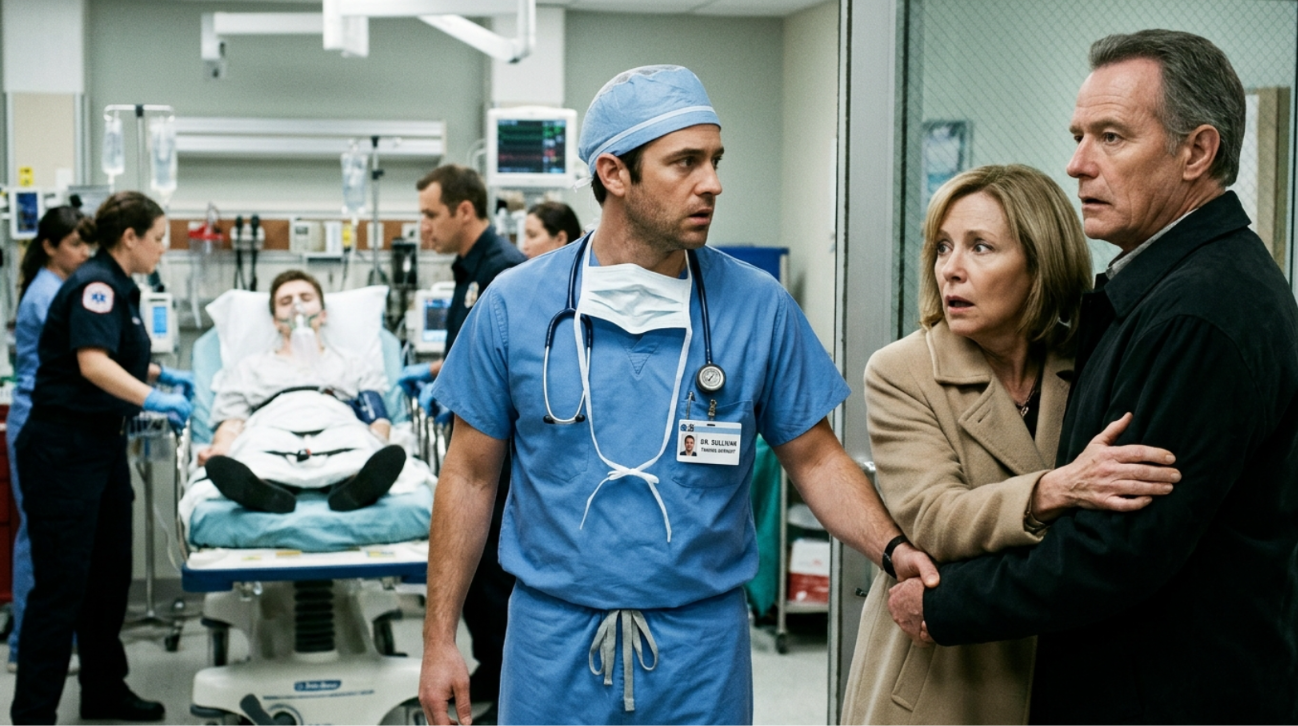
I looked down at the badge on my chest.
Then back at her.
“I tried.”
My father took one step toward me.
“Arthur, listen. We didn’t know. Julian told us—”
“Exactly.”
My voice wasn’t loud, but it stopped him.
“Julian told you something, and you believed him. I told you something, and you refused to listen.”
My mother pressed the tissue against her mouth.
“We thought you had left medical school.”
“I know what you thought.”
“We thought you were in trouble.”
“I know.”
“We were worried about you.”
That sentence finally broke something inside me.
I took a slow breath.
“Worried? Mom, I called you from a hospital room when Sarah was dying. I told you I was taking an approved leave of absence. I told you I was coming back. I told you I had paperwork proving everything. Do you remember what you said?”
She shook her head.
I remembered every word.
“You told me I had embarrassed the family. You said you didn’t want to hear another excuse. Then Dad told me not to call until I was ready to apologize.”
My father’s face changed.
He looked at my mother.
Then at the floor.
“I don’t remember saying it like that,” he muttered.
“I do.”
I reached into the pocket of my white coat and pulled out my phone.
For five years, I had kept certain things.
Not because I wanted revenge.
Because sometimes, when people spend years telling you that your memories are wrong, you need evidence that you aren’t losing your mind.
I opened an old folder.
There were photographs of Sarah.
Her hospital bracelet.
A picture of us sitting outside the oncology center.
And screenshots of the messages I had sent my parents before they blocked me.
I turned the screen toward them.
“Here’s the message I sent you the night before Sarah died.”
My mother leaned closer.
Her eyes moved across the screen.
Mom, Sarah’s condition is getting worse. I’m scared. I don’t know what I’m going to do when she’s gone. I just wanted you to know that I’m still in school. I have approval from the university, and I’ll return when this is over. Please don’t believe everything Julian tells you.
My mother began crying.
I scrolled down.
There was another message.
I graduated from the first stage of my program. I wish you could be here. I miss you both.
Then another.
My residency application was accepted. I got into the trauma surgery program. I know you probably won’t read this, but I wanted you to know.
And finally, a message from the morning of my wedding.
I’m getting married today. Her name is Clara. She’s wonderful. I wish you could meet her. I hope someday we can be a family again.
My father stared at the screen.
His mouth opened, but no words came out.
My mother reached for the phone.
I pulled it back.
“Please don’t.”
She looked at me with a desperate expression.
“Arthur, sweetheart…”
“Don’t call me that because you’re suddenly discovering I’m successful.”
Her hand fell.
“I loved you when I was a medical student sleeping in a tiny apartment. I loved you when I was taking care of Sarah. I loved you when I had no money and no idea whether I would ever finish school.”
My voice trembled slightly.
“I needed my parents then. Not tonight.”
My father rubbed his forehead.
“Your brother said you were doing drugs. He said you were unstable. He said you had abandoned your responsibilities.”
I stared at him.
“Did he show you proof?”
Silence.
“Did he ever show you a university letter?”
Nothing.
“Did he show you a withdrawal notice?”
My father slowly shook his head.
“Then why didn’t you ask me?”
He looked away.
That was the answer.
They hadn’t needed proof.
They had needed a reason to believe the son they already preferred.
A nurse appeared at the end of the corridor.
“Dr. Vance?”
I turned.
“Your patient is waking up.”
I nodded.
“Thank you.”
My mother immediately stepped forward.
“Can we see him?”
“Not yet. The ICU team needs to assess his condition.”
“Please, Arthur. He’s our son.”
I looked at her.
“Yes. He is.”
Then I walked away.
I had saved Julian’s life.
But I wasn’t ready to save our family.
Not yet.
Two hours later, I was reviewing Julian’s scans when my phone vibrated.
It was Clara.
Clara: Are you okay? You left before I woke up.
I stared at her message for a moment.
Then I typed.
Me: Julian is here.
Her response came almost immediately.
Clara: Your brother?
Me: Yes. Car accident. I operated on him.
There was a pause.
Then she called.
I answered quietly.
“Hey.”
“Arthur, are you serious?”
“Yeah.”
“Is he alive?”
“He’s stable for now.”
Clara exhaled.
“Oh, my God.”
I leaned against the counter.
“Mom and Dad are here too.”
Another silence.
“Did they recognize you?”
“They saw my badge.”
“What happened?”
I told her everything.
The waiting room.
My father’s questions.
My mother’s tears.
The messages.
The excuses.
When I finished, Clara remained quiet for several seconds.
Then she said something I desperately needed to hear.
“You don’t have to forgive them just because they finally found you.”
I closed my eyes.
“I know.”
“And you don’t have to punish yourself by pretending this doesn’t hurt.”
That was Clara.
She never tried to tell me how to feel.
She simply reminded me that I was allowed to feel it.
“I think I need to talk to Julian,” I said.
“Only when you’re ready.”
“I don’t know if I’ll ever be ready.”
“Then don’t rush.”
After we hung up, I returned to Julian’s room.
He was awake.
Barely.
His face was swollen, his left arm was immobilized, and a breathing tube had recently been removed.
When he saw me standing beside the bed, his eyes widened.
For a moment, he looked confused.
Then recognition settled over his face.
“Arthur?”
I nodded.
His lips moved.
“You…”
I checked the monitor.
“Don’t try to speak too much. You have several injuries, and you need to rest.”
He ignored me.
“You saved me?”
“Yes.”
His eyes filled with tears.
I adjusted the blanket.
“Your surgery went well. You’re in the ICU. You’re going to need time to recover.”
He stared at me.
Then he whispered something that made my hands stop.
“They’re here?”
I looked at him.
“Mom and Dad?”
He nodded weakly.
“Yes.”
“They’re in the waiting area.”
He closed his eyes.
A tear slipped down his temple.
Then he whispered:
“Don’t let them tell you what happened.”
I frowned.
“What?”
He tried to lift his head, but the pain stopped him.
“Arthur…”
His voice was almost inaudible.
“I need to tell you something.”
I pulled a chair closer.
“What is it?”
He looked toward the door.
Then back at me.
“Five years ago… I didn’t just tell them you quit medical school.”
My stomach tightened.
“What else did you do?”
His lips trembled.
“I made sure they never received your letters.”
I didn’t move.
“What?”
“I intercepted them.”
For a moment, I couldn’t hear the monitor anymore.
Julian continued.
“I told them you were sending apologies, but you were asking for money. I told them you wanted to come home because you had nowhere else to go.”
I stared at him.
“You’re saying you took my letters?”
He began crying.
“All of them.”
I stood up.
“How many?”
He looked away.
“Arthur…”
“How many?”
“I don’t know. More than twenty.”
My jaw tightened.
“You let them believe I abandoned them.”
He nodded.
“And you let me believe they didn’t want me.”
He closed his eyes.
“Yes.”
I stepped away from the bed.
My hands were shaking.
I had imagined many explanations over the years.
I had imagined that my parents were stubborn.
That they were disappointed.
That they were too proud to admit they had made a mistake.
But I had never imagined that someone had physically stood between us, collecting every attempt I made to come home.
“Why?” I asked.
Julian began crying harder.
“I was afraid.”
“Of what?”
“You were always the one Dad talked about.”
I stared at him.
“What does that have to do with anything?”
“You were good at everything. You got the scholarship. You were going to be a doctor. Everyone was proud of you.”
“So you destroyed my relationship with our parents?”
“I didn’t think it would go this far.”
I let out a bitter breath.
“You had five years to stop it.”
He didn’t answer.
“You had five years to tell them the truth.”
Still nothing.
Then he whispered:
“I thought you would eventually give up.”
I looked at the man lying in front of me.
My older brother.
The person I had once defended at school.
The person I had trusted with my fears.
The person whose life I had just spent four hours fighting to save.
And I realized something painful.
He hadn’t simply made one terrible decision.
He had spent five years maintaining it.
Before I could respond, he grabbed my wrist weakly.
“There’s something else.”
I looked down.
“What now?”
He swallowed.
“The letters weren’t the only thing.”
My heart began beating faster.
“What else did you take?”
He turned his head toward me.
“Dad’s safe.”
I frowned.
“What about it?”
“There’s something inside it. Something Mom and Dad never knew about.”
I stared at him.
“Julian, I don’t understand.”
He looked directly into my eyes.
“It’s the reason I couldn’t let them find out you were still in medical school.”
I felt a chill run down my back.
“What is inside that safe?”
He opened his mouth.
But before he could answer, the ICU door swung open.
My father stood there.
His face was pale.
Behind him was my mother.
My father looked at Julian.
Then at me.
And finally, he said something that changed the entire conversation.
“Julian, stop. You don’t need to tell him about the inheritance.”
I slowly turned toward my father.
Inheritance?
I looked back at my brother.
Julian began crying again.
And suddenly, I understood that the five years I had lost might have been about much more than jealousy.
PART 4
For several seconds, nobody moved.
My father stood in the doorway, one hand gripping the frame. My mother was behind him, her face drained of color.
I looked at my father.
“Which inheritance?”
He swallowed.
“Arthur, this isn’t the right time.”
I almost smiled.
“That’s interesting. Five years ago, you decided I wasn’t your son without giving me a chance to explain. Tonight, I saved your other son’s life. And now, when I ask a question, suddenly the timing isn’t right?”
My father lowered his eyes.
Julian began coughing.
I immediately turned toward him and checked his monitors.
“Everyone needs to step back. He’s recovering from major surgery.”
My father nodded and moved away.
But I wasn’t finished.
“Dad, you mentioned an inheritance. What does that have to do with me?”
My mother began crying.
“Your grandfather.”
I froze.
Grandfather Vance had died six years earlier, just before I began my final years of medical training.
He had been the one person in our family who never compared me to Julian.
He used to tell me that being intelligent wasn’t the same as being good, and that a person’s character was measured by what they did when nobody was watching.
He had also been the first person I told about Sarah’s illness.
I remembered sitting with him on his back porch, explaining why I wanted to take time away from school.
He had listened without interrupting.
Then he had squeezed my shoulder.
“You’re doing the right thing, Arthur. Never let anyone convince you that compassion is a weakness.”
I hadn’t known that conversation would be one of our last.
“What about Grandfather?” I asked.
My father took a long breath.
“Your grandfather left an estate. The house, some investments, and a substantial amount of money.”
“How much?”
“Approximately $2.4 million.”
I stared at him.
My mother looked at Julian.
“Your grandfather divided it between the two of you.”
I frowned.
“Then what’s the problem?”
My father rubbed his forehead.
“Your grandfather included a condition. The estate was to be divided equally between his two grandsons, but he wanted both of you to remain in good standing with the family and demonstrate responsibility before the final distribution.”
I shook my head.
“That doesn’t sound like something Grandfather would do.”
“It was complicated,” my father said.
“No. It sounds like something someone is explaining badly.”
Julian shifted in his bed.
Then he whispered:
“Arthur, I lied about the will.”
My mother covered her mouth.
My father closed his eyes.
I looked at Julian.
“Tell me.”
He took a shaky breath.
“Grandfather left you something separate from the estate. A medical education trust.”
I stared at him.
“What?”
“Two hundred and fifty thousand dollars. It was specifically established to support your education and professional development.”
I felt my stomach tighten.
“Where did that money go?”
Julian looked at the ceiling.
“I used it.”
The room became completely silent.
My father turned toward him.
“Julian!”
But Julian continued.
“I was supposed to manage the trust temporarily because Dad said you were still in school. I transferred the money into my investment account.”
I couldn’t believe what I was hearing.
“You stole my education fund?”
“I was going to put it back.”
“When?”
He didn’t answer.
“When, Julian?”
His eyes filled with tears.
“I lost most of it.”
I stepped away from the bed.
For years, I had worked extra shifts, applied for scholarships, borrowed money, and lived on almost nothing.
I had driven an old car with a broken heater through Connecticut winters.
I had eaten cafeteria leftovers after twelve-hour hospital shifts.
Clara and I had postponed our honeymoon because we needed to pay off my remaining student loans.
And somewhere, all that time, my grandfather’s money had been sitting in an account that my brother had treated like his personal property.
I looked at my father.
“Did you know?”
He shook his head.
“Not until recently.”
“Recently?”
My mother finally spoke.
“Three months ago, we received a letter from the estate attorney. He was conducting a review because the trust was supposed to be transferred to you after your graduation.”
I stared at her.
“What happened?”
My father looked toward Julian.
“He told us you had signed documents giving him permission to manage the funds.”
I laughed once.
A short, empty sound.
“Of course he did.”
Julian began crying.
“I didn’t know how to fix it.”
“You had five years.”
“I know.”
“You had five years to tell the truth.”
“I know!”
His voice broke.
Then he said something I wasn’t expecting.
“I was jealous of you.”
I looked at him.
He continued.
“After Grandfather died, Dad started talking about how you were going to become a doctor. Mom kept showing everyone your scholarship letters. Every family gathering became another conversation about Arthur.”
I shook my head.
“So you decided to destroy me?”
“I didn’t plan everything.”
“You intercepted my letters.”
“Yes.”
“You told them I quit medical school.”
“Yes.”
“You told them I was unstable.”
He began crying.
“Yes.”
“You let them miss my graduation.”
He couldn’t answer.
“You let them miss my wedding.”
His face crumpled.
I leaned closer.
“Do you know what I wanted most on my wedding day?”
Julian looked at me.
“I wanted my father to walk me into the reception and complain that I was taking too many pictures. I wanted Mom to hug Clara and tell her she was beautiful. I wanted you standing beside me, making some stupid joke about how I was finally getting married.”
My voice cracked.
“I didn’t want your money. I didn’t want your position. I wanted my family.”
Nobody spoke.
Then my mother began sobbing.
And for the first time that night, I saw my father cry.
But tears couldn’t return five years.
They couldn’t bring Sarah back.
They couldn’t put my parents in the empty chairs at my wedding.
And they couldn’t give me back the birthdays I had spent wondering whether they even remembered me.
I straightened.
“I’m going back to work.”
My father reached for me.
“Arthur, please.”
I stopped.
“Please don’t make any decisions tonight,” he said.
I looked at his hand.
Then at his face.
“I made enough decisions based on what I thought my family might eventually become. I’m done doing that.”
I walked out.
This time, nobody followed me.
The following morning, I received a call from the hospital’s legal department.
It was about Julian’s medical records.
His insurance information had been processed, but there was a discrepancy in his emergency contact and financial documentation.
The administrator wanted to confirm whether I had any personal involvement that could create a conflict of interest.
I explained the situation.
I told them Julian was my brother, that I had performed the emergency surgery because I was the available trauma surgeon, and that all future treatment decisions would be handled according to hospital policy.
They documented everything and arranged for another attending surgeon to oversee his ongoing care.
I had saved his life.
I wasn’t going to compromise my professional responsibilities because of what he had done.
Around noon, Clara arrived with coffee and a sandwich.
She found me sitting alone in the physicians’ lounge.
“You look terrible,” she said gently.
“Thank you. That’s exactly what every surgeon wants to hear.”
She smiled faintly and sat beside me.
“Have you eaten?”
I shook my head.
She placed the sandwich in front of me.
Then she noticed the expression on my face.
“What happened?”
I told her about the inheritance.
She listened without interrupting.
When I finished, she took my hand.
“Arthur, you need to speak with the estate attorney.”
“I know.”
“And you need to protect yourself. Don’t let anyone pressure you into signing anything.”
“I won’t.”
She squeezed my fingers.
“Good.”
Then she leaned her head against my shoulder.
For a few minutes, we sat quietly.
It was strange.
My parents had spent five years convincing themselves that I was the problem.
Yet the woman who had never met them until after I was already building my life understood me better than they ever had.
That afternoon, I contacted the law firm handling my grandfather’s estate.
The attorney’s name was Margaret Ellis.
She had represented my grandfather for nearly twenty years.
When I introduced myself, she went silent.
Then she said:
“Arthur Vance?”
“Yes.”
“Oh, my goodness.”
She sounded genuinely emotional.
“Your grandfather spoke about you constantly.”
I closed my eyes.
“He did?”
“Every time we discussed his estate, he asked whether you were still pursuing medicine.”
I swallowed.
“Yes. I am.”
“I know. I’ve been following your professional achievements through the university’s public announcements.”
I wasn’t sure what to say.
Then Margaret continued.
“Arthur, there’s something important you need to understand. Your grandfather anticipated that someone might attempt to interfere with the medical trust.”
I sat upright.
“What do you mean?”
“He established specific protections. The trust could only be used for your approved education, and any withdrawal required your written authorization.”
I felt my chest tighten.
“So Julian couldn’t legally transfer that money?”
“Not without violating the trust agreement.”
I stared at the desk.
“Do you have the original documents?”
“Yes. And I have the transaction records showing where the funds went.”
I rubbed my forehead.
“Why wasn’t I informed?”
“We attempted to contact you using the last address provided in the estate file. Several notices were returned. Later, your father contacted us and said you had withdrawn from medical school and no longer wished to receive anything from the estate.”
I closed my eyes.
Another lie.
Margaret continued.
“However, your grandfather left instructions that the trust must not be terminated simply because someone claimed you had abandoned your education. We were required to verify that directly with you.”
“Did anyone?”
“No. The investigation began after discrepancies appeared in the financial records.”
I took a slow breath.
“Margaret, I want the truth. Everything.”
“I understand. I suggest we arrange a formal meeting.”
We scheduled it for the following week.
Before hanging up, she said something that stayed with me.
“Your grandfather once told me that he didn’t want his money to make his grandsons successful. He wanted it to protect them from people who might take advantage of their trust.”
I looked through the glass wall of the lounge.
A nurse was pushing a wheelchair past the corridor.
For the first time in years, I felt that perhaps my grandfather had understood exactly what kind of family problem he was trying to prevent.
Three days later, Julian was moved out of intensive care.
His condition was improving, although he still faced a long recovery.
I visited him after my shift.
He looked considerably better.
His color had returned, and he was able to speak without struggling.
When I entered, he looked at me.
“Arthur.”
I pulled a chair toward the bed.
“Hey.”
He looked surprised that I had come.
“I thought you wouldn’t visit.”
“I came to check on you.”
He nodded.
For a moment, we said nothing.
Then he asked:
“Did you speak to Margaret Ellis?”
I looked at him.
“How do you know her name?”
He swallowed.
“Because she contacted me last month.”
I leaned forward.
“What did she say?”
“She told me the trust was being investigated. She asked me to provide documentation.”
“And what did you give her?”
“Nothing.”
“Why?”
“Because I couldn’t.”
I stared at him.
He continued.
“I didn’t have the money anymore. I had investments, business expenses, debts. I kept thinking I could recover everything before anyone found out.”
“Did you use the money for your business?”
He nodded.
“Some of it.”
“And the rest?”
He looked away.
“Personal expenses.”
I shook my head.
“Do you understand what you’ve done?”
“Yes.”
“No, Julian. I don’t think you do.”
I leaned back.
“You didn’t just steal money. You took something our grandfather left for my future. You lied to our parents. You destroyed my relationship with them. And you watched me struggle while you knew exactly what you had done.”
He covered his face.
“I know.”
“Why did you let it continue?”
He lowered his hands.
“Because every year it became harder to admit the truth.”
I stared at him.
“That’s not an explanation. That’s an excuse.”
He nodded.
“I know.”
Then he reached toward the bedside table.
There was a small envelope.
“I found this in my apartment before the accident. It was from Grandfather.”
I took it.
My name was written across the front.
Arthur.
I recognized the handwriting immediately.
My hands began trembling.
“Where did you get this?”
“Dad gave it to me after Grandfather died. I never opened it.”
I stared at the envelope.
“Why are you giving it to me now?”
Julian looked at me.
“Because I’m tired of lying.”
I opened it carefully.
Inside was a letter written on cream-colored paper.
The first line made my eyes fill immediately.
My dear Arthur,
If you’re reading this, I hope you’re already doing something that makes you proud of the person you have become.
I know you want to become a doctor. I also know that you sometimes feel responsible for everyone around you.
Remember something, my boy. You cannot save every person, and you should never sacrifice your entire life trying to prove that you deserve to be loved.
I stopped reading.
I pressed the paper against my knee.
Then I continued.
I have arranged a medical education trust for you. It is yours, and it is protected for your benefit. I hope you will use it wisely.
But there is something more important than the money.
Never confuse being successful with being worthy. You were worthy long before you earned your first degree.
I am proud of you.
Love,
Grandfather.
I couldn’t speak.
For five years, I had wondered whether my family had ever been proud of me.
Now I was holding a letter from the one person who had believed in me without needing to see a diploma.
I folded it carefully.
Julian watched me.
“I’m sorry,” he whispered.
I looked at him.
“I believe you’re sorry.”
His eyes filled with hope.
“Does that mean—”
“No.”
His expression changed.
“I can’t pretend everything is fine.”
He nodded slowly.
“But I won’t hate you for the rest of my life either. I have too much to live for.”
He looked down.
“I understand.”
I stood.
“Get better, Julian.”
He looked up.
“Arthur?”
I turned.
“Thank you for saving me.”
I paused.
Then I answered honestly.
“I would have done the same for any patient.”
And I left.
The meeting with Margaret Ellis took place the following Thursday.
My parents attended.
Julian was still recovering and participated remotely with his attorney.
I arrived with Clara.
Margaret greeted us in a conference room overlooking downtown Hartford.
There were several folders on the table.
She began by explaining the estate structure.
My grandfather had established a separate educational trust worth $250,000.
The trust had been intended to cover tuition, approved living expenses, professional development, and other educational costs.
Any withdrawal required Arthur’s written authorization.
The records showed that Julian had transferred money from an account connected to the trust without the required authorization.
Margaret also explained that the remaining estate distribution had been handled separately.
My grandfather had left equal inheritance shares to both grandsons, with the intention that each would receive the funds directly once the estate administration was complete.
There was no condition requiring me to maintain a relationship with my parents.
There was no clause disqualifying me for taking an approved medical leave.
And there was no document showing that I had voluntarily surrendered my educational trust.
My father stared at the paperwork.
“I was told Arthur signed something.”
Margaret opened another folder.
“We have no such document.”
My mother looked at Julian’s attorney on the screen.
“Then why did he tell us that?”
Nobody answered.
Margaret continued.
“The estate has already referred the unauthorized transfers to the appropriate financial professionals and legal representatives. Any recovery will be handled through the proper process.”
I looked at her.
“What happens to my educational trust?”
“Your grandfather’s instructions remain valid. We can calculate the remaining amount, determine what was improperly withdrawn, and pursue recovery where legally appropriate.”
I nodded.
“I want that handled properly.”
My father looked at me.
“Arthur, perhaps we can settle this privately.”
I turned toward him.
“What do you mean?”
“We’re family. We don’t need lawyers fighting each other.”
I took a breath.
“Dad, you didn’t seem concerned about family when you refused to open my letters.”
He looked down.
“I know.”
“You didn’t seem concerned about family when you believed Julian without asking me one question.”
My mother began crying again.
I continued.
“And you didn’t seem concerned about family when you missed my wedding.”
My father rubbed his eyes.
“I made a terrible mistake.”
I nodded.
“Yes, you did.”
He looked up.
“Can you forgive us?”
I didn’t answer immediately.
Instead, I looked at Margaret.
“Please continue with the legal process.”
She nodded.
My father lowered his head.
That was the first time I had ever seen him understand that saying sorry didn’t automatically restore everything.
Six months passed.
Julian completed rehabilitation and returned home.
His legal situation was being handled separately, and he had agreed to cooperate fully with the investigation.
The money was not magically restored.
Some of it had been spent, some had been lost, and some remained tied up in assets.
The estate’s legal representatives pursued the appropriate recovery process.
I refused to make promises about forgiveness in exchange for repayment.
Those were two separate matters.
Meanwhile, my career continued.
I returned to the operating room.
I trained residents.
I attended trauma conferences.
I went home to Clara.
And slowly, I stopped thinking about my parents every time my phone rang.
One evening, about six months after the accident, my mother called.
I almost didn’t answer.
But something made me pick up.
“Hello?”
There was silence.
Then her familiar voice.
“Arthur?”
“Yes.”
She began crying.
“I don’t know how to start.”
“Then just say what you want to say.”
She took a breath.
“I found your letters.”
My chest tightened.
“What?”
“Margaret gave me copies of the correspondence. The letters you sent us. The ones Julian intercepted.”
I closed my eyes.
She continued.
“I read every single one.”
I said nothing.
“I read about Sarah. I read about your graduation. I read the message you sent on your wedding day.”
Her voice broke.
“I saw the picture of you and Clara. You looked so happy.”
I looked toward the living room.
Clara was sitting on the couch, reading a book.
“I’m sorry, Arthur,” my mother whispered. “I’m so sorry.”
I leaned back in my chair.
“Why didn’t you believe me?”
She didn’t answer immediately.
Then she said:
“Because it was easier to believe Julian. He was living with us. He was telling us what we wanted to hear. We thought he was protecting us from your mistakes.”
I swallowed.
“And I was your son too.”
“I know.”
“You could have called the university.”
“I know.”
“You could have opened the letters.”
“I know.”
“You could have driven to my apartment.”
Her voice became almost inaudible.
“I know.”
I waited.
Then she said something I hadn’t expected.
“Your father has been looking at your wedding photographs.”
I frowned.
“What?”
“He printed the pictures Margaret sent us. He keeps them in his study.”
I didn’t know what to say.
“He says he wishes he could go back and stand beside you.”
I looked down at my hands.
“Mom, I don’t know what you expect me to say.”
“Nothing. I don’t expect anything.”
She took another breath.
“I just wanted you to know that I understand now. I understand that we didn’t lose you because you abandoned us. We lost you because we refused to listen.”
For a moment, neither of us spoke.
Then I said:
“I appreciate the apology.”
She began crying again.
“Does that mean I can see you?”
I looked at Clara.
She noticed my expression and quietly put her book down.
I considered the question.
“Not yet.”
My mother inhaled sharply.
“But maybe someday.”
I heard her crying softly.
“That’s enough,” she whispered. “I’ll wait.”
When the call ended, Clara came over.
“How was it?”
“Hard.”
She sat beside me.
“Are you okay?”
I nodded.
For the first time, I actually meant it.
A month later, my father sent me a letter.
Not an email.
Not a text.
A handwritten letter.
The envelope was addressed to me at the hospital.
I opened it during my lunch break.
Arthur,
I have spent many nights thinking about the five years we lost.
I keep remembering the day you called me. I remember being angry because Julian told me you had quit school. I remember telling you not to call again.
What I cannot understand is why I didn’t ask you for proof.
I was your father. I should have protected you from lies, not helped them destroy your life.
I missed your graduation. I missed your wedding. I missed the opportunity to know the man you became.
I cannot ask you to forget that.
I only hope that one day you might allow me to meet the woman who stood beside you when we did not.
I am proud of you, son.
I should have told you that years ago.
Dad.
I read it twice.
Then I folded it and placed it inside my desk drawer.
I didn’t call him immediately.
But a week later, I sent him a message.
Clara and I would be willing to meet you for coffee next Saturday. Just coffee. Let’s take things slowly.
He replied within seconds.
Thank you, Arthur. I’ll be there.
The following Saturday, my father arrived fifteen minutes early.
He stood outside the coffee shop, holding a small paper bag.
When Clara and I walked in, he stood up.
For a moment, we simply looked at each other.
Then he placed the bag on the table.
“I brought something.”
Inside was an old photograph.
It showed me at about ten years old, sitting on my grandfather’s shoulders.
I was holding a toy stethoscope.
My father smiled sadly.
“You said you were going to be a doctor.”
I looked at the photograph.
“I remember.”
“I should have believed you.”
I nodded.
He looked at Clara.
“Thank you for staying beside my son.”
Clara smiled gently.
“He’s very easy to love.”
My father looked down.
“I should have known that.”
We sat together for nearly two hours.
There were awkward silences.
There were difficult questions.
There were moments when my father started explaining himself, then stopped and admitted that he was making excuses.
It wasn’t a perfect reunion.
But it was honest.
And honesty was something we hadn’t had in years.
My mother met us a few weeks later.
She hugged me carefully, as though she was afraid I might disappear.
I let her.
But I didn’t pretend the past had vanished.
Trust returned slowly.
One conversation at a time.
Julian was the last person I allowed back into my life.
Nearly a year after the accident, he asked whether I would meet him for lunch.
I agreed.
We met at a quiet restaurant near the hospital.
He arrived using a walking cane.
He looked thinner and older.
But he also looked different.
He no longer carried himself like the golden child who always had an answer.
He sat across from me.
“Thanks for coming.”
I nodded.
“How’s your recovery?”
“Better. Still doing physical therapy.”
“Good.”
He looked down at his hands.
“I’ve been thinking about something.”
I waited.
“I spent five years trying to make you look like a failure because I was afraid you would become someone better than me.”
I said nothing.
He continued.
“And then you became exactly the person you wanted to be. You became a surgeon. You built a family. You did all of it without us.”
He looked up.
“I thought I was protecting my place in the family. But I destroyed the family instead.”
I took a slow breath.
“Why are you telling me this?”
“Because I don’t want another chance based on pity. I want to earn whatever relationship might still be possible.”
I studied his face.
“Julian, I need you to understand something.”
He nodded.
“I don’t hate you. But I don’t trust you.”
“I understand.”
“You’re my brother. That doesn’t mean you get automatic access to my life.”
“I know.”
“And the money is still being handled legally. I won’t interfere with that process.”
“I understand.”
I looked at him for a long moment.
Then I said:
“If you want to rebuild something, start by telling the truth even when it costs you something.”
He nodded.
“I will.”
I stood up.
He looked disappointed.
“Are we done?”
“For today.”
I extended my hand.
He looked at it for several seconds before shaking it.
It wasn’t forgiveness.
Not yet.
But it was a beginning.
Two years after the accident, our hospital held its annual trauma department recognition ceremony.
I had been asked to speak about emergency medicine, the importance of teamwork, and the responsibility of treating every patient with dignity.
Clara sat in the front row.
My parents were there too.
They had asked whether they could attend.
I said yes.
Julian wasn’t there. He was still rebuilding his life, and we had agreed that some distance was healthier for both of us.
When I stepped onto the stage, I looked across the room.
For a moment, I remembered the empty chairs at my graduation.
The wedding photographs without my parents.
The countless nights when I wondered whether I would ever hear my mother’s voice again.
Then I looked at Clara.
She smiled.
I began speaking.
“I became a trauma surgeon because I learned something early in life. People don’t always get to choose when they need help. Sometimes they arrive in the middle of the night, frightened, injured, angry, or alone.”
I paused.
“And when they arrive, we don’t ask whether they deserve our help. We don’t ask whether they have made good decisions. We don’t ask whether we agree with their past.”
I looked around the room.
“We treat them because their lives matter.”
My voice softened.
“I once had to save someone whose actions had caused me years of pain. That experience taught me something I will never forget. Compassion does not require us to excuse wrongdoing. And forgiveness does not require us to surrender our boundaries.”
The room was quiet.
“We can save someone’s life without giving them control over ours. We can wish someone well without inviting them back into every part of our lives. And we can choose kindness without forgetting the truth.”
I finished my speech.
The room erupted in applause.
My mother was crying.
My father stood and clapped.
Clara was smiling through her tears.
After the ceremony, my father approached me.
He looked at the plaque in my hands.
“Your grandfather would have been so proud.”
I smiled faintly.
“I think he would.”
My father nodded.
Then he asked:
“Would you mind if we took a family photograph?”
I looked at him.
For years, I had imagined that moment.
I had imagined standing beside my parents again, smiling as though nothing had happened.
But life had taught me that some things could be repaired without ever becoming exactly what they once were.
So I said yes.
Clara stood beside me.
My mother held my father’s arm.
And I stood in the middle.
The photograph was taken.
Nobody pretended those five missing years hadn’t happened.
Nobody pretended one afternoon could erase everything.
But for the first time in a long time, we were standing together because we had chosen to be there.
Not because someone had lied.
Not because someone had demanded it.
Because we were finally telling the truth.
That evening, Clara and I returned home.
I placed the photograph on the living room table.
Then I went to my study and opened the drawer where I kept my grandfather’s letter.
I read it again.
You were worthy long before you earned your first degree.
I smiled.
For so many years, I had thought becoming a surgeon would prove something to my family.
I had thought that one day they would see my name on a hospital badge and finally understand that I hadn’t been the failure Julian described.
But eventually, I realized something.
I hadn’t needed to become chief of trauma surgery to deserve my parents’ love.
I hadn’t needed a degree, a wedding, a title, or a successful career.
I had deserved their love when I was a frightened medical student sitting beside a dying friend.
I had deserved it when I was sending letters that nobody opened.
I had deserved it when I was sleeping in a tiny apartment and wondering how I would pay my bills.
And I had deserved it even when they believed the worst about me.
My phone vibrated.
A message from my mother appeared.
Thank you for today, Arthur. I love you. Good night.
I stared at it for a moment.
Then I replied.
Good night, Mom.
It wasn’t a dramatic reunion.
It wasn’t a perfect ending.
But it was honest.
I turned off the light and walked into the living room.
Clara was waiting for me.
She wrapped her arms around my waist.
“Thinking about everything?” she asked.
“A little.”
“Do you regret saving him?”
I considered the question.
Then I shook my head.
“No.”
“Why?”
I looked at the photograph on the table.
“Because I didn’t save him because he deserved it. I saved him because I didn’t want to become someone I wasn’t.”
Clara kissed my cheek.
I held her close.
And for the first time in five years, I no longer felt like the boy waiting for his parents to call.
I was Arthur Vance.
A husband.
A surgeon.
A man who had survived betrayal without allowing it to turn him into someone cruel.
My brother had once taken five years from me with a lie.
But he hadn’t taken my future.
He hadn’t taken my ability to love.
And he hadn’t taken the life I had worked so hard to build.
The greatest thing I ever proved wasn’t that I could become a surgeon. It was that even after everything my family did, I could still choose who I wanted to be.
And that was a victory no inheritance could ever buy.