
PART 3
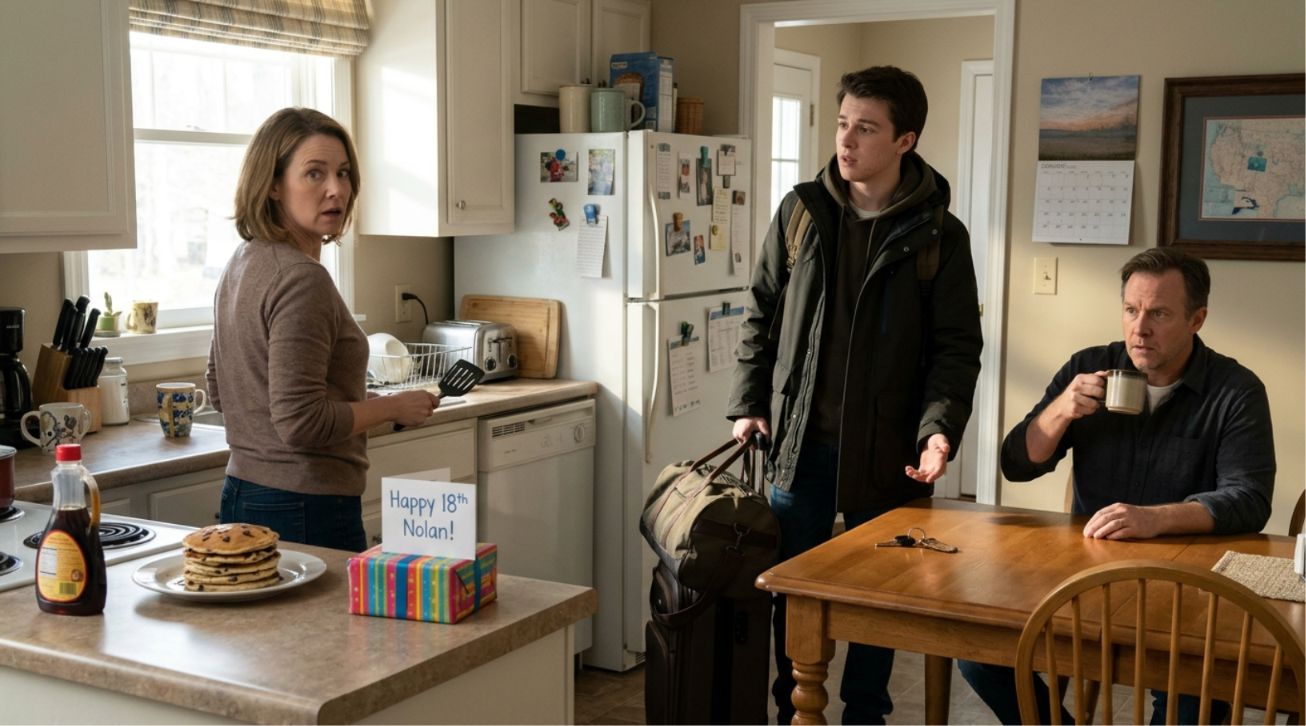
My hand went to my mouth.
I couldn’t believe what I was hearing.
Six years.
Six entire years.
This boy had lived in our house, eaten at our table, celebrated Christmas with us, and called us Mom and Dad while secretly believing that every moment of happiness came with an expiration date.
I looked at my husband.
“Tell me he didn’t say that.”
He rubbed his forehead.
“Nolan, I think you’ve misunderstood something.”
Nolan immediately lowered his eyes.
“I’m sorry.”
Those two words hurt more than anything else.
He apologized even when someone else had broken his heart.
My husband leaned forward.
“I was trying to explain that foster care arrangements were temporary. I didn’t want you to believe something that wasn’t guaranteed.”
Nolan nodded.
“I understand.”
“No, son. Listen to me.”
“You don’t have to explain. I know the rules.”
He reached for his suitcase again.
“I just wanted to make sure I left before anybody had to ask me.”
I stepped between him and the kitchen doorway.
“Stop.”
He froze.
“Please, sweetheart. Don’t move.”
I turned toward my husband.
“Did you tell a twelve-year-old child that he wasn’t allowed to feel at home here?”
My husband stood silently.
“Did you tell him that he had to leave when he turned eighteen?”
He finally looked at me.
“I was worried about making promises we couldn’t keep.”
“Then why didn’t you tell me?”
He didn’t answer.
I felt my chest tightening.
For six years, I had believed Nolan was slowly learning what it meant to belong to a family.
I thought his occasional fear came from his earlier experiences.
I never imagined that some of that fear had been planted inside our own home.
I turned back to Nolan.
“Sweetheart, look at me.”
He slowly raised his head.
“You are not leaving today.”
His eyes filled with tears.
“But I’m eighteen.”
“I know.”
“And you don’t have to take care of me anymore.”
I shook my head.
“Taking care of someone isn’t a punishment that expires on their eighteenth birthday.”
He looked confused.
I continued.
“You don’t have to earn your place at this table. You don’t have to pay us back for the food you’ve eaten. You don’t have to return the towels, the blankets, or anything else we bought for you.”
His lower lip trembled.
“But I don’t want to be a burden.”
I walked toward him and placed both hands on his shoulders.
“Nolan, you have never been a burden to me.”
He looked down again.
“I know you say that.”
“Because it’s true.”
He began crying quietly.
Not the kind of crying that comes from a bad day or disappointment.
It was the kind of crying that comes when someone has held something inside for so long that their body finally refuses to hold it anymore.
I pulled him into my arms.
This time, he didn’t hug me back immediately.
His arms remained at his sides.
Then, slowly, he wrapped them around me.
And he cried.
My husband stood a few feet away, watching us.
I didn’t know what to say to him.
I didn’t know whether I was angrier about what he had said six years earlier or about the fact that he had allowed Nolan to carry that belief for so long.
After several minutes, Nolan stepped away and wiped his face.
“I’m sorry about your birthday breakfast.”
I almost laughed through my tears.
“Your birthday breakfast?”
“I made you worry.”
I shook my head.
“You didn’t make me worry. You showed me something I should have known a long time ago.”
I took his suitcase and placed it beside the refrigerator.
“Now sit down. Your pancakes are getting cold.”
He looked at me uncertainly.
“Am I still allowed to have them?”
I couldn’t stop myself.
I cried again.
“Yes, sweetheart. You’re allowed to have pancakes.”
He slowly sat down.
I placed his blue plate in front of him.
For a few seconds, he simply stared at it.
Then he picked up his fork.
My husband sat opposite him.
Nobody spoke.
The candles remained beside the plate.
And I realized that the most important thing I could do that morning wasn’t throw a party, buy an expensive present, or take photographs.
It was make sure my son understood that he didn’t have to disappear just because he had grown older.
But the conversation wasn’t finished.
Not even close.
After breakfast, Nolan went upstairs to change.
I waited until I heard his bedroom door close before turning toward my husband.
“Explain everything.”
He sighed.
“Please don’t start a fight on his birthday.”
I stared at him.
“I’m not starting anything. I’m asking you why our son believes he has to leave today.”
My husband looked toward the stairs.
“I didn’t think he’d remember that conversation.”
“That isn’t an answer.”
He rubbed his hands together.
“Six years ago, when Nolan first arrived, I was nervous. We had discussed fostering, but I wasn’t completely sure what it would mean for our future.”
I listened without interrupting.
“He was already twelve. He had been through several difficult situations. I worried he would become attached to us, and then something might happen with the placement.”
“So you told him not to get attached?”
“I didn’t use those exact words.”
“But he understood that message.”
My husband looked down.
“I thought I was being realistic.”
I took a slow breath.
“Do you understand what he has been doing for six years?”
He looked at me.
“He has been living here.”
“No. He’s been preparing to leave.”
I pointed toward the stairs.
“He kept his clothes packed when he first arrived. He asked permission to eat an apple. He worried about using too much toothpaste. He apologized whenever he broke something. We thought he was slowly becoming comfortable.”
My voice cracked.
“But perhaps he never believed he was safe enough to stop being careful.”
My husband didn’t respond.
I continued.
“Every time he called you Dad, he probably wondered whether you wanted him to.”
He covered his face.
“I never wanted him to feel that way.”
“Intentions don’t erase what a child hears.”
That sentence seemed to stay between us.
Finally, he spoke.
“I made a terrible mistake.”
I looked at him.
“Then we need to fix it.”
He nodded.
But I knew that apologizing to me wouldn’t be enough.
The person who needed an apology was upstairs, probably folding clothes he had already decided he couldn’t afford to leave behind.
Around eleven, Nolan came downstairs wearing a clean sweatshirt.
He had removed the suitcase from the kitchen, but his backpack was still beside the front door.
I noticed it immediately.
“Going somewhere?”
He looked startled.
“No. I just thought I’d leave it there in case.”
I walked over and picked it up.
“In case of what?”
He shrugged.
“In case you change your mind.”
I closed my eyes for a moment.
Then I placed the backpack on the couch.
“Nolan, we’re going to talk about something important.”
He nodded and sat down.
My husband joined us.
I took Nolan’s hands.
“First, I want you to know that I love you.”
He looked at me.
“Second, your eighteenth birthday doesn’t change that.”
He swallowed.
“Third, I want you to tell us what you actually want.”
He looked confused.
“What do you mean?”
“If you could choose without worrying about disappointing us, what would you want to do?”
He was quiet for a long time.
Then he whispered:
“I want to go to college.”
I smiled.
“That’s wonderful.”
“But I don’t have enough money.”
“We can talk about that.”
“And I wanted to get a job and save for a car.”
“That’s a good plan too.”
He looked toward my husband.
“But I thought I had to find somewhere else to live first.”
My husband leaned forward.
“Nolan, I need to tell you something.”
Nolan straightened immediately.
“I also need to apologize.”
The boy’s eyes widened.
My husband continued.
“When you first arrived, I was afraid of making promises I couldn’t keep. I thought I was protecting everyone by explaining that foster care was temporary.”
He paused.
“But I chose the wrong words. And I never realized how deeply they affected you.”
Nolan looked at his hands.
My husband continued.
“I told you that you would have to leave when you turned eighteen. I shouldn’t have said that. I was wrong.”
Nolan didn’t move.
“I also shouldn’t have made you feel that you weren’t really part of this family.”
My husband swallowed.
“You were twelve years old. You needed a father, not another person reminding you that people could leave.”
Nolan’s eyes began filling again.
“I thought you didn’t want me to call you Dad.”
My husband shook his head.
“I liked it more than I ever told you.”
“Really?”
“Really.”
“Even when I was little?”
My husband smiled sadly.
“Especially then.”
Nolan stared at him.
Then my husband moved closer.
“I’m sorry, son.”
For several seconds, Nolan didn’t speak.
Then he asked something that made my heart ache.
“Can I still call you Dad?”
My husband immediately reached for him.
“Of course you can.”
Nolan leaned forward.
And my husband hugged him.
It wasn’t a perfect moment.
There were tears, awkward movements, and years of things neither of them knew how to say.
But it was honest.
And sometimes honesty is where healing begins.
That afternoon, I decided we were still having a birthday celebration.
Nolan protested.
“You don’t have to do all that.”
“I know.”
“You already made breakfast.”
“I know.”
“And I don’t need presents.”
I smiled.
“Good. Because the presents are already wrapped.”
He laughed for the first time that day.
A little later, his friends arrived.
They brought balloons, snacks, and a ridiculous birthday card covered in embarrassing photographs from school.
Nolan seemed embarrassed when everyone sang to him.
But when I brought out the chocolate cake, he was smiling.
Before he blew out the candles, I asked him to make a wish.
He looked at the candles for a long time.
Then he closed his eyes.
I wondered what he was wishing for.
Perhaps a college acceptance letter.
Perhaps a car.
Perhaps a future that didn’t frighten him.
Or perhaps something much simpler.
A home.
A place where he didn’t have to wonder how long he was allowed to stay.
He blew out the candles.
Everyone clapped.
And I thought that was the end of the difficult part.
I was wrong.
Because the following Monday, I received a phone call that would force our entire family to make an important decision.
It was from the social worker who had originally brought Nolan to our home.
She introduced herself and asked whether we had a few minutes to discuss his eighteenth birthday.
I immediately became concerned.
“Is something wrong?”
“Not necessarily,” she said. “I just wanted to check how Nolan was doing with the transition into adulthood.”
I looked toward the living room.
Nolan was sitting on the couch, working on a college application.
“He’s doing well,” I answered carefully. “But I think there are some things we need to discuss.”
She paused.
“What sort of things?”
I explained what had happened on his birthday.
I told her about the suitcase, the house key, and the conversation Nolan remembered from six years earlier.
There was silence on the other end.
Then she said something I wasn’t expecting.
“Did Nolan ever tell you about his independent living plan?”
I frowned.
“His what?”
“When he was sixteen, we discussed extending support through the young adult transition program. Depending on eligibility and the arrangements available, there may be options for continued assistance with education, housing, and employment.”
I looked toward the living room again.
“No. He never mentioned anything like that.”
She sighed.
“I see.”
Then she asked:
“Has he told you what he believes will happen to him now that he’s eighteen?”
I hesitated.
“He thinks he has to leave our house.”
The social worker was quiet.
Then she said:
“That is concerning. Because when I spoke with him last year, he told me he hoped to stay with your family while attending college.”
My stomach tightened.
“He told you that?”
“Yes. He said he finally felt he had a family and didn’t want to lose that.”
I felt tears gathering in my eyes.
The social worker continued.
“There’s something else. Nolan was eligible for a transition savings program, but I don’t know whether he ever received the information about it. I would like to review his file with him and make sure he understands his options.”
I thanked her and ended the call.
For a moment, I simply stood in the kitchen.
Then I walked into the living room.
“Nolan?”
He looked up from his laptop.
“Yes, Mom?”
“Can I ask you something?”
“Sure.”
“Have you ever spoken to your social worker about staying with us after eighteen?”
He looked uncomfortable.
“A little.”
“What did you tell her?”
He closed his laptop.
“I told her I wanted to go to college and maybe stay here while I worked.”
“And what did she say?”
He hesitated.
“She said there might be programs to help me.”
“Did you ever receive any information?”
He shook his head.
“Not really.”
I sat beside him.
“Why didn’t you tell me?”
He looked toward the window.
“Because I thought you and Dad already had enough to do.”
I took his hand.
“Nolan, you don’t have to protect us from knowing what you need.”
He gave a small nod.
Then he said something that made me realize how much work we still had ahead of us.
“I didn’t want to ask for more time.”
I squeezed his hand.
“More time?”
He nodded.
“I already got six years. I didn’t think it was fair to ask for more.”
I pulled him into my arms.
“Oh, sweetheart.”
He rested his head against my shoulder.
“I know you love me. I do. But sometimes I still feel like I’m borrowing this life.”
I closed my eyes.
And I understood that one birthday breakfast, one apology, and one family celebration couldn’t erase six years of fear.
We would have to show him.
Not just tell him.
We would have to show him every day that he belonged.
And this time, we would make sure he believed it.
PART 4
The following morning, I woke up earlier than usual.
I couldn’t stop thinking about what Nolan had said.
Sometimes I still feel like I’m borrowing this life.
Those words followed me from the bedroom to the kitchen, from the kitchen to the laundry room, and even into the shower.
I kept remembering the twelve-year-old boy who had arrived at our house carrying his belongings in a torn black trash bag.
I remembered how carefully he had asked for an apple.
I remembered how he apologized for using too much toothpaste.
And now, at eighteen, he was still measuring how much space he was allowed to occupy in our lives.
I made coffee and sat at the kitchen table.
A few minutes later, my husband came downstairs.
He noticed my expression.
“You’re thinking about Nolan again, aren’t you?”
I nodded.
“I don’t think we understand how much that conversation six years ago affected him.”
My husband pulled out a chair.
“I know.”
“He’s been preparing to leave since the day he arrived.”
He stared into his coffee.
“I keep thinking about what he said on his birthday. He asked whether he could take an old towel.”
I nodded.
“He was deciding what he was allowed to keep.”
My husband rubbed his eyes.
“I wish I could go back and change that night.”
“So do I. But we can’t.”
He looked at me.
“What can I do?”
I considered the question.
“Stop trying to convince him that everything is fine. Start showing him that he doesn’t have to earn his place here.”
My husband nodded slowly.
Then he said something I hadn’t expected.
“I think I need to talk to someone.”
I looked at him.
“About what?”
“About why I was so afraid of making a permanent commitment to a child who needed one.”
For the first time since Nolan’s birthday, I felt that my husband understood this wasn’t something we could fix with a single apology.
He needed to understand his own actions.
And Nolan needed time to heal.
Two days later, the social worker visited our home.
Her name was Melissa.
She had worked with Nolan during several stages of his childhood and remembered him arriving with his black plastic bag.
When she entered the living room, Nolan stood up immediately.
“Hello, Melissa.”
She smiled.
“Happy belated birthday, Nolan.”
“Thank you.”
She sat down and opened a folder.
“I spoke with your mother, and she told me a little about what happened.”
Nolan glanced at me.
I squeezed his shoulder.
“You don’t have to be embarrassed, sweetheart.”
Melissa looked at him.
“I want you to understand something. Turning eighteen doesn’t mean you suddenly lose every form of support. There are different programs available depending on your circumstances and local eligibility rules.”
Nolan listened carefully.
She explained the transition services he could explore, including assistance with education, employment planning, and independent living.
Then she asked him a question.
“What would you like your life to look like over the next few years?”
Nolan looked at his hands.
“I want to study automotive technology.”
My husband looked up.
“You never told me that.”
Nolan shrugged.
“I mentioned it once.”
I remembered.
He had spent months watching videos about repairing engines and restoring old cars.
He could identify different engine components and had even repaired a neighbor’s lawn mower.
Melissa smiled.
“That’s a wonderful goal. Have you looked into any programs?”
“I found one at the community college. I just don’t know if I can afford it.”
“We can help you investigate financial aid and available transition support.”
Nolan nodded.
Then Melissa asked another question.
“Do you want to remain with your foster family while you study, if that’s something everyone is willing to discuss?”
Nolan went quiet.
I watched his expression.
He looked at me.
Then at my husband.
“I would like that.”
His voice was barely audible.
“But I don’t want to force them.”
My husband leaned forward.
“Nolan, can I say something?”
Nolan nodded.
“You don’t have to force us. We want you here.”
Nolan’s eyes became wet.
My husband continued.
“And I don’t want you to stay because you think you owe us anything. I want you to stay because this is where you want to be.”
Melissa looked at Nolan.
“It’s important that you have choices. You can build independence without having to abandon the people who love you.”
Nolan nodded slowly.
For the first time, I saw him consider a future that didn’t involve running away from our home.
Over the following weeks, things began changing.
Not dramatically.
Not overnight.
But in small ways.
Nolan started leaving his bedroom door open.
He stopped asking whether he could eat something from the refrigerator.
He began talking about college applications without immediately apologizing for the cost.
And one evening, he came downstairs carrying a stack of papers.
“Mom?”
I was reading a book on the couch.
“Yes, sweetheart?”
“Can you help me with something?”
“Of course.”
He placed the papers beside me.
It was a college application.
He had filled in almost everything except the section asking for emergency contact information.
He pointed to it.
“I wasn’t sure what to write here.”
I looked at the form.
There were spaces for two contacts.
I smiled.
“Who do you want to put?”
He hesitated.
“I thought maybe you and Dad.”
I looked at him.
“Then write our names.”
He picked up his pen.
But before he wrote anything, he asked:
“Is that really okay?”
I put my book down.
“Nolan, if you want us to be your emergency contacts, we’ll be honored.”
He smiled.
Then he wrote our names.
I watched him carefully fill in our phone numbers.
It was such a small thing.
But I understood what it meant.
He was allowing us to be part of his future.
Not just his past.
About a month later, Nolan received an email from the community college.
He had been accepted into its automotive technology program.
He came running downstairs with his phone in his hand.
“Mom!”
I was preparing dinner.
“What happened?”
“I got in!”
For a moment, I didn’t understand.
Then he showed me the email.
I screamed.
Actually screamed.
My husband came rushing into the kitchen.
“What happened?”
Nolan held up his phone.
“I got accepted!”
My husband read the message twice.
Then he smiled.
“That’s my boy!”
Nolan laughed.
We hugged him so tightly that he complained he couldn’t breathe.
That evening, we celebrated with pizza.
Nolan talked about classes, workshop equipment, and the possibility of getting an apprenticeship after his first year.
He was excited.
Really excited.
And I noticed something.
He wasn’t talking about leaving.
He was talking about building something.
A future.
His own future.
But one that included us.
A few weeks later, something happened that I will never forget.
It was a Saturday afternoon.
I was folding laundry when I heard Nolan calling from upstairs.
“Mom?”
“Yes?”
“Where are my blue towels?”
I smiled.
“They’re in the linen closet!”
A moment later, he appeared at the top of the stairs.
“Can I take two?”
I looked up.
“Of course.”
He nodded and disappeared.
Then I heard him call again.
“Dad?”
My husband was working in the garage.
“What?”
“Can you help me move my desk?”
“Why?”
“I want to rearrange my room.”
My husband laughed.
“Sure. Give me five minutes.”
I continued folding clothes.
Then I suddenly stopped.
Something about the conversation felt different.
Nolan was asking for towels.
He was rearranging his room.
He was making plans.
He wasn’t cleaning everything before leaving.
He was making the room his own.
I sat down on the edge of the bed and cried.
Not because I was sad.
Because something I had wanted for six years was finally happening.
Nolan was beginning to believe he could stay.
However, the most important conversation happened three months after his eighteenth birthday.
It was late October.
The weather had turned cold, and the leaves in our backyard had begun falling.
Nolan had been working part-time at a local garage while attending his classes.
He was doing well.
He had made friends.
He had started saving money.
And he had even bought himself a used bicycle.
One evening, he came into the kitchen while I was preparing dinner.
“Mom, can we talk?”
I put down the knife.
“Of course.”
He pulled out a chair.
Then he looked toward the hallway.
“Is Dad home?”
“He’s in the garage.”
“Can you call him?”
I immediately became nervous.
“Is everything okay?”
“Yeah. I just want both of you here.”
I called my husband.
He came inside and sat beside me.
Nolan placed a folded piece of paper on the table.
“What is that?” I asked.
He unfolded it.
It was a letter.
“I’ve been writing this for a while,” he explained. “I wasn’t sure whether I should give it to you.”
My husband looked at him.
“What’s it about?”
Nolan took a breath.
“It’s about the first night I came here.”
Neither of us interrupted.
He began reading.
“Dear Mom and Dad,
I don’t know if you remember the first night I arrived.
I remember everything.
I remember the bedroom with the blue blanket.
I remember the lamp beside the bed.
I remember Mom showing me where the apples were.
And I remember Dad telling me that I shouldn’t get too comfortable because I would have to leave when I turned eighteen.
For a long time, I believed that was the most important rule in the house.
I thought I had six years.
So I tried to be good.
I tried not to ask for too much.
I tried not to break anything.
I tried not to become difficult.
I thought if I was easy to take care of, maybe you wouldn’t regret having me.
I know now that you both loved me.
But I also know that I was afraid.
When I turned eighteen, I packed my suitcase because I thought leaving was the right thing to do.
I didn’t want you to have to tell me twice.
I didn’t want to make you uncomfortable.
And I didn’t want to discover that I had misunderstood what this family meant to me.
But something happened that morning.
Mom told me I didn’t have to leave.
Dad apologized.
And for the first time, I realized that maybe I had been wrong about the future.
I’m still learning.
Sometimes I still worry that I’m taking up too much space.
Sometimes I still wonder whether I deserve the things you give me.
But I’m trying.
I want to finish college.
I want to get a good job.
I want to buy my own car.
And someday, I want to help someone else who feels the way I felt when I was twelve.
I want them to know that they aren’t a burden.
I want them to know that they deserve a family.
Thank you for giving me six years that I will never forget.
And thank you for giving me the chance to believe there can be more.
Love,
Nolan.”
He folded the letter.
Nobody spoke.
My husband was crying.
I reached across the table and held Nolan’s hand.
“Can I tell you something?” I asked.
He nodded.
“The first day you arrived, I thought I was giving you a bedroom.”
I smiled through my tears.
“But somewhere along the way, you became the reason that bedroom felt like home.”
Nolan looked down.
I continued.
“I don’t know what the future will bring. You might move away for college one day. You might get married. You might have children of your own. You might build a life somewhere far from here.”
He smiled slightly.
“But I want you to know that leaving home someday and being forced out are two very different things.”
He nodded.
“And when you leave because you’re ready to build your own life, we’ll be proud of you.”
I squeezed his hand.
“But you will always have a place to come back to.”
My husband leaned forward.
“And I want to add something.”
Nolan looked at him.
“I spent six years worrying that I might make promises I couldn’t keep.”
He paused.
“But I understand now that being a father isn’t about knowing exactly what will happen in the future.”
His voice cracked.
“It’s about showing up, even when things are difficult.”
Then he looked directly at Nolan.
“I can’t change what I said when you were twelve. But I can spend the rest of my life making sure you know that you are my son.”
Nolan began crying.
My husband stood and walked around the table.
Then he hugged him.
And Nolan hugged him back.
Not cautiously.
Not politely.
Not like a boy who was afraid of asking for too much.
He hugged his father like someone who finally believed he was allowed to.
The following Christmas was different from every Christmas we had celebrated before.
We decorated the tree together.
Nolan put the star on top.
My husband burned the first batch of cookies.
And I complained that nobody was helping me in the kitchen.
It was ordinary.
Beautifully ordinary.
On Christmas morning, Nolan came downstairs wearing his old gray sweatshirt.
He opened his presents.
A toolbox from my husband.
A new winter jacket from me.
And a small envelope containing some money to help with his college expenses.
He stared at the envelope.
“Mom, you didn’t have to do this.”
I smiled.
“I know.”
He laughed.
Then he handed me a present.
I opened it carefully.
Inside was a framed photograph.
It was a picture of the three of us from his eighteenth birthday.
The birthday breakfast.
The pancakes.
The candles.
And Nolan standing between us with his arms around our shoulders.
At the bottom, he had written:
“The day I thought I was losing my family was the day I learned I had one.”
I couldn’t speak.
I pulled him into a hug.
“Where did you get this picture?”
“You took it after breakfast. I found it on your computer.”
I smiled.
“It’s beautiful.”
He nodded.
Then he said:
“I want to put one in my bedroom too.”
I looked at him.
“Of course.”
He paused.
“Actually, I want to ask you something.”
“What is it?”
“Can we take another family picture this year?”
My husband laughed.
“Another one? We have hundreds.”
“I know. But I want one where we’re all looking at the camera.”
I smiled.
“Why?”
Nolan shrugged.
“Because I want to have something to look at when I’m older.”
My husband put his arm around him.
“Then we’ll take as many as you want.”
Years passed.
Nolan graduated from community college.
He found a position at a respected automotive repair shop.
Eventually, he became a certified technician and began saving money to open a small garage of his own.
He didn’t forget the people who had helped him.
He volunteered with a local organization supporting teenagers transitioning out of foster care.
Sometimes he helped young people prepare for job interviews.
Sometimes he helped them apply for college.
And sometimes he simply listened.
One afternoon, I visited him at the garage.
He was working beneath the hood of an old pickup truck.
When he saw me, he wiped his hands.
“Hey, Mom!”
I smiled.
“Am I interrupting?”
“Never.”
He walked over and hugged me.
I looked around.
The garage was small, but it was clean and organized.
There were tools hanging on the walls, a desk near the window, and a photograph of our family beside the entrance.
I pointed toward it.
“You kept that picture.”
He smiled.
“Of course.”
Then he showed me another photograph.
It was the picture of the black trash bag he had arrived with six years earlier.
I stared at it.
“Why do you have that?”
He looked at the photograph for a moment.
“Because I don’t want to forget where I started.”
He paused.
“But I also don’t want to spend my whole life thinking that’s who I am.”
I nodded.
He continued.
“That boy thought everything good in his life was temporary. He thought people only kept him around because they were being kind.”
He looked at me.
“I want to remember that I was wrong.”
I reached for his hand.
“You were never wrong for wanting a family.”
He smiled.
“I know that now.”
Several years later, on another birthday, Nolan invited us to dinner.
He had rented a small private room at a restaurant.
When we arrived, there were balloons, flowers, and a large birthday cake.
My husband looked around.
“What’s all this?”
Nolan smiled.
“Just a little celebration.”
We sat down.
After dinner, he stood and tapped his glass.
“I want to say something.”
Everyone became quiet.
He looked at us.
“When I turned eighteen, I packed a suitcase.”
I smiled sadly.
“I remember.”
He laughed.
“I had everything ready. My clothes, my documents, my money, and even my own towel.”
Everyone chuckled.
Then his expression became serious.
“I thought becoming an adult meant I had to stop needing people.”
He paused.
“I thought growing up meant leaving behind anyone who had helped me.”
He looked at my husband.
“Dad, I’m glad you apologized. But more importantly, I’m glad you changed.”
Then he turned toward me.
“Mom, thank you for never making me feel like I had to earn your love.”
My eyes filled with tears.
He continued.
“You both taught me that family isn’t just about who shares your blood. It’s about who shows up, who takes responsibility, and who stays willing to love you even after making mistakes.”
He raised his glass.
“To family.”
My husband raised his glass.
I raised mine.
And Nolan smiled.
“Especially the kind that lets you come home.”
Later that evening, when everyone had left, Nolan walked us to the car.
Before we got inside, he hugged me.
Then he hugged his father.
“Drive safely,” he said.
“We will,” my husband replied.
Nolan stepped back.
Then he looked at me.
“Mom?”
“Yes, sweetheart?”
“Do you remember what I asked you on my eighteenth birthday?”
I nodded.
“You asked whether you could take an old towel.”
He laughed.
“Yeah.”
He looked down for a moment.
“I was so scared that morning.”
I touched his cheek.
“I know.”
“I thought I was leaving the only family I had.”
I hugged him again.
He whispered:
“I wish I could tell that twelve-year-old boy that everything would be okay.”
I held him tightly.
“You don’t have to go back and tell him.”
He looked at me.
“Why?”
“Because you can tell the next child who feels that way.”
He smiled.
Then he nodded.
“I think I will.”
A few months later, Nolan began volunteering as a mentor for teenagers preparing to leave foster care.
One evening, he called me.
“Mom, I met a boy today.”
I listened.
“He’s seventeen. His placement is ending soon, and he’s terrified about turning eighteen.”
My heart tightened.
“What did you tell him?”
Nolan was quiet for a moment.
“I told him that being eighteen doesn’t mean he has to face everything alone.”
I smiled.
“What else?”
“I told him that he deserves a safe place to live, that there are programs that can help, and that asking for help isn’t weakness.”
He paused.
“Then I told him something you once told me.”
“What was that?”
“That he doesn’t have to earn the right to be treated like a human being.”
I closed my eyes.
I was proud of him in a way I couldn’t put into words.
Then Nolan added:
“He asked me whether I still talked to my foster parents.”
I laughed softly.
“What did you say?”
“I told him they’re not my foster parents anymore.”
I felt tears forming.
“What did you call us?”
He answered without hesitation.
“My parents.”
That night, after the call ended, I went upstairs and opened the small box where I kept photographs from Nolan’s childhood.
There was the picture from his first Christmas.
The picture of him holding his high school diploma.
The picture from his eighteenth birthday.
And tucked beneath them was a photograph I had almost forgotten.
It showed a thin twelve-year-old boy standing beside a social worker at our front door.
He was holding a torn black plastic bag.
His eyes were down.
His shoulders were tense.
He looked like someone who had already learned not to expect too much from life.
I held that photograph for a long time.
Then I placed it beside the newer family picture.
The two photographs told the story of six years.
One showed a child who believed he was temporary.
The other showed a young man who finally understood that he was loved.
And I realized something important.
We had once believed that fostering meant giving a child a place to stay until his circumstances changed.
But Nolan had taught us something much bigger.
A home isn’t simply a place where someone is allowed to sleep.
A family isn’t simply a group of people who share a last name.
And love isn’t something that should come with an expiration date.
The morning Nolan turned eighteen, he had packed a suitcase, washed his sheets, cleaned his bedroom, and placed his house key on the kitchen table.
He thought he was doing the right thing.
He thought he was leaving before anyone had to tell him to go.
But he didn’t leave that morning.
Instead, he sat down and ate his favorite chocolate chip pancakes.
And for the first time in his life, he began to believe that he didn’t have to pack his belongings every time his birthday came around.
He was eighteen.
He was growing up.
He was building his own future.
And he was still our son.
The suitcase he packed that morning remained in the back of his closet for years.
Not because he was preparing to leave.
But because he wanted to remember the day he finally learned that he didn’t have to.
And that, to me, was the greatest birthday present any mother could ever receive. ❤️