
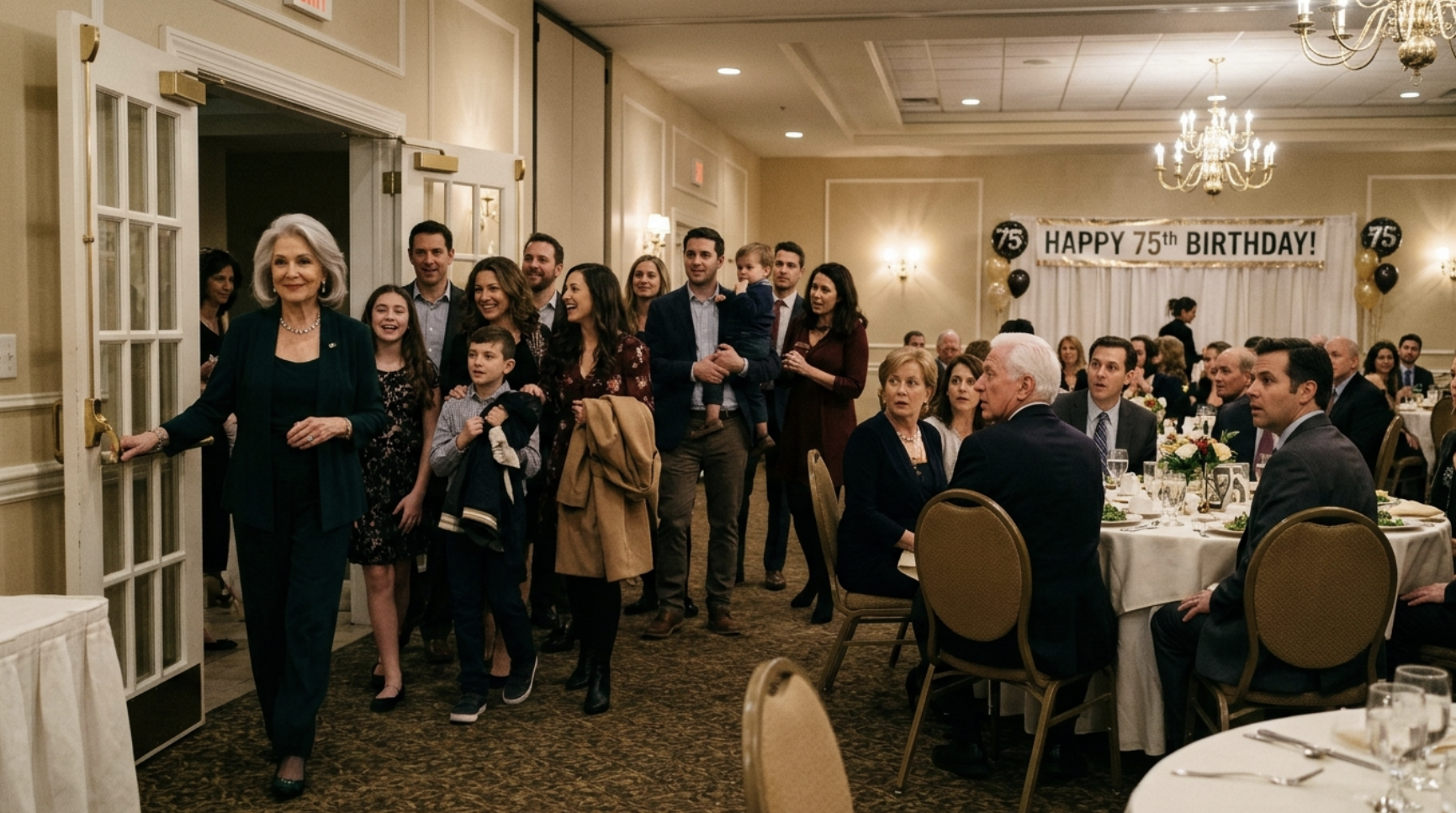
PART 3
Garland stared at him.
“Thank you,” he managed.
The man turned toward me and kissed my cheek.
“Hello, Mama.”
That one word changed the entire room.
Mama.
Garland’s eyes moved back to me.
“Who is that?”
I smiled.
“That’s David.”
David extended his hand.
“David Carter. Nice to meet you, sir.”
Garland shook it, though his fingers seemed to have forgotten what they were supposed to do.
Another man stepped forward.
“Hi, Mama. Sorry we’re a little late. Traffic was terrible.”
“You’re right on time, Michael.”
He hugged me.
Then came Rebecca, my oldest girl, who had driven all the way from Memphis with her husband and their daughter.
Then Samuel, who had flown in from Nashville.
Then Thomas, who had brought his wife and two children.
And finally, little Evelyn, the youngest of the grandchildren, who was holding a drawing she’d made for me.
Eleven people.
Eleven people who had answered my phone calls.
Eleven people who had spent years calling me Mama, Grandma, and sometimes, when they wanted something, the most important woman in the world.
I looked at Garland.
“These are my children.”
Bonnie let out a little laugh.
“Your children?”
“Yes.”
“But you couldn’t have children.”
There it was.
The sentence she’d probably been waiting forty-two years to say.
I looked at her carefully.
“You’re right. I couldn’t give birth to them.”
The room became very quiet.
“But I raised them.”
I could see people beginning to exchange looks.
Garland pulled a chair away from the table.
“Della, I don’t understand.”
“I know.”
He looked at the children standing around me.
“How many?”
“Five,” I answered. “Five children. Six grandchildren. And one wonderful son-in-law who’s been helping me with my garden because he says I shouldn’t be lifting heavy things at my age.”
“Five?” Garland repeated.
“Five.”
He looked confused.
“But I thought…”
“You thought I couldn’t be a mother.”
I let that sentence sit between us.
Then I smiled at the little girl holding the drawing.
“Come here, sweetheart.”
Evelyn walked over and handed it to me.
It was a picture of a house with a red roof. There were twelve stick figures in front of it, all holding hands.
At the top, she’d written:
OUR FAMILY.
I kissed her forehead.
“Thank you, baby.”
Garland watched us.
His expression had changed.
I couldn’t tell whether it was surprise, embarrassment, or something else.
Bonnie, however, wasn’t finished.
“Well, this is certainly unexpected,” she said. “Garland never mentioned that you had a family.”
I turned toward her.
“That’s because he hasn’t spoken to me since 1984.”
She blinked.
Garland lowered his eyes.
I could hear the microphone humming near the birthday cake.
Somebody at the back of the hall coughed.
I wasn’t there to ruin a birthday party. I hadn’t driven two hours to scream at an old man in front of his grandchildren.
I’d had forty-two years to learn that anger was a heavy thing to carry.
But I also wasn’t going to pretend the past hadn’t happened.
David pulled a chair out for me.
“Sit down, Mama.”
I sat.
The children arranged themselves around me, just as they always did at Thanksgiving.
And that was when Garland finally asked the question.
“Della, how did all this happen?”
I folded my hands on the table.
“It started with a phone call.”
It was 1985.
I was twenty-four years old, divorced, and living in a little rented house outside Indianola.
My bus-driving job paid enough to keep the lights on, but not much more.
I had a secondhand sofa, a kitchen table with one uneven leg, and a refrigerator that made a terrible noise every time it started.
I wasn’t looking to become anybody’s mother.
I was simply trying to put my life back together.
One afternoon, a woman from the county called.
Her name was Mrs. Wilkins.
She worked with children who needed temporary homes.
She knew I was a school bus driver. She knew I had a spare bedroom. And she knew I’d recently gone through a divorce.
“Miss Della,” she said, “we have a little boy who needs somewhere safe to stay. Just for a while.”
“How old?”
“Six.”
“Does he have family?”
She paused.
“His mother isn’t able to care for him right now. His father is unknown.”
I looked down at my hands.
“What’s his name?”
“David.”
I didn’t know then that one phone call would change everything.
David arrived on a rainy Thursday afternoon with a plastic grocery bag containing two shirts, a pair of trousers, and a toy truck missing one wheel.
He didn’t speak much.
He stood in my doorway with his coat hanging off his shoulders.
“Hello, David,” I said.
He looked at the floor.
“Are you hungry?”
He shrugged.
I made him grilled cheese sandwiches.
He ate one and put half the other in his pocket.
I pretended not to notice.
That night, when I tucked him into bed, he asked me something I still remember.
“Do I have to leave tomorrow?”
“No, sweetheart.”
“What about next week?”
“Not unless we find somewhere better for you.”
He thought about that.
Then he asked the question that broke my heart.
“Can I stay until somebody wants me?”
I sat on the edge of his bed.
“David, you don’t have to earn a place in this house.”
He looked at me for a long time.
Then he turned toward the wall and cried quietly.
I stayed beside him until he fell asleep.
Three months later, the county asked whether I would consider becoming his permanent foster mother.
I said yes.
A year later, after all the paperwork and court hearings, I adopted him.
I was twenty-five years old.
And for the first time in my life, someone called me Mama.
Not because I had given birth.
Not because I had married somebody.
But because a little boy who had been passed from one place to another finally had somewhere to belong.
David was the beginning.
Michael came three years later.
His mother had died, and his father was serving time in prison. He was eight years old and had a habit of sleeping with his shoes on because he was afraid somebody would take him somewhere while he slept.
Rebecca came after that.
She was nine when she arrived, angry at the world and convinced every adult eventually left.
Samuel was only four.
And Thomas, my youngest, was three when he came into my life.
Five children.
Five different stories.
Five little hearts that needed somewhere safe to land.
I didn’t have a perfect house.
I didn’t have much money.
But I had a kitchen table, a refrigerator full of groceries, and a heart that had learned how much love could fit inside it.
I worked long hours.
I drove the school bus in the mornings and afternoons. I picked up extra work during the summer. Ernestine helped me with the children whenever she could.
There were nights I cried because I couldn’t afford new shoes for everybody.
There were Christmas mornings when the presents were small.
But there was always food.
There were always birthday cakes.
And nobody ever had to wonder whether they were wanted.
Back in the VFW hall, Garland was still staring at me.
“You adopted all five?” he asked.
“Yes.”
“All of them?”
I nodded.
Bonnie folded her arms.
“That’s very generous, I suppose.”
I looked at her.
“Generous?”
She smiled awkwardly.
“Well, taking in children who aren’t yours…”
David put down his glass.
“Ma’am, she didn’t take us in because she felt sorry for us.”
Bonnie turned toward him.
“Excuse me?”
David kept his voice calm.
“She became our mother because she loved us. There’s a difference.”
Michael nodded.
“She was there when I broke my arm. She was there when I graduated. She was there when I got married. She was there when my first child was born.”
Rebecca added, “She sat beside me in the hospital for three nights when I had surgery. She didn’t go home once.”
Samuel smiled.
“She also embarrassed me at my high school graduation by cheering louder than everybody else.”
That earned a laugh.
Even I laughed.
Thomas leaned over and kissed my forehead.
“And she still calls me every Sunday to ask whether I’ve eaten.”
“Because you never answer the first time,” I said.
The children laughed again.
For a moment, the room felt warm.
It felt like home.
Then Garland asked something that made the laughter disappear.
“Why didn’t you ever tell me?”
I looked at him.
“Tell you what?”
“That you had children.”
I almost laughed.
Not because it was funny.
Because sometimes a person can say something so ridiculous that your mind doesn’t know whether to laugh or cry.
“Garland, you left me forty-two years ago.”
“I know.”
“You never called.”
“I know.”
“You never asked how I was doing.”
He looked down.
“I know, Della.”
“So why would I have told you?”
He didn’t answer.
I took a sip of water.
“You had your life. I had mine.”
Bonnie stepped closer to him.
“Garland, perhaps we should get back to the birthday program.”
He didn’t move.
Instead, he kept looking at me.
“Are you happy, Della?”
That question surprised me.
I thought about the little house where I’d raised five children.
The broken washing machine.
The school concerts.
The graduations.
The first apartments.
The weddings.
The grandchildren who climbed into my bed during thunderstorms.
The Sunday dinners when everyone talked at once.
The Christmas stockings I still counted every year.
Then I looked at him.
“Yes, Garland. I am.”
He nodded slowly.
“Good.”
It was the first kind thing he’d said to me in forty-two years.
And somehow, it was also the saddest.
The birthday celebration continued, but something had changed.
People no longer looked at me like an unwanted guest.
Several came over to introduce themselves.
One elderly woman told me she remembered me from my bus-driving days.
Another said she had heard about my foster children through the church.
A gentleman near the cake leaned toward me and whispered, “You raised a fine family, ma’am.”
I thanked him.
Bonnie spent most of the evening beside Garland, smiling whenever somebody approached, but her eyes kept returning to my children.
At one point, David went to get me a cup of coffee.
When he returned, he noticed Garland standing beside my chair.
“May I speak with you privately, Della?” Garland asked.
I looked at David.
He gave me a small nod.
“Of course,” I said.
Garland pulled out the chair beside mine.
For a few moments, neither of us spoke.
Then he said something I hadn’t expected.
“I need to apologize.”
I looked at him.
He rubbed his hands together.
“I’ve thought about that day in 1984 more times than you probably realize.”
“Have you?”
“Yes.”
“Then why did it take forty-two years?”
He swallowed.
“I was young. I wanted children. My parents wanted grandchildren. Everybody around me seemed to have the life I thought I was supposed to have.”
“And I was in the way.”
He closed his eyes.
“I told myself leaving was the right thing.”
I waited.
“But it wasn’t.”
The hall was noisy around us.
Someone was laughing near the kitchen. A microphone squealed. A child ran past carrying a balloon.
And there we sat, two old people discussing the lives we’d once imagined.
“Bonnie and I had three sons,” he continued. “I got what I wanted.”
I glanced toward his three grown boys.
“They look like good men.”
“They are.”
“Then you were fortunate.”
He nodded.
But something in his face told me there was more.
“I don’t know them as well as I should,” he said quietly.
I didn’t respond.
“I worked all the time. I thought providing money was enough. Bonnie handled everything at home. The boys grew up, went to college, got jobs, and built their own lives.”
He looked toward them.
“Sometimes I feel like a stranger at my own dinner table.”
I studied his face.
For the first time that evening, I saw something other than the man who had left me.
I saw an old man looking at the years behind him.
And perhaps realizing that money and a family photograph weren’t the same thing as being loved.
He turned back to me.
“Do you think your children would ever forgive me?”
I stared at him.
“Forgive you for what?”
“For the way I treated you.”
I leaned back in my chair.
“Garland, my children don’t need to forgive you for something you did to me before they were born.”
He nodded.
“But I do hope you understand something.”
“What’s that?”
“I didn’t bring them here to punish you.”
He looked confused.
“I brought them because they’re my family. Because they wanted to celebrate with me. And because I wasn’t going to leave the most important people in my life at home just to make your birthday easier.”
He looked down at his hands.
“I understand.”
I wasn’t sure he did.
Then Rebecca approached us.
“Mama, we’re about to take a family picture.”
I smiled.
“All right, sweetheart.”
She looked at Garland.
“Would you like us to take one for you too?”
He seemed surprised.
“Would that be all right?”
“Of course,” Rebecca said.
She turned toward the photographer.
“Let’s get everybody together.”
My five children gathered around me.
Their spouses stood beside them.
The grandchildren squeezed into the front.
Garland watched us arrange ourselves.
Then little Evelyn looked up at him.
“Mr. Garland?”
He bent slightly.
“Yes, sweetheart?”
“Do you want to stand with us?”
Nobody spoke.
I looked at Evelyn.
She was only six.
She didn’t know about the kitchen in Indianola.
She didn’t know about the duffel bag.
She didn’t know about the winter I cried in the bus barn.
She only saw an old man standing alone.
Garland looked at me.
I gave him a small nod.
“Go ahead,” I said.
He stepped into the picture.
And for one brief moment, eleven people stood around me, with the man who had once told me I could never have a family standing at the edge.
The photographer lifted his camera.
“Everybody smile!”
The flash went off.
But just as everyone began moving away, I heard a familiar voice behind me.
“Della?”
It was Ernestine.
She had finally come inside from the parking lot.
And she wasn’t alone.
She was holding a large envelope.
Her face was serious.
I stood up.
“What’s wrong?”
She looked at Garland.
Then at Bonnie.
Then back at me.
“There’s something you need to know about that invitation.”
I frowned.
“What are you talking about?”
Ernestine held up the envelope.
“I found something in the mailbox before we left home. It was addressed to you, but it had been delivered to my house by mistake.”
She handed it to me.
My name was written across the front.
Della Hatchett.
I turned it over.
There was no return address.
I opened it carefully.
Inside was a single sheet of paper.
I read the first sentence.
Then I read it again.
My hands went cold.
Because the person who had written that cruel little message on the birthday invitation wasn’t Bonnie.
And the letter explained why Garland had invited me after forty-two years.
I slowly raised my eyes.
Across the room, Garland was watching me.
“What’s wrong?” he asked.
I folded the paper.
Then I looked at the man who had once walked out of my kitchen and never looked back.
“Garland,” I said quietly, “I think you and I need to have a very different conversation.”
And this time, it wasn’t about the children.
PART 4
Garland looked at me as though he already knew what was inside that envelope.
Bonnie noticed it too.
“What’s that?” she asked.
I didn’t answer her.
I unfolded the paper and read it one more time.
It was a letter from Garland’s youngest son, Richard.
He had written:
Dear Della,
You don’t know me, and I understand if you never want to. But I need you to know that the invitation you received wasn’t entirely my father’s idea.
Three weeks ago, I found an old box of documents in his study. Inside were letters he had written in 1984, along with papers from the hospital where you and my father went after your marriage.
I also found something that changed everything I thought I knew about my father’s first marriage.
Please don’t leave the birthday party without speaking to me.
There’s something you deserve to know.
Richard.
I lowered the paper.
Garland was standing now.
“Where did you get that?”
“Richard wrote it.”
He looked toward the three men.
“Which one of you gave her that?”
The youngest son stepped forward.
“I did, Dad.”
Bonnie immediately moved between them.
“Richard, what are you doing?”
“Something I should have done a long time ago.”
Garland’s face tightened.
“Not here.”
Richard shook his head.
“No. We’ve spent enough years pretending things didn’t happen.”
The room had become quieter.
I could feel people watching us.
I folded the letter and placed it inside my purse.
“Garland, what is this about?”
He looked at Bonnie.
She looked away.
Then Richard spoke.
“It’s about the medical records.”
I felt my stomach tighten.
“What medical records?”
Richard took a breath.
“The records from 1984. The ones Dad kept hidden.”
Garland closed his eyes.
“Richard, stop.”
But his son continued.
“My father always told us his first wife couldn’t have children. He said he had to leave because he wanted a family.”
I stared at Garland.
Richard continued.
“But that wasn’t the whole truth.”
I couldn’t speak.
He reached into his jacket and pulled out a folded document.
“I found this in the box. It was a medical report from the hospital.”
He handed it to me.
I looked at the date.
April 1984.
The hospital name was familiar.
It was the same place where Garland and I had gone together.
I remembered sitting in a small examination room while the doctor explained that we would need more tests.
I remembered Garland asking questions.
I remembered him becoming quiet.
And I remembered the drive home.
I unfolded the paper.
My eyes moved slowly across the page.
Then I stopped.
The report stated that my examination had not established infertility. Further testing was recommended.
There was another section.
It concerned Garland.
His examination had also been inconclusive.
Neither of us had received a definitive diagnosis.
Neither of us had been told that I was incapable of having children.
I looked up.
“Garland?”
He couldn’t meet my eyes.
“Is this real?”
He nodded.
“Yes.”
“Then why did you tell me I couldn’t have children?”
His lips trembled.
“I was ashamed.”
“Of what?”
He rubbed his forehead.
“I was afraid the problem was mine.”
The words landed like stones.
For forty-two years, I had carried a sentence that wasn’t even medically true.
I had spent a winter crying over something neither doctor had actually told us.
I had believed I was the reason my marriage ended.
And all that time, Garland had known there was another possibility.
I looked at the report again.
“Did you ever find out?”
He nodded.
“Years later, I had another examination.”
“And?”
He took a long breath.
“They told me there was a problem with my fertility. A serious one.”
I sat down.
Richard spoke quietly.
“That’s what he told us when we were older. But he never admitted what he’d said to you.”
Bonnie finally interrupted.
“That’s enough. This is a birthday party, not a courtroom.”
Richard turned toward her.
“Then perhaps you shouldn’t have written that sentence on the invitation.”
Bonnie’s face changed.
I looked at her.
“You wrote it?”
She didn’t answer.
Richard did.
“I saw her writing the note. I asked her why she wanted to send it. She said she wanted Dad’s first wife to see what she had missed.”
Bonnie looked furious.
“I was trying to make the invitation personal!”
“Personal?” Richard repeated. “You wanted to humiliate a woman who had already been hurt by our father.”
Bonnie raised her voice.
“I didn’t know she would bring half a town with her!”
For a moment, nobody moved.
Then Ernestine laughed.
Not a polite laugh.
A full, unmistakable Ernestine laugh.
“Well, honey, you should have written ‘Bring your family’ if you didn’t want her to bring one.”
A few people near us smiled.
Even David couldn’t hide his grin.
But I wasn’t laughing.
I was looking at Garland.
“Forty-two years,” I said.
He lowered his head.
“Yes.”
“Forty-two years of believing I was broken.”
“I know.”
“No, Garland. You don’t know.”
My voice was shaking now.
“You don’t know what it feels like to be twenty-three years old and have your husband tell you that you’re not enough. You don’t know what it feels like to sit in a bus barn and cry because you think every other woman has something you don’t.”
He wiped his eyes.
“I am sorry.”
“I know you are.”
I paused.
“But an apology doesn’t give me back those years.”
He nodded.
“I know.”
I looked down at the report.
Then something inside me settled.
Not anger.
Not revenge.
Just a strange, peaceful understanding.
I had spent too much of my life believing that Garland had taken something from me.
But he hadn’t taken my ability to love.
He hadn’t taken my ability to raise children.
And he certainly hadn’t taken away my chance to become a mother.
I looked at Richard.
“Thank you for telling me.”
He nodded.
“You deserved to know.”
I reached for his hand.
“Your mother must be proud of the man you’ve become.”
He smiled sadly.
“Thank you.”
The birthday party eventually returned to normal.
The cake was cut.
People sang.
Garland blew out his seventy-five candles, although he needed help with the last few.
His three sons stood beside him.
Bonnie smiled for the photographs, but she barely spoke to anyone.
I didn’t stay until the end.
At around eight-thirty, I gathered my purse and called the children together.
David put on my coat.
Rebecca collected the grandchildren’s jackets.
Michael carried the leftover cake somebody had packed for us.
And Evelyn came running toward me with her little drawing.
“Mama, don’t forget this!”
I smiled.
“I wouldn’t forget it for the world.”
She held it up.
“Can we put it on your refrigerator?”
“That’s exactly where it’s going.”
As we reached the door, Garland called my name.
“Della.”
I turned.
He was standing near the birthday table.
His hands were in his pockets.
“Will you let me see you again?”
I looked at him for a long moment.
I thought about the twenty-three-year-old woman who had once waited by a window for his truck to come home.
I thought about the sixty-five-year-old woman standing in front of him now.
They were not the same person.
And that was a good thing.
“I don’t know, Garland.”
He nodded.
“I understand.”
Then he said something I didn’t expect.
“Thank you for bringing your children.”
I smiled.
“They’re not decorations, Garland. They’re my life.”
“I know.”
“And I’m glad you got to meet them.”
He looked at David.
Then Rebecca.
Then Michael, Samuel, and Thomas.
“They’re good people.”
“They are.”
He swallowed.
“You did a wonderful job.”
For a second, I couldn’t answer.
Then I said, “We did all right.”
He looked confused.
I explained.
“They helped raise me too.”
He nodded slowly.
I turned toward the door.
And this time, when I walked away from Garland Hatchett, I didn’t look back.
THE LAST CHRISTMAS STOCKING
Three months passed.
Life returned to its ordinary rhythm.
I planted tomatoes.
Ernestine complained about her knees.
David came over every Saturday to fix something I hadn’t asked him to fix.
Rebecca called every Wednesday.
Michael sent photographs of his children.
Samuel brought me a new television because he said mine was older than the grandchildren.
Thomas still forgot to call before visiting.
And I still counted the Christmas stockings.
But something had changed.
I no longer thought about 1984 every time somebody mentioned children.
I no longer wondered what my life might have been like if Garland had stayed.
I had stopped measuring my happiness against the life I never got to live.
Then, one afternoon in December, a letter arrived.
This time, it was from Garland himself.
His handwriting was shaky.
I opened it at the kitchen table.
Dear Della,
I have been thinking about what you said at my birthday.
You told me that an apology doesn’t give you back the years.
I’ve been trying to understand that.
For most of my life, I told myself I left because I wanted children. The truth is that I was frightened. I was ashamed of my own medical problems, and instead of facing them, I blamed you.
I made you carry a burden that was never yours.
I cannot undo what I did.
I also cannot ask you to make me feel better about it.
I only want you to know that you were never the woman I made you believe you were.
You were enough in 1984.
You were enough every year after that.
And you are enough now.
I hope your children know how lucky they are.
Garland.
I read the letter twice.
Then I folded it and put it in the drawer beside my mother’s old recipe cards.
I didn’t cry.
Not because it didn’t matter.
But because I had finally stopped needing those words.
Christmas Eve arrived.
My house was full.
The kitchen smelled like roasted turkey, sweet potatoes, and the pecan pie Ernestine insisted on making even though she always burned the edges.
David was outside with Michael, trying to untangle the Christmas lights.
Rebecca was arguing with her husband about how to arrange the dining chairs.
Samuel was teaching the grandchildren a card game.
Thomas had brought too much food, as usual.
I stood in the doorway and watched them.
Five children.
Six grandchildren.
Eleven people who had come into my life through different doors.
Eleven people who had made a home with me.
Then Evelyn came running toward me.
“Grandma!”
“Yes, baby?”
“Can we hang the stockings now?”
I smiled.
“Of course.”
We went into the living room.
There were twelve stockings hanging across the fireplace.
One for me.
Five for my children.
Six for the grandchildren.
I had counted them so many times over the years that I could have done it with my eyes closed.
Evelyn pointed to the biggest stocking.
“That’s yours, Grandma.”
“It is.”
“Why is yours bigger?”
“Because I’m the oldest.”
She giggled.
Then she asked a question.
“Grandma, did you always have us?”
I knelt beside her.
“No, sweetheart. I didn’t.”
“Then when did you get us?”
I looked toward the kitchen.
David was laughing.
Rebecca was singing.
Michael was helping the younger children.
Samuel was pretending he couldn’t understand the rules of his own card game.
Thomas was stealing pieces of turkey before dinner.
I smiled.
“One at a time, baby.”
She thought about that.
Then she hugged me.
“Well, I’m glad you got us.”
I held her tightly.
“So am I.”
At seven o’clock, the doorbell rang.
Ernestine looked at me.
“Are you expecting somebody?”
“No.”
David went to answer it.
A moment later, he returned.
“Mama, there’s somebody here for you.”
I walked toward the door.
Garland was standing outside.
He wore a brown coat and held a small wrapped box.
He looked nervous.
“Hello, Della.”
“Hello, Garland.”
He glanced past me.
“I hope I’m not interrupting.”
I looked at the crowded living room.
“You are. But come in anyway. It’s cold.”
He stepped inside.
My children noticed him immediately.
David approached first.
“Hello, Mr. Hatchett.”
Garland shook his hand.
“David.”
Then Rebecca greeted him.
Michael offered him a chair.
Nobody was unkind.
Nobody was overly friendly either.
They simply treated him like a guest.
And that was exactly what he was.
He handed me the little box.
“Merry Christmas.”
I opened it.
Inside was a small silver ornament.
It was shaped like a school bus.
On the back, engraved in tiny letters, were the words:
To Della, who gave more children a home than I ever understood.
I looked at him.
“Thank you.”
He nodded.
“I remembered you used to drive that old yellow bus.”
I smiled.
“Thirty-six years.”
“That’s a long time.”
“Some of the best years of my life.”
He looked around the room.
“Your family is beautiful.”
“Thank you.”
He stood quietly for a moment.
Then he asked whether he could say something.
I nodded.
He turned toward my children.
“I want to apologize to all of you.”
The room grew quiet.
“Your mother was a good woman long before I knew how to appreciate her. I treated her terribly. I blamed her for something that wasn’t her fault, and I walked away.”
He paused.
“She deserved better than me.”
David looked at him.
“Yes, she did.”
Garland nodded.
“I know.”
Then he turned toward me.
“I don’t expect to become part of your family, Della. I just wanted to say that I was wrong.”
I studied him.
He looked much smaller than the man who had walked out of my kitchen in 1984.
Not because he had lost weight.
But because I was no longer looking up at him.
I was standing on my own.
“Thank you for saying that, Garland.”
He nodded.
Then Evelyn appeared beside me.
“Grandma, is he staying for dinner?”
I looked at Garland.
He looked at me.
I thought about the past.
I thought about the future.
And I thought about the fact that forgiveness didn’t have to mean forgetting.
“Would you like some turkey?” I asked him.
His eyes filled.
“If that’s all right.”
“There’s plenty.”
David pulled out a chair.
Garland sat down at the far end of the table.
He wasn’t sitting in my husband’s chair.
He wasn’t sitting in a place that belonged to my past.
He was simply a guest at a Christmas dinner.
And that was enough.
THE WOMAN WHO HAD EVERYTHING
After dinner, everybody gathered around the fireplace.
The grandchildren opened their presents.
Ernestine fell asleep in her chair.
Garland stayed for about an hour before leaving.
At the door, he turned toward me.
“Della?”
“Yes?”
“Do you think you could ever forgive me?”
I looked at him.
“I already have.”
He seemed surprised.
“Really?”
“Yes. But forgiveness doesn’t mean I want the life we once had.”
He nodded.
“I understand.”
I smiled.
“I hope you have a peaceful life, Garland.”
“And you, Della.”
He walked down the front steps.
David closed the door.
I watched the headlights disappear down the road.
Then I turned around.
My grandchildren were laughing.
My children were cleaning up the dishes.
Ernestine was snoring.
The Christmas tree lights reflected against the windows.
And I suddenly remembered that invitation.
Come see what a real family looks like.
I smiled to myself.
Bonnie had meant those words as an insult.
But she had accidentally given me the most wonderful gift.
She had reminded me to bring the people who made my life worth living.
I walked to the fireplace and adjusted the little silver school-bus ornament.
Then I counted the stockings.
One.
Two.
Three.
Four.
Five.
Six.
Seven.
Eight.
Nine.
Ten.
Eleven.
Twelve.
All twelve were there.
I stood quietly for a moment.
Forty-two years earlier, a man had walked away from me because he believed I couldn’t give him a family.
But he had been wrong about something far more important than my ability to have children.
He had believed that a family was something you received.
I learned that a family was something you built.
It was the little boy who stopped sleeping with his shoes on because he finally knew he was safe.
It was the girl who learned to trust again.
It was the son who called every Sunday.
It was the grandchildren who filled my house with noise.
It was my sister who never let me eat Christmas dinner alone.
It was all the ordinary days when somebody needed a ride, a hug, a meal, or simply someone who would answer the telephone.
I had spent years believing I had lost the chance to become a mother.
But I hadn’t lost anything.
My family had simply arrived differently.
And when I finally turned off the living room lights, I whispered something to the quiet house.
“Thank you, Lord, for the family I was given.”
Because at sixty-five, I understood something I wished I had known at twenty-three:
A woman is not measured by the children she gives birth to, the man who chooses her, or the life other people think she should have.
She is measured by the love she gives, the lives she touches, and the home she builds.
Garland had three sons.
I had five children.
But that Christmas, I didn’t feel like I had won anything.
I felt grateful.
And that was a much better feeling.