
PART 3
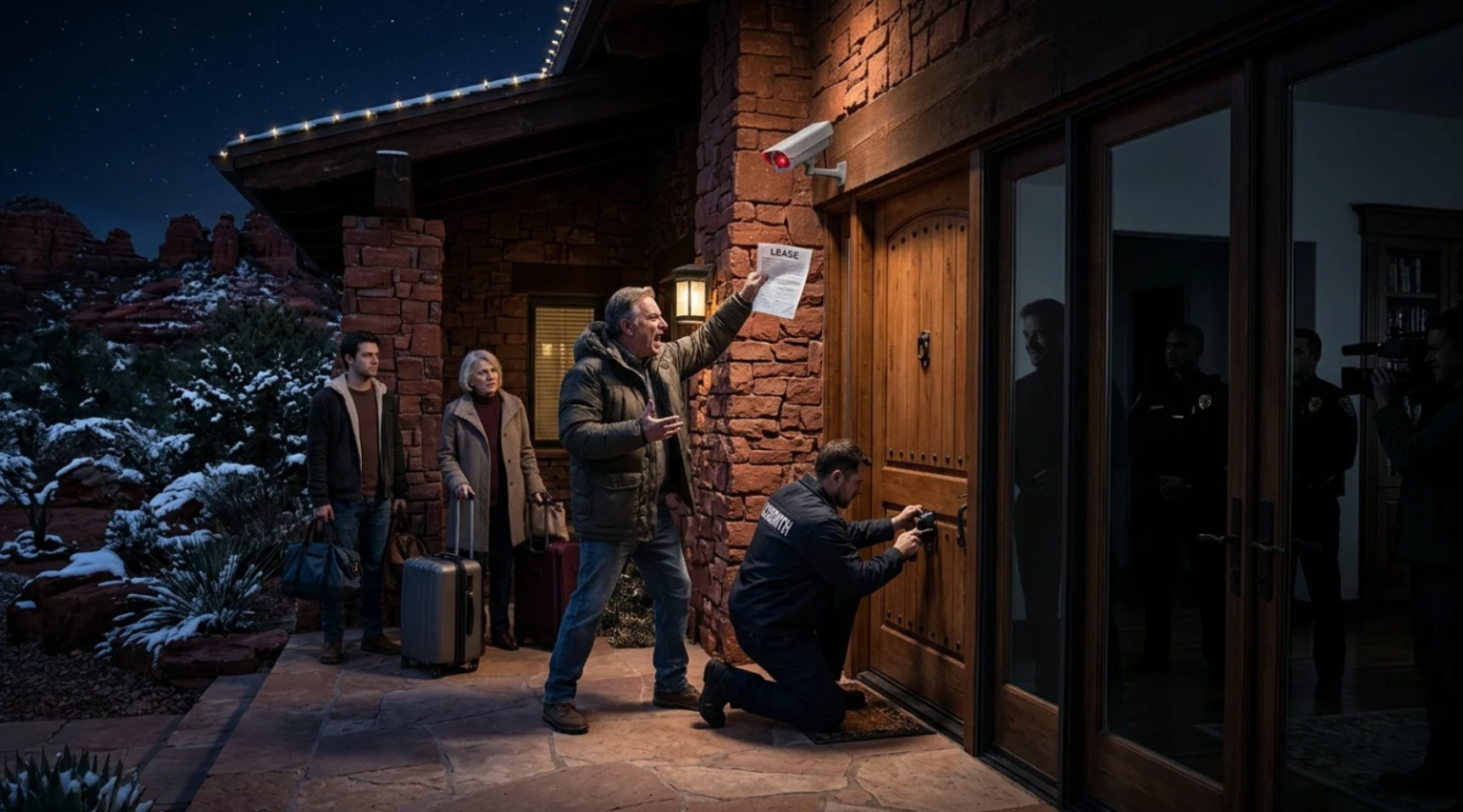
Marcus stepped forward, holding a thick black binder.
“Mr. Voss, I suggest you stop speaking before you make your situation considerably worse.”
Dad stared at him.
“Who are you?”
“Marcus Hale. I represent the legal owner of this property.”
Dad pointed at me.
“She’s my daughter. We have a legal agreement.”
Marcus opened the binder.
“Then perhaps you can explain why the signature on this agreement does not match the owner’s verified signature, why the notary identification number belongs to a deceased notary, and why the supposed psychiatric assessment was never authorized by the physician whose name appears on it.”
For several seconds, nobody spoke.
The locksmith slowly stepped away from Nathan.
“I told you something wasn’t right,” he muttered.
Nathan immediately turned toward him.
“You agreed to do this!”
“I agreed to open a property after being shown legal authorization. I did not agree to participate in a fraud.”
Dad’s face turned red.
“This is ridiculous. We have a lease. We have every right to be here.”
Marcus pulled another document from the binder.
“No, you don’t.”
He handed a copy to the officer.
“This is the recorded deed. The property is owned by Voss Creative Holdings, an entity established independently of Mr. Voss’s company. Elena Voss is its sole beneficial owner.”
Dad snatched the paper.
He examined it.
Then he examined it again.
I watched the realization slowly settle into his face.
He had spent months believing he could take my house because he assumed I had purchased it carelessly.
He had never imagined I had structured the ownership through my own company.
“You hid this from us,” he whispered.
I stepped closer.
“Why would I tell you?”
“Because we’re family!”
I almost laughed.
Family.
That word had been absent from thirty-one Christmases.
But suddenly, standing outside a house worth millions of dollars, he remembered how to pronounce it.
“You forgot my birthday last month,” I said quietly.
Mom immediately interrupted.
“Elena, please. This isn’t the time.”
“You forgot my birthday. Again. But you somehow remembered the address of my house.”
Her eyes filled with tears.
“We’ve been worried about you.”
“No, Mom. You’ve been worried about Dad’s company.”
Nathan shifted his weight.
“Can we stop making this dramatic? We just need somewhere to stay temporarily.”
I looked at the two suitcases beside him.
“Temporarily?”
He shrugged.
“Things have been difficult.”
“Then you should have rented an apartment.”
Dad stepped between us.
“Your brother is in a difficult financial position. We came here to help him get settled. You’re making this unnecessarily complicated.”
I looked directly at him.
“Did you know about the $1.8 million loan guarantee?”
His mouth closed.
That was the first answer.
I continued.
“Did you know my name was used without permission?”
He glanced at Marcus.
“That’s a business matter.”
“Did you know someone forged a psychiatric evaluation claiming I couldn’t make my own decisions?”
Mom started crying.
“Elena, we never wanted things to go this far.”
I turned toward her.
“Then why did you sign it?”
She stopped crying.
The silence was immediate.
Nathan looked at her.
Dad looked at her.
Even the officers exchanged a glance.
Marcus removed another page from the binder.
“Mrs. Voss, your signature appears on the submission cover sheet accompanying the fraudulent medical document. We also have the email account used to transmit it.”
Mom shook her head.
“I didn’t know what it was.”
Marcus remained calm.
“Then you should have no difficulty explaining that to investigators.”
My father suddenly turned toward the officers.
“This is a private family matter. I want these people removed.”
The older officer didn’t move.
“Sir, your daughter has provided evidence of suspected document fraud and unauthorized financial activity. We are investigating the circumstances surrounding your attempted entry.”
Dad pointed at me.
“She is lying!”
I had expected that sentence.
I had heard it in different forms since childhood.
But this time, nobody laughed.
Nobody nodded.
Nobody asked me to apologize for making him angry.
Instead, one of the reporters stood up from the dining room.
A woman with short gray hair and a notebook approached.
“Mr. Voss, my name is Rebecca Sloan. I’m an investigative journalist with the Arizona Ledger.”
Dad looked at her as if she had suddenly appeared from another planet.
“What are you doing here?”
Rebecca glanced at the damaged door.
“We’ve been investigating financial irregularities connected to Voss Development Group for several months.”
His face changed.
Marcus looked at me.
This was the part I had been waiting for.
Because my family had made one enormous mistake.
They believed the forged documents were an isolated incident.
They weren’t.
And the investigation had uncovered something much bigger.
Three months earlier, after discovering the fraudulent loan guarantee, Marcus had contacted the lender’s internal fraud department.
At first, the investigation seemed straightforward.
My father had submitted a guarantee in my name without my knowledge.
But the lender discovered several additional documents.
A second guarantee.
A third.
An authorization supposedly signed by me.
And an ownership statement claiming that I had invested $600,000 into Voss Development Group.
I had never invested a single dollar.
In fact, the company had received money from me only once.
The $12,000 I had sent my mother for employee health insurance.
The records showed that money had been transferred into a company account, then moved through several accounts controlled by Nathan.
When investigators examined the transactions, they discovered payments for luxury vacations, gambling-related transfers, expensive watches, and personal purchases.
My father had been reporting those expenses as business development costs.
Nathan had been enjoying the benefits.
And I had apparently been listed as one of the company’s silent investors.
My name was on financial documents I had never seen.
My signature was on guarantees I had never signed.
And my supposed investment had been used to make the company appear more financially stable than it actually was.
But the most disturbing discovery came from an email exchange between my father and the company’s financial consultant.
Dad had written:
If Elena objects, we can demonstrate that she has a history of emotional instability. Her mother can support the statement. Once the property is secured, the bank will have sufficient collateral.
The consultant had replied:
The medical documentation must be legitimate. Otherwise, it creates additional exposure.
Dad’s response was only six words.
We have someone who can handle it.
That email changed everything.
It wasn’t simply a father trying to borrow money.
It was a coordinated attempt to use my identity, reputation, and property to protect a failing business.
And the people standing outside my house had brought the evidence directly to my doorstep.
Back in the entrance hall, Rebecca approached my father.
“Mr. Voss, did you submit financial guarantees using your daughter’s identity?”
“No comment.”
“Did you instruct anyone to prepare a medical assessment claiming she was incapable of managing her affairs?”
“No comment.”
“Did your company receive $1.8 million in financing based partly on documents bearing her signature?”
Dad looked toward the officers.
“I want my attorney.”
Marcus nodded.
“That’s an excellent decision.”
Then Rebecca turned toward me.
“Elena, may I ask you one question?”
I nodded.
“Why did you agree to let us witness this?”
I looked at the damaged wooden door.
Then I looked at my mother.
“Because for thirty-one years, my family has told everyone a version of my life that made them look innocent and made me look difficult.”
I paused.
“I wanted the truth documented before they had another opportunity to rewrite it.”
Rebecca slowly lowered her notebook.
For the first time that morning, my mother looked genuinely frightened.
Not because the police were there.
Not because the reporters were recording.
But because the story she had spent decades telling was finally being challenged by people who weren’t afraid of my father.
The officers separated everyone.
The locksmith cooperated and provided copies of the communications Nathan had sent him.
He explained that Nathan had contacted him two weeks earlier, claiming to be a tenant who had lost access to a property after a dispute with the owner.
The forged lease had been emailed to him.
The locksmith had initially believed it was legitimate.
But when he arrived and saw the security cameras, the expensive property, and my explicit refusal to grant entry, he became uncomfortable.
That was why he had called Marcus after receiving a suspicious message from Nathan.
Nathan, however, had a different explanation.
He insisted Dad had arranged everything.
Dad insisted Nathan had handled the lease.
Mom claimed she had only signed what Dad gave her.
Within an hour, the three people who had arrived together were blaming one another.
I watched from the staircase.
It was almost surreal.
For years, they had presented themselves as an unbreakable unit.
They had agreed on every version of my supposed failures.
They had supported every accusation.
They had repeated every lie until even I occasionally questioned my own memory.
Now, when their actions had consequences, nobody wanted to stand beside anyone.
My father finally looked up at me.
“Elena, we need to talk privately.”
I didn’t move.
“About what?”
“About our family.”
I looked at him.
“You had thirty-one years to talk to me about our family.”
He lowered his voice.
“Don’t do this in front of strangers.”
I glanced at Rebecca.
“Why? Are you afraid they’ll remember what you say?”
He clenched his jaw.
“You’re making a terrible mistake.”
“No, Dad. The terrible mistake was believing that I would spend the rest of my life protecting you from the consequences of your decisions.”
His eyes narrowed.
“You think these people care about you?”
I didn’t answer.
He continued.
“They want a story. They don’t care if they destroy your family.”
I looked at the reporters.
Then back at him.
“You destroyed the family long before they arrived.”
By late afternoon, the initial police investigation had concluded.
My father and Nathan were not allowed to enter the manor.
The locksmith’s tools were returned to his van, and he provided a written statement.
The officers collected copies of the documents and photographs of the damaged door.
My attorney arranged for the evidence to be preserved and forwarded to the appropriate financial investigators.
My mother remained in the driveway for almost twenty minutes after everyone else had moved away.
She kept looking toward the entrance.
Eventually, she approached me.
“Can I come inside?”
I stood behind the doorway.
“No.”
Her eyes filled.
“I’m your mother.”
“I know.”
“Then how can you do this?”
I took a breath.
“Mom, do you remember the Christmas when I was eleven?”
She looked confused.
“The scarf you wrapped for me because you hadn’t bought me a present?”
Her expression changed.
“I remember.”
“You told everyone I refused to open my gifts because I was being difficult.”
“I was under a lot of pressure.”
“I was eleven.”
She looked down.
“I know.”
I continued.
“Do you remember when you and Dad went skiing without telling me when you were leaving?”
She started crying.
“Elena, please.”
“I remember waking up alone. I remember feeding the cat. I remember watching your Christmas video and hearing Dad tell everyone I had chosen not to come.”
She wiped her cheeks.
“We made mistakes.”
I nodded.
“Yes. You did.”
Then I asked the question I had carried for years.
“Did you ever love me the way you loved Nathan?”
She opened her mouth.
No words came.
And strangely, that silence hurt more than any answer she could have given.
After a long moment, she whispered:
“You were always so independent.”
I almost smiled.
There it was.
The explanation.
The family-approved version.
I was independent, so they forgot me.
I was strong, so they abandoned me.
I was capable, so they took from me.
I was the daughter who could survive anything, which apparently meant I deserved to be put through everything.
“Being independent doesn’t mean I didn’t need a mother,” I said.
She looked at me.
For a moment, I thought she might finally understand.
Then she asked:
“Could you at least help your father save the company?”
I stepped back.
And I closed the door.
Not violently.
Not angrily.
Just firmly.
That evening, Marcus and I sat in the library.
The fire burned quietly.
The reporters had left, promising to contact us before publishing anything that identified private financial information.
My attorney placed the black binder on the table.
“There is one more thing you need to see.”
I looked at him.
“What?”
He opened a section I hadn’t examined before.
Inside were copies of emails, bank statements, and a document from my father’s company’s accounting department.
“What am I looking at?”
Marcus turned the document toward me.
“Your father has been using your identity for longer than we initially believed.”
I stared at the first page.
It contained a list of financial transactions.
Dates.
Amounts.
Account numbers.
And my name.
Then I noticed the total.
$286,400.
My stomach tightened.
“What is this?”
“Payments and credit obligations associated with accounts your father represented as being connected to you.”
I slowly turned the page.
There were several accounts I had never opened.
One had been used to pay the mortgage on my parents’ home.
Another had been used to cover Nathan’s business expenses.
A third had received deposits from Voss Development Group.
I looked at Marcus.
“Can they really do this?”
“They can attempt to. Whether those obligations are legally enforceable against you is another matter. We are challenging them.”
I leaned back.
For a few seconds, the room seemed unusually quiet.
Then I noticed something else.
A document dated eleven months earlier.
It was a preliminary agreement between my father and a private investment company.
The agreement proposed using the Sedona manor as collateral for a restructuring loan.
My father’s company had been negotiating over my property before I had even purchased it.
I looked up.
“He knew I was buying this house?”
Marcus nodded slowly.
“It appears someone supplied him with information about the purchase.”
“Who?”
“We’re still tracing that.”
I looked at the document again.
Then I saw the name of the person who had signed the preliminary agreement on behalf of Voss Development Group.
Nathan.
My younger brother.
The same brother who had stood outside my house holding a pry bar.
But that wasn’t the worst part.
Attached to the agreement was an email from Nathan.
It contained one sentence.
Once we establish residency, Elena won’t have the authority to remove us without a lengthy court process.
I read it twice.
Then a third time.
My brother hadn’t simply come along because Dad asked him to.
He had helped plan the entire thing.
Marcus closed the binder.
“There’s another development. The lender has agreed to provide investigators with the original submission records. We may finally establish who prepared the forged documents.”
I looked toward the dark windows.
Outside, the desert was quiet.
The Christmas lights around the courtyard glowed softly against the stone walls.
I had imagined spending Christmas in this house surrounded by paintings, music, and people who understood what it meant to start over.
Instead, I had spent the first week fighting the people who were supposed to love me.
I thought the worst part was discovering what my father had done.
I was wrong.
Because the next morning, I received a message from an unknown number.
It contained a photograph of an old Christmas card.
The card was addressed to me.
It was dated eleven years earlier.
And written inside, in my father’s handwriting, were the words:
To Elena. We are proud of you. Love, Dad.
I stared at the photograph.
I had never received that card.
I had never even known it existed.
A second message appeared.
Your father told us he delivered it personally. He lied.
Then another message.
If you want to know why your family spent so many years treating you like you didn’t exist, you need to meet me before Christmas.
At the bottom was a name.
Daniel Voss.
My father’s older brother.
The uncle I had been told died when I was twelve.
And beneath his name was an address.
He was alive.
And apparently, he had been waiting eleven years for me to discover the truth.
PART 4
I read the message seventeen times before I finally believed what I was seeing.
Daniel Voss.
My father’s older brother.
The man I had been told died when I was twelve.
The man whose photograph had once stood on my grandmother’s fireplace.
The man whose name nobody in my family was allowed to mention.
Alive.
I sat at the library desk, holding my phone, while the fire burned lower.
For years, whenever I asked about Uncle Daniel, my father gave the same answer.
“He made some bad decisions. We don’t discuss him.”
When I was twelve, I had asked whether he would ever visit us again.
Dad had put down his newspaper.
“He’s gone, Elena. You need to accept that.”
I had assumed he meant he had died.
Apparently, I had misunderstood something far more deliberate.
I immediately called Marcus.
He arrived twenty minutes later.
When I showed him the messages, he read them carefully.
“Don’t respond yet.”
“Why?”
“Because we don’t know who sent them or what they want. Given everything that has happened, we need to be careful.”
He examined the photograph.
The Christmas card was unmistakable.
My father’s handwriting.
My name.
And a date from eleven years earlier.
“Can you verify Daniel is alive?”
“I’m going to try.”
An hour later, Marcus called me into the library.
He had found something.
Daniel Voss was living in Flagstaff, Arizona.
He had owned a small architectural restoration company and had apparently been involved in a lengthy legal dispute with my father over their late parents’ estate.
He was not dead.
He had simply disappeared from our family’s life.
Marcus found a phone number through a public business record.
I called.
A man answered after the second ring.
“Hello?”
I swallowed.
“Uncle Daniel?”
There was a long silence.
Then I heard him exhale.
“Elena?”
My eyes filled immediately.
“Yes.”
“Oh, sweetheart.”
His voice broke.
“I wondered whether I’d ever hear your voice again.”
I covered my mouth.
“Why did Dad tell me you were dead?”
Another silence.
Then he said something I would remember for the rest of my life.
“Because if you knew I was alive, you might have discovered what he did to your grandmother.”
The next morning, Marcus accompanied me to Flagstaff.
Daniel lived in a modest brick house surrounded by pine trees.
There was an old wooden bench near the entrance and a small workshop behind the property.
When he opened the door, I recognized him immediately.
He was older than the man in my grandmother’s photographs, with silver hair and tired eyes.
But his smile was the same.
He looked at me for several seconds.
Then he opened his arms.
I stepped forward.
He hugged me tightly.
“I’m sorry,” he whispered.
I didn’t understand.
“Why are you apologizing?”
“Because I should have found you sooner.”
He invited us inside.
The house smelled of coffee and old books.
On a shelf near the living room stood a framed photograph of my grandmother, my father, Daniel, and me as a little girl.
I pointed at it.
“Where did you get that?”
Daniel smiled sadly.
“Your grandmother gave it to me.”
I sat down.
“Tell me everything.”
He took a deep breath.
“Your grandmother left behind two things when she died. A small property portfolio and a trust intended to support her grandchildren.”
I stared at him.
“Grandchildren?”
“Yes. You and Nathan.”
He explained that my grandmother had owned several rental properties and an investment account.
Her intention had been simple.
Each grandchild would receive an equal share when they reached thirty.
Nathan’s portion had been administered through my father because Nathan was younger.
My portion had been placed under independent administration.
But there was a problem.
My father had contested the arrangement.
He argued that I was financially irresponsible and emotionally unstable.
He wanted control of the entire trust.
Daniel had objected.
The dispute became bitter.
Then Daniel discovered that money had already been withdrawn from accounts associated with the estate.
He reported the transactions.
My father responded by accusing him of mismanagement.
Their relationship collapsed.
And then came the Christmas card.
“Your grandmother died believing you would always be protected,” Daniel said quietly. “I tried to tell you what was happening, but your father blocked my letters and messages.”
I stared at him.
“All those years?”
He nodded.
“I sent you birthday cards. Christmas presents. Letters. I even tried contacting your mother.”
“Did she know?”
Daniel looked down.
“Yes.”
My throat tightened.
“She knew you were alive?”
“She did.”
I looked toward the window.
The woman who had cried outside my house the previous day had known that my uncle was alive.
She had known I was being denied contact with someone who wanted to see me.
And she had allowed me to believe he was dead.
“Why?” I whispered.
Daniel opened a drawer and removed a folder.
“Because your father was afraid of what I knew.”
Inside were copies of correspondence, trust documents, and financial statements.
One document caught my attention.
It showed that a portion of my grandmother’s estate had been transferred to an account associated with Voss Development Group.
The amount was $412,000.
I looked up.
“Was this my money?”
“Part of it, yes.”
I felt sick.
“How much was supposed to be mine?”
Daniel placed another document in front of me.
According to the trust’s records, my original share had been valued at approximately $580,000, including investments and property interests.
But that wasn’t all.
The trust had also specified that the remaining funds should be distributed to support educational and creative opportunities for the grandchildren.
I looked at him.
“Why didn’t anyone tell me?”
“Because your father wanted you to believe you had received nothing.”
I leaned back.
Suddenly, the missing Christmas presents, the forgotten birthdays, the constant dismissal of my achievements, and the years of being portrayed as difficult felt connected in a way I had never understood.
My father had not merely forgotten me.
He had controlled what I knew.
Daniel placed a hand over mine.
“Elena, I need you to understand something. Your grandmother loved you very much. She used to talk about your drawings. She kept every picture you ever sent her.”
He stood and walked to a cabinet.
From a wooden box, he removed a collection of old papers.
Inside were my childhood drawings.
My first attempt at drawing a house.
A painting of a blue bird.
A Christmas illustration I had made when I was eight.
On the back of the illustration was my grandmother’s handwriting.
My little Elena will build beautiful things one day. I hope nobody ever makes her believe she isn’t special.
I began crying.
Not because of the money.
Not because of the property.
But because someone had remembered.
Someone had kept the drawings.
Someone had noticed me.
And for the first time in years, I felt that the little girl who had waited beside the Christmas tree had not been entirely forgotten.
When we returned to Sedona, Marcus immediately contacted the estate attorney listed in the documents.
The following week brought a series of developments.
The trust administrator confirmed that the estate had never been properly closed.
There were unresolved transactions.
There were unauthorized withdrawals.
And there was enough documentation to justify a full investigation.
Meanwhile, the financial investigators working on my father’s company had obtained additional records.
They discovered that my father had been using the supposed investment from my grandmother’s estate to support the company’s financial statements.
The same money had been presented to lenders as evidence of financial stability.
The same money had helped secure additional borrowing.
And the same money had been used to pay expenses connected to Nathan.
The situation was much larger than anyone initially believed.
My father had not simply forged one loan guarantee.
He had built years of financial decisions around money he had no authority to use.
The authorities began examining the records, and Marcus helped me file the necessary civil claims to protect my identity and challenge the unauthorized obligations.
For the first time, my father couldn’t simply call me dramatic and expect everyone to believe him.
There were bank statements.
There were emails.
There were signatures.
There were records.
And there were people who could verify them.
Three days before Christmas, my phone rang.
It was Nathan.
I almost ignored it.
But something made me answer.
“Elena.”
His voice sounded different.
Not confident.
Not irritated.
Just exhausted.
“What do you want?”
He hesitated.
“I need to talk.”
“You’ve already said plenty.”
“I know.”
I waited.
Then he said:
“Dad told me the house was supposed to belong to the family.”
I laughed quietly.
“Did he also tell you to bring a locksmith?”
Nathan didn’t answer.
“Did he tell you to use my signature?”
Another silence.
Finally, he whispered:
“I knew the lease wasn’t real.”
I closed my eyes.
There it was.
An admission.
“I thought it was just something temporary. Dad said we needed to establish residency before the bank moved against the company.”
“You knew it was fraudulent?”
“I knew it wasn’t exactly legitimate.”
I looked toward the courtyard.
“There’s no such thing as almost legitimate, Nathan.”
He sighed.
“I didn’t think you’d actually call the police.”
I almost couldn’t believe what I was hearing.
My brother had helped plan an illegal entry into my home, and his biggest disappointment was that I had refused to let him get away with it.
“Why did you do it?”
He finally answered.
“Because Dad said if the company collapsed, we’d lose everything.”
I spoke quietly.
“You mean you’d lose everything.”
He didn’t respond.
I continued.
“You had years to build something of your own. Instead, you spent Dad’s money, borrowed against things that weren’t yours, and expected me to rescue you.”
“You’re making it sound worse than it was.”
“No, Nathan. I’m finally describing it accurately.”
He began crying.
“Can you help me?”
I stared at the phone.
For years, that had been my role.
Whenever Nathan made a mistake, I was expected to understand.
Whenever he needed money, I was expected to contribute.
Whenever he embarrassed the family, I was expected to remain silent.
But I had learned something important.
Helping someone does not mean protecting them from accountability.
“I won’t lie for you,” I said. “I won’t give you money to cover what happened. But if you’re ready to tell investigators the truth, you should speak with your attorney and cooperate.”
“You’re really going to let this happen to your own brother?”
I took a breath.
“You let it happen to your own sister.”
Then I ended the call.
On Christmas Eve, I received a letter from my father.
It arrived through Marcus’s office.
The envelope contained three handwritten pages.
He wrote about the company’s financial difficulties.
He wrote about the pressure he had been under.
He wrote about how difficult it had been to maintain the family’s reputation.
Then came the sentence I had expected.
I never thought you would turn against us.
I read it twice.
There was not one sentence acknowledging what he had done.
Not one apology for the forged documents.
Not one mention of the years he had made me feel invisible.
He described himself as a father who had made difficult decisions.
At the bottom, he wrote:
I hope you can find it in your heart to remember that we are still your family.
I folded the letter.
Then I placed it in the same drawer where I kept the old document titled The Letter I Will Never Send.
For years, I had written letters to people who never listened.
This time, I decided not to write another one.
I had already said everything that needed saying.
The financial investigation continued into the new year.
The lender confirmed that several documents had been submitted without my authorization.
My father’s company entered a formal restructuring process, and its financial records were examined in detail.
The forged psychiatric letter was also referred for investigation.
The person whose name appeared on it confirmed that he had never evaluated me or written such a report.
The original notary records further undermined the documents my family had presented.
The legal proceedings took months.
There were interviews, hearings, financial reviews, and countless meetings with Marcus.
My father eventually faced charges connected to the financial misconduct and fraudulent documents. Nathan also faced legal consequences for his involvement in the attempted entry and related conduct.
My mother admitted signing documents without properly verifying them.
She later agreed to cooperate with investigators and provided records concerning the transactions.
I did not celebrate anyone’s downfall.
I simply wanted the truth established.
The courts and investigators would decide responsibility.
My job was to protect the life I had built.
And to stop paying for decisions I had never made.
The claims against me were challenged, and the lender acknowledged that the guarantees had not been properly authorized.
The fraudulent obligations were not treated as legitimate debts of mine.
More importantly, my identity was no longer being used as an invisible financial resource for my father’s company.
The trust investigation also produced results.
The estate administrator recovered part of the misappropriated funds and established a proper accounting of the remaining assets.
My grandmother’s intentions were finally recognized.
I received the distribution that belonged to me.
But the most valuable thing I recovered was not money.
It was the truth about the woman who had loved me before anyone taught me to doubt it.
Part 4: The Christmas I Finally Chose for Myself
The following Christmas was different.
The manor was no longer a construction project.
The old library had been restored.
The ballroom had become a gallery.
The detached studio was filled with canvases, brushes, sculptures, and unfinished projects.
And the guest rooms?
They were occupied.
Six women had arrived through the residency program.
One was a painter who had left an abusive marriage.
Another was a single mother rebuilding her career after losing her savings to a fraudulent business partner.
One was a young illustrator who had spent years being told that her work was worthless.
They were all different.
But they shared something.
Each had reached a point in life when starting over seemed impossible.
I understood that feeling.
On Christmas Eve, I walked through the ballroom carrying a tray of hot chocolate.
Someone had decorated the staircase with pine branches and small golden lights.
A pianist played quietly near the fireplace.
The women were laughing.
One of them was hanging handmade ornaments on the Christmas tree.
I stopped when I noticed a small drawing near the bottom.
It was a blue bird.
The same blue bird I had drawn when I was eight.
I had made a copy of my childhood illustration and turned it into a Christmas ornament.
On the back, I had written:
You were never invisible. Some people simply refused to look.
Daniel arrived that afternoon.
He carried a wooden box.
“I brought you something,” he said.
Inside were the remaining letters my grandmother had written to me.
Some were birthday cards.
Some were Christmas letters.
Some were simply little notes about the drawings she had seen.
I picked up the oldest one.
It was dated the year I turned twelve.
Dear Elena,
I hope you are still drawing every day. Your father tells me you are becoming a wonderful young artist. I wish I could see your work more often.
Remember that you never need to become someone else to deserve love.
I am proud of you.
Grandma.
I held the letter against my chest.
Daniel sat beside me.
“She would have loved this place.”
I looked around the ballroom.
Women were laughing near the fireplace.
Paintings covered the walls.
The house was warm.
For the first time, the manor felt exactly the way I had imagined it.
“Do you think she’d be proud?” I asked.
Daniel smiled.
“Elena, I think she would be telling everyone she knows that her granddaughter built something extraordinary.”
I laughed through my tears.
Later that evening, my phone rang.
It was my mother.
I stared at the screen for a long time.
Then I answered.
“Merry Christmas, Elena.”
Her voice was quiet.
“Merry Christmas, Mom.”
There was a pause.
“I know you probably don’t want to hear from me.”
I didn’t answer.
“I’ve been thinking about what you said last year. About being eleven and waiting for a present. About the ski trip. About your birthday.”
She began crying.
“I should have protected you.”
I closed my eyes.
“Yes. You should have.”
“I was afraid of your father. I convinced myself that keeping the peace was the same as keeping the family together.”
I listened.
“But I was wrong. I allowed him to hurt you because I didn’t want to challenge him.”
It was the first time she had acknowledged her part without blaming my personality, my career, or my independence.
“I’m sorry, Elena.”
I looked at the Christmas tree.
A woman in the ballroom was helping another resident hang an ornament.
For a moment, I wanted to tell my mother everything.
I wanted to tell her about the studio, the women, the paintings, and the way the house had finally become a home.
But I realized something.
I didn’t need her approval to enjoy my life.
“I appreciate you saying that,” I replied.
“Could we meet sometime?”
“Maybe one day.”
She cried again.
“Do you think you can forgive me?”
I thought carefully.
“I don’t want to spend the rest of my life being angry. But forgiveness doesn’t mean everything goes back to how it was.”
“I understand.”
“And trust will take time.”
“I understand.”
We said goodbye.
I didn’t promise her a place at my Christmas table.
I didn’t promise her anything.
But I also didn’t feel the need to punish her.
I simply allowed the conversation to end.
Sometimes healing doesn’t mean opening the door again.
Sometimes it means being able to close it without hatred.
A few minutes before midnight, Daniel approached me.
“There’s someone else who sent you something.”
He handed me a small envelope.
I opened it.
Inside was a photograph of my grandmother standing beside a Christmas tree.
She was holding a little girl.
Me.
On the back was a handwritten sentence.
To my Elena, who will one day build a home where nobody has to beg to belong.
I began crying.
Daniel placed his arm around my shoulders.
“She knew you would.”
I looked toward the ballroom.
Six women were sitting around the fireplace.
Someone was laughing.
Someone else was playing the piano.
A young woman was showing her painting to the others, and they were applauding.
Nobody was being ignored.
Nobody was being told to sit quietly because someone more important had arrived.
Nobody was waiting for permission to feel loved.
I walked to the center of the room.
“Everyone,” I said.
The conversations slowly quieted.
“I want to say something before Christmas begins.”
I looked at the women around me.
“Some of us came here after losing homes. Some came after losing relationships. Some came after discovering that the people we trusted were not who we thought they were.”
I paused.
“But I want you to remember something.”
I looked at the little blue bird ornament hanging on the tree.
“Your value was never determined by how someone treated you. You don’t become less important because someone failed to recognize your worth.”
Nobody spoke.
Then I raised my glass.
“To new beginnings. To second chances. And to homes where love is never something you have to earn.”
Everyone raised their glasses.
“To new beginnings!”
And for the first time in thirty-four years, I wasn’t wondering whether my family remembered me at Christmas.
I was surrounded by people who were happy I was there.
Epilogue: One Year Later
The investigation eventually concluded with formal legal consequences for those responsible.
My father’s company was dismantled through the restructuring process, and the remaining assets were handled through the appropriate legal proceedings.
Nathan began working with his attorney and eventually found employment outside the family business.
My mother moved into a smaller apartment and began rebuilding her life independently.
I heard that my father had asked about me several times.
I never asked for details.
Daniel became a regular visitor to the manor.
He helped me organize my grandmother’s papers, and we eventually established an annual creative scholarship in her name.
The scholarship supported young artists who had experienced financial hardship or family rejection.
The first recipient was a nineteen-year-old woman named Sophie.
She arrived carrying one suitcase and a portfolio of drawings.
She looked nervous when she entered the studio.
“Are you sure I belong here?” she asked.
I smiled.
“Why wouldn’t you?”
She looked down.
“People usually tell me I’m not good enough.”
I remembered being eleven.
I remembered the empty Christmas tree.
I remembered the scarf my mother had wrapped from her own present.
And I remembered the little girl who had spent years believing that being forgotten meant she was forgettable.
I handed Sophie a key.
“Here, you have your own room. The studio is yours whenever you need it. And nobody here gets to decide whether your dreams are important.”
Her eyes filled.
“Thank you.”
I smiled.
“Don’t thank me yet. I want to see what you create.”
That evening, I walked alone through the library.
The old family photographs were gone.
Not because I was ashamed of where I came from, but because I no longer wanted my home to be a museum of people who had hurt me.
Instead, the shelves held books written by women who had rebuilt their lives.
The walls displayed paintings from former residents.
And above the fireplace hung my grandmother’s handwritten note:
You never need to become someone else to deserve love.
I stood there for a long time.
Then I heard laughter coming from the ballroom.
I turned off the library lights and joined them.
Outside, snow began falling lightly over the red rocks of Sedona.
For thirty-one Christmases, I had waited for my father to remember me.
For thirty-one Christmases, I had believed that if I became successful enough, talented enough, generous enough, or quiet enough, perhaps one day I would finally deserve a place in his heart.
But I had been asking the wrong question.
I should never have asked why I wasn’t good enough for them.
I should have asked why I kept allowing people to make me feel that way.
I didn’t get the childhood I deserved.
I didn’t get the parents I needed.
I couldn’t recover the Christmas mornings I spent alone or the years I spent apologizing for things I hadn’t done.
But I could decide what happened next.
And I did.
I turned the house they tried to steal into a home where people could begin again.
I turned the money they tried to take into opportunities for others.
I turned the family secrets that once silenced me into a truth nobody could rewrite.
And I finally understood something my grandmother had tried to teach me all those years ago.
Being forgotten by the wrong people doesn’t mean you are unworthy of being remembered.
That Christmas, when the clock struck midnight, I looked around the room.
Everyone was smiling.
Everyone belonged.
And for the first time in my life, I didn’t feel like a daughter waiting outside someone else’s family.
I felt like a woman who had finally built her own home.