
PART 3
Then he opened the door.
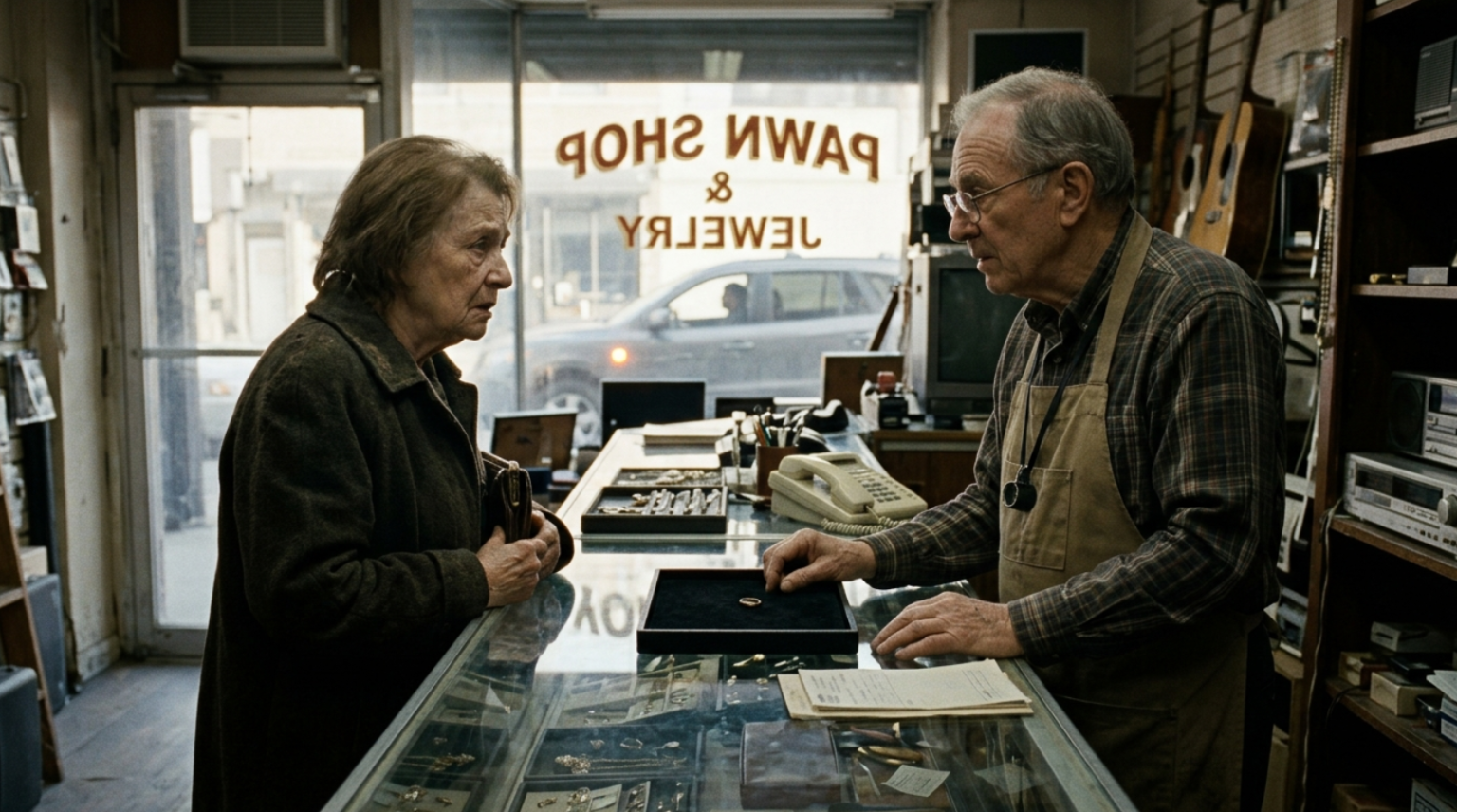
A small bell jingled above his head.
The elderly jeweler emerged from the back room, wiping his hands on a cloth. His face had turned pale.
“Mr. Bishop,” he whispered.
I stared at the newcomer.
“My husband was Harold Bishop.”
The man removed his sunglasses.
“I know, Mrs. Bishop.”
My heart began pounding.
“Who are you?”
He swallowed hard before answering.
“My name is Daniel Whitmore. Your husband saved my father’s life sixty-five years ago.”
The room seemed to tilt.
I gripped the edge of the counter.
“That’s impossible. Harold was a welder. He worked long shifts, came home with burns on his sleeves, and spent his weekends fixing whatever was broken around the house. He never told me about saving anyone’s life.”
Daniel gave me a sad smile.
“That’s exactly the kind of man he was.”
He glanced down at the ring resting on the velvet pad.
“And those six words inside it are the reason my family has spent decades looking for you.”
I stared at the tiny diamond.
For sixty-four years, I had believed those words were simply Harold’s private promise to me.
Now a stranger in an expensive suit was telling me they had something to do with an entire family searching for us.
I shook my head.
“No. Harold never mentioned your name.”
“He wouldn’t have,” Daniel replied. “He promised my father he would keep the truth hidden until the right moment. My father made the same promise to him.”
“What truth?”
Daniel pulled a chair away from the wall and placed it beside me.
“Please sit down, Mrs. Bishop. This may take a little time.”
“I don’t want a chair. I want answers.”
He nodded respectfully.
“Then I’ll start with the six words.”
He looked at the jeweler, who had quietly turned the sign on the door to CLOSED.
Then Daniel spoke the words that had been engraved inside my wedding ring for more than six decades.
“When the time comes, remember Daniel.”
My breath caught.
Those were the words.
Not a declaration of love. Not a date. Not the names of two young people beginning their lives together.
Six words that Harold had once told me never to forget.
I remembered that winter evening in 1961 as clearly as if it had happened yesterday.
We had been sitting at our tiny kitchen table. Harold had just returned from the jeweler with the ring, his hands rough and his face flushed from the cold.
He had slipped the ring onto my finger and kissed my forehead.
“There’s something inside,” he had told me.
I had squinted at the engraving.
“When the time comes, remember Daniel.”
I had laughed.
“Who is Daniel?”
Harold’s expression had changed so quickly that I had almost missed it.
“Someone who may need our help someday.”
I had asked him whether Daniel was a friend from the welding shop.
He had shaken his head.
“Not exactly.”
“Then why put his name in my wedding ring?”
He had taken both my hands in his.
“Because, Diane, if anything ever happens to me, I need you to know that the promise I made wasn’t just for myself. It was for us.”
I had thought he was being dramatic.
Harold wasn’t a man who spoke in riddles. He was a man who believed in paying bills on time, keeping his word, and bringing me home a little bunch of flowers every Friday, even when money was tight.
So I had kissed him, told him he was being mysterious, and never asked again.
A few years later, I had almost forgotten the conversation.
Then life happened.
We had Kevin. We raised him. We bought a small house. We celebrated birthdays, endured illnesses, and watched our hair turn gray.
The ring became part of me.
And Harold’s mysterious words became just another small piece of our life together.
Until now.
I looked at Daniel.
“How did my husband know you?”
Daniel sat opposite me.
“He didn’t know me when he first made that promise. He knew my father.”
He paused.
“My father was Thomas Whitmore. In 1960, he owned a small manufacturing company. He was wealthy, but he was also a very sick man. His business partners were trying to force him out of his own company, and someone had been tampering with the machinery at one of his factories.”
“Tampering?”
“Deliberately damaging equipment. It was supposed to look like ordinary mechanical failure. But one evening, a machine malfunctioned while my father was inspecting the production floor.”
Daniel’s hands tightened around his sunglasses.
“Your husband was working there as a temporary welder. He noticed something wrong with the machine and tried to warn everyone. When the equipment failed, he pulled my father out of the danger zone.”
I felt a chill travel down my back.
“Harold never told me he worked at a factory owned by a Whitmore.”
“He worked there for only a few weeks. He was hired to repair damaged equipment. My father wanted to reward him, but Harold refused money. He said he had only done what any decent person would do.”
That sounded exactly like my husband.
Daniel continued.
“My father insisted on meeting him again. They became friends, despite coming from completely different worlds. My father had money, connections, and a large company. Your husband had a rented house, an old truck, and a wife he was saving every penny to marry.”
I smiled despite myself.
“He always wanted to give me a beautiful wedding.”
“And he did.”
Daniel reached into his jacket and removed a small, worn photograph.
He placed it on the counter.
My fingers trembled when I picked it up.
There was Harold, younger than I had ever seen him in any photograph we owned, standing beside a distinguished man in a factory uniform.
Harold was grinning.
The other man had his arm around Harold’s shoulder.
I turned the photograph over.
On the back, in Harold’s familiar handwriting, were the words:
Thomas and Harold. A promise is a promise.
I pressed the photograph against my chest.
“Why didn’t he tell me?”
Daniel lowered his eyes.
“My father asked him not to. The men who had tried to destroy his company were dangerous. He believed that if they discovered how close they had become, your husband might be targeted.”
I stared at him.
“Harold could have been killed?”
“Possibly. My father didn’t want to take that risk.”
For a moment, I couldn’t speak.
All those years, I had assumed my husband had simply lived an ordinary life.
He had worked hard, loved his family, and died quietly in his sleep at eighty-four.
Now I was learning that there had been an entire chapter of his life I had never known.
Daniel continued.
“My father eventually regained control of his company. He wanted to give your husband a share of the business, but Harold refused. He accepted only enough money to cover a few urgent expenses after your wedding. He insisted that anything else should be used to help workers who had been injured on the job.”
I laughed softly through my tears.
“That sounds like Harold, too.”
Daniel nodded.
“But my father never forgot what Harold had done. Before he died, he created a private trust. It was meant to protect Harold’s family if they ever faced hardship.”
I looked at him sharply.
“What kind of trust?”
“A substantial one.”
“How substantial?”
Daniel hesitated.
“Today, the assets set aside for your family are worth approximately twelve million dollars.”
I stared at him.
For several seconds, I thought I had misunderstood.
“Twelve million?”
“Yes, ma’am.”
I began shaking my head.
“No. That can’t be right. We never received any money. Harold worked until he was nearly seventy. We lived carefully. We paid our bills. When he became ill, we used our savings for his care.”
Daniel’s expression tightened with concern.
“That’s why I came here as soon as the jeweler called. The trust was never supposed to be paid automatically. My father left instructions that the beneficiary had to be identified through the ring and verified through certain records.”
He looked at the jeweler.
“This gentleman recognized the engraving because he was the apprentice who helped make the ring in 1961. He kept the original order record. When I received his call, I brought our family attorney and the trust administrator.”
I glanced toward the window.
Tara’s car was still parked outside.
The engine was running.
She was staring at her phone, apparently growing impatient.
She had sent me into this shop expecting me to exchange sixty-four years of love for a few hundred dollars.
She had no idea that the ring she wanted me to sell had just opened a door to a history she couldn’t imagine.
But Daniel wasn’t finished.
“There is one more thing you need to understand, Mrs. Bishop.”
“What?”
“The trust was established for Harold and his descendants. Your son Kevin is included, but the controlling beneficiary is you. My father specifically stated that the money must never be used to pressure you into making decisions against your wishes.”
I felt something inside me go still.
“Why would he write that?”
Daniel looked toward the street.
“Because he knew what money could do to families. He had seen people become cruel when they believed someone else had something they wanted.”
I thought of Tara’s comments about my ring.
The sighs whenever she discussed the vacation.
The way she calculated every expense I paid while somehow forgetting the money I contributed.
The way she had told me that Harold wouldn’t want me to keep the ring.
I looked down at my hand.
For the first time in years, I wasn’t thinking about how much my family needed me.
I was thinking about how little they seemed to understand what I had already given them.
Daniel placed a business card in front of me.
“Our attorney can explain everything. You won’t be asked to sign anything today. You can take your time, speak to an independent lawyer, and decide what you want to do.”
I studied his face.
“Why help me now?”
He answered without hesitation.
“Because my father asked me to. And because your husband once did something for my family that money could never repay.”
I slipped the ring back onto my finger.
It fit perfectly, as it always had.
Then I looked at the jeweler.
“Thank you for not buying it.”
The old man smiled sadly.
“Some things shouldn’t have a price, Mrs. Bishop.”
Outside, Tara honked again.
This time, she leaned out of the driver’s window and shouted something I couldn’t hear.
Daniel followed my gaze.
“Is that your daughter-in-law?”
“Yes.”
“Does she know why you came here?”
I thought about lying.
Then I decided I was too old to waste my remaining years protecting other people’s lies.
“She brought me here to sell my wedding ring so she could afford a luxury vacation.”
Daniel’s expression hardened.
He didn’t raise his voice.
He didn’t insult her.
He simply said, “I see.”
Then he turned to his attorney, who had just entered the shop carrying a leather folder.
“Please make sure Mrs. Bishop has every document she needs. And arrange for someone to take her home safely.”
I frowned.
“I can go home by myself.”
“Of course,” he said gently. “But you shouldn’t have to ride back with anyone who has made you feel that your memories are worthless.”
Those words struck deeper than he could have known.
I had spent years making myself useful.
I cooked because I wanted to help.
I paid rent because I didn’t want to be a burden.
I watched the children because I loved them.
But somewhere along the way, I had started believing that being loved and being useful were the same thing.
That afternoon, an old stranger reminded me they weren’t.
And when I finally walked out of the pawn shop, I was no longer the woman Tara had sent inside.
I was Diane Bishop.
Harold’s wife.
And for the first time in a very long time, I was ready to stand up for myself.
The first person Tara saw when I stepped outside was Daniel.
Her smile disappeared.
She looked from his expensive suit to the black car, then back to me.
“What took you so long?” she demanded. “Did they offer you anything?”
I stopped beside her window.
“No.”
She rolled her eyes.
“Then what were you doing in there for forty minutes?”
“Talking.”
“About what?”
“Harold.”
Her expression shifted.
“Oh, for heaven’s sake, Diane. We don’t have time for this. Get in the car.”
I didn’t move.
Daniel’s driver opened the rear door of the black sedan.
Tara stared.
“Who is that?”
“Someone who knew my husband.”
She gave a sharp, disbelieving laugh.
“Your husband has been dead for years.”
“I know.”
“Then why is some rich stranger following you around?”
Daniel stepped forward, but I raised my hand slightly.
I wanted to answer this myself.
“Tara, you brought me here because you wanted my ring.”
She folded her arms.
“I brought you here because you said you wanted to help the family.”
“I never said that.”
“You know what I mean.”
“No,” I replied quietly. “I don’t think I do.”
Her face flushed.
“Kevin and I have sacrificed so much. We have a mortgage, two children, bills. You live under our roof, and the least you can do is help us enjoy one nice vacation.”
I looked at her for a long moment.
“How much do I pay you every month?”
She blinked.
“What?”
“My rent. How much is it?”
“That’s not the point.”
“Then tell me.”
She glanced toward Daniel, clearly irritated that someone else was listening.
“Two thousand dollars.”
“And what is your monthly mortgage payment?”
“Why are you asking me these questions?”
“Because I’d like to understand why you believe I owe you my wedding ring.”
She opened her mouth, then closed it.
For years, I had avoided arguments. I had told myself that peace was worth more than being right.
But peace that required me to surrender a piece of myself every time someone demanded it wasn’t peace.
It was fear wearing a polite face.
Tara leaned toward the window.
“Get in the car, Diane. You’re embarrassing me.”
I looked at her.
“No.”
The word was so simple that it seemed to surprise us both.
“No?” she repeated.
“No. I’m not getting in your car.”
She stared at me as if I had suddenly begun speaking another language.
Then she laughed bitterly.
“Fine. Call Kevin. See what he thinks about this little performance.”
“I will.”
I took out my phone.
And for the first time since moving into their house, I called my son not to ask whether he needed anything, but to tell him that something had to change.
I had no idea that the conversation waiting for me would reveal an even deeper betrayal.
PART 4
Kevin answered on the fourth ring.
“Mom? What is it? Tara says you’re making a scene outside some pawn shop.”
I closed my eyes.
Not Are you okay, Mom?
Not Why did Tara take you to a pawn shop?
Just an accusation.
“Kevin,” I said quietly, “did you agree that I should sell my wedding ring?”
There was a pause.
Then he sighed.
“Mom, it’s just a ring. Dad is gone. You have so many memories of him. Nobody is asking you to forget him.”
“Your wife told me that your children deserved a decent vacation more than I deserved to keep the ring your father placed on my finger.”
“That’s not what she meant.”
“Then what did she mean?”
He didn’t answer.
I looked through the pawn shop window at the small velvet pad where my ring had rested only minutes earlier.
“Kevin, did you know she was bringing me here?”
Another pause.
“Yes.”
The word hurt more than I expected.
“You knew?”
“Mom, we talked about it. Tara thought the ring might be worth a few thousand dollars. We could use the money for the vacation, and you could still keep Dad’s photographs and everything else.”
Everything else.
As though a marriage could be divided into objects, and I could be permitted to keep the inexpensive pieces while surrendering the one thing I had worn for sixty-four years.
I swallowed the ache in my throat.
“Did you know what your father had engraved inside it?”
“No. Why?”
“Because your father asked me to remember someone named Daniel. Today, that promise brought me to a man who knew him.”
Kevin sounded impatient.
“Mom, I don’t understand what you’re talking about.”
“Neither did I. But I am beginning to understand something else.”
“What?”
“I understand that you were willing to let your wife take my wedding ring before you ever asked whether I wanted to sell it.”
“That’s not fair.”
“No, Kevin. It isn’t.”
I ended the call.
My hand trembled, but I didn’t cry.
Not yet.
Daniel had waited patiently beside the car. When I looked up, he offered me his arm.
“Would you like to go somewhere quiet?” he asked.
I nodded.
As I settled into the back seat of his car, I saw Tara watching us through her windshield. Her expression had changed from irritation to confusion.
Then she noticed the black sedan’s driver opening my door and the attorney carrying his leather folder.
She started her engine again.
For a moment, I thought she might drive away.
Instead, she pulled alongside us and lowered her window.
“Diane! What is going on?”
I looked at her.
“For once, Tara, I think I’m going to find out what happens when I stop explaining myself to everyone.”
Then the driver closed my door.
And we left.
The attorney took me to a quiet office overlooking a small garden.
His name was Richard Cole. He had represented the Whitmore family for nearly thirty years, and he spoke with the measured patience of a man who understood that some conversations required more than legal documents.
He placed a glass of water in front of me.
“Mrs. Bishop, I want to assure you that you are under no obligation to accept anything today. First, we need to establish the facts and verify your identity.”
“Of course.”
He opened his folder.
Inside were copies of old documents, letters, photographs, and a sealed envelope bearing Harold’s name.
I recognized his handwriting immediately.
My fingers hovered above the envelope.
“Where did you get this?”
“From the Whitmore family archive. It was left with instructions to be delivered to you if the ring was ever presented for verification.”
“Harold wrote this?”
“Yes. The letter was deposited with the trust administrator many years ago.”
I looked at Daniel.
“Did you read it?”
“No,” he replied. “It was addressed to you. We respected that.”
For the first time that afternoon, I felt something resembling peace.
I opened the envelope carefully.
Inside was a single sheet of paper.
My dearest Diane,
If you are reading this, it means the promise I made to Thomas has finally reached the moment when it matters.
I have kept this part of my life from you because I wanted our home to remain a place where you never had to worry about the troubles of powerful men. I knew you would ask questions, and I knew you would want to help. That is one of the many reasons I love you.
Thomas once told me that money reveals what people already carry inside their hearts. It can make a generous person more generous, or give a selfish person more opportunities to take.
I refused his offer of wealth because I did not want our friendship to become a transaction. But I accepted his promise that if our family ever faced a genuine need, you would not be left without protection.
I hope you will never need it.
But if you do, remember that accepting help is not the same as owing someone your freedom.
You have given me sixty-four years of love. You gave me a home when I had nothing more than a toolbox and a dream. You gave me a son. You stood beside me when life was difficult, and you never once made me feel that I was less of a man because I earned less than others.
If the day comes when someone makes you feel that your worth depends on what you can give them, please remember this: you were enough before you had anything to offer.
You will always be enough.
Forever your husband,
Harold.
I lowered the letter.
For the first time since his death, I cried without trying to stop myself.
I cried for the young man who had saved every penny to buy me a ring.
For the husband who had carried burdens I never knew existed.
For the years I had spent making myself smaller because I feared becoming a burden to my own son.
And for the simple, devastating truth that Harold had understood something I was only beginning to learn.
Love was never supposed to be a debt.
Daniel waited until I was ready to speak.
“Your husband loved you very much,” he said.
I wiped my cheeks.
“Yes. He did.”
Richard gently turned the documents toward me.
“The trust was established to provide financial security for Harold’s immediate family. It includes provisions for you and your descendants. Based on the current valuation, the assets are approximately twelve million dollars, subject to final accounting and the trust’s terms.”
I stared at the figures.
I had spent my life comparing grocery prices, repairing old clothes, and saving money for emergencies.
Twelve million dollars was a number so enormous that it felt unreal.
But Richard continued carefully.
“Your husband did not leave you instructions to distribute the money to anyone. You will have independent legal advice before making any decision. The trust’s precise structure will determine what you can access directly and what remains subject to its terms.”
I nodded.
“Then I have a question.”
“Certainly.”
“If I decide to help my son, can I do that without allowing anyone to control me?”
“Absolutely. Any assistance should be voluntary, documented, and based on your wishes.”
I thought about Kevin’s mortgage.
His children’s school expenses.
The vacation Tara had wanted.
Then I thought about the way she had watched me remove my ring.
“I don’t want to punish my family,” I said. “I just don’t want to be treated like something they can use.”
Richard nodded.
“That’s a very reasonable place to begin.”
That evening, I returned to Kevin’s house with a plan.
I would not tell Tara about the money yet.
Not because I wanted to deceive her, but because I needed time to understand the trust, protect my independence, and decide what kind of relationship I wanted with my family.
For the first time in years, I would make a decision without asking permission.
And that was only the beginning.
When I arrived home, Tara was waiting in the living room.
Kevin sat beside her, his elbows resting on his knees.
The children were upstairs.
The moment I entered, Tara stood.
“What was all that about?”
I removed my coat.
“I met someone who knew Harold.”
“Someone who drives a luxury car?”
“Yes.”
Kevin rubbed his forehead.
“Mom, please. Can we stop making this complicated?”
I looked at my son.
“I would love that.”
“Then tell us what happened.”
“I learned something about your father. I also learned that I should have asked more questions before allowing either of you to make decisions about my belongings.”
Tara gave an incredulous laugh.
“Your belongings? Nobody stole anything from you!”
“You brought me to a pawn shop and told me to sell my wedding ring.”
“For the family!”
“Did you ask me whether I wanted to?”
She folded her arms.
“You’re making me sound like a terrible person.”
“I am telling you what happened.”
Kevin rose.
“Mom, Tara has been under a lot of stress. We were trying to plan something nice for the kids. It got out of hand.”
I looked at him sadly.
“Then why didn’t you tell her no?”
He looked away.
That silence told me more than an argument could have.
Tara stepped forward.
“You know what? If you don’t want to help, just say so. But don’t act like you’re the only person in this family who has sacrificed anything.”
I nodded slowly.
“You’re right. Everyone sacrifices something. But sacrifice doesn’t give anyone ownership of another person’s life.”
She rolled her eyes.
“Here we go again.”
“No,” I said. “We’re not going again. We’re going to do things differently.”
I told them I would continue paying my agreed household expenses for the time being, but I would no longer give additional money without a clear reason and a decision made freely.
I would also keep my personal documents, bank information, and valuables in a secure place.
And I would never again allow anyone to pressure me into surrendering something meaningful to me.
Tara looked at Kevin as though she expected him to intervene.
He didn’t.
Finally, she muttered, “Fine. Keep your ring.”
I looked down at it.
“I intend to.”
Then I went upstairs.
For the first time in months, I slept peacefully.
But the following morning, I discovered that my family’s problems were more complicated than I had imagined.
At breakfast, Kevin placed a stack of papers beside my plate.
“Mom, I need you to look at something.”
I set down my coffee.
“What is it?”
He hesitated.
“It’s about the house.”
Tara, standing by the kitchen counter, suddenly became very interested in pouring orange juice.
Kevin explained that their mortgage payments had increased, their credit-card debt had grown, and they had been struggling to keep up with expenses.
He had hoped the vacation would give the family something positive to look forward to.
I listened carefully.
I knew they were under financial pressure. I had seen the bills arriving and heard the arguments after the children went to bed.
But I also knew that a luxury vacation had never been the solution to a financial problem.
“How much do you owe?” I asked.
Kevin gave me a number.
It was substantial, but not impossible to manage with careful planning.
“Why didn’t you tell me you were struggling?”
He stared at the papers.
“Because I was embarrassed.”
I reached across the table and touched his hand.
“Kevin, you never needed to pretend that everything was perfect.”
His eyes filled with tears.
“I know.”
“Then why did you agree to let Tara take my ring?”
He covered his face.
“I don’t know, Mom. I thought it was just an object. I thought you would be upset for a little while, but then you’d understand.”
I withdrew my hand.
“That is what hurts. You thought my grief was something you could manage for me.”
He began to cry.
“I am sorry.”
I believed that he was genuinely sorry.
But forgiveness, I was learning, didn’t mean pretending that nothing had happened.
I told him I would not sell my ring, and I would not pay for their vacation.
However, if he and Tara genuinely wanted to improve their finances, I would help them find an independent financial counselor.
They would need to make a budget, reduce unnecessary spending, and take responsibility for their own decisions.
“I won’t rescue you from every difficult situation,” I told him. “But I will help you learn how to stand on your own feet.”
Kevin nodded.
Tara remained silent.
Then, just as I thought the conversation was over, she asked the question that changed everything.
“Are you going to tell us how much that man offered you for the ring?”
I looked directly at her.
“He didn’t buy it.”
“But he must have told you what it was worth.”
I paused.
“Yes. He told me something about its history.”
She narrowed her eyes.
“What does that mean?”
“It means Harold had a life before he became your father-in-law. And some of the things he did mattered more than any of us knew.”
Tara stared at me.
For the first time, I saw uncertainty in her face.
She had assumed the ring was worth only what someone would pay for the gold and diamond.
She had never considered that its value might be connected to something beyond money.
I stood, picked up my coffee, and carried it to the sink.
“I have an appointment today,” I said. “I’ll be back this afternoon.”
“Where are you going?” Kevin asked.
“To see my lawyer.”
His expression changed.
“Your lawyer?”
“Yes.”
I smiled gently.
“It’s time I made sure my future is protected.”
Over the next several weeks, my life changed in ways I could never have imagined.
Richard introduced me to an independent attorney who specialized in trusts and estate planning. Together, we reviewed the documents, confirmed my identity, and established the precise extent of my rights under the trust.
Nothing happened overnight.
There were records to verify, accounts to review, and legal procedures to complete.
But eventually, the trust administrator confirmed the arrangement Harold and Thomas had created so many years earlier.
The assets were real.
The money had been preserved and invested for decades.
And I was entitled to receive the benefits set out in the trust.
For the first time in my life, I had financial security beyond anything I had dreamed of.
I could afford my own home.
I could pay for medical care without worrying about draining my savings.
I could travel if I wanted to.
Most importantly, I could make decisions without fearing that I would become homeless if someone became angry with me.
I bought a small, comfortable house in a quiet neighborhood.
It had a sunny kitchen, a garden large enough for roses, and a little porch where I could sit with a cup of tea in the mornings.
I chose the curtains myself.
I filled the rooms with photographs of Harold.
I placed his old toolbox beside the bookshelf in the study, not because it was valuable, but because it reminded me of the man who had built a beautiful life with his hands.
When I moved out of Kevin’s house, I didn’t leave in anger.
I cooked dinner for the family on my final evening there.
I hugged my grandchildren.
I told them that I loved them and that they could visit me whenever they wished.
Then I gave Kevin a letter.
Inside, I wrote:
My dear son,
I have loved you since the first moment I held you.
That love has never depended on your success, your income, or your ability to make me happy.
But I need you to understand that loving someone does not mean surrendering every boundary.
I am your mother. I am not your financial plan, and I am not a burden you must tolerate in exchange for money.
I want you to build a good life. I want you to become a man who treats people with kindness, even when they have nothing to offer you.
If you can learn that lesson, then perhaps something good will come from what happened.
I will always love you.
Mom.
When I handed him the letter, he held it against his chest.
“I don’t want you to go,” he whispered.
I touched his cheek.
“Then don’t let me become someone you only value when you need something.”
He began to cry.
And I hugged him.
Because he was still my son.
But I finally understood that I could love him without allowing him to decide what my life should be.
Tara did not take the news well.
When Kevin told her I was moving, she accused me of abandoning the family.
She said the children would miss me.
She said Kevin would struggle without my help.
She even suggested that I was being manipulated by Daniel and the Whitmore family.
But I didn’t argue.
I simply moved into my own home.
A few days later, Daniel visited me with a small wooden box.
Inside was a photograph of Harold and Thomas, along with a letter from Thomas Whitmore that had been written shortly before his death.
It read:
To the wife of the man who saved my life,
If this letter has reached you, then my promise to Harold has finally found its way home.
He never asked me for anything. When I offered him wealth, he asked me to help people who had been forgotten by the world.
He told me that a person’s character was measured not by what he could take, but by what he was willing to protect.
I have never forgotten that lesson.
Whatever you decide to do with the resources entrusted to you, I hope you will use them in a way that brings you peace.
You owe me nothing.
You owe Harold nothing.
And you owe the world no explanation for choosing a life in which you are safe, respected, and free.
With gratitude,
Thomas Whitmore.
I read the letter twice.
Then I looked at Daniel.
“Your father and my husband would have gotten along very well.”
Daniel smiled.
“They did. In many ways, your husband was the only person who ever treated my father as a man instead of a fortune.”
I thought about that.
Then I made a decision.
I would use a portion of the trust’s permitted distributions to establish a small charitable fund in Harold’s name, subject to the trust’s terms and professional advice.
The fund would help older people who were being pressured by relatives to surrender their savings, sign away property, or give up their independence.
It would pay for legal consultations, emergency housing, and practical support for people who had nowhere else to turn.
I didn’t want to create a grand institution with my name on the door.
I wanted to help people who felt as powerless as I had felt sitting in that pawn shop.
Daniel helped me connect with experienced professionals who could administer the fund responsibly.
Within a year, the Harold Bishop Senior Support Fund was assisting its first group of elderly residents.
And every time I received a letter from someone who had found safety, I thought of Harold.
The man who had once refused a fortune because he believed that helping someone mattered more than becoming wealthy.
He had never known that his quiet act of kindness would eventually help hundreds of people.
But perhaps that was the point.
The best things we do in life often grow far beyond what we can see.
Six months after I moved out, Kevin came to visit.
He looked tired, but different.
He had found a second job doing accounting work on weekends. He and Tara had sold one of their expensive vehicles and canceled several subscriptions they rarely used.
They had also begun working with a financial counselor.
For the first time in years, Kevin was taking responsibility for his choices instead of hoping someone else would solve his problems.
We sat in my garden beneath the rosebush Harold would have loved.
Kevin looked at my wedding ring.
“Mom, can I ask you something?”
“Of course.”
“Do you ever think about selling it now?”
I smiled.
“No.”
He nodded slowly.
“I didn’t understand why it mattered so much. I thought you were attached to it because Dad was gone.”
“That’s part of it.”
“What else?”
I turned the ring around my finger.
“It reminds me of the man your father was when he had almost nothing. He didn’t buy it because he was rich. He bought it because he wanted to make a promise to me, and he worked hard to keep it.”
Kevin looked down.
“And I tried to take that away from you.”
“Yes.”
He wiped his eyes.
“I am so sorry, Mom.”
I reached for his hand.
“I forgive you.”
He looked up hopefully.
“Does that mean everything can go back to how it was?”
I shook my head gently.
“No, sweetheart. It means we can build something better.”
For a long time, we sat together without speaking.
Then he told me something I hadn’t expected.
He had started talking to Tara about the way they treated me.
At first, she had become defensive. She blamed stress, money, and the pressures of raising children.
But Kevin had refused to let the conversation end there.
He had told her that he had been wrong, too, and that their marriage could not continue as though his mother’s dignity was negotiable.
Tara had eventually agreed to attend counseling with him.
She wasn’t transformed overnight.
There were still difficult conversations, old habits, and moments when she struggled to accept that I was no longer available to solve every problem.
But Kevin was learning to speak up.
And Tara was slowly learning that boundaries were not punishments.
They were the conditions that allowed relationships to survive.
A few months later, she came to my house alone.
She stood on the porch holding a small bouquet of white roses.
I invited her inside.
We sat at the kitchen table where I had placed Harold’s photograph.
Tara looked uncomfortable.
“I came to apologize,” she said.
I waited.
“I was selfish. I wanted that vacation so badly that I convinced myself your ring was something you could spare. I didn’t think about what it meant to you.”
“No,” I replied. “You didn’t.”
She looked down at her hands.
“I also thought that because you lived with us and helped with the children, you should be willing to do whatever the family needed.”
“And now?”
She swallowed.
“Now I understand that helping us was something you chose to do. It wasn’t something we were entitled to demand.”
I studied her face.
I wanted to believe her, but I had learned not to confuse an apology with a guarantee.
“Thank you for saying that,” I told her. “I hope we can build a better relationship. But I need you to understand that my home, my money, and my belongings are mine to manage.”
She nodded.
“I understand.”
We didn’t suddenly become best friends.
Trust takes longer to rebuild than it takes to break.
But Tara began calling before visiting. She stopped asking me to cover unexpected expenses. When the children came over, she thanked me for spending time with them instead of treating my help as an obligation.
Slowly, our relationship became more honest.
And that was enough.
One year after the day Tara drove me to the pawn shop, I returned to the jeweler who had recognized my ring.
His name was Arthur.
He was sitting behind the same counter when I entered, though the guitars and old leather jackets had been rearranged.
He smiled when he saw me.
“Mrs. Bishop! It’s wonderful to see you.”
I held up my hand.
“Still wearing it.”
Arthur chuckled.
“I would have been disappointed if you weren’t.”
I placed a small framed photograph on the counter.
It showed Harold standing beside Thomas Whitmore at the factory, both men smiling as though the future held nothing but possibility.
“I thought you might like a copy.”
Arthur adjusted his glasses.
“Thank you. I’ll treasure it.”
I looked around the shop.
The place no longer seemed filled with other people’s desperation and heartbreak.
It seemed filled with stories.
Every object behind the glass had once belonged to someone who had loved it, needed it, or carried it through a difficult chapter of life.
I thought about the people who might walk through that door tomorrow, hoping to turn something precious into enough money to get through another week.
That was why the support fund mattered.
Not because I could save everyone.
But because I could help some people find another choice.
Before leaving, I turned to Arthur.
“Do you remember the first thing you said when you read the engraving?”
He smiled.
“I believe I said I needed to make a phone call.”
“You did.”
“And I suppose that phone call changed your life.”
I looked down at Harold’s ring.
“No,” I said softly. “The ring reminded me that my life was still mine to change.”
Arthur nodded.
Then I stepped out into the afternoon sunlight.
I had no luxury vacation planned.
No first-class ticket waiting for me.
No enormous suite overlooking a tropical beach.
Instead, I had a little house filled with flowers, a garden where I could hear the birds in the morning, grandchildren who visited on weekends, and a son who was finally learning that love required more than taking.
And on my finger was a thin gold band with a small diamond.
Inside it were six words that had survived more than six decades.
When the time comes, remember Daniel.
For years, I thought those words were a mystery about someone my husband had known.
Now I understood their deeper meaning.
Harold had left me a promise, but he had also left me something far more valuable than money.
He had left me the courage to remember who I was.
I was not merely an old widow who needed a place to stay.
I was not a source of rent, free childcare, or emergency money.
I was not someone whose memories could be exchanged for another person’s comfort.
I was Diane Bishop.
I had loved a good man for sixty-four years.
I had raised a son.
I had survived loss.
And I had every right to live the rest of my life with dignity.
Sometimes, the greatest inheritance is not the money someone leaves behind.
It is the reminder that you were worthy of love long before anyone knew what you possessed.
And sometimes, the smallest ring carries a promise large enough to change an entire family.