
PART 3
She looked toward the window.
“He said we shouldn’t worry about rent because we’d be taking care of the house until it became ours.”
For several seconds, neither of us spoke.
Outside, a delivery truck rumbled down the street. Somewhere in the neighborhood, a dog barked twice and fell silent.
I looked at the woman sitting in my living room and realized that we had not been arguing about a birthday present, an unexpected visit, or even a lease.
We had been living inside two completely different versions of the same arrangement.
I believed I was helping my son through a difficult season of his life.
Apparently, my son had begun treating that help as an inheritance he was entitled to receive early.
“Sarah,” I said carefully, “when did David tell you that?”
“Years ago.”
“How many years?”
She sighed as though I were deliberately making an unpleasant conversation more complicated.
“I don’t remember exactly. Maybe when Leo was little.”
“So, around the time I first let you move in?”
“Yes.”
“And did either of you ever ask me whether I intended to give David the property?”
Her lips tightened.
“Why would we need to ask? You’re his mother.”
I nearly laughed, but there was no humor in it.
That sentence explained more than she realized.
Because I was his mother, I had become the person who was expected to provide without asking questions.
Because I was his mother, my retirement savings were apparently available whenever their budget became inconvenient.
Because I was his mother, my generosity had somehow transformed into a promise I had never made.
And because I was his mother, they seemed to believe that disagreeing with them was a betrayal.
I folded my hands in my lap.
“Sarah, I love David. I love Leo. I have never wanted either of them to struggle. But I have never promised David this house.”
She stared at me.
“Are you saying you intend to sell it?”
“I’m saying the house belongs to me, and I will decide what happens to it.”
“But David has been living there for five years!”
“Yes.”
“He has made it his home.”
“That is what a person does when they live somewhere for five years.”
She blinked, apparently expecting a different answer.
I continued.
“That doesn’t make him the owner.”
Sarah stood and walked toward the fireplace. She studied the framed photograph of Arthur and me standing in front of the house shortly after we purchased it.
Arthur was wearing an old baseball cap, and I was laughing because he had insisted on holding a paintbrush for the photograph even though we had finished painting the front porch the previous day.
“He told me you wanted him to have it,” Sarah said quietly.
“Then David misunderstood me, or he told you something that wasn’t true.”
She turned around sharply.
“Are you calling my husband a liar?”
“No. I’m telling you what I know. I have never promised him ownership of this property.”
For a moment, I thought she might shout.
Instead, she picked up her bag.
“Well, this is going to destroy our family.”
I felt those words settle between us.
Not because I believed them, but because I recognized the strategy.
If I continued allowing them to live there without paying rent, I was a loving mother.
If I asked them to contribute fairly, I was destroying the family.
If I paid their expenses, I was generous.
If I stopped, I was cruel.
There was apparently no version of me that could say no without becoming the villain in their story.
“Sarah,” I said, “asking adults to make a plan for their housing isn’t destroying a family.”
She shook her head.
“You don’t understand what we’re dealing with financially.”
“Then tell me.”
She hesitated.
For the first time that morning, I thought she might actually speak honestly.
“Our car payments are high. David’s student loan payments restarted. Childcare costs are ridiculous, and everything is expensive. We have credit cards, too. We were hoping to save enough for a down payment on a better house, but it’s been difficult.”
I listened.
I understood financial pressure. I had lived through recessions, rising grocery bills, unexpected medical expenses, and the long, frightening months after Arthur died when I wondered whether I could maintain everything we had built together.
I wasn’t unsympathetic.
But there was a difference between struggling and refusing to acknowledge the help that made your life possible.
“How much do you pay every month for the SUV you’re saving for?” I asked.
Sarah looked uncomfortable.
“We haven’t bought it yet.”
“How much are you planning to spend?”
“David wants something around forty-five thousand dollars.”
I stared at her.
“And you believe you cannot afford fourteen hundred fifty dollars in rent?”
“It’s not the same thing.”
“No,” I agreed. “It isn’t. Rent keeps a roof over your family’s head. A new SUV is a choice.”
Her cheeks flushed.
“You make it sound like we’re irresponsible.”
“I don’t know what you are, Sarah. I know what the numbers tell me. You have been living in my property for five years without rent, and I have been paying expenses that were supposed to be part of my retirement income. Meanwhile, you are telling me you cannot afford a reasonable rent payment while planning to purchase an expensive vehicle.”
“We deserve to have something nice!”
The words came out before she could stop them.
I looked at her for a long moment.
Then I nodded slowly.
“Of course you do. But deserving something nice doesn’t mean someone else must pay for it.”
She opened her mouth, then closed it.
I could see that she had expected me to become defensive, perhaps even apologetic. She had come prepared to pressure an older woman who had spent years accommodating her family.
She had not expected me to ask questions.
“Take the lease home,” I said. “Read it carefully. If you and David believe there is something unreasonable in it, you can discuss that with me. But I will not withdraw it simply because you are upset.”
She grabbed her bag.
“David is going to be furious.”
“Then David can call me.”
“He might not speak to you for a long time.”
That hurt.
I won’t pretend it didn’t.
Even after everything I had heard, the thought of my son cutting me out of his life made my chest tighten.
But I had reached an age when I understood something that had taken me far too long to learn.
You can love someone with your entire heart and still refuse to let them control you with the threat of withholding theirs.
“I hope he doesn’t make that choice,” I said. “But I cannot make decisions about my own property based on whether my son is willing to speak to me.”
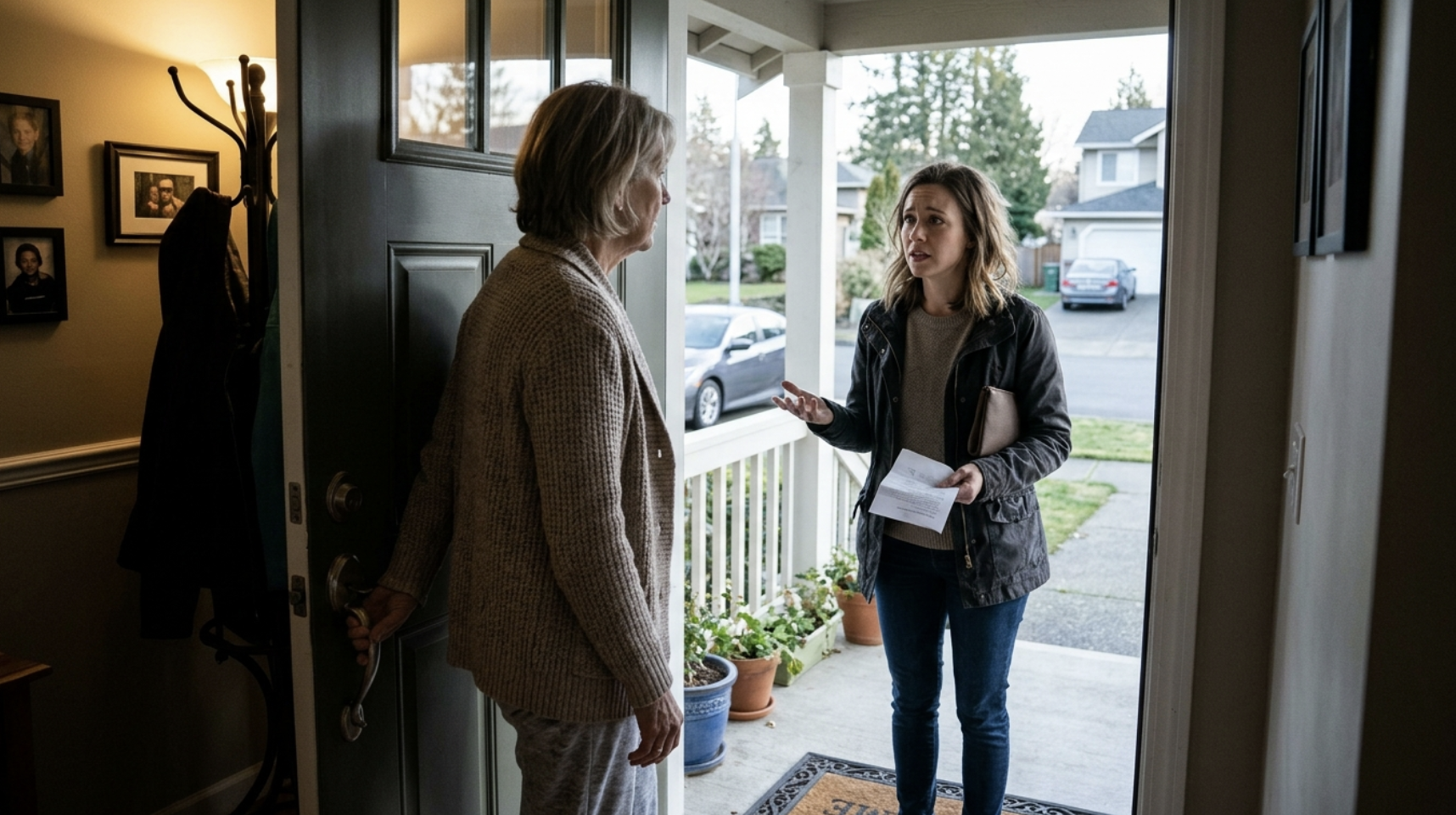
Sarah walked to the door.
Before leaving, she turned around one last time.
“You’re really going to do this?”
“Yes.”
She stared at me as though she were seeing a different person.
Then she left.
I closed the door gently.
I didn’t feel victorious.
I felt sad.
I went into the kitchen, made myself a cup of tea, and sat beside the window where Arthur used to read the newspaper on Sunday mornings.
For years, I had told myself that helping David was one of the ways I kept my husband’s memory alive.
Now I wondered whether I had misunderstood what Arthur would have wanted.
Arthur loved our son. He also believed that love without responsibility could become a burden to everyone involved.
I could almost hear him saying, Caitlyn, you can give a person a hand without carrying them forever.
That afternoon, I decided to find out exactly what David believed he had been promised.
And I decided that from then on, every important conversation about the house would happen in writing.
I had no idea how important that decision would become.
Because at 4:37 that afternoon, my phone rang again.
This time, it was David.
And he wasn’t calling to apologize.
“Mom, what exactly did you tell Sarah?”
His voice was sharp enough to make me pull the phone away from my ear.
“Good afternoon to you, too, David.”
“Don’t do that.”
“Do what?”
“Act like this is some normal conversation. Sarah came home crying.”
I closed my eyes briefly.
“I didn’t make her cry. We discussed the lease.”
“You told her the house isn’t going to be mine.”
“I told her the truth. I have never promised you this property.”
Silence.
Then he said, “That’s not what you told me when Dad died.”
I straightened in my chair.
“What are you talking about?”
“You told me you wanted the family to keep the house.”
“I said I wanted to keep the property in the family if it made financial sense. That is not the same as giving it to you.”
“You knew we were planning our future around it.”
“No, David. I knew you were living there. I did not know you were planning your future around an inheritance you had never discussed with me.”
He exhaled angrily.
“Unbelievable.”
“What did you believe would happen when I retired? Did you think I would keep paying every expense indefinitely?”
“I thought you wanted to help us.”
“I did help you.”
“Then why are you suddenly acting like a landlord?”
The question struck me because it was so simple.
He genuinely believed that being his mother and being the owner of the property were roles that could never be separated.
I could be his mother when he needed money, his mother when he needed childcare, his mother when he needed a place to live.
But when I asked him to respect the fact that the house belonged to me, he wanted me to become something else entirely.
A silent source of support.
“David, when your father and I bought that house, we intended it to be an investment. We expected it to generate income. When you lost your job and Sarah was pregnant, I offered you a temporary arrangement because I wanted to help. I did not sign the property over to you.”
“We’ve taken care of the place!”
“You have paid the utilities, as we agreed. I’ve paid the property taxes, insurance, and major repairs.”
“We’ve maintained it.”
“And I’m grateful for that.”
“So what more do you want?”
The question came out with such genuine frustration that I almost struggled to answer.
I wasn’t asking for an apology.
I wasn’t asking for gratitude.
I wasn’t even asking for the full market rent.
I wanted a relationship in which my kindness was not treated as an obligation.
“I want us to have a clear arrangement,” I said. “I want you to understand that the house is mine. I want you to have a realistic plan for your family’s future. And I want to be able to visit my grandson without being treated as though I’m trespassing.”
“You weren’t invited!”
“I left a birthday present on the porch.”
“You could have called first.”
“I sent you a message.”
“After you were already there!”
I took a breath.
“David, if you had simply asked me to call before visiting, I would have respected that. But you didn’t just ask for advance notice. You told me it was your home and demanded boundaries as though I had no connection to the property.”
“Because it is our home!”
“It is your residence. You are welcome to make it feel like home. That doesn’t make you the owner.”
He made a frustrated sound.
Then his voice lowered.
“Mom, listen. We have a child. We can’t just move out in sixty days.”
“I understand that.”
“Do you? Do you have any idea how hard it is to find a decent place to live?”
“Yes, David. I do.”
“Then how can you do this to us?”
I looked toward the hallway, where a photograph of Arthur hung beside the staircase.
When David was eight years old, he had broken his arm falling out of a tree. Arthur had carried him all the way to the car, ignoring David’s protests that he was too old to be carried.
I remembered how our son had cried into his father’s shoulder.
I remembered the fierce protectiveness Arthur felt toward him.
I remembered making a promise to myself that I would always be there for David.
Perhaps that was where I had gone wrong.
I had mistaken always being there for always saying yes.
“I’m not forcing you out tomorrow,” I said. “The lease gives you sixty days before rent begins. I’m asking you to use that time to decide what you can afford.”
“And if we can’t?”
“Then we need to discuss a realistic alternative.”
“What does that mean?”
“It means we can talk about a different rent arrangement for a limited period, if we can agree on one. Or you can look for another place. But doing nothing is no longer an option.”
He was quiet for several seconds.
Then he said something that made my heart sink.
“Sarah says you threatened to sell the house.”
“I did not threaten anything. I said I would decide what happens to my property.”
“Well, if you sell it, you’re selling our home.”
“If I sell it, I will give you the notice required by our agreement and applicable law. But I haven’t decided to sell it.”
“So you might.”
“Yes. I might.”
The silence that followed felt different.
I could almost hear him reconsidering the conversation, searching for a way to make me retreat.
Finally, he said, “Dad wouldn’t recognize you.”
I felt the familiar sting.
But this time, I didn’t let it decide for me.
“Your father knew me very well,” I replied. “He knew I loved you. He also knew I would never be able to protect you from every difficult decision in your life.”
“Whatever.”
“David—”
He hung up.
I stared at the phone.
Then I placed it face down on the table and finished my tea.
I didn’t call him back.
For the first time in five years, I allowed the consequences of his choices to remain his responsibility.
The next three days were quiet.
Too quiet, in fact.
I received no messages from David.
No photographs of Leo.
No updates about school, soccer practice, or the little science experiments my grandson liked to conduct at the kitchen table.
I tried not to interpret the silence as punishment, but it was difficult.
I had spent years believing that being useful was one of the most reliable ways to remain close to my family.
Now I was learning how fragile that arrangement could be.
On Thursday morning, I went to the property management office of a local real estate agency.
I had never hired a property manager because the house had previously been rented to responsible tenants, and I was comfortable handling the arrangements myself.
But I wanted professional advice before making any decisions.
A woman named Monica greeted me at the front desk. She was in her forties, wore a navy blazer, and had the calm, practical manner of someone who had spent years helping people navigate difficult housing situations.
I explained the arrangement with David and Sarah.
I showed her the lease I had drafted.
I also showed her the property’s tax statements, insurance bills, and repair invoices.
Monica reviewed everything carefully.
“First, I want to say that you’re right to get the arrangement clarified,” she told me. “But because they’ve lived there for five years, you should have a local landlord-tenant attorney review the situation before you rely on this document. Depending on your location and the existing arrangement, they may have established tenancy rights even without a written lease.”
I nodded.
“That’s why I’m here.”
“Good. Also, don’t assume that because you own the property, you can enter whenever you want. Their privacy rights may still apply. You need a clear, lawful agreement about notice and access.”
That was fair.
I had never intended to intrude on their privacy. I simply hadn’t realized how complicated the distinction could become after five years.
Monica examined the financial records.
“Have you calculated how much you’ve spent supporting this property since they moved in?”
“I’ve started.”
“Let’s look at it together.”
We spent nearly an hour reviewing the expenses.
Taxes.
Insurance.
Repairs.
The replacement water heater.
A plumbing emergency.
A damaged section of fencing.
The roof repair after a storm.
Routine maintenance I had covered because I wanted to help.
Then Monica asked a question I hadn’t expected.
“Are you financially dependent on the rental income for retirement?”
“Not entirely,” I replied. “I have savings and my pension. But the rental income was supposed to help preserve my savings and cover future expenses.”
“Then you need to think about what happens if you continue subsidizing this household for another five or ten years.”
I looked down at the spreadsheet.
That was the question I had been avoiding.
I had spent so much time thinking about what David needed that I had barely considered what I might need at seventy-five, eighty, or eighty-five.
What would happen if I needed expensive medical care?
What if the house required a new roof?
What if I wanted to travel, help Jenna with an emergency, or simply enjoy my retirement without worrying about every unexpected bill?
My son had a future.
So did I.
And mine wasn’t an endless resource.
Monica recommended that I consult an attorney before sending any formal notices or attempting to enforce the proposed lease. She also advised me to stop covering optional expenses unrelated to the property.
I thanked her and scheduled a consultation with an attorney she recommended.
On my way home, I stopped at the grocery store and bought myself a small bouquet of yellow tulips.
Arthur used to buy me flowers whenever he thought I was working too hard.
I put them in a glass vase on the kitchen table.
For the first time in days, I felt a little lighter.
I had taken a step that didn’t depend on David’s approval.
It was a small thing.
But it mattered.
On Friday evening, my daughter Jenna called.
“Mom, what’s going on with David?”
I was folding laundry when she asked.
“Why do you ask?”
“Because he called me yesterday.”
I stopped folding a towel.
“What did he say?”
“He said you’re trying to evict him and Sarah because they asked you to respect their privacy.”
I closed my eyes.
“That’s not an accurate description.”
“I figured.”
Jenna had always been more direct than her brother. She was three years younger, worked as a nurse, and had a way of asking uncomfortable questions without making people feel attacked.
“What actually happened?” she asked.
I explained the birthday present, the text message, the lease, and Sarah’s visit.
Jenna listened without interrupting.
When I finished, she was silent for a moment.
Then she said, “Mom, can I ask you something?”
“Of course.”
“How long have you been paying their expenses?”
“Which expenses?”
“All of them. The phones, the insurance, the repairs, everything.”
I thought about it.
“Five years for the house. The phones and insurance started earlier.”
“And they still haven’t paid you rent?”
“No.”
“Not even a small amount?”
“No.”
Jenna exhaled slowly.
“Mom, that’s not temporary help anymore.”
“I know.”
“Do you? Because every time I’ve asked whether you wanted to sell that house or find tenants, you told me you didn’t want to upset David.”
I felt my cheeks warm.
She was right.
“He’s your brother,” I said weakly.
“And you’re my mother.”
The simplicity of that answer made me look down.
Jenna continued.
“I love David. I love Sarah. I adore Leo. But why is it always your job to protect them from being uncomfortable? Who’s protecting you?”
I had no answer.
“I don’t want to interfere,” Jenna said. “But I need you to know something. David told me you were going to leave him the house, too.”
My head lifted.
“He told you that?”
“Yes. About three years ago. He said you’d already decided, and he was just waiting until you were ready to transfer it.”
I felt a chill move through me.
“Did you believe him?”
“I didn’t know what to believe. I assumed you’d told him something I didn’t know about.”
“I didn’t.”
“I understand that now.”
I sat down on the edge of the bed.
“Jenna, did he ever say anything about the property taxes or insurance?”
“No. He said he was taking care of the house. He made it sound like you had handed it over to him.”
I stared at the floor.
For five years, I had quietly paid the bills while my son apparently told other people he was responsible for the property.
Perhaps he hadn’t intended to deceive everyone. Perhaps he had convinced himself that living there long enough made him a future owner.
But I could no longer pretend that the misunderstanding was harmless.
“Jenna,” I asked, “do you think I should sell it?”
She took a moment before answering.
“I think you should do what is best for you. Not what will make David happy. Not what will make me happy. And not what you think Dad would want if you’re only guessing.”
I felt tears prick my eyes.
“Your father would have wanted us to get along.”
“Of course he would. But I don’t think he would want you sacrificing your retirement to avoid an argument.”
I wiped my cheek.
“I miss him.”
“I know, Mom.”
“I keep thinking that if I help David enough, perhaps I can keep the family together.”
Jenna’s voice softened.
“You don’t have to buy your place in your own family.”
That sentence stayed with me long after we ended the call.
I went downstairs and stood in front of Arthur’s photograph.
For years, I had used his memory as a reason to keep giving.
But perhaps I had been overlooking the most important thing he had taught me.
Love was supposed to make people stronger.
It wasn’t supposed to make one person responsible for everyone else’s life.
On Monday morning, I met with the attorney.
His name was Mr. Bennett, and he had practiced property law for more than twenty years.
He examined the deed, the tax records, and the documents relating to the house.
Then he looked at me.
“The property is in your name alone?”
“Yes.”
“Was it transferred to your son at any point?”
“No.”
“Is there a written agreement promising him ownership?”
“No.”
“Any trust, recorded transfer, or other document giving him a present ownership interest?”
“Not that I’m aware of.”
He nodded.
“Based on what you’ve shown me, the deed identifies you as the owner. But we’ll need to review the complete records and the circumstances of the occupancy before determining the appropriate next steps.”
I appreciated his careful wording.
He explained that ownership and occupancy were separate issues. David and Sarah might not own the property, but their long-term residence could give them legal protections that I needed to respect.
We discussed the proposed lease, the notice period, the possibility of negotiating a new agreement, and the procedures that would apply if the arrangement ended.
I left with a list of documents to gather and a clear understanding that I should not attempt to remove them or change the locks myself.
For the first time, I felt that I was dealing with the situation rather than simply reacting to it.
When I returned home, I found an email from David.
The subject line read:
WE NEED TO TALK ABOUT THE HOUSE.
I opened it.
His message was brief.
“Mom, Sarah and I have been discussing everything. We don’t think the lease is fair. We want to meet with you this weekend to discuss the future of the property. We also think you need to reconsider what Dad intended for the house. Please don’t make any decisions before we talk.”
I read it twice.
Then I forwarded it to my attorney and asked whether he recommended any changes to my approach.
After that, I replied to David.
“I’m willing to discuss a realistic housing arrangement. I won’t make any decisions about ownership based on assumptions about what your father intended. The property remains mine, and any agreement about its future must be clear and documented. Let’s meet Saturday afternoon.”
I pressed send.
Then I sat back.
For five years, I had avoided a conversation because I feared it would damage my relationship with my son.
Now the conversation was happening whether I wanted it to or not.
And I had a feeling that Saturday would reveal far more than David intended.
Saturday arrived with a cold rain.
At two o’clock, David and Sarah pulled into my driveway.
I watched them through the living room window before opening the door.
David carried a thick folder.
Sarah held her phone and a small notebook.
Neither of them looked pleased to be there.
“Come in,” I said.
They sat at the dining table where Arthur and I had celebrated birthdays, anniversaries, and countless ordinary family dinners.
I brought out coffee and a plate of cookies.
For a moment, the familiar setting made the situation feel almost normal.
Then David opened his folder.
“Mom, we’ve put together a proposal.”
I folded my hands.
“All right.”
He removed several printed pages and slid them across the table.
“We think the best solution is for you to transfer the house to us now.”
I looked at him.
“Transfer it?”
“Yes. That way, there’s no confusion about ownership. We can take over the property taxes, insurance, and repairs.”
I glanced at the pages.
They had prepared a document describing a proposed transfer of ownership. It also included an estimate of the property’s value and a list of expenses they expected to assume.
There was no purchase price.
No repayment for the years of taxes and insurance I had covered.
No discussion of my retirement needs.
Just a proposed transfer from me to them.
“How did you determine that this was the best solution?” I asked.
David shifted in his chair.
“We’re family. The house was always meant to stay in the family.”
“Staying in the family does not automatically mean giving it to you.”
Sarah leaned forward.
“But what happens when you’re gone? The house will go to us eventually, won’t it?”
I studied her.
“That depends on my estate plan and the decisions I make. I haven’t promised you this property.”
She exchanged a glance with David.
He looked irritated.
“Mom, we’re not asking you to give us money. We’re asking you to put the house in our names.”
“That is giving you something worth a considerable amount of money.”
“It’s a house we’ve been living in for five years!”
“And I’ve been paying the taxes, insurance, and major repairs for five years.”
“We’ve taken care of it, too,” Sarah said.
“I know. And I appreciate that you have.”
David rubbed his forehead.
“This is exactly what I was afraid of.”
“What were you afraid of?”
“That you’d start treating us like strangers.”
I felt a familiar ache in my chest.
“David, if I were treating you like a stranger, I would never have offered you five years without rent.”
“Then why can’t you just trust us?”
“Trust you with what?”
“The house!”
I took a breath.
“Because trust doesn’t require me to give away my property. I can trust you and still keep ownership of something I worked hard to acquire.”
He leaned back.
For several seconds, he said nothing.
Then Sarah spoke.
“Can we at least agree that the house belongs in the family?”
I considered the question.
“I agree that I would like it to remain a place where our family can gather. But I will not agree to transfer ownership simply because you believe you’re entitled to it.”
David’s expression hardened.
“So what? You’re going to rent it to strangers?”
“If that becomes the best decision for my financial future, yes.”
Sarah shook her head.
“After everything we’ve done?”
I looked at her carefully.
“What exactly do you believe you’ve done that entitles you to ownership?”
She opened her mouth.
Then she closed it.
David answered for her.
“We’ve made it our home. We’ve raised Leo there. We’ve built our lives there.”
“And I’m glad you’ve had a stable place to raise him. That was the purpose of my help.”
“Then why are you taking it away?”
“I’m not taking anything away today. I’m asking you to decide whether you want to enter into a proper rental arrangement or make plans to move.”
David looked down at the papers.
“We can’t afford fourteen hundred fifty dollars.”
“Then let’s discuss your actual budget and determine whether there is a realistic alternative. I am willing to listen. But I am not willing to transfer the house for nothing.”
Sarah’s face turned red.
“You’re making this about money.”
“No,” I said. “I’m making this about responsibility, honesty, and the future.”
I pointed toward the folder.
“Before we discuss any proposal, I need you to answer one question. Have you told other people that you already own this house?”
David looked up sharply.
“What?”
“Jenna told me you said I had promised it to you. You told Sarah the same thing. Did you tell anyone else?”
His expression changed.
For the first time that afternoon, he looked genuinely uncomfortable.
Sarah turned toward him.
“David?”
He avoided her eyes.
“Mom, this is getting ridiculous.”
“Did you tell anyone else?”
He pushed the papers away.
“I told a few people that the house would eventually be ours.”
“On what basis?”
“Because you’re my mother!”
I nodded slowly.
“That is not an answer.”
He stood abruptly and walked toward the window.
“You have no idea what it’s like to plan a future when you don’t know whether you’ll ever own a home.”
I watched him.
There it was.
Not the excuse I had expected, but the truth beneath all the excuses.
He wanted security.
He wanted to believe that his family would have a permanent home.
He wanted to escape the uncertainty that came with rising costs, employment changes, and the fear that he might never build the life he had imagined.
Those were understandable desires.
But he had tried to achieve that security by treating my property as though it were already his.
“David,” I said, “I understand wanting a home of your own. I really do. But you cannot build your future by deciding that someone else’s property already belongs to you.”
He turned around.
“I never said it was yours to use forever!”
“You just asked me to transfer it to you.”
“Because I thought that’s what you wanted!”
“Then you should have asked me.”
Sarah stared at him.
“David, you told me your mother had already decided.”
He rubbed his face.
“I thought she would eventually agree.”
The room became very still.
I felt something settle inside me.
Not anger.
Not even surprise.
Just clarity.
He had not misunderstood a promise.
He had mistaken an expectation for a promise because he wanted it to be true.
And over five years, that expectation had hardened into entitlement.
I gathered the papers and placed them neatly back into the folder.
“I won’t sign this proposal,” I said.
Sarah looked at me as though I had slapped her.
David’s jaw tightened.
“Then what happens now?”
“We’ll review the available options. My attorney will help me make sure everything is handled properly. If we agree on a rental arrangement, it will be written down. If we cannot agree, you’ll have to make other housing plans in accordance with the law.”
“You would actually make your own son move?”
I felt my eyes grow hot.
“I hope we can find an arrangement that allows you to stay, David. But I will not surrender ownership of my property to prevent you from being upset with me.”
He looked away.
Sarah stood and gathered her notebook.
“This isn’t over.”
“No,” I said softly. “It isn’t.”
They left without finishing their coffee.
I watched their car disappear down the street.
Then I returned to the dining table and sat in Arthur’s chair.
I had expected the meeting to be painful.
I hadn’t expected it to be so revealing.
For the first time, I understood that my son wasn’t simply resisting a rent payment.
He was resisting the possibility that his future might not unfold exactly as he had imagined.
And I was the person standing between his expectation and reality.
But I was also the person who had to live with the consequences if I allowed that expectation to continue.
I didn’t know yet whether David and Sarah would agree to rent the house, find another place, or challenge me.
I only knew that I could no longer make their decisions for them.
And then, late that evening, an email arrived from an address I didn’t recognize.
The sender’s name was Mark Ellison.
The subject line read:
Regarding the Craftsman House and David Russell.
I opened it.
The message contained only three sentences.
“Mrs. Russell, I hope you don’t mind my contacting you. Your son recently spoke with me about purchasing a property he said would soon belong to him. Before proceeding with anything, I believe you should know what he told me.”
I read the message again.
Then I looked at the clock.
It was 10:16 p.m.
For the first time since David sent that text on Tuesday, I felt something other than sadness.
I felt afraid of what I might discover.
Because if my son had begun making plans involving a house he did not own, this was no longer just a family disagreement about rent.
It was something I needed to understand before it went any further.
And the next morning, I would learn exactly what David had been planning.
PART 4
At 8:30 the next morning, I called Mark Ellison.
He answered on the second ring.
“Mrs. Russell? Thank you for calling. I wasn’t sure whether you would.”
“Your email said my son had been discussing a property purchase with you. I need to understand what that means.”
There was a brief pause.
“Of course. I’m a mortgage broker. David contacted me several weeks ago to discuss financing for a home purchase. During our conversation, he explained that his family was currently living in a property owned by his mother, but that the house would eventually be transferred to him.”
I closed my eyes.
There it was again.
The same assumption, repeated to someone who had no reason to question it.
“Did he ask you to arrange a mortgage against my house?”
“No, not directly. He asked what his borrowing options might look like if he could use the equity in the property as part of his financial plan. I explained that he couldn’t borrow against a property he didn’t own without the owner’s involvement and appropriate legal documentation.”
I gripped the telephone.
“Did he tell you I had agreed to transfer it?”
“He said he believed you intended to do so. When I asked whether there was a signed agreement, he couldn’t provide one. That is why I decided to contact you before proceeding with any further discussions.”
I thanked him for being careful.
After we hung up, I remained seated at the kitchen table.
David had not merely assumed that the house would someday be his.
He had started making financial plans around that assumption.
I didn’t know whether he had done anything unlawful, and I wasn’t going to accuse him of something I couldn’t prove. But I now understood why he had become so angry when I refused to sign his proposal.
He had built a future in his mind around an asset he did not own.
And he was terrified that I might take that future away.
I called my attorney and explained what Mark had told me.
Mr. Bennett advised me to preserve the email and any other relevant records, avoid making accusations, and continue handling the property through proper legal channels.
He also reminded me that I had every right to seek independent financial advice about my own retirement.
“Mrs. Russell,” he said, “you don’t need to decide today whether to rent the property, sell it, or eventually leave it to someone. But you do need to make sure your decisions are based on your wishes and your financial circumstances, not on pressure from your family.”
After the call, I walked into the living room and stood before Arthur’s photograph.
“I wish you were here,” I whispered.
Then I wiped my eyes and returned to the kitchen.
For the first time in a long while, I wasn’t going to wait for David to decide what happened next.
I was going to decide what was right for me.
That afternoon, David called.
“Mom, we need to talk.”
“I agree.”
“Can I come over?”
“Tomorrow afternoon would be fine.”
He sounded surprised that I hadn’t immediately agreed to see him.
“Okay. I’ll come at three.”
When he arrived the following day, he came alone.
He looked tired. His shirt was wrinkled, and dark circles had appeared beneath his eyes.
For a moment, I saw the little boy who used to climb into my bed after a nightmare.
Then I remembered that he was thirty-four years old.
I opened the door and let him in.
He sat on the sofa while I took the armchair opposite him.
Neither of us spoke for several seconds.
Finally, I said, “A mortgage broker named Mark Ellison contacted me.”
David’s head lifted.
The color drained from his face.
“What did he say?”
“He told me you had discussed using the equity in the house as part of your financial plans.”
David looked down at his hands.
“He wasn’t supposed to contact you.”
“Why not?”
“Because it was a private conversation.”
“About my property.”
He rubbed his forehead.
“I wasn’t trying to steal anything, Mom.”
“I never said you were.”
“I was just exploring options.”
“Options based on what?”
He didn’t answer.
I leaned forward.
“David, did you honestly believe I had promised you the house?”
He looked at me for a long time.
Then, quietly, he said, “I wanted to believe it.”
The honesty surprised me.
He continued.
“After Dad died, everything felt uncertain. You were handling the house, your retirement, and all the paperwork. I remember you saying you wanted to keep it in the family. I thought that meant it would eventually be mine.”
“I said I wanted the property to remain in the family if it made financial sense. I never promised you ownership.”
“I know that now.”
“Do you?”
He nodded, but his eyes remained fixed on the floor.
“I think I started treating it like it was already mine. We decorated the bedrooms. We put Leo’s height marks on the kitchen doorframe. We planted flowers in the garden. After a while, it stopped feeling like a rental property.”
“I understand that.”
“Then when you sent the lease, it felt like you were taking something away from us.”
I let him speak.
“I know we’ve been getting a lot of help from you,” he continued. “I know you paid for things we should have handled ourselves. But I kept telling myself that we were saving for our future and that eventually the house would be ours. I thought it would all work out.”
“David, I wasn’t asking you to repay five years of rent. I was asking you to start contributing to your own housing.”
He swallowed.
“Sarah thinks you’re punishing us because of the text.”
“I was hurt by the text. But the lease isn’t punishment. It’s a boundary.”
He looked up.
“Can I ask you something?”
“Of course.”
“Were you really going to leave the house to Jenna?”
I stared at him.
“No.”
He looked confused.
“I haven’t made a final decision about the house or my estate. I’ve never promised it to either of you. And I won’t make that decision because one of my children pressures me.”
He nodded slowly.
For the first time since he had entered my home, he seemed to understand that the question was not which child deserved the house.
The question was what I wanted to do with something I owned.
“I suppose I thought it was already decided,” he said.
“It wasn’t.”
He leaned forward, his elbows on his knees.
“Mom, I don’t know what to do now.”
I looked at my son.
There was fear in his face, but also something I hadn’t seen in several days.
Uncertainty.
Perhaps, for the first time, he was beginning to understand that he would have to make his own choices.
“You start by looking honestly at your finances,” I said. “You and Sarah decide what you can afford. You make a budget. You stop planning your future around money you haven’t been promised.”
“And the house?”
“We can discuss a proper rental arrangement. If we cannot agree, you’ll need to find somewhere else to live. I will follow the law, and I expect you to do the same.”
He was silent.
Then he asked, “Would you consider giving us more time?”
“That depends on the plan you propose.”
He nodded.
“Okay.”
Before he left, he stood beside the front door for a moment.
“Mom?”
“Yes?”
“I’m sorry about the birthday present.”
I felt my throat tighten.
“Thank you.”
“I shouldn’t have sent that message.”
“No, you shouldn’t have.”
He looked as though he expected me to reassure him that everything was forgiven.
But an apology was a beginning, not a solution.
I gave him a gentle hug before he left.
For the first time in a week, I felt hopeful.
Not because everything had been resolved.
Because, finally, we had begun telling the truth.
The next two weeks were difficult.
David and Sarah argued about money.
They argued about the lease.
They argued about whether moving would be embarrassing and whether staying would mean admitting that they had made mistakes.
David called me twice to ask whether I could pay one of their credit card bills while they sorted things out.
Both times, I said no.
I explained that I could help them review their budget if they wanted, but I would not continue paying unrelated expenses.
The first time, David became angry.
The second time, he simply sighed.
Progress, I supposed, sometimes arrived in very small amounts.
Then, one Sunday afternoon, Sarah called me.
“Caitlyn, could I come over?”
“Of course.”
She arrived an hour later carrying no leather tote and no notebook.
She looked exhausted.
We sat at the kitchen table.
“I owe you an apology,” she said.
I waited.
“When I came over that first morning, I told you the house was going to be David’s. I said it as though you had no right to make your own decisions. That wasn’t fair.”
I nodded.
“Thank you for saying that.”
She stared at her hands.
“I think I became so used to having help that I stopped seeing it as help. It became part of our budget. We didn’t pay rent, so we used that money for other things. Then those other things became commitments, and suddenly we couldn’t imagine living any other way.”
I understood more than she knew.
That was precisely how my generosity had become invisible.
She continued.
“David told me the house would eventually be ours, and I believed him. I never asked whether you had actually promised it. I just assumed.”
“Why didn’t you ask me?”
She looked up.
“Because I was afraid you might say no.”
Her answer was so honest that I couldn’t help respecting it.
She wasn’t proud of what she had done.
She was finally willing to acknowledge it.
“Sarah,” I said, “I want you and David to have a good life. I want Leo to grow up feeling secure. But I also need to be secure. I cannot keep making decisions based on what you might want from me.”
“I understand.”
“Do you?”
She nodded.
“We’ve gone through our expenses. We canceled the SUV plan. We also realized we were spending more on takeout, subscriptions, and other things than we thought.”
I smiled faintly.
“Those little expenses add up.”
“They really do.”
She took a breath.
“We’d like to propose a rent payment of twelve hundred dollars a month for the first six months, then fourteen hundred fifty after that. We’d pay the utilities and take responsibility for routine maintenance, as long as we agree on what that includes. We’d also like a written agreement explaining who handles major repairs.”
I considered her proposal.
It was not unreasonable to discuss a transition period. But I wasn’t going to agree to anything without checking the numbers and having the arrangement properly documented.
“I’ll review it with my attorney,” I said. “If the terms are workable and legally appropriate, we can consider it.”
Sarah nodded.
Then she surprised me.
“There’s something else.”
“What is it?”
“I think we owe you a lot more than an apology.”
I looked at her.
“We don’t owe you five years of rent because you offered to let us stay. You made that decision, and we accepted your help. But we should have been more grateful. We should have asked what you needed. We should never have treated your kindness as something we were entitled to.”
I felt tears gather in my eyes.
Not because she had solved everything.
Because she had finally acknowledged the part that had hurt me most.
I had never needed them to worship me or thank me every day.
I had simply wanted them to remember that I was a person, too.
A person with bills, fears, dreams, and a future that mattered.
“Thank you, Sarah,” I said.
She reached across the table and took my hand.
“I hope we can fix this.”
“So do I.”
Over the following month, we worked through the practical details.
My attorney reviewed the documents and explained the legal requirements for establishing the new arrangement. We made sure the terms were clear, including rent, utilities, routine maintenance, major repairs, access to the property, and the notice required for any future changes.
David and Sarah reviewed their budget and made several difficult choices.
They sold a second vehicle they rarely used.
They canceled the expensive SUV plan.
David began looking for opportunities to increase his income, while Sarah picked up additional hours when childcare allowed.
They also began setting aside money for an emergency fund.
The changes were not easy.
There were arguments and occasional setbacks.
But for the first time in five years, they were making decisions based on what they could afford rather than assuming I would fill every gap.
Eventually, we signed the new rental agreement.
David paid the first month’s rent.
When the payment appeared in my bank account, I stared at the screen for a long time.
It wasn’t the money itself that moved me.
It was what the payment represented.
An agreement between adults.
A clear understanding of responsibilities.
A relationship that no longer depended on me silently sacrificing my financial security.
I transferred the money into the account I used for the property’s expenses and future repairs.
Then I took Arthur’s old photograph from the shelf and held it in my hands.
“We got there,” I whispered.
I wished he could have seen it.
Three months later, Leo turned eight.
This time, I called David before visiting.
He answered almost immediately.
“Hi, Mom.”
“Hello, sweetheart. I was wondering whether I could drop off Leo’s birthday present this afternoon.”
There was a brief pause.
Then he said, “You don’t have to leave it on the porch. Come inside. We’re having cake around four.”
I smiled.
“Thank you. I’d love that.”
When I arrived, the front door was open.
Leo came running down the hallway.
“Grandma!”
He wrapped his arms around my waist, nearly knocking the gift bag from my hand.
“I got you something special,” I told him.
“Is it science stuff?”
“Maybe.”
He grabbed my hand and dragged me toward the living room.
Sarah was setting plates on the dining table. David was carrying a cake from the kitchen.
For a moment, the house looked exactly as I remembered it from the early days of their stay.
Family photographs lined the shelves.
Leo’s drawings covered the refrigerator.
A small pair of shoes sat beside the front door.
It was a home filled with the ordinary evidence of a family’s life.
But something had changed.
I no longer felt that I had to purchase my place in it by paying for everything.
I could simply be Grandma.
We ate cake, watched Leo open his presents, and listened to him explain an elaborate theory about why volcanoes would be much more exciting if they erupted chocolate.
David laughed.
Sarah rolled her eyes affectionately.
And for the first time in months, we all laughed together.
Later, while Leo was busy with his new science kit, David joined me on the porch.
He leaned against the railing and looked out at the garden.
“Mom, can I tell you something?”
“Of course.”
“I was angry with you for a long time.”
“I know.”
“I thought you were taking away the future I had planned.”
I waited.
“But I think I was angry because I had never really made a plan of my own. I just assumed the house would solve everything eventually.”
He looked at me.
“I didn’t realize how much pressure I was putting on you.”
I felt my eyes grow warm.
“I’m glad you understand that now.”
He nodded.
“I also owe you an apology for what I said about Dad.”
I looked toward the garden.
“Your father loved you very much.”
“I know.”
“And he would have wanted you to build a good life for yourself.”
David swallowed.
“I think he’d have told me to stop expecting you to rescue me.”
I laughed softly.
“Your father would probably have said it much less politely.”
David laughed, too.
Then he became serious again.
“Thank you for not giving up on me.”
I reached for his hand.
“I haven’t given up on you, David. But loving you doesn’t mean I can live your life for you.”
He nodded.
For a long moment, we stood quietly beside each other.
Then he said, “I hope you know you’re always welcome here.”
I looked at him.
“Thank you. But I want us to remember something. Being welcome is not the same as being entitled. And setting boundaries doesn’t mean we love each other any less.”
He squeezed my hand.
“I understand.”
This time, I believed him.
Six months later, I made a decision about the property.
I decided not to sell it immediately.
The house had been a good investment for Arthur and me, and the new arrangement was working. David and Sarah were paying rent, handling the utilities, and contributing to the property’s upkeep according to our agreement.
They were still learning how to manage their finances, but they were making progress.
I also made an appointment with an estate-planning attorney.
I updated my will, reviewed my retirement plan, and made sure my wishes were documented clearly.
I didn’t promise the house to David.
I didn’t promise it to Jenna, either.
Instead, I made decisions based on my financial needs, my long-term plans, and the legacy I wanted to leave.
I loved both my children.
But I understood now that love did not require me to treat them identically or give them everything they wanted.
It required me to be honest with them.
It required me to protect my own future.
And it required me to stop confusing guilt with responsibility.
I also started traveling again.
Arthur and I had always wanted to visit the coast in Maine, but we had postponed the trip for years because there was always something else to pay for.
One morning, I booked a weeklong trip.
When I told Jenna, she nearly shouted through the phone.
“Mom! Finally!”
I laughed.
“I know. I should have done it years ago.”
“You absolutely should have.”
I spent that week walking along rocky beaches, eating fresh seafood, reading books beside the water, and watching the sun disappear into the Atlantic.
I thought about Arthur every day.
But for the first time in a long while, my memories of him were not mixed with the constant worry that I was failing someone.
I could miss him and still enjoy my life.
I could love my children and still say no.
I could be a generous mother without sacrificing every part of myself.
And I could finally understand that the most meaningful inheritance I could leave my family wasn’t necessarily a house.
It was the example of a woman who loved deeply, stood firmly, and learned that her own life mattered, too.
A year after the original birthday incident, Leo called me on a Saturday morning.
“Grandma, can I ask you something?”
“Anything, sweetheart.”
“Is the house really yours?”
I paused.
“Yes, sweetheart. It belongs to me.”
“Then why does Dad say it’s our home?”
I smiled.
“Because you live there, and it’s where your family makes memories. A place can be your home without being something you own.”
He thought about that.
“So my home is where I live?”
“That’s right.”
“Then your home is your house?”
“Exactly.”
He seemed satisfied.
Then he asked, “Can I still come to your house whenever I want?”
I laughed.
“You can always call me, sweetheart. And if I’m home, there’s usually room for one more person at my table.”
“Even if I bring my science kit?”
“Especially if you bring your science kit.”
He giggled before running off to tell his mother.
I sat by the window after we hung up.
The yellow tulips on my table had been replaced by fresh flowers, and Arthur’s photograph rested on the shelf beside them.
I thought about the text that had started everything.
This is my home, not yours.
At the time, those words had hurt more than I could explain.
But they had also forced me to confront a truth I had spent years avoiding.
I had allowed my fear of losing my son to make me afraid of standing up for myself.
I had mistaken endless giving for unconditional love.
And I had believed that if I made life easy enough for my family, they would never have a reason to turn away from me.
I knew better now.
Real love doesn’t require one person to disappear so everyone else can be comfortable.
Real family doesn’t mean one person pays every bill while everyone else makes the decisions.
And boundaries aren’t walls designed to keep love out.
Sometimes, they’re the very things that allow love to survive.
David and I weren’t perfect.
We still disagreed occasionally. Sarah and I still had different opinions about certain things. There were days when I had to remind myself not to rush in and solve every problem they faced.
But our relationship was more honest than it had been in years.
David had begun calling me just to talk, not because he needed something.
Sarah occasionally sent me photographs of Leo’s school projects.
And when I visited the house, I was greeted with a smile rather than the feeling that I had somehow inconvenienced everyone by showing up.
The property remained mine.
Their home remained theirs.
And our family finally understood the difference.
One evening, I sat at my kitchen table and opened the small notebook where I had begun recording the lessons I wanted to remember as I grew older.
I wrote a single sentence:
Never let your fear of losing someone’s love convince you that you must give away your peace to keep it.
Then I closed the notebook.
Outside, the sun was setting, painting the sky in shades of gold and rose.
I thought about Arthur, about our children, and about all the years I had spent believing that a good mother was one who never stopped giving.
I still believed in generosity.
I still believed in helping family.
I still believed that love was worth fighting for.
But I no longer believed that love meant saying yes to everything.
Sometimes, the kindest thing you can do for someone is to stop making their life easier at the expense of your own.
Sometimes, the strongest thing you can say is no.
And sometimes, when you finally stand up for yourself, the people who truly love you learn to stand beside you.
I was sixty-eight years old when I learned that lesson.
I only wished I had learned it sooner.
But I wasn’t going to waste the years I had left regretting the years behind me.
I had a house to maintain, places to visit, friends to see, books to read, and a grandson who believed chocolate volcanoes were the greatest scientific invention in human history.
I had a life.
And at last, I was living it for myself.